

Working on this Visuals feature with Ted Barrow was a pleasure. His tasteful selection, careful consideration, and articulate analysis of why each visual holds significance hit our inbox fully realised. Enjoy Ted’s musings on three choice moments that stretch from the early nineties to the cusp of the millennium, a collaborative board graphic with one of skateboarding’s true visionaries, and a bonus piece of art history…
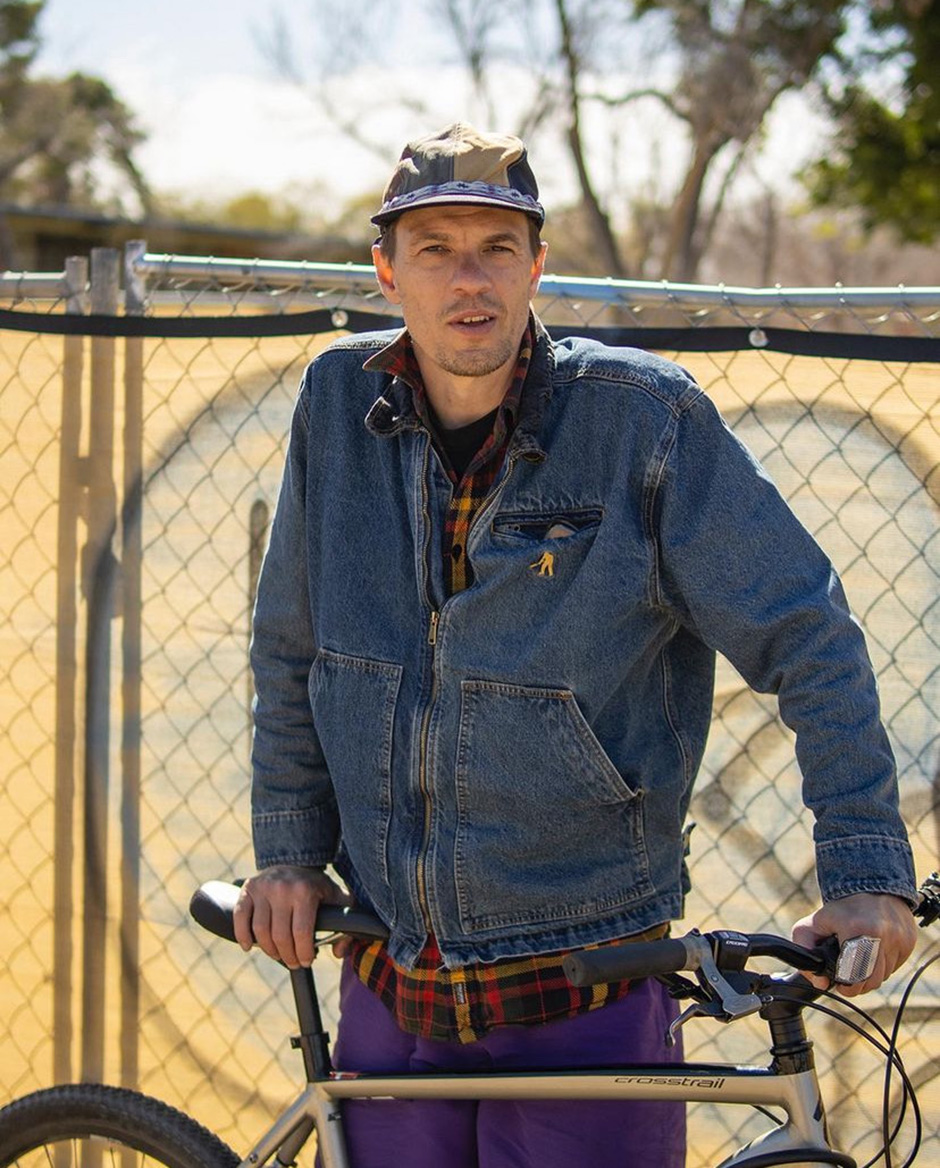
Ted Barrow cycling around San Francisco. PH: Ryan Lay
Ted Barrow is a multifaceted individual, the kind of mind that enhances and embellishes skateboarding’s rich tapestry through any outlets at his disposal. His @feedback_ts Instagram account became legendary, as his hilarious, and often misunderstood, satirical critique of skate clips sent to him en masse, became part of our daily diet. Anyone hankering for that familiar tone can still find it at @beratethebirds, where Ted’s reviews remain a voice of reason. This persona began as a distraction for someone with many more things going on but, as he acknowledges during the course of this article, it not only served as an escape but also opened doors, providing him with a platform to keep expressing what he loves about skateboarding. The most recent example of Ted giving back, and using that platform, is the excellent This Old Ledge series on Thrasher. This launched by gifting us a thorough history lesson about four iconic San Francisco skate spots, and their place in the narrative of the city.
Ted has a Ph.D in Art History, and his ability to look at skateboarding through that academic lens offers fresh perspectives. That, and his tangible passion, and reverence for skateboarding made him an obvious choice for one of these interviews, as visuals drive his daily existence professionally, and outside of the lecture hall. We knew this would be a good one as soon as he agreed to do it, what we didn’t know was that he would come back with his selection almost instantaneously, and that his thoughts about each pick would follow shortly after on the same day. This isn’t even the result of an interview, these are his thoughts unabridged, and they couldn’t read any better.
Find out why Ted considers Bobby Puleo’s part in the INFMS video revolutionary in its approach, a reaction to what was typical as we entered the noughties. Dip back to the early nineties and find out why an Eric Pupecki trick on an SF staple ushered in new energy from the East, then fast forward to the tail end of that decade to find Sean Young making his mark on the same city with Tobin Yelland behind the lens. Ted’s obvious choice for a graphic was the Feedback TS board issued by Strangelove, a collaboration with Sean Cliver, and a special moment in time. Ordinarily that would close out one of these articles, but when we found out about an additional story set in London that involves a painting by Angolo Bronzino, and bookends the whole thing with Bobby, we knew that had to be in there too. We want to thank Ted for his time, and the care he took approaching this. Enjoy this selection from someone who thinks about these things more than most…
Bobby Puleo – INFAMOUS Skateboards: INFMS (1999)
It’s not easy for me to parse my favorite Bobby Puleo part from the rest–they’re all so good–but this one, to me, is pretty special because it seems to, at once, stand alone and above the typical video parts of that era (end of the millennium/y2k–think Transworld’s Feedback), while simultaneously becoming something of en emblem of a certain approach, an ethos, to skateboarding. Put it this way: if you can’t find something to like about this part, I won’t find much to like about your taste in skateboarding.
First, the song. While not exactly a deep cut, Boogie Down Productions’s “Essays on BDP-ism” is by no means the most popular song on BDP’s “Criminal Minded,” from 1987, their debut album which, even by 2000, was not easy to get. I’m not sure if Bobby was a deep Fat Beats digging in the crates-type guy or whatever but I mean, does he skate to hip-hop in any other part? But he’s definitely got a little more classic east coast swag in this part.  He’s shed the DC’s and is wearing low-top Converse in most of this part, fitted hat cocked back crooked, a move that seems both totally authentic to the East Coast while also, for the era, reading like a manifesto in back-to-the-basics skate Minimalism.
“You see I like to study, I like money
I like eatin’ wheat bread with honey”… what a line!
The song is equally stripped down, KRS just barely catches up to the beat in each of his verses with a slight lag that is deliberate and casual, playful even, and it goes perfectly with Bob’s low-impact masterful stylings. No crooked grinds here, just perfectly-balanced fakie 5-0’s, nosegrinds, back tailslides, and front blunts on the unique type of spots that demand these tricks.
When you watch Puleo’s parts, you become really aware that he has thoughtfully considered exactly which tricks would be the best tricks to do at each spot. He’s not the type of skater to just rifle off every trick down a set of stairs to fill space and show off. Instead, his parts are convincing essays on what tricks, or sequence of tricks, look best on the obstacles he chooses. That fakie nosegrind on the metal rack into the bank on Harrison street in SF, for example: perfectly considered.
“his parts are convincing essays on what tricks, or sequence of tricks, look best on the obstacles he chooses”
The part is basically half filmed in waterside parks in San Francisco, half filmed in downtown Manhattan, with a little Jersey and Brooklyn maybe thrown in.. I’m not sure about the timing, which clips were filmed when, but he looks ever-so-slightly more hip-hop in the San Francisco clips, with the backwards crooked fitted, than in the NY clips, where he’s wearing what looks like striped polos that, at the time, were a retro, almost Indy rock throwback. It’s sort of like what we do when we travel: we keep our accents when we’re in a new place, but we come back speaking city slang. The French Realist painter Gustave Courbet, who was from Ornans, dressed like a hick and emphasized his country twang when he was in the capital, but wore the latest Parisian fashions when he was back home. Maybe Puleo is doing the same thing in this video: turning up the East Coast attitude in SF (although SF was pretty hard back in that era) while dressing a little bit like a twee vintage hipster in NY. Or it could simply be two different eras, but the juxtaposition between his SF and NY footage is pretty apparent. Is this the first part of his that introduces the brown cords? Legendary.
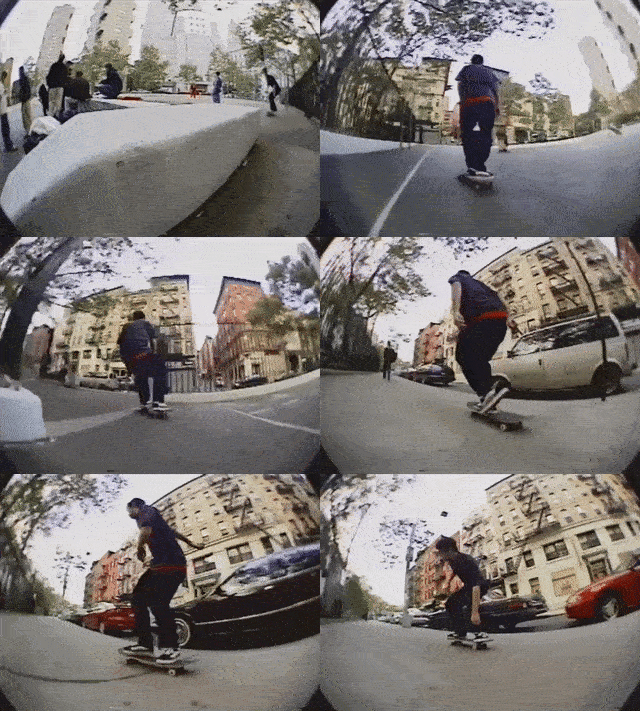 Plus those weird chunky Vans Old-School redux lowtops. That’s a real vibe. There’s one bit, towards the end, that begins with his line in Columbus Park, the one with the best fakie varial flip ever filmed (every time I’m on that sidewalk in Five Points I do a fakie v flip tribute to Bobby) and ends with that switch pop shove it over the small sidewalk gap by the Banks… those spots are pretty close to each other and I have no reason to doubt that he filmed all of that in the same day. He stacked that day, and it all looks like cool tasteful lines that he strung together spontaneously. The best kind of filler.
I love Bobby’s FTC part that he filmed with Meza, with the 50-50 that Chewy [Cannon] mentioned before, but I really think that this part is transitional in a different way, as it constitutes his last SF footage being in one of his full parts. Through the late 90’s, East Coast footage was still kind of niche, whereas SF footage was slowly getting played out. It’s telling to me that, while his opening line was at 3rd and Army, a relatively new spot in the year 2000, his other line in SF (on those wooden benches) was kind of a spot-searcher obscure spot that not many other people skated. The rest of Bobby’s part is basically filmed on the East Coast, and are either one-hit spots that only Bobby skated, or that he skated for the first time, or better-known spots that Bobby skated in a way that only he could skate. That’s what I mean about an ethos. In the same way that he skated to a somewhat obscure BDP song from the late 80’s, he skates spots that weren’t necessarily easy to find, requiring the same kind of exploration of the city that a graffiti writer might do: looking for new spots that only another practitioner, someone who speaks the language, might appreciate.
“Where you skate matters as much as how you skate. That ollie into the narrow bank at the end is a manifesto: change your life”
This part showed a significant turn away from Cali spots to NY-centric skating. [Jason] Dill’s part in Photosynthesis is another great example, same year where, weirdly, they both skate some of the same spots (the bank on the other side of the Brooklyn Bridge, for example). Downtown Manhattan was always an amazing place to skate, but sometimes you just needed those video parts, to see what could be done at these spots, for it to legitimise skating and filming there. Along with RB’s footage earlier, Bobby and Dill’s parts in this year really opened up this part of Manhattan. It’s not the Plaza skating of LOVE that was also peaking that year with [Josh] Kalis and Stevie [Williams]’s whole movement, but this was more about skating around the city, finding new ways to skate awkward spots, and just seeing the potential in the thing that was right outside of your building. It’s a revolutionary approach to skateboarding that probably traces back to Natas [Kaupas] in Santa Monica in the 80’s, but is beautifully expressed in the most convincing way possible in Bobby’s part. Where you skate matters as much as how you skate. That ollie into the narrow bank at the end is a manifesto: change your life.
Eric Pupecki – Element: Fine Artists Vol.1 (1994)
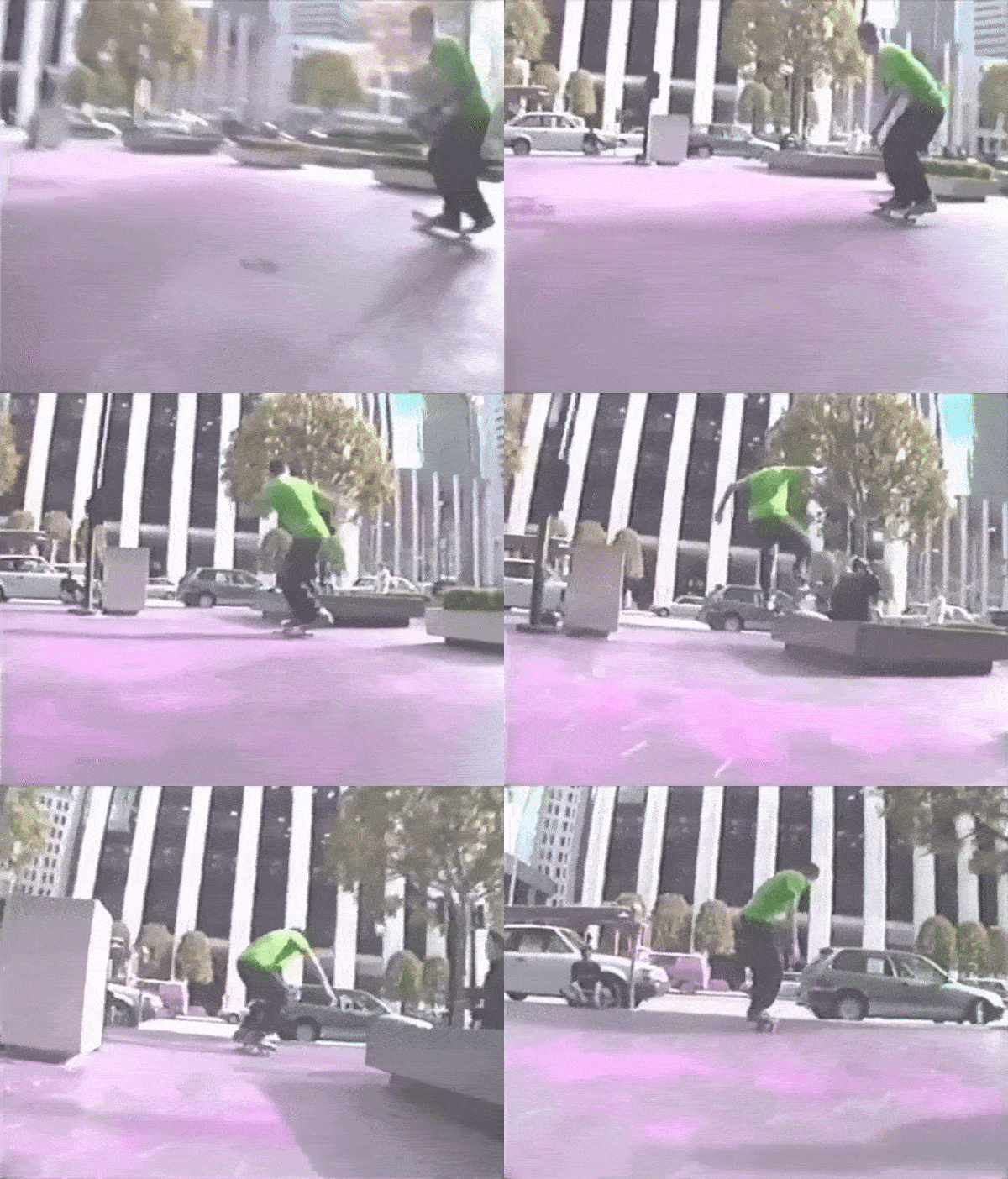
[Eric] Pupecki frontside flipped the Gonz and hardflipped the Seven, and that was that: big dog, done deal, and a new sheriff was in town: red beard. In the era after MC [Mike Carroll] and Henry [Sanchez]’s parts at Embarcadero, how many people came to San Francisco because of those two parts? Pupecki, who to me is like the spiritual godfather of a certain type of tall tech skater, was part of that influx of East Coast skaters who seemed to have brought with them more pop, more style, and a new way of approaching the city. Sure, he has his Embarcadero clips, and Brown Marble was by no means an obscure spot (it’s barely 2 blocks from Embarcadero), but those dudes did kind of open up filming tricks on higher ledges on sidewalks in the Financial District downtown, which to me reads as more East Coast than California. I could be wrong, but that’s my take. And while Pupecki is probably best known for the backside version of this trick–one need only refer to that Menace ad of him in Santa Monica–look at how he does it here. It’s like what the guy said about Kris Kristoffersen’s songwriting in “Sunday Morning Coming Down:” all those words in the dictionary, and nobody put them together in that order before. Similarly, while that trick had certainly been done on lesser ledges by less-graceful skaters, nobody floated through that trick like Pupecki. Tricks done like this pulled skateboarding out of the dark-ages.
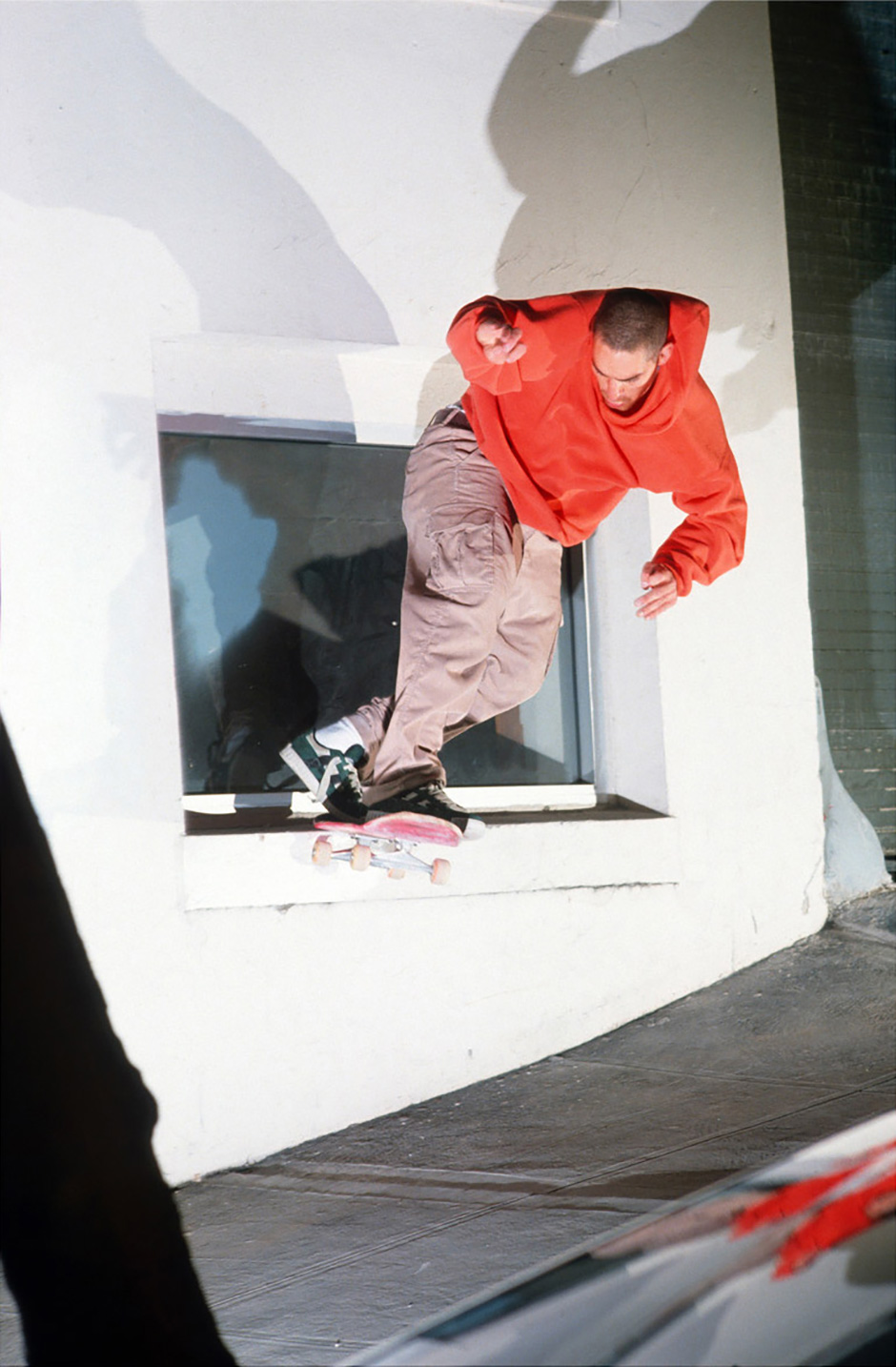
Sean Young in San Francisco. PH: Tobin Yelland (1998)
Does a bad photo of the otherwise elusive Sean Young exist? Probably not. And all of the photos that he took with Tobin Yelland, a legitimate national treasure in skateboarding, are… perfect. I first encountered Sean Young at the Skatepark of Houston in 1992, at this insane am contest where it seemed like every iconic pro from the 90’s was there competing. Reynolds? Yup. Matt Rodriguez? Mmhmm..skating for Chapter 7 and doing switch-foot heelflip body varials (it’s not what you think). Danny Minnick? You betcha. World Industries’ Love Child had just come out, and the thing that everyone was talking about was how high Jed had caught that kickflip on the 3rd street bump at the end of his part. Skateboarding was at its most disgusting and technical, this was the ripe “goofy boy” era where we looked like homeless ravers/corny graffiti characters, but there was a sea change underfoot, and it seemed like Sean Young was part of it. He was on a cross-country road trip to California from Atlanta with Hurley and Jamie Thomas. I’m not sure how much older these guys were than me, I was 15, but they seemed like road-weary men, fully formed. They were wild, sarcastic, dirty, and intense. Jamie skated the contest in green Fresh Jive jeans, a tight Iron Maiden shirt, and no underwear. Sean Young would barge the course between runs, doing backside 180’s over the metal pyramid, a trick in its simplicity and speed that seemed like a gnarly rebuke of the slow and low pressure flips done by the, um, contestants.
“If you ever have to explain why skateboarding is the most radical thing that humans have ever done, show them this photo”
Anyway, their arrival in SF, sleeping in their car or under the wave at Embarcadero, and Jamie’s trajectory is the stuff of legend, but I always liked what little footage I saw of Sean Young, the unknown asshole. Watch his Spitfire part, “that’s what you get for sitting there,” or his footage just flying around Union Square in Fucktards, and you are looking at skateboarding at its most pure and gnarly: not something that ever needed to change to fit the trends of the time.
I love the awkwardness of this trick, that he probably had to ollie from the driveway, just out of the frame, and just poke his tail into that windowsill, click, then bomb that hill that I imagine must be somewhere in SF’s tenderloin. Look at his hands, his left trailing hand, the position of his fingers, and his foreshortened right arm. That is style: when whatever thoughts you may have about how the trick is supposed to look are jettisoned in favour of the specific imperatives of the moment. It’s like whatever discursive ideas he had are leaving the body through his fingers. Mind must be clear for that trick to work, and Tobin perfectly captures that moment and movement, framing the windowsill through the diagonal of the tree trunk and the car hood, which also reflects the orange hoodie, twice. Perfect compositional rhythm by the photographer, unconventional but equally perfect form on the part of Sean Young. If you ever have to explain why skateboarding is the most radical thing that humans have ever done, show them this photo. He electrified that otherwise dead window.
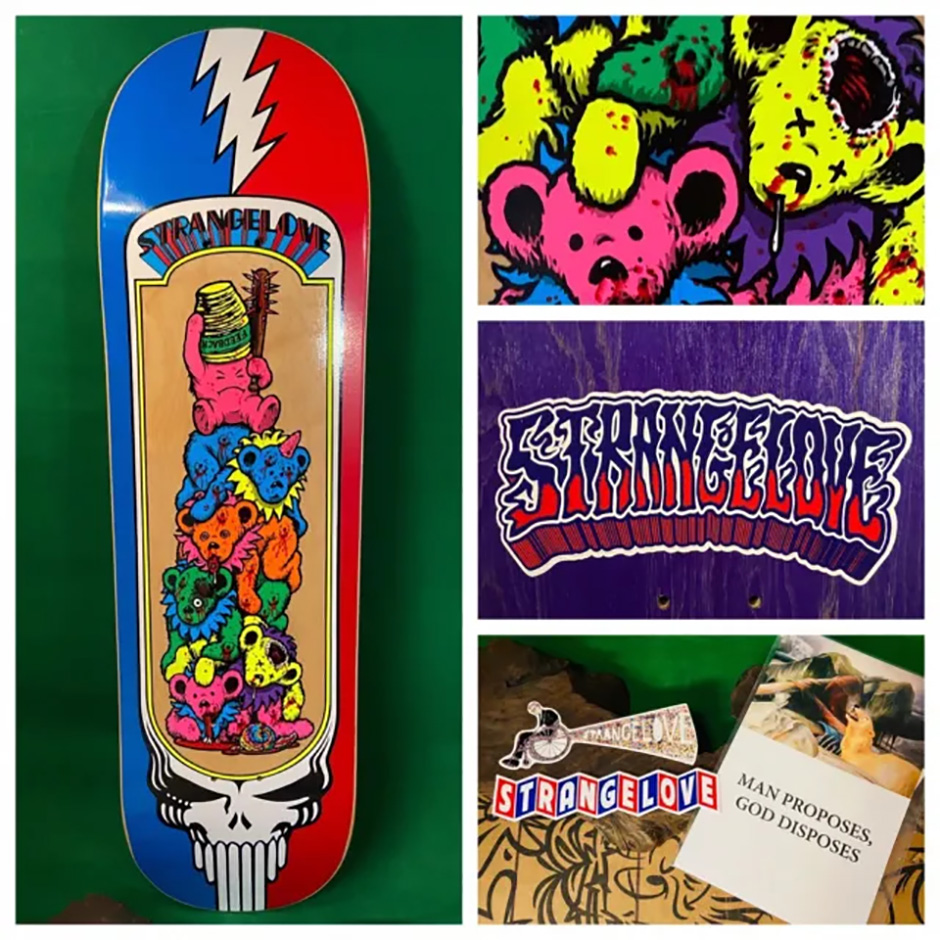
Feedback TS x Strangelove deck by Sean Cliver (2019)
I won’t go too far into the details of this graphic, as I have devoted entire instagram accounts (and a physical zine) to explaining what it means and why. Instead, I will simply say this: running feedback_ts was as weird and confusing to me as it probably was to the people who know me from that project. I can’t say that I did every review in good faith, I am sure that I made some enemies through my persona there, and I would not doubt that there are still some hard feelings towards me for what I did or what people think that I represented when I was doing that, and I get it. You can’t make an account that is about how odious skateboarding is on instagram without some of your audience thinking that you are odious too. I got out by the skin of my teeth.
However, a few years away from it all, when I look at the arc of what happened in my life because of that account, it bends more towards the positive than negative. Because I was thinking about skateboarding all of the time, I ended up skating a lot more than I had in the previous decade. I relearned old tricks, made new friends, and found myself in the fortunate position where, despite the constant threats of physical harm in the DM’s, almost everyone that I met in real life presented their best self to me. Whatever notoriety I gained in that account led to genuine friendships and productive collaborations with people that I respect and care about to this day and, seriously, changed my life for the better. Not many people my age (who aren’t good at skating) get to have a platform in skateboarding where they can express what they love about it and people listen. I do, and that is a gift that I never expected or thought would be possible.
“Just as I always looked at feedback_ts as a collaborative process…the genesis of this graphic came out of the collaboration between several much more talented artists and myself”
If you grew up skateboarding in the 90’s, and you care about graphics, you worship at the altar of Sean Cliver. He got his start doing graphics at Powell, but was soon part of that subversive Rocco wave of legendary graphics that changed the course of our visual culture and defined the attitude of an entire era. Somehow, sometime during my tenure as a professional meme on instagram, I got in contact with Sean and, without fanning out too hard on my end, we started kicking around ideas. Well, he had the (misguided and charitable) idea of doing a graphic for my account. I’m not sure if he knew how deeply uncomfortable DeadHeads make me, but he had the sketch of this graphic laying around– I think it came out of a sketch for a Pearl Jam poster that somehow, luckily for me, never got made–and the rest is history. The bear at the top with the spike bat and the frown on his jar of course comes from Winnie the Pooh, vectored through SMA World Industries, and my friend Andrew Manning’s amazing talent to turn my dumb ideas into an emblem. Just as I always looked at feedback_ts as a collaborative process (the account wouldn’t have existed if people didn’t send me their clips for review), the genesis of this graphic came out of the collaboration between several much more talented artists and myself. I’m not much of a wall-hanger board guy, however, so I do not have any of the boards they sent me. Oh well. Skateboard graphics are meant to be destroyed, and the deck is nothing more than a disposable bit of ephemera, lasting only as long as we remember them. Still though: what a treat! I’m glad I still remember it.
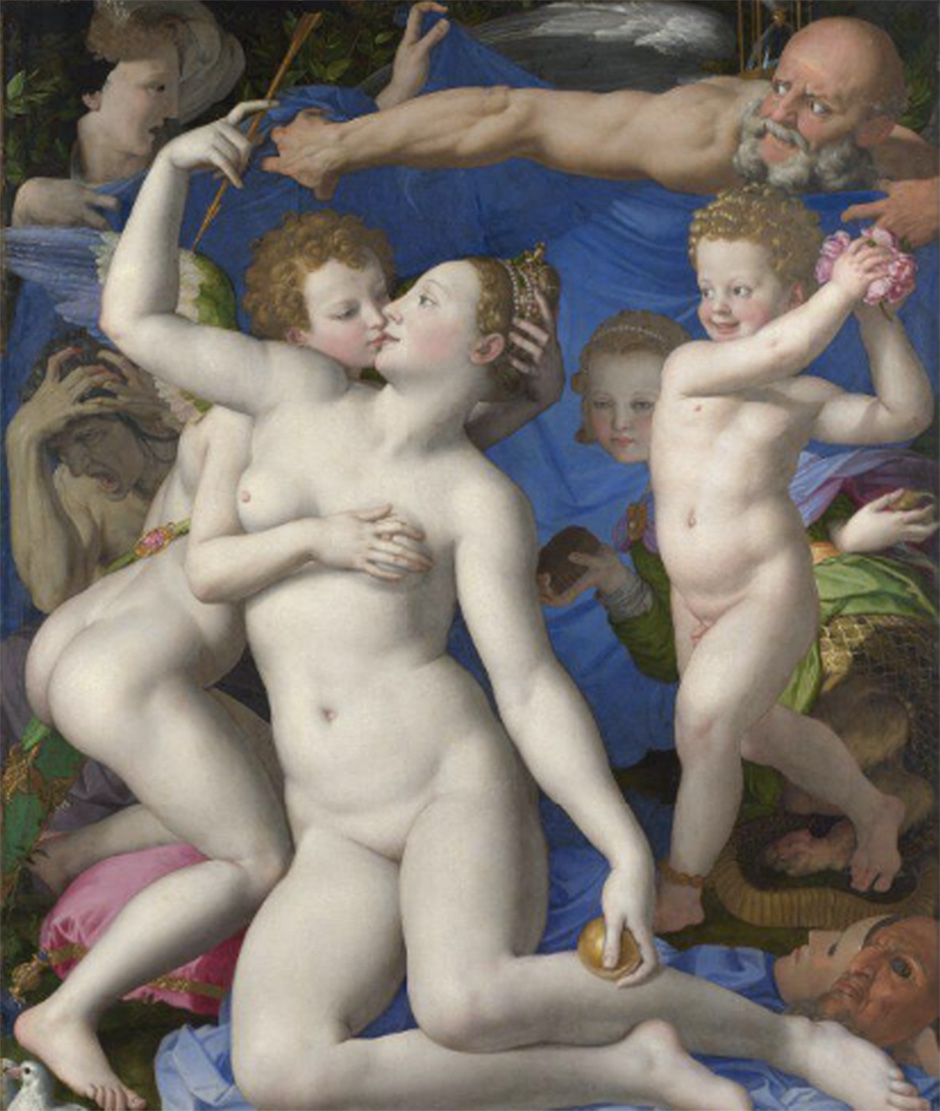
An allegory with Venus and Cupid – Angolo Bronzino (1545)
I have had truly terrible luck in London, where my experience has been so bad that I can’t begin to fathom how anyone could possibly live there, swiftly followed by the exact opposite experience and take away: what an exquisitely beautiful, richly-layered capital city!!! If this sounds like a reductive binary of what is for most people a multivalent and complex experience of London, let me just summarise my few experiences there. First trip to the UK, first day in London, still jet-lagged, skating for no longer than 10 minutes, and I completely folded my ankle, making it painful and nearly impossible for me to walk for the next 4 weeks as I traveled around Europe. London, ugh.
In 2006, I was in St. Andrews for a wedding, and on my way back, was stuck at the Edinburgh airport for four hours, only to learn that all flights to Heathrow were cancelled. This was that time when someone attempted to bring liquid explosives onto a plane. Anyway, I make it to London City Airport, somehow, but have nobody to call, and no way to call them even if I did know anyone’s number, and also an exceedingly-scarce amount of Pounds with which to do any purchasing of any kind.
So there I am, after a week in Scotland, wherein the pretence of the happy romantic relationship that I had been in was laid bare to be a little more romantic but also pretty unhappy. Weddings can do that. So not only am I totally stranded, broke, and burdened by my bags and some heartbreak, but I also don’t know how to contact anyone. This is 2006. Myspace days. People simply do not have the internet on their phones, and internet cafes = identity theft and identity theft = even less money.
I won’t go into granular detail of my desperate perambulations around the streets of London that evening, but eventually I ended up at the house of a friend’s cousin in Hackney, who had a spare bedroom. The next morning, she supplied me with breakfast toast and tea, a bus map, and told me about the architectural and historical significance of Southbank, how this renowned Brutalist building had been a forward-looking project that had fallen into neglect through the seventies but that skateboarding had revitalised the area. Somehow, this thoughtful description of Southbank was the germ for what has become, especially recently, my abiding interest: the trefoil of art, architecture, and skateboarding in cities. “Trefoil” means “adidas logo.”
“I realised that even if art doesn’t really clearly verbalise the exact terms of what it means, it somehow gets closer, than words ever could, to what it feels like to experience something at its most vivid”
After breakfast, armed with my bus map, I went to the National Gallery to kill time before my flight, tentatively scheduled for later that evening. Museums are great places to go when heart sick. Simply being in a different place, seeing new things with new eyes, is transformative. I walked around, following my nose, recognising some Turners and Claude’s, but mostly, I just wandered aimlessly. Eventually I found myself in a gallery that had Bronzino’s Allegory with Venus and Cupid, c. 1545. I had studied this, way back, in University, just about a decade before. In fact, as I stood in front of it, I realised that it was this painting, and the way that it was described by my Art History teacher, that got me into studying art history in the first place. Bronzino and his cohorts worked in the wake of the High Renaissance. They were the generation after Raphael and Michelangelo, after the calm order and ideal serenity of the early 16th century, the cool self-confidence of the older generation had morphed into an overly-stylised caricature of emotional iciness and strange, erotic, but cold-blooded abstraction. Bronzino and other mannerists articulated a political and spiritual loss of faith in a way that we might recognise from the dead eyes of fashion models looking back at us from the glossy pages of a magazine, a neurotic artificiality that expressed profound alienation.
Nobody really knows what this painting is about, or why Cupid is tongue-kissing Venus, his mother, in a pose that is both charged with concupiscence and, somehow, deadpan boredom. We do know that it was not intended to be seen by the public, that it was a gift from Cosimo de Medici to King Francois I in France, and that it may be some kind of complex allegory about lust and syphilis.
Something clicked for me though, right there, in front of that painting in 2006. I realised that even if art doesn’t really clearly verbalise the exact terms of what it means, it somehow gets closer, than words ever could, to what it feels like to experience something at its most vivid. A small detail in the lower right, a thorn piercing the foot of the little idiotic baby throwing rose petals at the incestuous couple, perfectly captured the pain that we stupidly endure for love, be it in skateboarding or the heart, that I felt after that week. 24 hours before I had been stranded on the steps of St. Paul’s, the next day I was having my Ferris Bueller moment in front of Bronzino. Abject pain and transcendent pleasure, and nothing in between.
Anyway, I made it to Heathrow and checked into my flight, got in a very long line to board the plane, and guess who was ahead of me in line as it snaked through a bend? Bobby Puleo.
We want to thank Ted Barrow for speaking to us, and offering his take on some visuals that have made a mark on his psyche. Thanks also to Tobin Yelland for sending us the Sean Young photo. You can grab a print of this, and many more iconic images from his website. Check them out at TobinShop.
For more from Ted start by following his @beratethebirds Instagram account, and tune in to the Vent City podcast. We also can’t recommend the This Old Ledge series he produced for Thrasher enough.
Related reading: Offerings: Bobby Puleo, Bobby Puleo Interview, Tobin Yelland Interview, Sean Cliver Interview.
Previous Visuals Interviews: Dave Mackey, Jack Brooks, Korahn Gayle, Will Miles, Kevin Marks, Joe Gavin, Chewy Cannon