

This interview with Neil Macdonald marks the release of his incredible new book ELSEWHERE. This love letter to UK skateboarding was a mammoth undertaking, and this conversation unpacks the thought processes, hurdles, and hard work that went into getting it on our shelves…
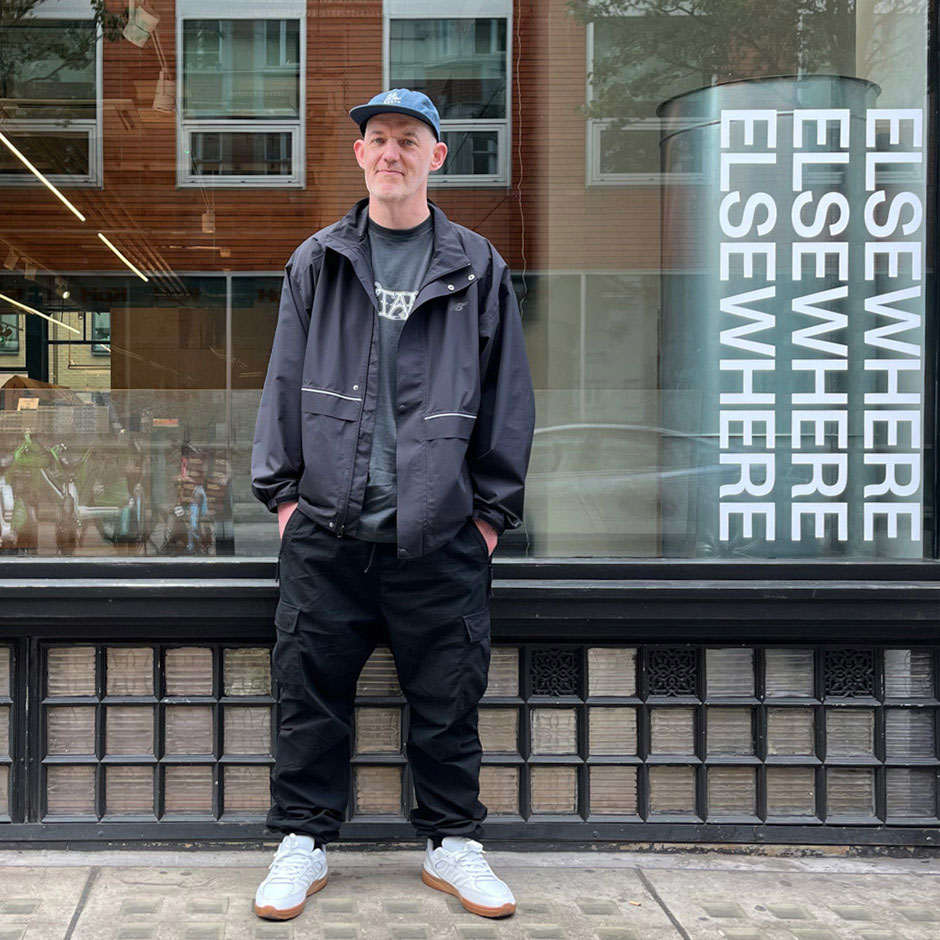
Words and interview by Jacob Sawyer. Neil Macdonald bringing ELSEWHERE to Aries. PH: Phil Wilson
You can check out an audio version of this article on our Listen In podcast. Available on Apple Podcasts, Spotify, and all other major platforms.
Our last interview with Neil Macdonald was published three years ago, when he was approaching the halfway mark of creating his book ELSEWHERE. Many hours of continued conversation have transpired since then. Once all of the interview puzzle pieces were in place, and with a designer and publisher supporting, he has been busy making sense of a complicated fifteen-year timeline. Neil’s book tells the story of UK skateboarding from 1987 to 2002, a specific and carefully considered stretch of time, the chosen relevance of which is explained in our conversation. ELSEWHERE explores the evolution of skateboarding on this island, tackling touchstones methodically, year by year. The moments, people, shops, scenes, photographers, magazines, companies, events, exports, and visitors who make up this rich tale have been approached, and the book is narrated by the voices of the people who were there, living it, creating it, and observing it all unfold.
Neil is keen to reinforce the book’s intent. It is not a dry reference book devoid of nuance, nor is it a photo book (although there are hundreds of incredible photographs within). It is a yarn, a tale, the folklore he was mining for, told by the people best placed to relay the stories he wanted to hear firsthand. That being said, with over 250 interviews under his belt and a narrative to be woven that comprehensively covers an industry and a scene from all angles, this gargantuan task has a story all of its own. We wanted to get into the weeds and discuss exactly what went into getting this publication over the finish line, from fine-tuning the editing process to aligning how the words greet a reader with a designer. This interview marks the magic of an ambitious idea coming to fruition and the challenges involved in doing something truly great for the love of it. Fittingly, the conversation begins by unpacking the feelings surrounding this accomplishment, and the launch night for the book at Sofia Prantera’s Aries store, which assembled a lion’s share of the voices who contributed to the story.
The book is a triumph; Neil’s vast body of interviews have built a completely compelling story that keeps you turning the pages, backed up by a diverse array of photographs from an amazing list of professional photographers and contributors. Among them is Wig Worland, whose invaluable assistance is notable, a lensman whose prolific output helped define a golden era following the legacy of Tim Leighton-Boyce, and his photos play a vital role in bringing this period to life. We were sure to use this opportunity to reflect on the place Slam City Skates plays in this wider story, the relevance and importance of the shop to UK skateboarding, and to Neil himself. Slam as an entity exists in the book from start to finish, with an entry every year, something we were delighted to see when we first flicked through. As we gear up for a night of our own, celebrating this publication, it was a pleasure to reminisce about some Slam-centric moments that have made their way onto the pages. We hope you enjoy reading more about ELSEWHERE before adding this important publication to your own bookshelf.
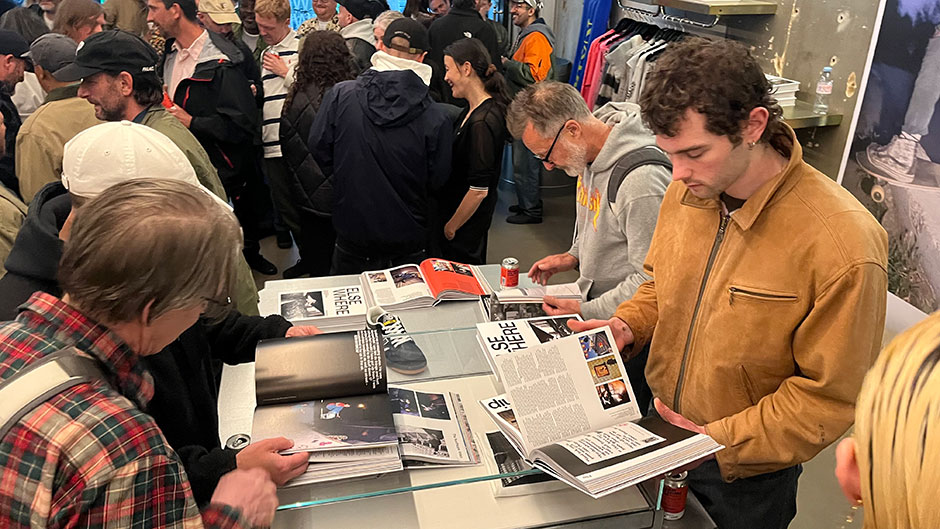
ELSEWHERE is finally in the right hands. Readers on the launch night included Ali Cairns and Meany
First of all, congratulations on making it out of Shawshank. How does it feel now that the book is out there in the hands of everyone in it?
Thanks very much, and thanks for being at the end of the phone for fact-checking along the way for the later era London, Southbank, and Slam confirmations. I’m glad that it is finished and made. If there was only ever going to be one copy, I would be glad that I’ve done it because I did this because I wanted to know all this stuff. I wanted to see these photos and find out these things, and get this information. But yeah, the fact that there was a publisher on hand to make a few thousand copies definitely helped. And seeing people’s reactions now that they’re getting it is really good. I think people possibly expected it to be a photo book or for it to just have some quotes here and there. It’s certainly neither of those things; that’s pretty satisfying, seeing that people are being surprised by it, by the size of it, and how much is in it.
I saw somebody commenting on Instagram yesterday saying they had no idea of the scope of this project.
Nice. Yeah, I mean, it’s not focused on one thing; it’s got lots in it. It’s got Death Box and Blueprint in it. It’s got Simon Evans and Harry in it. It says it’s a story on the front, so it’s not anything particularly hand-picked other than the best and most interesting parts, I would hope, and the things that people have been wondering about the most. I think it answers a lot of questions that have been floating around. The magazines of the time generally only printed positive stuff, and they were bound to a certain extent by their advertisers, so to be able to get the real stories of what actually happened from the individuals who were there at the time is pretty great. It’s not the book of an Instagram account; it’s not really related. I’m bracing for complaints that somebody’s kerb, or mini ramp, or t-shirt isn’t in it, or anything like that.
My fly-off didn’t make it!
Yeah, certainly. I mean, certain people’s fly-off did make it, and the fly-off at the end of your street is as important as anything. The scene where you grew up in Bromley is just as important to you as Morfa was to the vert skaters of Swansea. Just because something wasn’t in a magazine doesn’t mean that it’s no less a part of the story of UK skateboarding. So there is plenty of that in it, but, as a result, there’s also going to be stuff that’s not in it. It was meant to be 200 pages in the first place. I managed to get the publisher up to it being 400 pages. It ended up being 464 pages because there was just a brick wall of not being able to cut anything else. There’s no reasonable way that anything else could come out at a certain point. So the release date ended up getting pushed forward, and the factory had to be informed, and all this other stuff that the publisher dealt with. But it’s now out, and it’s great seeing people being happy with it.
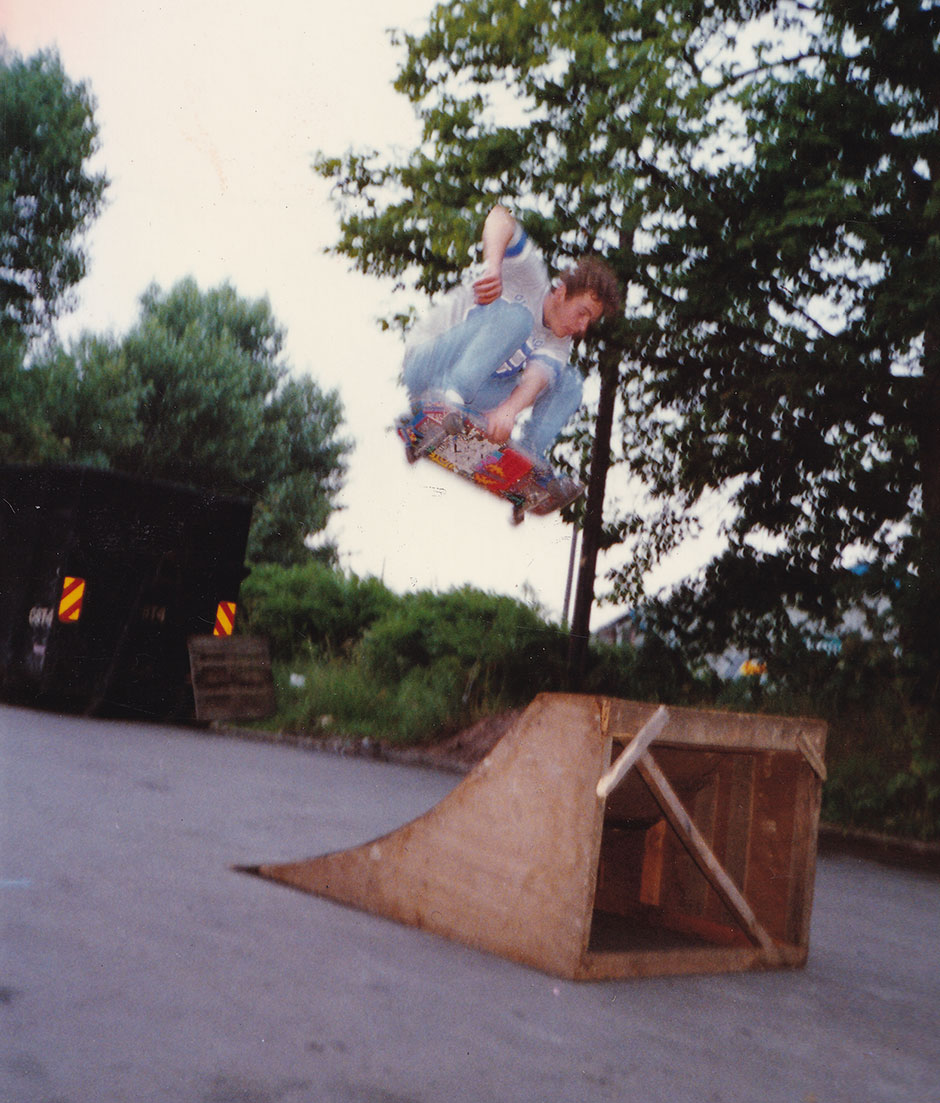
The Fly-off at the end of a Durham street. An airborne Jimmy Boyes circa 1988
The great thing about it is that you can do that a little. The narrative and the historical story are there in text, but the pictures themselves almost have a life of their own as far as telling that story. There are fly-offs in there, and photos of the wider scene at large, as well as the pivotal people in it.
Yeah, I mean, if you can’t read, then you’ll still enjoy it, and likewise, if your brain cannot absorb photographs and you can only read, you’ll probably still quite like it as well.
Was the launch night overwhelming? think it looked like that was all the feedback you need, quite a life-affirming turnout.
Yeah, I kind of left everybody to it. I wasn’t swanning around the room or anything. I got there pretty early to just walk about and check everything. Me, Wig [Worland], [Dan] Magee, Skin [Phillips], and Kevin Banks went along early, and there were already a load of people there an hour and a half before it was meant to begin. I suppose people were coming down to London or up to London from possibly quite far away, so yeah, you may as well head along early. Shout out to Corin Casey, who came over from New Zealand for it; there are a load of his photos in the book. Basically, if you looked anywhere, it was somebody from the book. The capacity of Aries, I think it was 250, and the guest list ended up being over 400. I’d emailed or texted everybody who was in the book to make sure that they had the opportunity to be there before I started asking Aries people or anything like that. We didn’t announce it. Aries posted on the day, but there was no countdown; it was just word of mouth.
“seeing people catching up again was amazing”
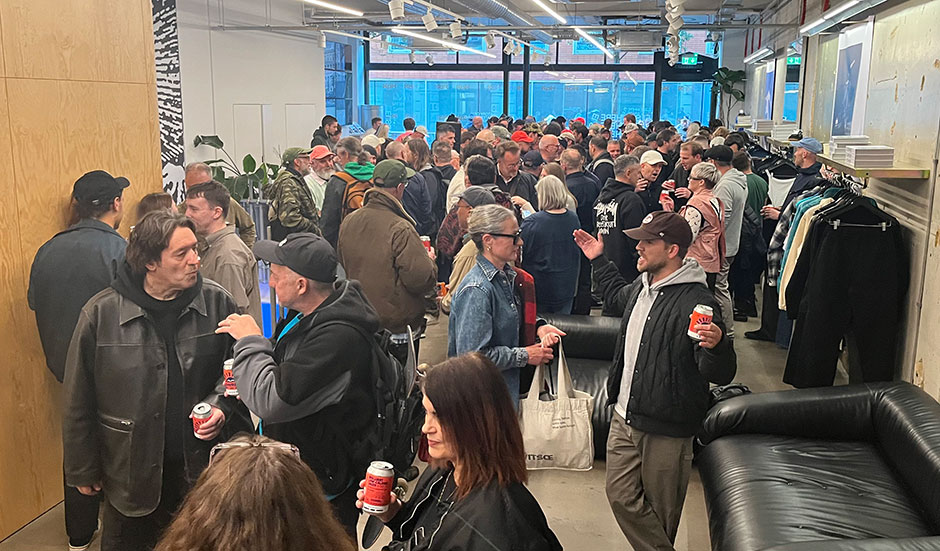
Word of mouth still delivers. The ELSEWHERE launch at Aries exceeded capacity. PH: Neil Macdonald
Honestly, the amount of people who were just so enthusiastic about it and seeing people catching up again was amazing. Seeing the Unabomber people reconnecting, there’s the Blueprint guys over there having a beer, everybody is mingling, there’s the Death guys standing under the massive Mark Nicholson print. It looked like the book in there, turn a page, and there’s Alan Rushbrooke by Andy Horsley, but then look over there, and there’s Alan Rushbrooke sitting with Andy Horsley. It was like the book coming to life. The New Balance team were in town too, so it was kind of nice seeing all those guys deep in the book, genuinely checking it out. Looking round and seeing Andrew Reynolds reading it. Then London people like Casper [Brooker] and Chewy [Cannon] came along, obviously Tom Knox. It was a good crowd.
You’ve brought them all back together with that launch. it’s like friends reunited.
Yeah, it was pretty good. Then, seeing all the Instagram posts over the following couple of days, and really becoming aware of who was there that I’d probably not spoken to, or had spoken to but hadn’t identified, and t tagged afterwards. It was a bit like, “Holy shit, that was him! No way!” Just because he wasn’t wearing cargo pants, a Dope sweatshirt, and a Kind beanie. People look different now; they don’t look like they used to in the magazines. Well, they do in some cases.
It was once said that if they dropped a bomb on the premiere night of Waiting For The World, it would have eradicated UK skateboarding; if the same were true of the Aries launch, it would have had a second chance for the survivors.
Yeah. It was a pretty good turnout. I think if that room had been in 2000, that hypothetical bomb would have seriously diverted UK skateboarding.
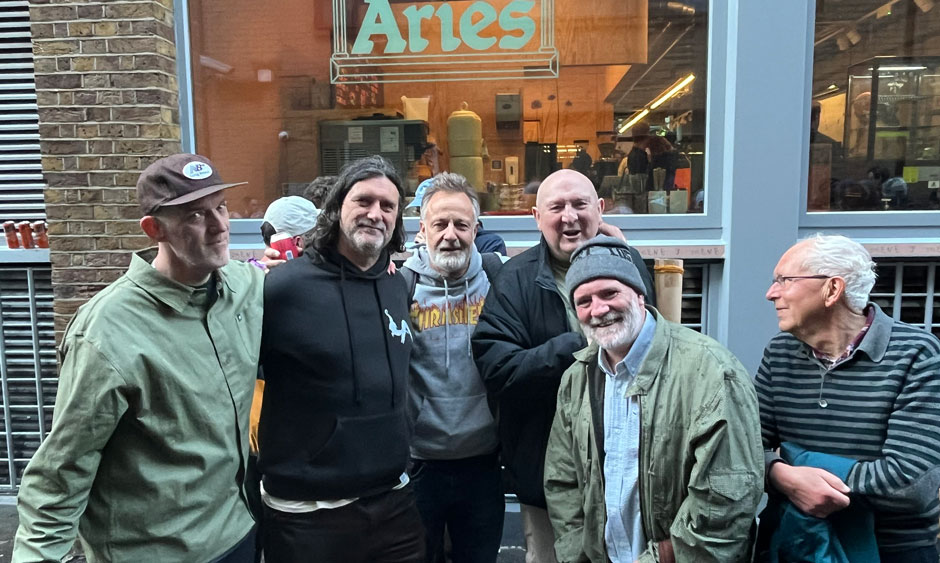
Legendary lineup: Neil with Kevin Banks, Meany, Skin Phillips, Dave Mackey, and Tim Leighton-Boyce
Wig Worland, in his foreword, does a great job. He talks, in hindsight, about analysing why he pulled back from shooting at a point. Having a realisation of how special that pre-internet, pre-big budget time had been. Having pieced all of this together, and having run your Insta account for so long, which also takes you down rabbit holes, you’ve just relived the golden era more than possibly anyone. Where is your nostalgia meter right now in how you view the world at large?
I mean, seeing the New Balance demo on the Saturday following the book launch certainly recalibrated my nostalgia meter. I’m a massive fan of current skateboarding. I watch new videos before I watch Playing Fields again. I’m not just living in the 90s.
Maybe the question needs rephrasing, I guess, having spent all of that time…
Am I sick of it now?
Well, I think how you answered it is key, the fact that you’re just as stoked on seeing that demo, and that demo in itself is a product of nostalgia for how rad things were, and could be for another generation. New Balance have recognised the importance of how things were and can still be.
Any demo that’s got a bunch of kids at it, you do kind of think this is possibly going to change their life. This kid is going to get it now. Like, that’s what you can do. That’s how cool you can look on a skateboard. Seeing Tiago and Tom Schaar both going off in the same space is going to blow your mind to the possibilities.
Any era is the golden era for a kid who has just picked up a skateboard.
Yeah, it’s funny because they’re so wrong, but people do think that. ‘We know when the golden era was, the actual golden era’, says everyone.
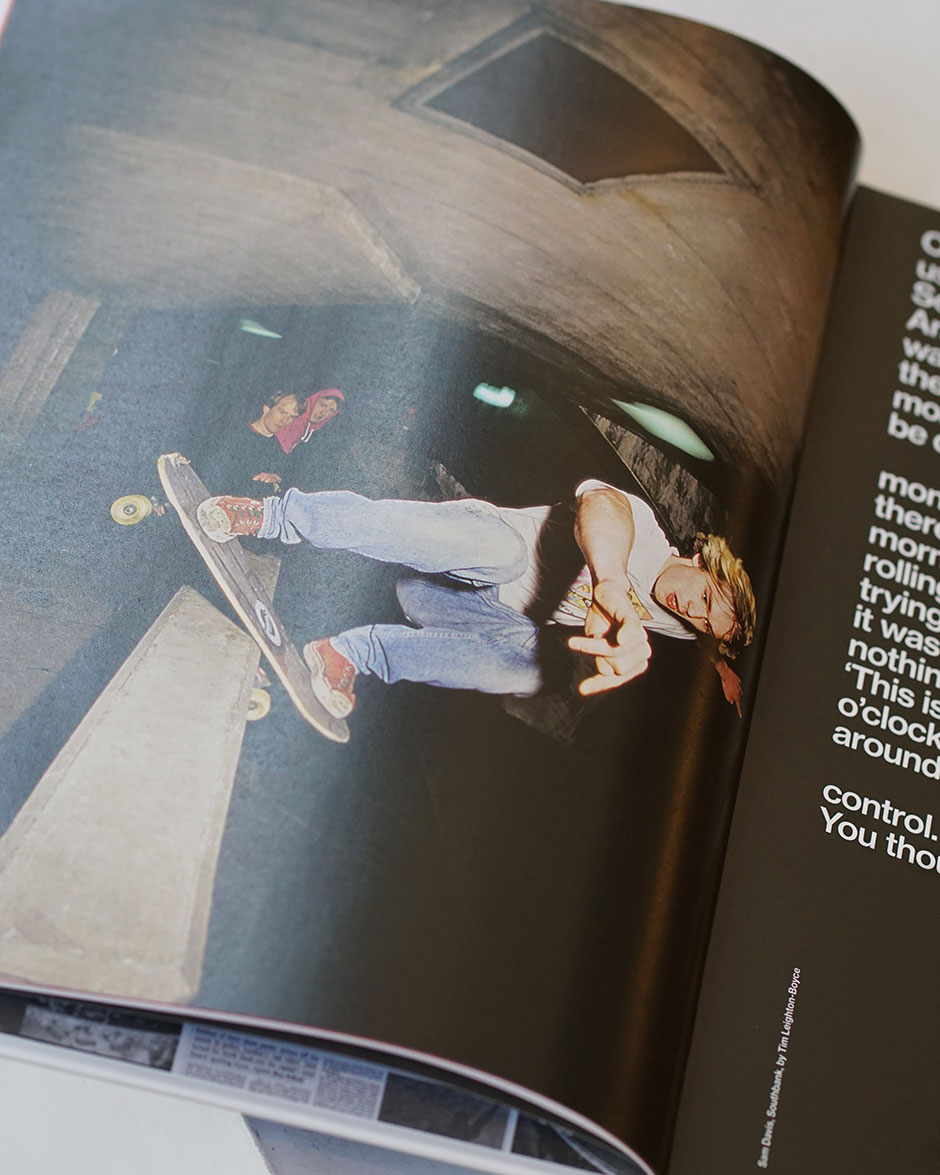
Sam Davis at Southbank in 1987 shot by Tim Leighton-Boyce
That’s what the book is highlighting, though, isn’t it? It’s the golden era for its era, but also for its period in time.
It’s kind of considered a golden era, although you could pinpoint that golden era to a couple of years, depending on how old you are, and when you started. But, it’s a fact that streetskating came in at a certain point, video really came in at a certain point, the UK created its own identity at a certain point, these brands existed, and then the commercialisation appeared at a certain point. These are set in stone, and that’s why it’s 1987 to 2002; I stand by that. That’s when, from Back to the Future, a generation started skateboarding at that point, and that was kind of the first big generation that really stuck at it. We still care, we still skate, or we still watch every new video. There are plenty of the 80s guys, the 70s guys that are still living it, but I think in terms of an entire culture. I think it was the post-Back to the Future, Police Academy 4, Public Domain, streetskating generation that stuck with it one way or another. There are people posting pictures of the book that I don’t know. I’ll look at their Instagram, and it will be pictures of them at the football, pictures of them just down the pub or something. You would have no idea that person cared about skateboarding, but because they’re part of that generation, it’s still part of them.
The Shane O’Brien quote is great, the opener, because that really sums up that post-Back to the Future explosion, the plague-like explosion of all these people, who came in with a completely different learning approach to Shane’s generation.
When Shane said that, as he was saying that, there was never any question that that was going to open the book; he just absolutely nailed it. There were these older guys, guys in their mid-twenties, that were coasting along just doing their thing, carving the banks. Then, suddenly, as he said, a new generation appeared overnight, and they’re skating completely differently. They’ve got a totally different approach; they don’t have the history, they’re maybe not bogged down in the history. They’re not complacent. They’re excited by it, and here we are now.
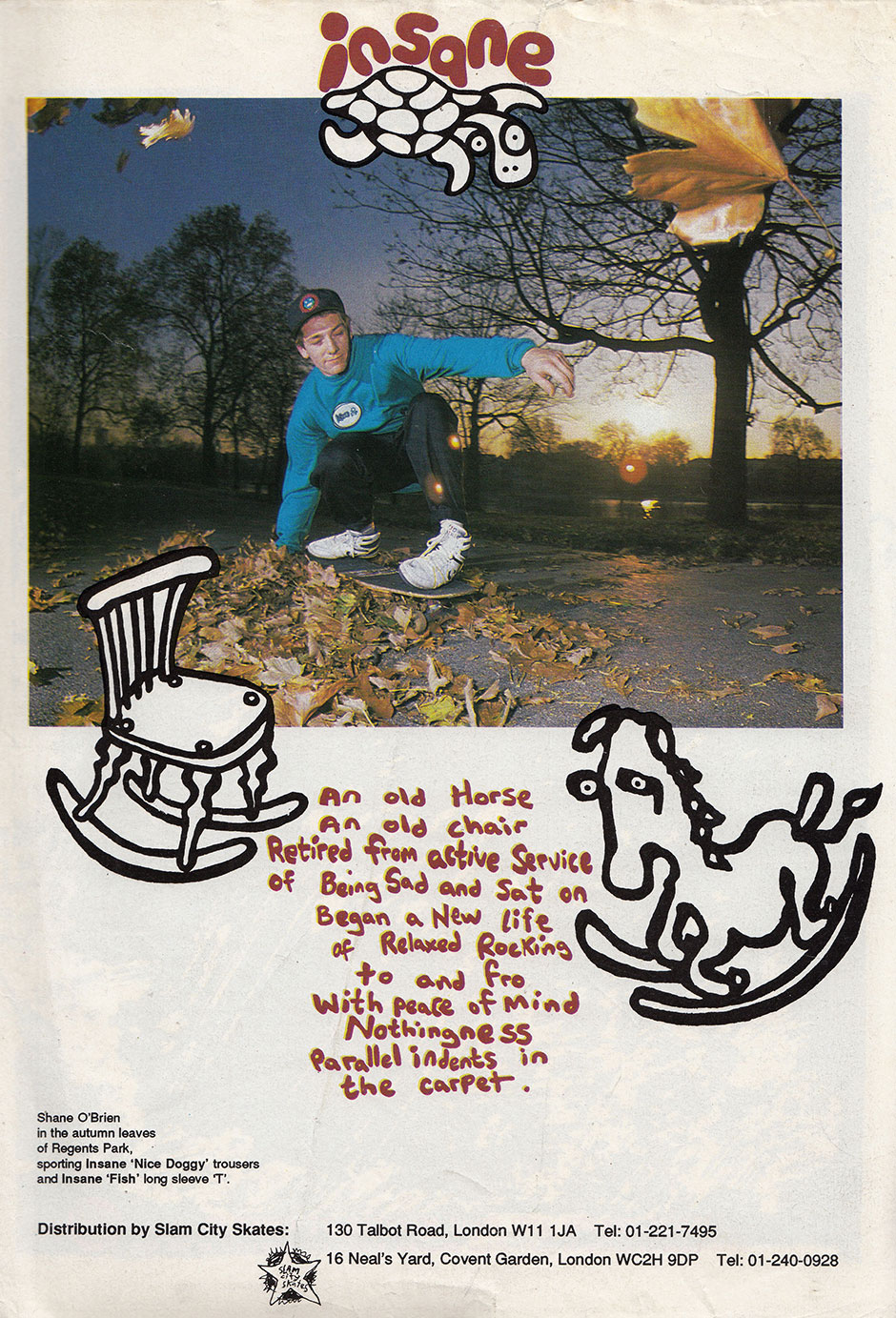
Shane O’Brien brushes some Autumn leaves for Ged Wells’ Insane brand with a Slam distro credit
This fresh wave of people, who, to those guys’ eyes, are just sort of throwing themselves at stuff.
Yeah, and not skating with the vert gene, not skating with the transition gene that these guys had. Not skating street like a ramp skater, not skating the banks like a ramp skater, just doing tricks.
So it was easy to land on the book’s beginning from that point. Was it hard to pinpoint a finish line? Did the finish line come later?
Well, at first, when I had this idea to do a book, which I thought would take a year. I thought 1987 to 2003, for whatever reason. Lost and Found was 2004, so I was thinking, maybe trying to get the first Landscape video, Portraits, in but so much of 2002 sort of bookended what felt like a defined era. And I think, another point, it’s maybe a minor thing, but I think it says a lot, is the redesign of Sidewalk and Document separately. It happened without each other knowing that they were redesigning. The October issues of those titles looked almost exactly the same. They both redesigned the mag logo and cover. independent of each other, and they both thought the other one had copied them.
This was Joel O’Connor and Nik Taylor at that point?
Correct, Joel at Document, and Nik at Sidewalk. They were both lowercase bold, and both with a little icon.The Document one was with the aperture blades, and Sidewalk, it was the S, which was also the nose of a skateboard, which is a brilliant bit of design. It had a wheel that made the curve of the S and a truck bolt hole. It was so much smarter than I think Nik got credit for. That was a good example of the homogenisation of what was happening and just how streamlined things were becoming. And of course, everything was becoming digital by that point.
So you lose Portraits, but First Broadcast as a video bookends the timeline.
Yeah, there was nothing really much else that happened in 2003, so I’m not going to try and add an extra year for the sake of getting one brilliant, brilliant video in there. I mean, [Chris] Massey gets shouts out, Landscape gets well covered. There’s no omission throughout that period, I don’t think. If you look at the magazines as well, there are people in 2003, 2004, 2005 with full interviews, and that was the only coverage that guy got. But throughout the previous years, you’re following people’s lives, people’s careers, people’s team moves, and everything. But then you get all these little brands, these shop brands, like who’s this guy with a pro board on what company? It just became a bit noisy, became a bit of a jumble, and all that stuff is fairly well documented anyway. Digital cameras were coming in, and people could save things on better computers by that point. People could afford to archive stuff, so it’s back again to your point, about Wig’s point, that it’s pre-internet, and I still stand by it being 2002. Anybody is welcome to do the book from 2003 onwards; have fun with that.
“This is a story. It’s a narrative. It’s, I think, funny and interesting, and sad and exciting and revelatory. It’s a story, and Slam has always been a big part of that story”
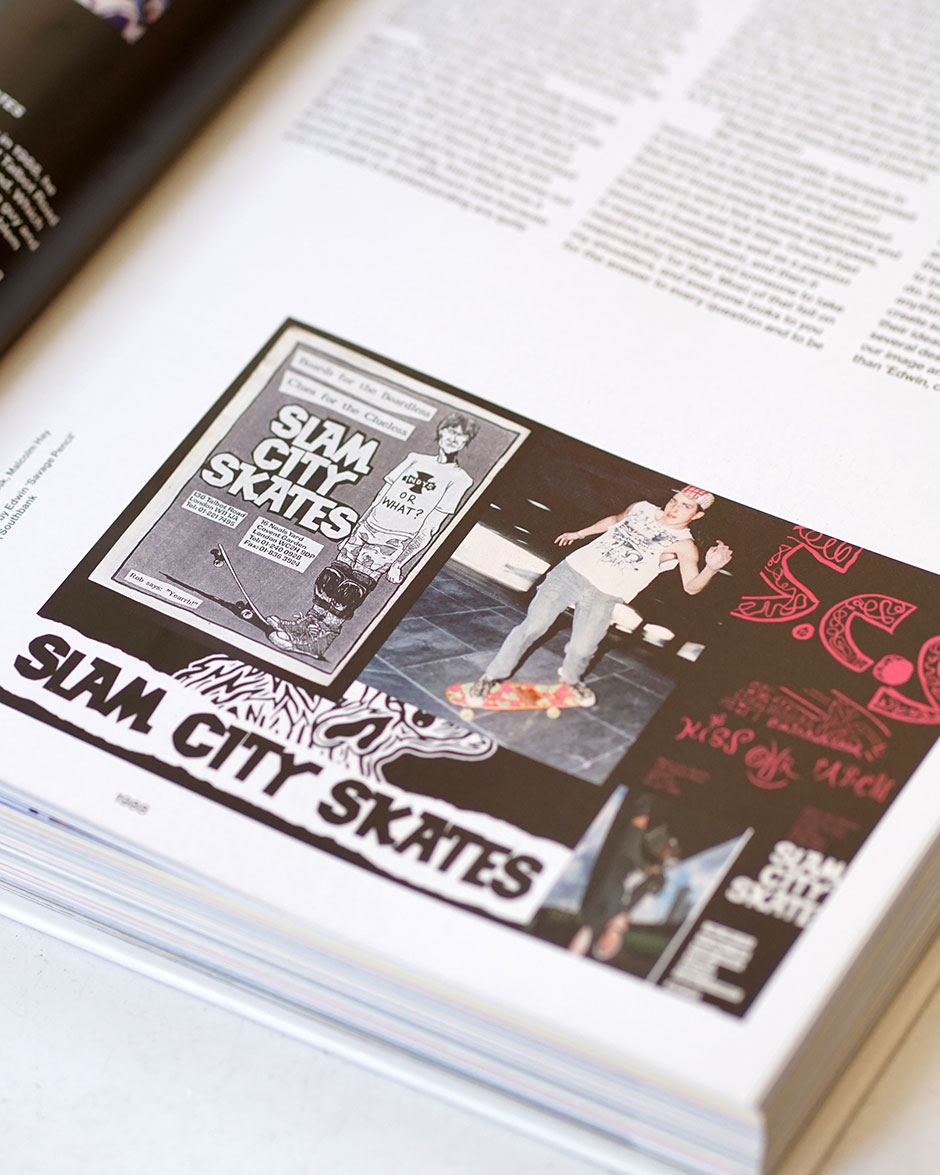
How important do you feel Slam’s contribution is to the book and, in turn, UK skateboarding?
Slam is one of the few entities that exists in the book from start to finish. Slam, I’m fairly sure, has an entry every year, and bear in mind, this isn’t a reference book, so there’s nothing in it just for the sake of it. There’s nothing that’s been recorded in here for the sake of having it down because it existed. This is a story. It’s a narrative. It’s, I think, funny and interesting, and sad and exciting and revelatory. It’s a story, and Slam has always been a big part of that story. I think my first mail order stuff was probably Rollersnakes, because they had the ads, but then maybe by the end of 88, 89 I was ordering little things from Slam just because the ads looked cool, and I wanted something from this place.
Do you remember what you first ordered?
I definitely ordered some Rip Grip from Slam and it was the cheapest thing there. Like literally, what can I order from this place for a couple of quid? I remember, possibly from having ordered from Slam, or having filled out a form and posted it in, but, for a little while, they did the mail order newsletters, which they still do. It’s just that they go to your email now. But yeah, it’s something that Paul Sunman was quite ahead with. In one of them there’s a little story about Jason Lee and Mark Gonzales being in London filming for the ‘as-yet-untitled Blind video’. Obviously, Video Days went on to change the world, and Mark Gonzales’ section opened with him skating Southbank, part of Southbank that the Southbank Centre destroyed.
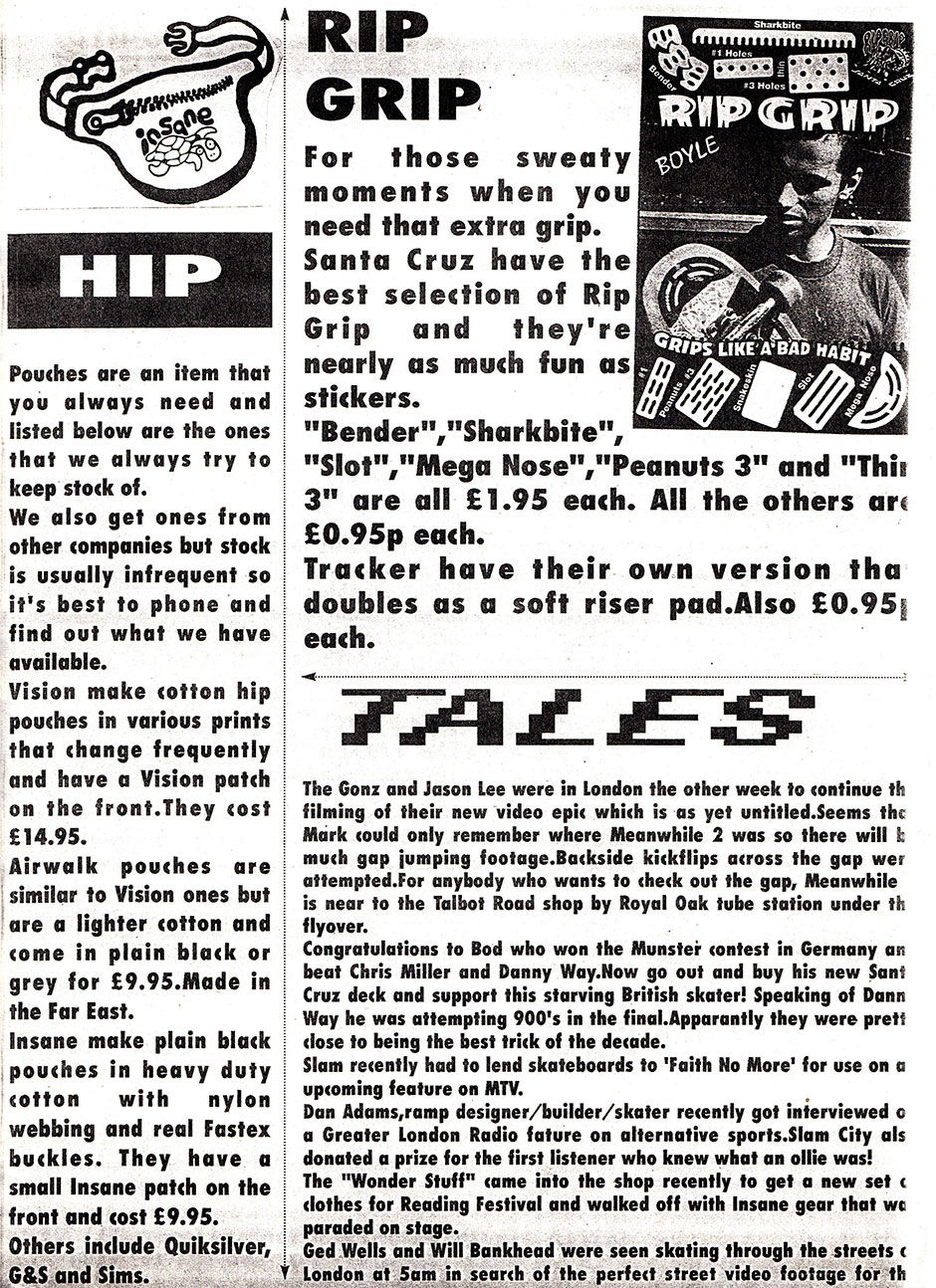
Paul Sunman penned Slam newsletter teasing the most influential video of all time
Slam ads were always different. It wasn’t the same ad with different words in it. It was a work of art, and then coming to understand that really interesting people like Rob Dukes and Ged Wells were involved there. These were the cool people. Something Tim Leighton-Boyce was concerned about, and I think it was unjustified, is that there was too much London coverage in RAD magazine, but I liked it! I liked seeing what was happening in London. I liked seeing the Slam ads because that just felt like the future. That felt like, you know, where stuff was happening. The photos looked the best, the Slam ads looked the best. Then again, I can’t really say that without talking about how much I loved Poizone clothing that Davie Phillip and Jamie Blair did out of Clan Skates. That was as local as it got for me; it was about an hour and a half away on public transport.
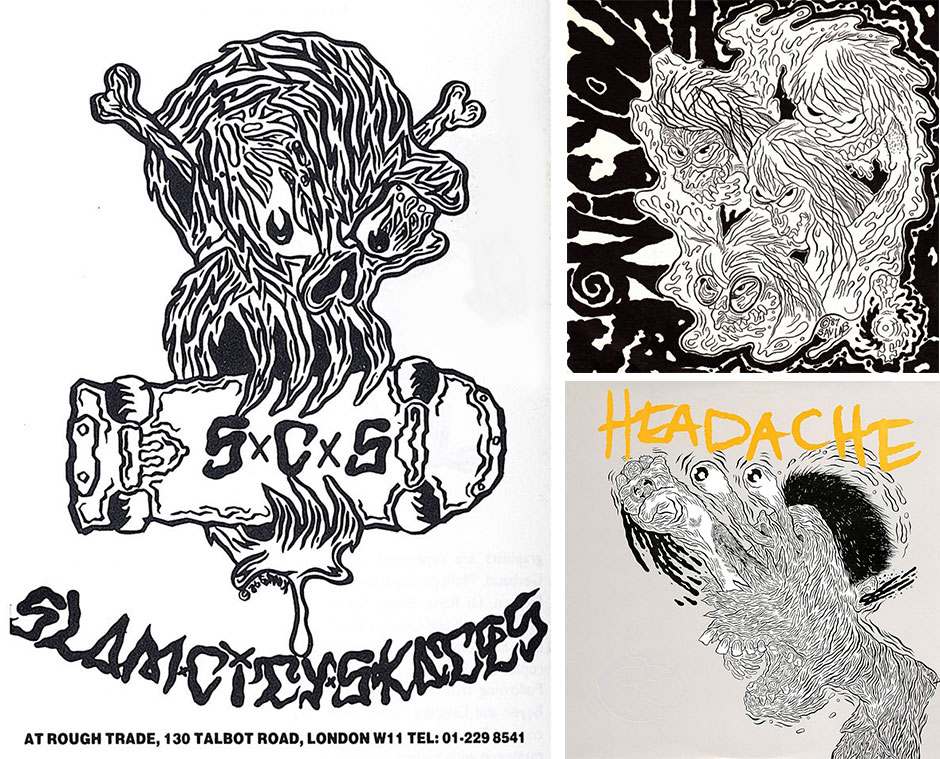
Savage Pencil (Edwin Pouncey) artwork for Slam City Skates, Sonic Youth, and Big Black
I imagine you were also hitting up places with your pound note for stickers, and stuff like that.
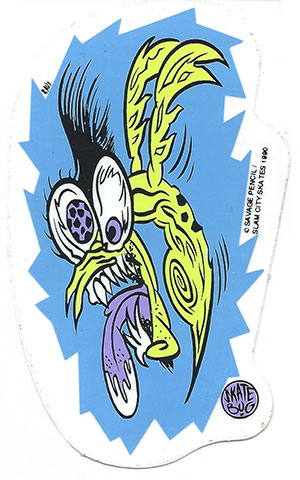 Yeah, a pound note or a pound coin taped to a bit of cardboard, and just hope for the best. There are big memories of a Savage Pencil Slam sticker, an Edwin Pouncey Slam sticker that I had stuck in my room for a long time. But then, becoming aware of Sonic Youth, and thinking, wait a minute, that looks a bit like… no way it says the same thing! It’s got a SAVX underneath it. Then Big Black, the Headache EP, of course. Then in hindsight, I suppose I established that it was the Rough Trade connection, maybe, that was making something like that happen. But wow, my favourite record has got the same kind of illustration on it as my favourite sticker from this skate shop. There’s more to this! There’s something going on here! This isn’t just a shop selling skateboards. And yeah, sure enough, when the story started to come out throughout the book, throughout that era, when it went from being run by a skateboarder to not being run by a skateboarder, being run by a skateboarder again. It’s that reflecting what London culture needed or what Slam needed to a greater or lesser degree of success.
From Sharon [Tomlin] to Seth [Curtis] to [Chris] Pulman is a timeline of things changing.
That’s a big one. I’m thinking of Tom Hodgkinson as well, of course, who wasn’t a skateboarder and didn’t want to work in Slam, but got the job, and it sort of changed his life. He went on to work on Phat and does The Idler now, of course, but that’s it, yeah, the Sharon, Seth, Pulman trilogy is an interesting story.
What do you think was the most interesting thing you learned about Slam’s history that you didn’t know before going into the book?
God, how hard it was to work in there, probably. What a thankless role the manager had. How entitled the skateboarders who came in there could be at certain times, whether that’s shoplifting stuff, or almost murdering somebody. I don’t think I was one of these people, but I think a lot of people probably took skate shops for granted. Like, I’m a skateboarder, so therefore this place has to exist, and as a result, I will abuse the hospitality of it? People thinking that skate shop owners are somehow multi-millionaires. Although, with that said, I’m well aware that Paul Sunman had a Lotus as a company car, but people were thinking that skate shops are the establishment or something. But then the tricky one for Slam, geographically placed as it was, at a very particular time in London culture, and the things that they sold. I’m talking pre-DC here, it’s when that was the place to get your big chunky Vision boots, and your Vision Street Wear, or even your Insane stuff when that was on Top of the Pops.
Jesus Jones era.
Yeah, Ian Baker, of course, managed the place. Then, when skateboarding was first appearing in The Face and iD, and then a couple of years later, it was the US stuff that Russell [Waterman] was ordering in. Fuct and X-Large, and things like that. Then cut to when Slam had DC, it’s just that there were always gonna be non-skaters shopping in there, but it’s non-skaters shopping in a lot of skate shops now, that’s helping keep the lights on, isn’t it?
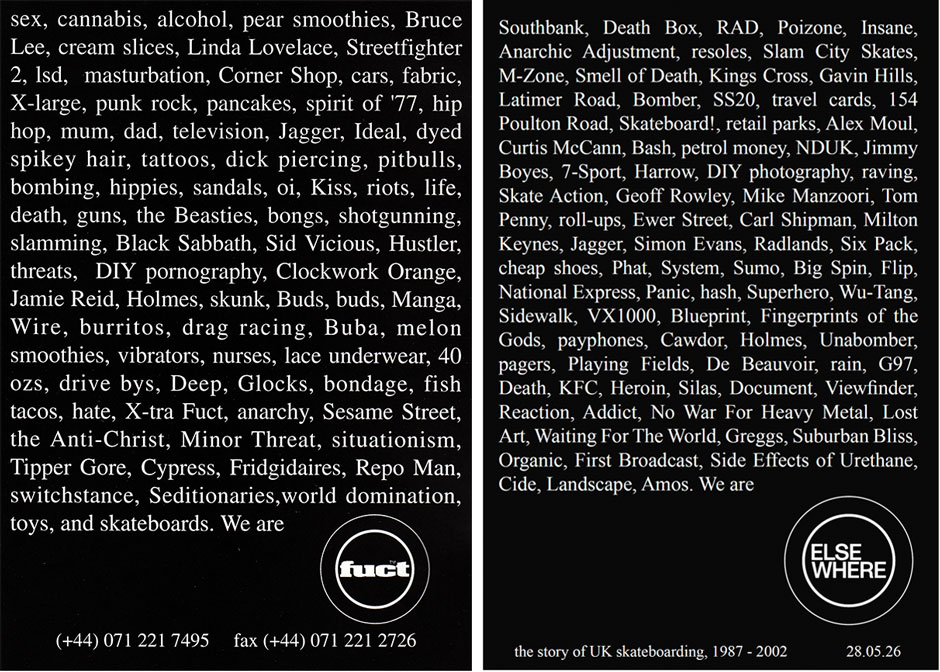
The Fuct ad Russell Waterman designed in 1993 and the ELSEWHERE homage to its genius
And I guess there was that cross-pollination where, you know, if you, in your mind, are kind of gatekeeping skateboarding culture as a skateboarder, Slam had this inbuilt, other demographic. People going up and down the stairs all day to the record store, who may or may not buy a t-shirt, and may or may not care what its affiliations are.
Right, and the Covent Garden tourists in general. But there was never, as far as I could tell from my trips to Slam in the nineties and beyond, never anything that looked like it was on the shelves for the sake of it. As far as I could see, Slam never conceded to stocking brands for the sake of it; there was a very well-curated selection of inventory.
You must be sitting on the most comprehensive Paul Sunman interview of all time. How long were conversations like that? Did you ask for the whole story or just mine for what was relevant to the time period?
Paul wanted to do it by email, so I sent a list of questions, and I think he replied to all of them. He certainly had the opportunity to ignore any of them, but yeah, I think he gave an answer to everything. He was just completely honest and heartfelt, and it didn’t feel like there was ever any suggestion that he was trying to glaze over anything or bring anything to the forefront. It just seemed completely straight up. I’m very glad to have been able to speak to Paul. Dan Adams helped maybe convince Paul that this was something legit and worth doing. So yeah, great to have Paul in there.
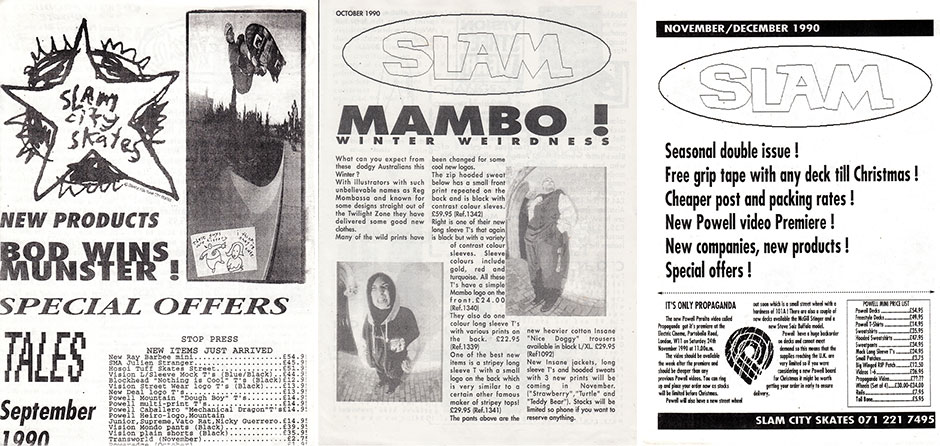
Consecutive Slam City Skates Newsletter mail outs from 1990
You spoke to almost every Slam employee. Who do you think had the biggest insights about their time served?
It was just amazing to hear Sharon be able to speak about her time there during that era. Somebody said it on the launch night, she was in the centre of London, in the centre of skateboarding, when it was a boys’ club and it was all about hip hop. Girls were not contemporaries at the time, as awful as it is. These teenage boys, at the time, we probably weren’t the most sensitive to how anything would feel to anybody who wasn’t a teenage boy. And, yeah, we were like a gang. In hindsight, there were people who were not part of that who were obliged to be in amongst it, and it must have been unbelievably difficult. Russell Waterman also, his recollection, his thoughts on it. He’s a brilliant man anyway, but his openness and ability to recall and recount everything was great. It’s an absolute blessing to have him in here. Of course, he went on to do various other incredible things as a result of having worked at Slam. I think Russell was probably my favourite Slam person to have spoken to. Or James Jarvis, but I’m lucky enough to speak to James quite a lot anyway.
“Slam ads were always different. It wasn’t the same ad with different words in it. It was a work of art”
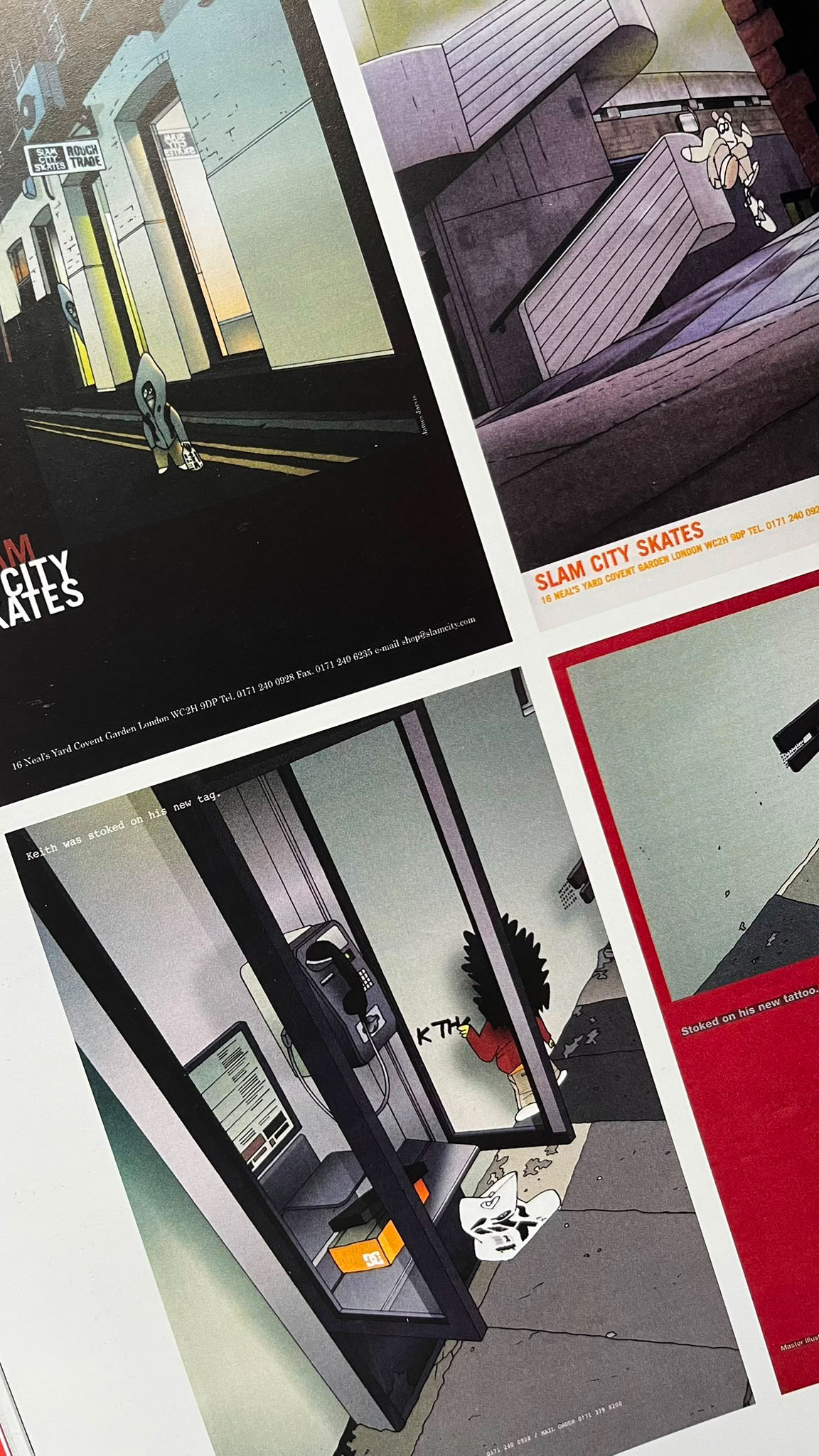
Some memorable James Jarvis adverts on the pages of ELSEWHERE
What is your favourite Slam-related photo or imagery from this time period?
The first thing that springs to mind, so maybe that means that it is my favourite, was Fos talking about Pin [Alex Osborne] calling up you to check on boards. He would ask you to measure everything and ask you to weigh them. And then I think Pulman said that one time he’s like, “Yeah, right, okay, okay. But what scales are you using?” He might ask you to use different scales to get an exact reading of how heavy this board is. But the best thing for me, in terms of making the book about that, was that Pin sent me a bunch of stuff. He had a bit of a clear-out, and there were some of the Silas toys that I needed. He sent that stuff up, and he sent a model of himself that Pete Fowler had made, this clay model of him on the phone. And it just looks like he’s talking to you, saying, “Okay, yeah, well, take it outside and weigh it. How windy is it ?” or something like that, because he’s so particular about his boards. And you can see that now on his Instagram, he’ll have ‘used’ Baker boards for sale. Just this pile of almost immaculate boards. It’s just funny how particular some people can be, but then there are other people who can break a board and just grab somebody else’s complete and then get the trick.
“But what scales are you using?”
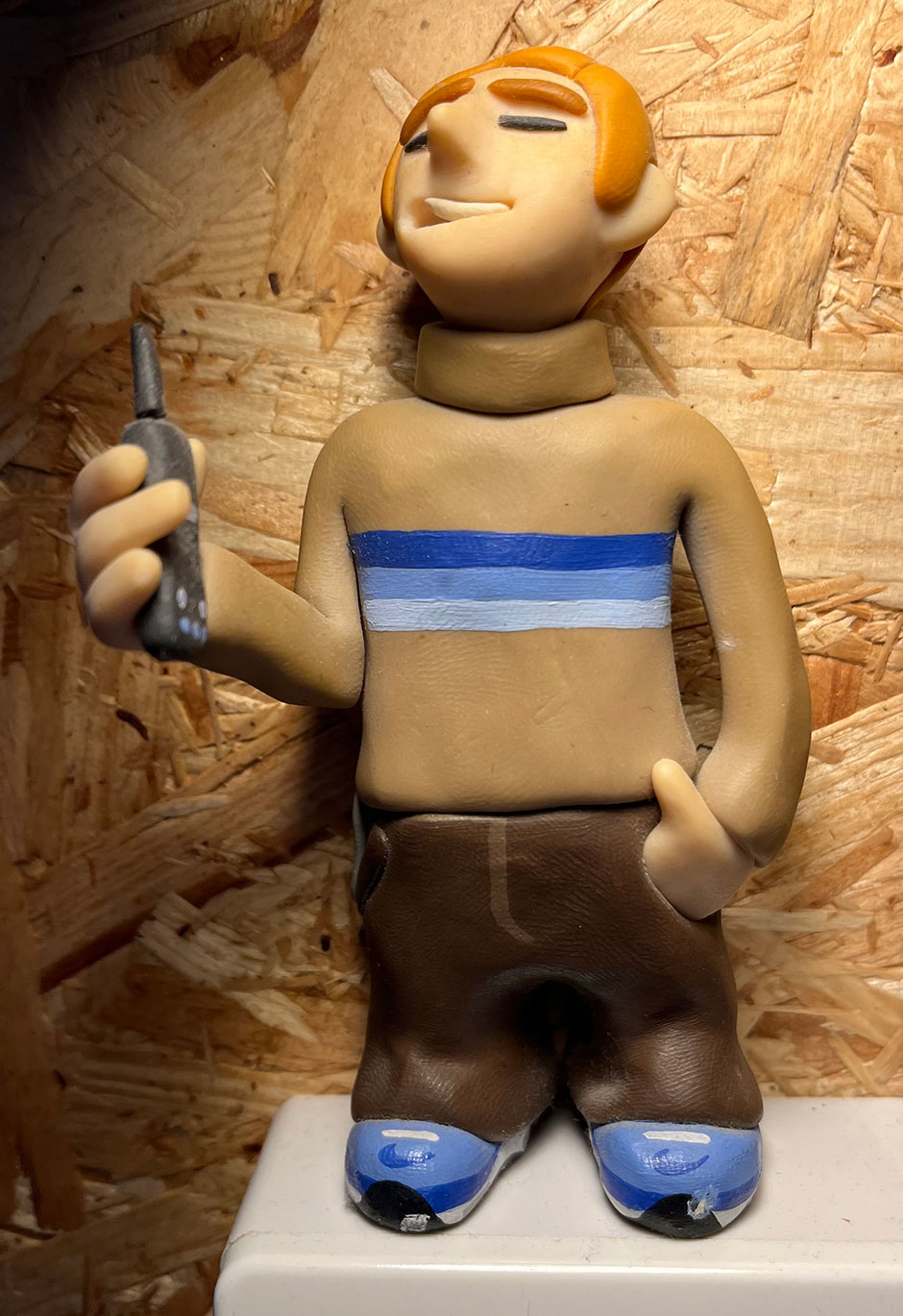
Lifelong friend of Slam Alex ‘Pin’ Osborne immortalised by Pete Fowler
Yeah, that was an interesting time. I think the source of it was that Pin couldn’t just come into the shop. When he did come in, he got to do all this stuff in person. But with the scales, I think Pin had some better scales or more accurate scales. Ours were primarily for weighing mail-order items, and Pin had some that were adjusted better to the weight of a board.
Amazing. Calibrated exactly. Coming all the way up from the Southwest just to weigh some boards and find the right one. That level, love it!
Pin is definitely still very particular about his setups. There’s also a moment in the book where somebody mentions Jimmy Boyes using Pin’s Makita drill as a hammer.
It was at The Side Effects of Urethane show and led to Pin saying that he was spinning out, and then Fos drew that bro model, the Pin ‘spinning out’ model. So good! Another story, I think that’s in there, about Jimmy Boyes finding the briefcase full of cocaine. “Wait a minute, this doesn’t taste like sugar!”
Yeah, I think some things got painted more quickly.
Yeah, now open 24 hours.
To cap the Slam talk a little bit, the Slam launch for the book is coming on June 13th, which is going to also host an unofficial Slam staff reunion, thanks to Tom Hodgkinson?
I messaged him about the launch, the Aries launch, and he was away, but he had said that he would be asking me for some contact details for some former Slam staff because he wanted to organise a get-together. Then I was able to say that we’re doing this Slam-centric launch at the shop on the 13th, so perhaps we should just try and get everybody down to that. That would be my ideal; it would be good to have generations of Slam staff in there and everybody from 2002 onwards. Most people could get there, I would hope, so it should be good. There’s more than enough Slam material, sort of Slam adjacent skate photos from that era, for it to be a Slam-specific exhibition in there.
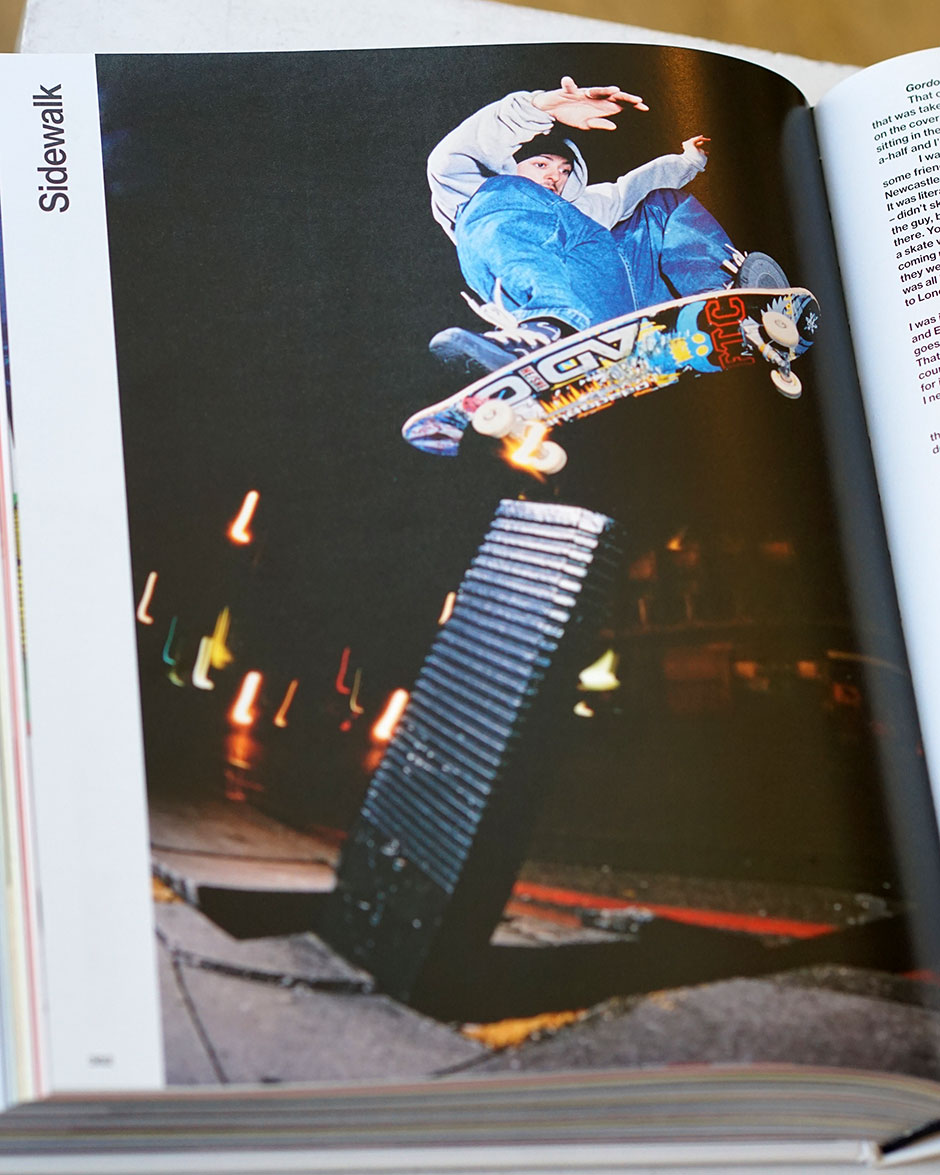
Seth Curtis from the cover of Sidewalk to the pages of ELSEWHERE. PH: Wig Worland
Now for some sort of nitty-gritty book-making questions. How many hours of recorded combo do you think you’ve logged?
I would dread to think, I only typed up the stuff that I thought would be usable, the stuff that I would want to use. After having done maybe around 250 interviews, I ended up with 800,000 words to go in the manuscript that I submitted, having no clue how anything works. I knew that that would need to get trimmed a bit, but it turns out that 800,000 words is too much. It’s a lot, but you would enjoy reading it; it’s good stuff, and that’s not even having people recounting the same story; I only kept in the best version of a story being told, whoever told the best version of it. In terms of hours of recordings, I dread to think. Do I have everything in one place? Probably, but it would be just an utterly astronomical amount of hours. It’s all I did for six years, and there are photos as well, of varying resolutions and file sizes.
Was it hard for you to surrender to that stricter kind of editing process?
Yeah, it made me ill; it was horrible. But now, in hindsight, I know that the best stuff is in the book, and it’s the stuff that fits in alongside itself. It’s stuff that works together. Because it’s a story, it’s not a reference book. I’m happy with how it came out, really, really happy. And there’s nothing in it that’s in it for the sake of it. It’s not like, ah, this person always makes this point, we need to get that point in it. There’s no filler. In the original 800,000 words, perhaps there might be a bit of filler, or there might be a few too many words talking about something that’s not that important in terms of everything else that was going on. There were a lot of amazing scenes, a lot of great stuff going on, but if there’s no real story, and if there are no photos to go alongside it, then should it be in a book that you pay money for? If it were some sort of web resource, then all this extra stuff could go in, but if it is just… we opened the shop, and people started coming, and we sold skateboards but we didn’t take photos of anything, then, I’m so glad that you did that, but that would be in it to tick a box, that’s not in it to inform or amuse or entertain anybody.
“After having done maybe around 250 interviews, I ended up with 800,000 words to go in the manuscript that I submitted… I knew that that would need to get trimmed a bit, but it turns out that 800,000 words is too much”
The story takes precedence.
Yeah, the things that happened that changed the culture that led to where we are today. And yeah, there are shops that opened in the book’s timeline. Note, Focus, Native and Ideal obviously come to mind. Incredible shops that are still open now, with good reason, and you should buy stuff from there. But if there’s no extra story to that? What Splodge, Sibs, Jackie and Kris and Zippy do is brilliant, and it’s crucial to skateboarding. So that was the hard part, to not have things like that in it. If there were no photos, there was no unusual part of the story, just we got a loan, we got an account with Faze 7 or Shiner, and then we started selling skateboards. Everybody knows these shops anyway, they’re some of the best shops, but if there wasn’t more to add, it doesn’t fit in because it’s not a reference book.
It’s quite noble, for want of a better word, to extricate yourself from the narration of this story, something we’ve talked about before at length. Getting out of the way of what is being told. Was it quite freeing once you did that, once you landed on that being the way that the story would be told?
It was. You and I have spoken in the past about how hard it is to write an intro for an interview that you’ve done. It’s easy enough to present the conversation, but when you have to define a person, and their role or their position, it can be quite hard. And as much as I had to write an intro for the book, because you just have to, it turns out. It’s like the law or something. I didn’t want my name on the cover, but for something like Amazon, if it’s got an ISBN number, Amazon has to have an author name on the cover. So yeah, it’s just weird, seeing this thing with my name on it, and I’m not in it, I didn’t write it. The publisher Batsford had asked for a cast list as well. They’d asked me to identify everybody who spoke in it, and that’s around 200 people. It’s going to be absolutely impossible because most people, like say Tom Penny, or Simon Evans, or Curtis McCann, people who changed skateboarding, would want it to just say, ‘skateboarder’. Actually, Simon Evans would probably say to just put ‘person’. He’s not even going to want to be acknowledged for what the publisher was asking for. It’s almost as if I should have said: “first person to skate in Gazelle’s, innovative, mind-blowingly original human”. So, it would just end up being skateboarder, skateboarder, skateboarder, skateboarder. Then you might have somebody here and there who’s going to want to be acknowledged as a skateboarder, filmer, photographer, artist. They might not have even really done that much, but it’s like, could you just put van driver, please? There’s no way you could define these people. So it is just names.
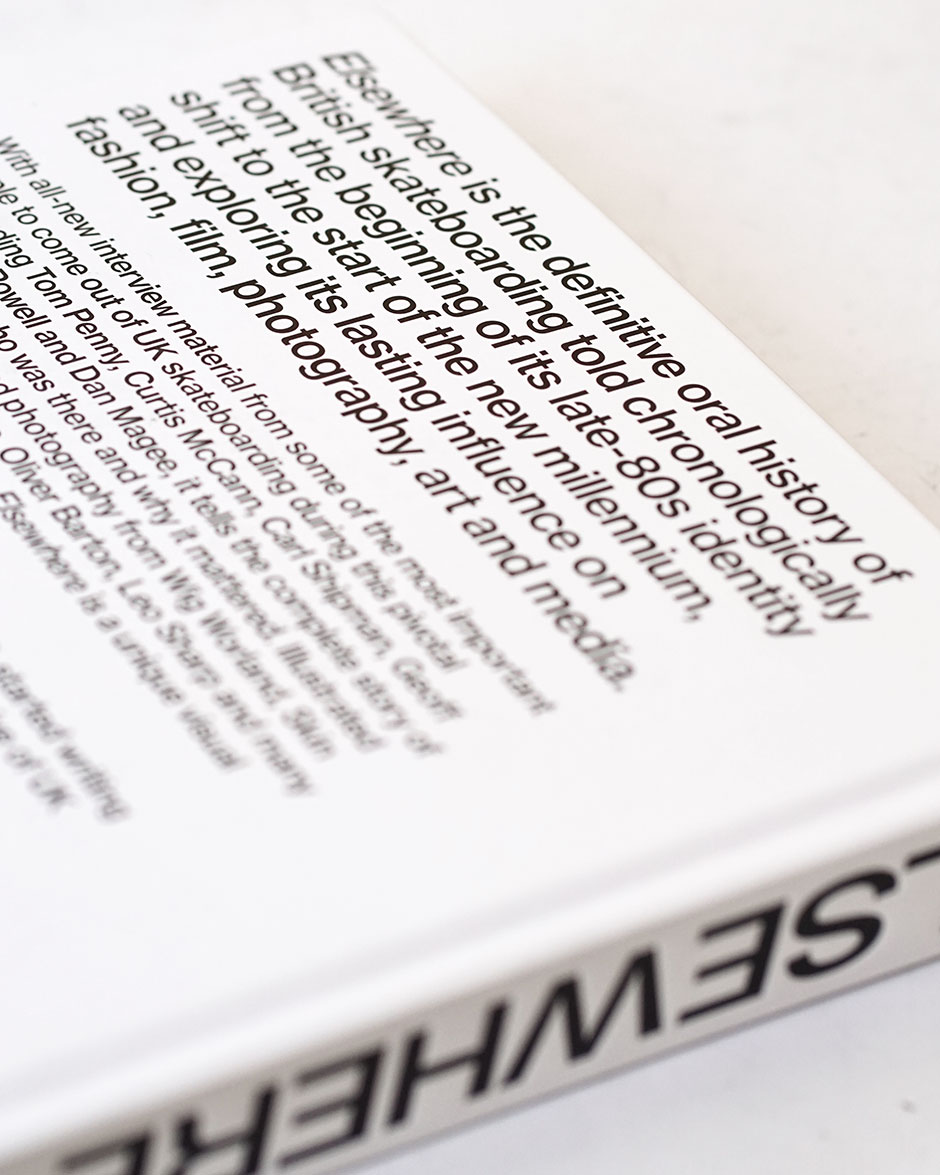
I think if somebody who has no idea about skateboarding picks it up and reads it, it doesn’t have to matter who Pete Hellicar, Dan Magee, or Jimmy Boyes are; you can just read what they’ve said. If I’m reading a book about football hooliganism, I don’t need to know who that guy is. I just want to hear his story, what happened that day. Then somebody else might mention him later on, and you would remember that was that guy who was at Leeds that one time from earlier. And that’s all it needs, it’s a bonus if you know who these people are telling these brilliant stories. Years and years ago, when I told Tim Leighton-Boyce that I’m not going to be writing in it, he said I’d have to, so I can introduce sections. So I had it in my head for a couple of years, at least, that I was going to need to go in and identify who these people are, their position, and their role. But reading it, it’s clear what everybody did.
100%, even to somebody with no knowledge of it at all. Through the different voices, each one qualifies, introduces, or summarises what another person is saying at the same time.
I don’t need to say, “Then Dan Magee convinced Joe Burlo to start up a new division under the Faze 7 umbrella, separate from Panic”. Dan says that in the book already; it’s clear, you can see that this is happening.
It’s almost developing a separate language in a way. You have Simon Evans saying something, but you’re almost preempting someone wondering who Simon Evans is, because somebody else who follows will then be talking about Simon. You’re kind of answering those questions through other people’s words.
Yeah, ordering the paragraphs was definitely a detailed job that had to be crafted quite carefully so that every bit of information comes in the right order, and then the response to that follows, rather than you having to read on to find out what that person was talking about. Every bit should be in order, even if that means I’m having to break up things that people have said to add something in there. I would much rather Mike Manzoori say it than me say it. So, just move that, put that in there. It’s not the story of my skateboarding. I started in 1988, and I was very much still skating through the 2000s. Although it was quite heartwarming, I suppose, quite pleasing, the amount of people who have said, “Oh, it’s a crazy coincidence that you’ve picked ’87 to 2002, because that’s when I was skateboarding the most, and that’s when I started.” It’s not a crazy coincidence, because that’s the same for a lot of people. That generation of ten, eleven, and twelve-year-olds that started because of Back to the Future, or just the late 80s boom, were then getting their first proper job, or moving away to uni, or settling down with the first proper girlfriend, or finishing uni. Whatever it was, around the early 2000s, there were life changes for that generation at that time, as well as what was going on in skateboarding. Then again, a new group of people coming in, and I don’t think there was ever another Shane O’Brien moment where it was all like “Oh my god, what’s happened here?” because it didn’t happen overnight, but there was definitely a shift.
There’s definitely a residing, “I saw Back to the Future” start point from many interviews.
Yeah, I had thought for a while that it would be fun just to have a page of 100 people all saying, ‘When I walked out of the cinema’, or ‘When I first saw that’. The number of people who mentioned Back to the Future, at first, it was like, “Cool, I have picked the right time and reason for this.” But then it got to the point, it’s like, God, yeah, I know, of course, it’s Back to the Future. Stop going on about Back to the Future, everybody.
That was the window into America, though, wasn’t it? A sanitised universal window into American pop culture. A skate mag is obviously that on steroids, but he’s got an electric guitar, he’s got a skateboard, he’s got a cool truck, he’s wearing Nikes, everything. Coca-Cola or Pepsi or whatever.
‘He’s got a fast car, this is great…’
And he’s got a video camera!
Of course, miles ahead. Yeah, I saw Back to the Future, I thought, “Wow, this guy’s cool”. Great, dig out a polyprop left over from the 70s, then you see Police Academy 4, Oh right, that’s what you can do. That’s much cooler. Skating down the street at night, with sparks! But these are things that are presented to you. These are things that were put in front of your face. It’s not like your mum comes back from the shops and says, ‘Oh, I saw this magazine called Thrasher, I thought you might like it’. That’s not happening; it’s only through pop culture, and before you can start seeking out BMX Action Bike or RAD, as it became in 1987, and Thrasher, if you’re lucky. Or a mate goes on holiday and comes back with a copy of Thrasher and a video that doesn’t play, it’s like, this exists, there’s stuff, there’s more to this. Now you can be a witness to the best skateboarders in the world in one second. You can just go on your phone and see any type of skateboarding done by the best people ever. But for us, it was rewinding that bit in Police Academy 4 that you’d taped off the telly. That was your skate inspo.
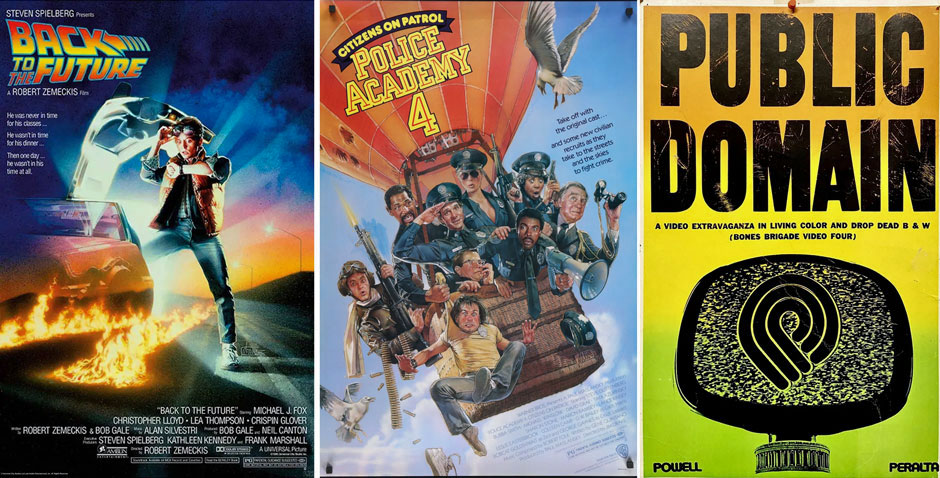
I guess TV was a very British experience. So a film release was like a portal into something else that’s happening in another country. Film releases were more vital than they are to a kid growing up now.
Yeah, and you would watch it. If you taped it off the TV, you’d watch it again and again. Or if you were renting it out, or if somebody had bought it and it was passed around the school. These things would stick with you. Attention spans were a bit more forgiving back then, I think.
Were you surprised, making the book to find more about the inner workings of things you perhaps initially had a skewed perception of the size of?
Well, I think I thought to an extent that at least most people got on with each other and were having fun, which is not necessarily the case with everybody. I’ve known these people for a long time now, but I had still always thought that Blueprint were the kind of classy, maybe more middle-class, uni people, and Unabomber were just like a bunch of scumbags. But with Unabomber, what did Mat Fowler describe himself as? ‘Upper working class’ I think. Unabomber were the upper working class art students who were reading poetry, and Blueprint were listening to hip hop and smoking weed. Maybe John Rattray less so.
I guess John was doing those things, but also reading about astrophysics.
Yeah, he shouldn’t have gone to Zero, he should have gone to Unabomber, and hung out with those guys. I just imagined Unabomber to be a bunch of pissed-up scumbags, but they were all super thoughtful. I just love both those brands. I mean, Blueprint, all those guys are just brilliant, brilliant people. I just thought that they were doing different things when they went home at night.
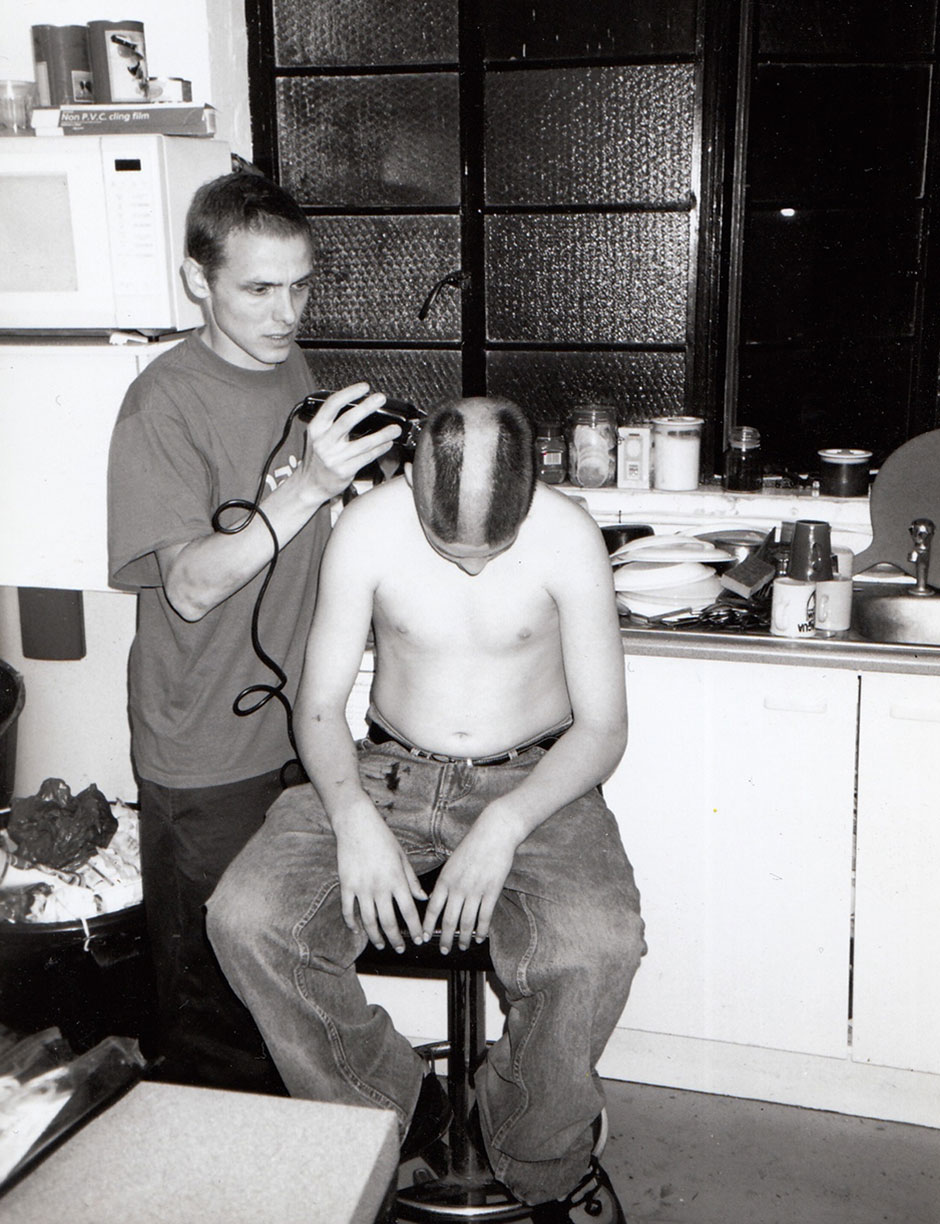
Pete Hellicar welcoming James Woodley to Unabomber with a fresh crop
How involved were you with the design side of the book? Was it easy working with Tijl Schneider on this, did your ideas and expectations align?
Tijl did the sample pages, just a few pages laid out, before I signed with Batsford. I thought it looked perfect. It’s a book about skateboarding for people who potentially care a lot about style, so it shouldn’t be patronising, it should look good. Batsford initially said they’d get their designer to try to replicate Tijl’s style, but eventually they agreed to take Tijl on for the design of the whole thing.
Did the aesthetic you landed on impact your editing process? It’s beautifully designed because there’s so much in there but it draws you to the words and everything has space to breathe.
The blank space meant that things had to be left out, but as you say, it puts more emphasis on what’s on the page. It’s like how the magazines couldn’t just have banging photos, page after page, because you’d desensitise the reader. Like a DJ playing nothing but bangers, it doesn’t actually work. So yeah, I think the space brings the content to life even more, and also it was mind-boggling how precise Tijl was with everything. He’s at the top of his game so he would be, but that side of things was definitely new to me.
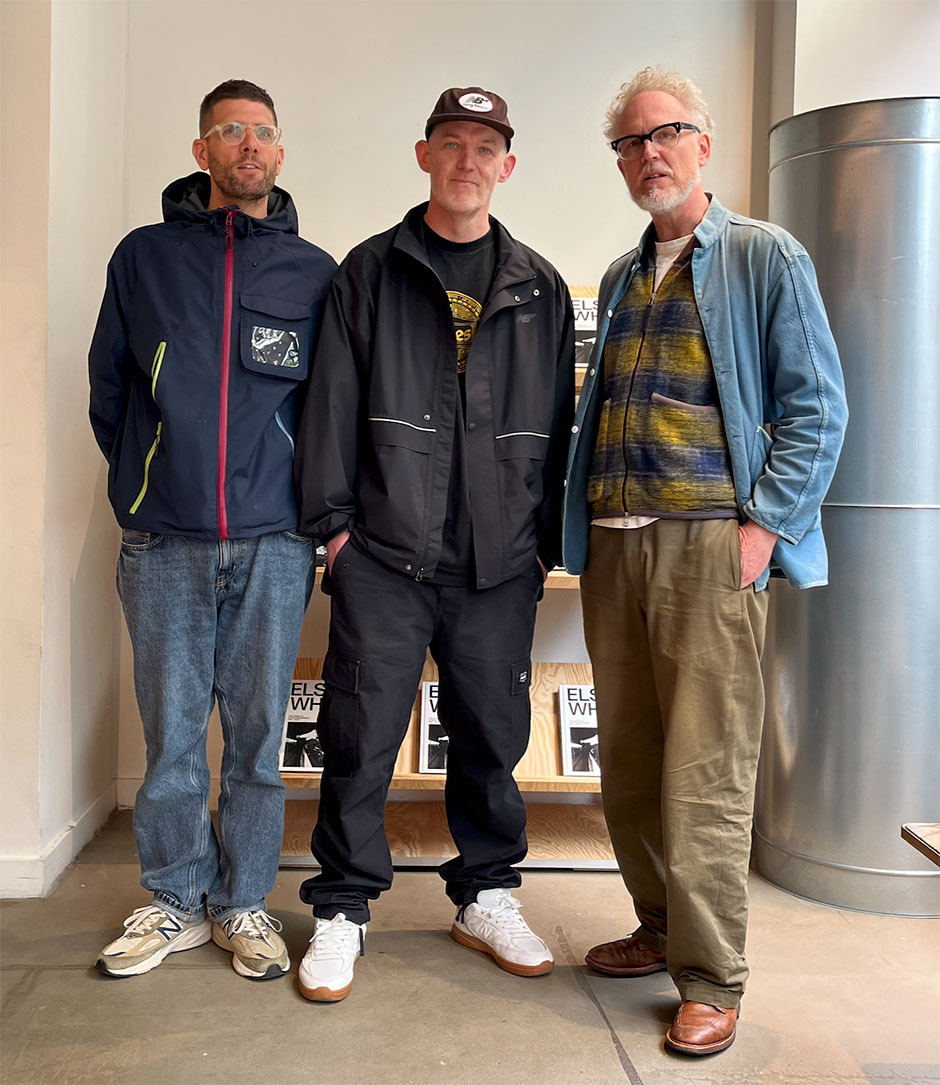
ELSEWHERE book designer Tijl Schneider, Neil Macdonald, and household name Wig Worland. PH: Sarah Feeney
How has making this book made you feel about UK skateboarding?
It’s even more special than I thought it was when I knew that it needed a book about it. Like the brilliant minds, the artists, the skateboarders, the photographers, the writers. The people who made things happen. It was done for the love; nobody was making money. It was only for the love, you can’t really put it into words. Maybe I should have, maybe I should have added this somewhere. Maybe it does say it in the intro, but the amount of work and effort, the amount that people struggled and suffered to make things happen, whether it was to put boards out or it was to put a magazine out once a month, or to organise trips, or film a video, or something. There was no shoe money in it then. Look at No War for Heavy Metal, basically a documentary that just shows the absolute reality of skateboarding in the UK. It rained the entire time on that trip. They’re at indoor parks, but not everybody was enjoying themselves. It’s like ten to a room in the Premier Inn. Everybody is just drinking and ordering takeaways to the room. There’s no, “I’ll meet you at the bar in half an hour, and we’ll go grab some food”. It’s like, let’s share a Chinese, and try and get pissed, and then you can fall asleep on the floor. That still happens, of course, in skateboarding, but not generally when going on a tour.
Not going on tour without a penny to your name.
Yeah, literally. There’s a story about Harry showing up at an airport for a trip, presumably a Dope trip, and he had a skateboard, and a plastic bag with one sandwich in it. It’s like, “Let’s go round Europe.” Snoz cycling to Munster, of course, as well. Pete Hellicar cycled a lot of the way to Munster, too.
Snoz definitely did some stuff on a shoestring, didn’t he, around the whole of Europe?
Yeah, famously, and so did everybody. Jimmy Boyes as well. Jimmy landed in maybe San Diego or something, and cycled up to LA to go to Geoff Rowley’s house. He knocked on the door, and Geoff wasn’t in, and he just carried on his way up the Pacific Coast Highway. You can’t phone ahead, you can’t text the person. It’s so easy now, as Oliver Payne said, you could start a brand on your phone during your lunch hour now. But back then, when it was knocking on doors, and it was trying to find somebody to press your boards, and print your graphics the way you want them. Trying to find a jean manufacturer that will do your custom rivets, and will do triple stitching with the material that you need. Then the people that sell the material might not be the right manufacturers to put the garment together, and then you’ve got to find out who that is. Now we can just click here, use some drop-down menus, and we’ll make you your thing straight away. But when nobody knew how to do that, nobody knew what they were doing. ‘Streetwear’ didn’t exist; we called it ‘clothes’ back then. To make it, you had to figure it out every step of the way yourself, really. There was no drop shipping, no, ‘We’ll turn around a thousand t-shirts in 48 hours and create your logo for you’, whatever it is. And you can see that a lot of the people who were doing those things, and figuring it out, can now do it for a living, like Ged Wells, Nick Philip, Sofia Prantera, and Gareth Skewis. These people do what they do now because they had to figure out every step of the way manually through trial and error.
You mentioned just now misgivings about not giving too much of a synopsis about how UK skateboarding kind of ran on fumes, but Russell Waterman crystallises that message at the end that there was nothing. Where the book ends is where cash being thrown at things begins.
Like Shane O’Brien’s opening quote, that was the perfect way to bookend this story and explain why it is these years. It was when the shadow of corporatisation was looming by that point. It was like this thing, you could hear it coming in the distance. You could see it in the magazines; adverts for cars, adverts for technology. It’s expensive stuff. Who do they think we are? But then, of course, it becomes your corporate extreme festival kind of landscape. These things are still, I suppose, great for getting people together. But when it’s suddenly all these brands that have had no previous interest in skateboarding and no relationship with the act of skateboarding, and or skateboarders sponsoring stuff suddenly, it’s a bit suspicious. And then, they want their version of skateboarding presented in a certain way, and the brands all got a lot more streamlined, like the global brands, I mean, even Blueprint did, and Unabomber gets sold, of course. Everything, I’m not saying it flat lines, but everything got slightly more predictable and slightly more homogeneous.
Have certain conversations never ended? Have you forged some friendships throughout these six years?
Yeah, it’s great, people still just being in touch. I would even dare say that I probably got my day job, the job that I do, as a kind of side effect, maybe of doing this.
That’s the Sidewalk Distribution role?
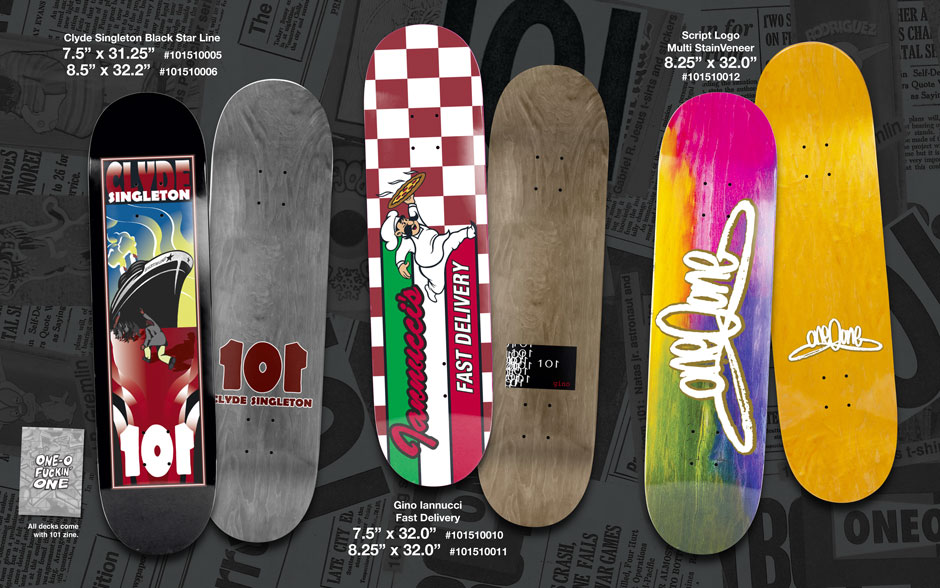
Yeah, I do the heritage division at Sidewalk. We work with Steve Rocco, who is part of Sidewalk and it’s reissues, but with the storytelling. It’s not just.‘Here’s an old board, would you like to buy this old board again?’ It’s, ‘Here’s an old board, and we’ve got it signed off by the artist. The rider has done our interview. Here’s some footage you’ve not seen. Here are some photos that have never been out there; have it in this zine’. It’s everything existing for a reason rather than ‘We can do this, so let’s just do it’. Let’s consider why we want to do this and why this matters. Some things from the World stable will be the things that you would expect, but some things will be potentially things you’ve never seen before, like the 101 drop.
The direction of the Sidewalk Distribution heritage division is guided by Neil Macdonald
The 101 drop is a really good overview of some amazing graphics.
I think so. I don’t think it needs to be, let’s look at 101 in 1994 or anything like that, or let’s just do the 20 Shot era. It can be, ‘That’s good, that’s good, and that’s good, and I would like all of those things, so we’ll put all these things together for now’. It’s not like what Powell or Santa Cruz do.
With very specific drops.
Exactly, and the thing with those boards is that those graphics stuck around for years. So there’s the Cab dragon again, but it’s in a slightly lighter grey than it was last time, for all you collectors out there. There’s nothing else that can be done with those, but when there’s a 101 Gino board that they may have only made 200 or 300 of them, and it’s banging, it can be much more interesting.
That would have been on the board wall for one delivery, and replaced by the next.
Yeah, and if your mate bought that, he might have broken it that day, you might never have seen it, but it looks amazing now. “I want that on my wall, I want to set up a 7.5”, I want to wear the t-shirt of it. There’s no reason why these things should be lost in time. An amazing-looking Gino Iannucci board, you can now own that, and it’s not just the classics.
The Natas graffiti board is amazing.
That’s it, that truly is amazing, it’s a work of art and it would be easy to do Oops!, the Challenger Explosion, in a different colour, and that will happen in different finishes and things, but for now, there are things that people go, “Ah nice”, and there are things where people go, “Holy shit, it’s that!”, so yeah, that’s what I want to be leaning into.
Were there any notable omissions while working on the book? Were there people you would have liked to have spoken to but didn’t?
Yeah, Neil Chester, Scott Palmer are not in there. Selley wasn’t feeling like talking at the time and Rodney Clarke didn’t want to talk. Franklin [Stephens] is not in there. Franklin didn’t want to talk, I think, and with Ches and Scott Palmer… everything led to the next conversation. I had my list of key people, and just knew that the other connections would flow from these people. And as much as those guys did other things, and Wig tells me that Scott’s one of the funniest people he’s met, if there’s nothing kind of beyond them, just skateboarding, and obviously Ches did plenty else beyond actually just skateboarding, I just don’t know why I ended up not speaking to him. I don’t want to say I reached out and he didn’t get back because I don’t think that’s the case. It’s not really the case with anybody. I think everybody just got back and said, yeah. Stepping back and looking at it, it’s just like, damn, I never got around to speaking to those three people. Obviously, there are more people than that, but those are the ones that come to mind. And again, it goes back to the shop thing as well. There could have been more about…
Four Down in Hull, for instance.
No, quite, and it’s kind of maybe a failing because it is called ELSEWHERE, and it should have Hull in it. It should have everywhere in it, really. But there was a certain amount of time to finish it, and the deadline was 2003. So thanks to Batsford for being so forgiving and making an extra two years, and an extra load of pages as well. But yeah, there still were limits to it. There were still things that had to stop; it couldn’t just go on forever.
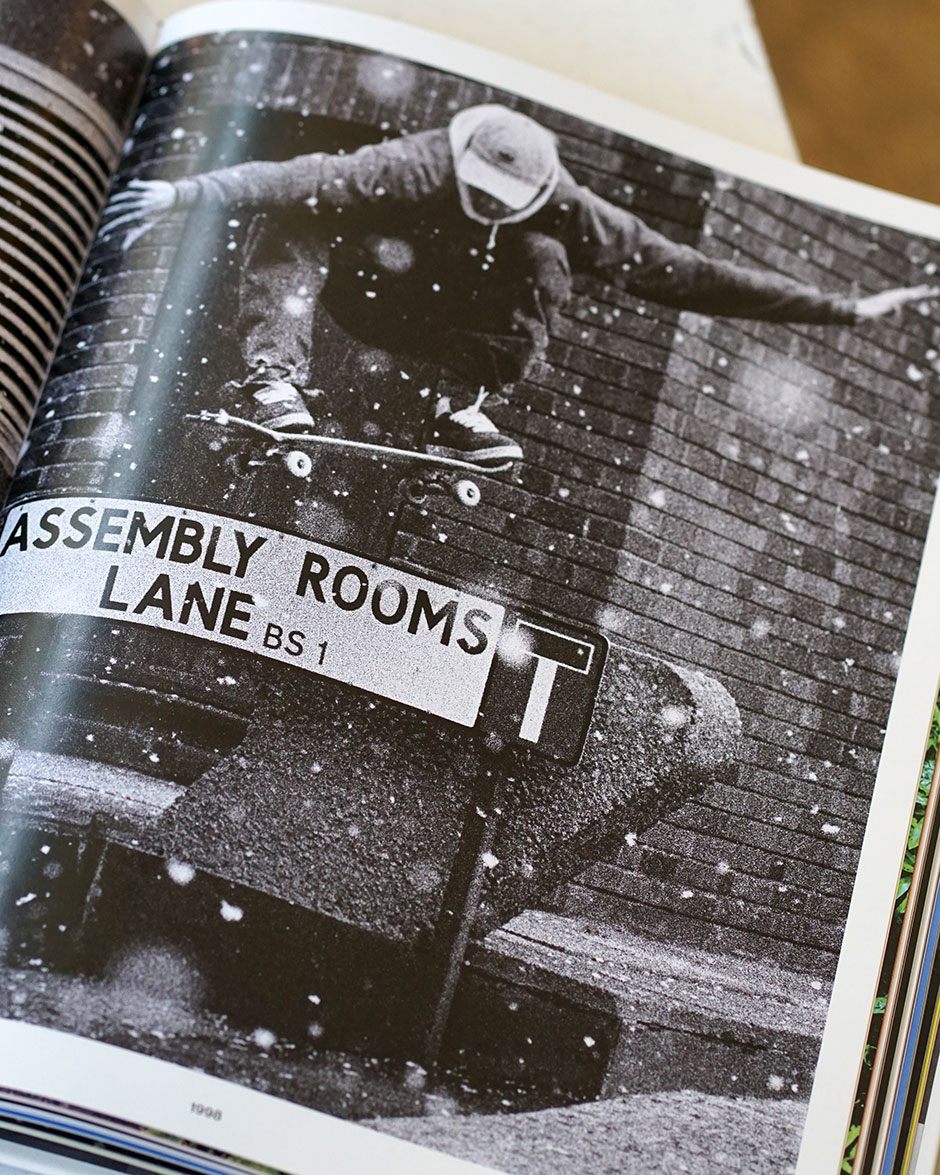
ELSEWHERE plays host to a huge Danny Wainwright ollie in Bristol. PH: Wig Worland
What was the most frustrating part of making the book, being curtailed?
Yeah, being bound by time, and page count, and word count. Bear in mind, I’m not getting paid doing this; I’m doing this instead of working, instead of doing a job. So I was running out of records and things to sell, just to stay afloat. Just selling off all this Supreme stuff, and selling off probably 80% of my record collection, which was quite a lot of records, just to exist. Sending this really great thing off to this Discogs person so that I can buy dinner, or so that I can pay a bill that will have no other effect on my life, like there’s no bonus, you don’t get anything. When you’re paying a bill, I’m now £100 down or £200 down, and everything’s exactly the same as it was yesterday. I’ve got nothing to show except that I can now literally keep the lights on and do this book for a little bit longer. That sounds like complaining but it’s not because what a pleasure it was to speak to all those people.
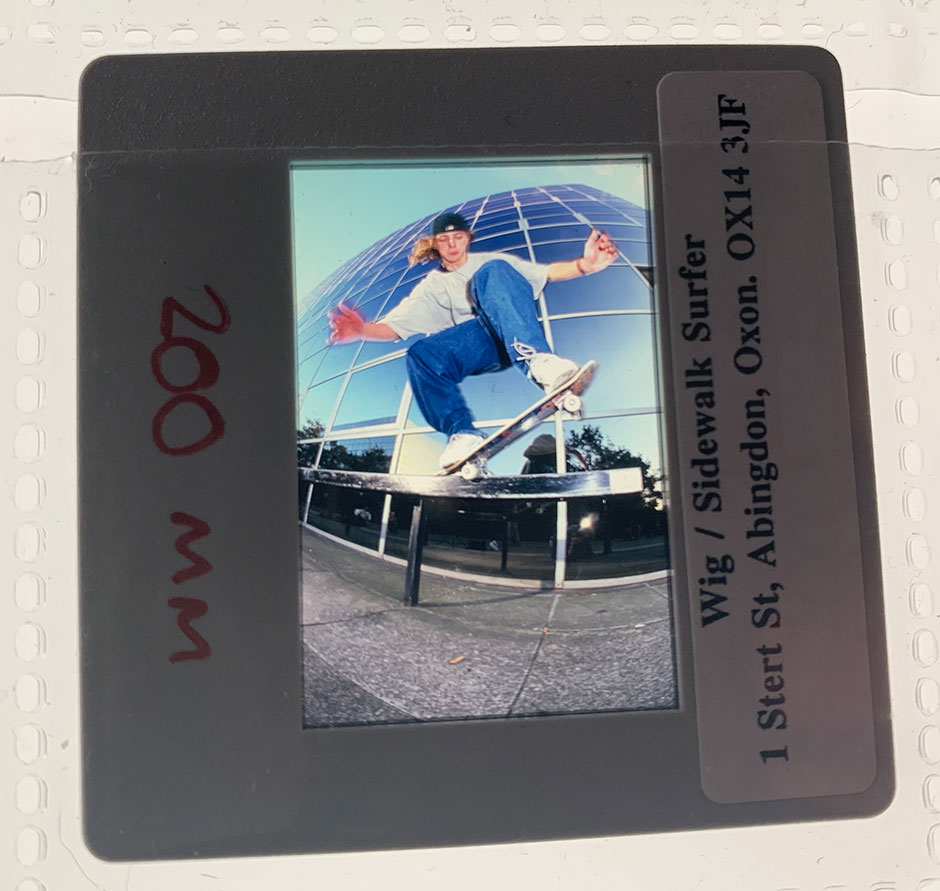
Wig Worland’s slides are things of beauty. Mark Baines in Milton Keynes in 1997
Then, as things started to come together and close, you know, to sort of be finalised, then New Balance Numeric appeared. Well, they’ve always been there, but Seb [Palmer] had been clear from a while ago that they would do everything they could to help get the book out there, help promote it, help people see it. [Mark] Baines and [Dave] Mackey over there were just a massive help. Suddenly, I could travel and New Balance would cover it. I could go and do stuff, and making the whole book involved an awful lot of traveling. There were a lot of times when it just made much more sense to go and meet the person, or if he’s going to say, ‘Yeah, come down, and I’ll get so and so to come along as well’. I would rather have these two talking together in a room than speak to them separately on the phone. Things like that brought a lot more to the book.
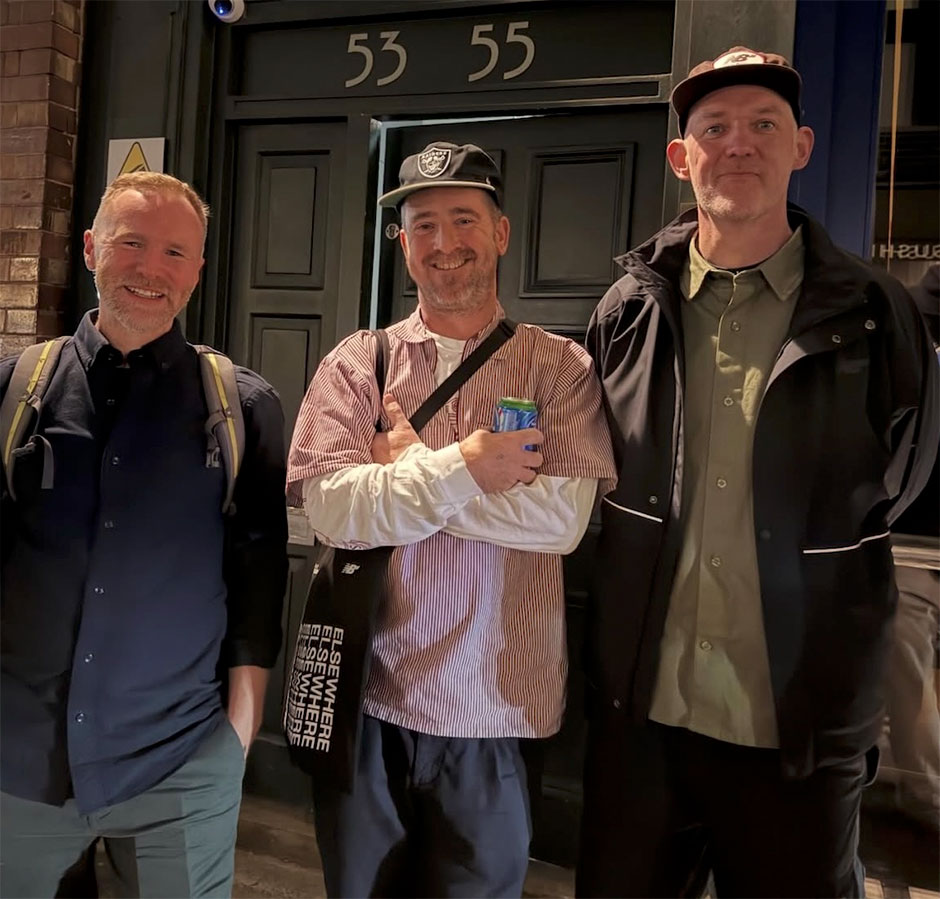
Peter Lee from Batsford, Sebastian Palmer from New Balance, and ELSEWHERE creator Neil Macdonald
Having Seb, Mackey, and Baines involved on that level, and as interviewees too. They are key figures in the book.
Yeah, all three of them are huge parts of the book. Mike Manzoori has probably got more full-page photos, but I think Baines might be second, because I’ve always been a massive fan, and he shot with Wig a lot so all his photos are perfect. All three of them have got thousands of words in the book, and they still would even if they were all now working at an accountancy firm or something. It’s just that they were all that important in the story. Likewise, Sofia Prantera, who runs Aries now, and who hosted the launch party. That was the perfect place to do it. She came into the story in 1991 when she started working in Slam doing Insane with Ged [Wells]. Ged wanted to do more than just print some t-shirts, and she was coming in having studied at St. Martin’s. She came in to do cut and sew stuff, and then of course onto Holmes with James Jarvis and Russell Waterman, and then went on to do Silas with them as well, through to doing Aries now. She would be in the book if she wasn’t doing Aries. There was no plan ever to have the launch date at her store, even when I called her up to talk to her for the book. At first, she was very much like, “Right, so what’s this again? Who are you?” I was like, “I know, I know, just bear with me. Let’s just talk about this”. Then two hours later, she’s saying, ” Hey, if you want to have a party, we’ll host it.” She totally got it.
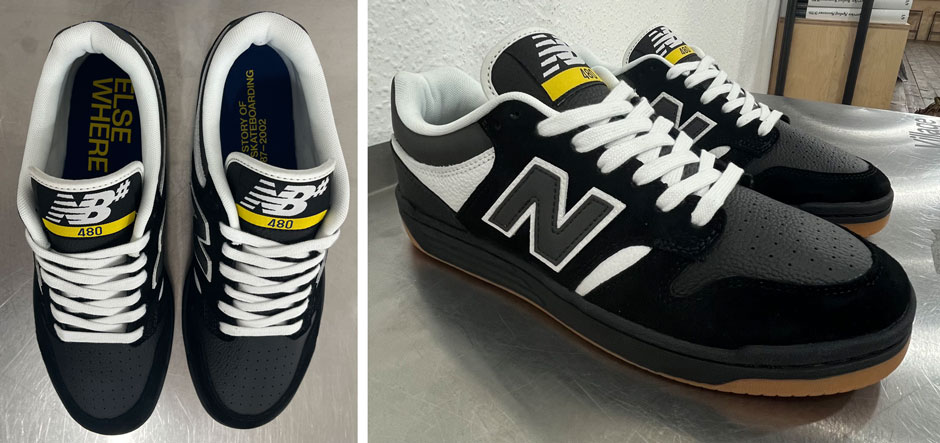
The limited edition ELSEWHERE colourway of the New Balance Numeric 480
With New Balance, what they can do in terms of helping me to get about is one thing, but just the enthusiasm from them, the unstoppable encouragement from them being involved, really helped get it over the line. I think everybody in it backs it, but knowing that those guys back it that hard, and they can make it part of their day job to help me out. We did the shoe, the 480, and they’re helping with the other regional launches as well, paying for printing so that we can get photos up on the wall. All of this stuff says so much about how much those guys love UK skateboarding.
Whose stories do you think could fill a book on their own?
Wig [Worland], potentially, just because he wasn’t much of a drinker, and he met probably the vast majority of people who are in the book. If you’ve got a question about somebody, he can tell you. I speak to Wig still every day, but he would be able to offer advice. ‘If you’re going to speak to him, make sure you ask about this, try not to mention this thing, and be aware that he rambles, or he’s really to the point.’ I’d be going in prepared because Wig had shot this guy in the past. Ben Powell, of course, again, could talk about anybody at length. Jonny Robson, I think, was just so aware of things that were going on and just a fan of it. Not enough of a fan to keep his job at Unabomber, or to edit Sidewalk, which he could have done by all accounts, but he’s definitely got a lot to say about things. Then, Dan Magee, it could be the Blueprint book, it could be just about Blueprint.
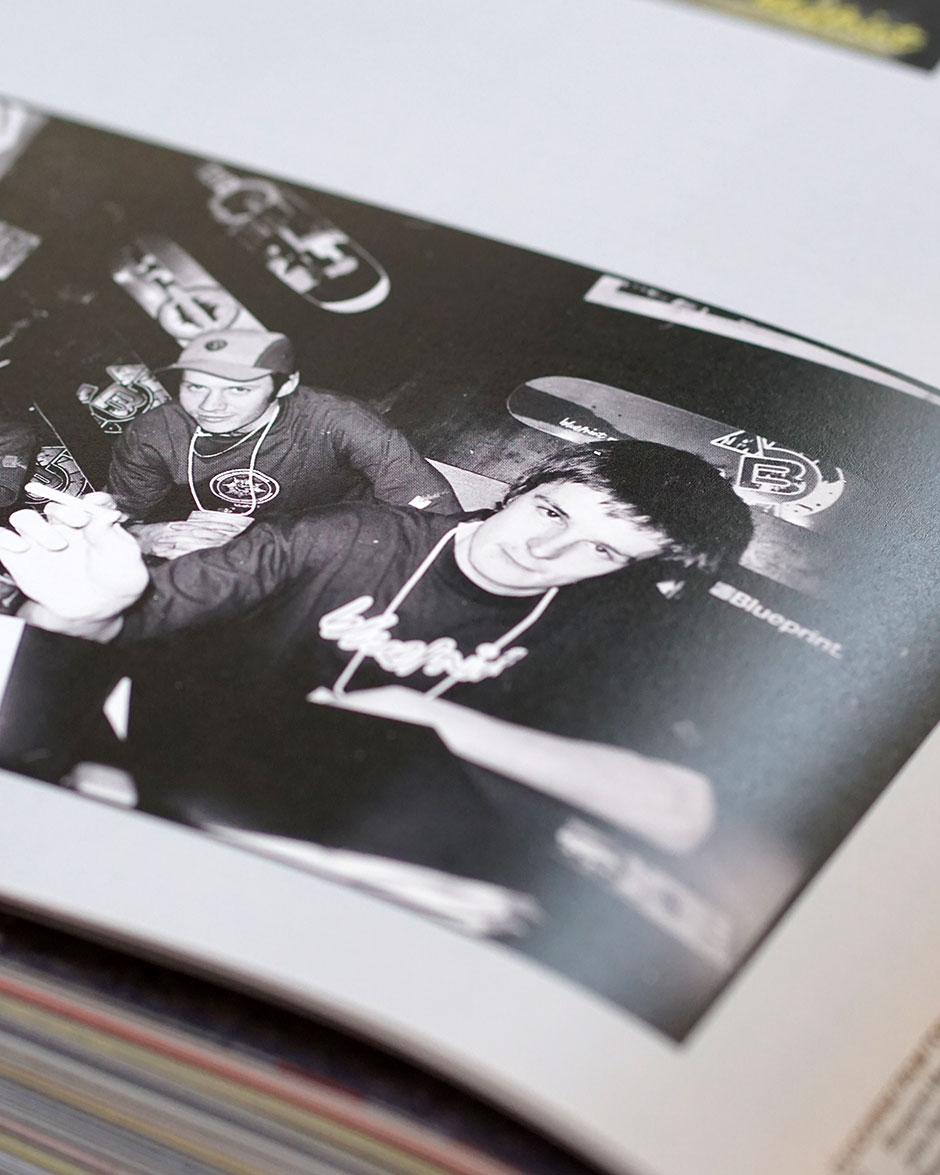
Paul Shier and Colin Kennedy repping Blueprint at the ASR trade show. PH: Richard Hart
I think most people who are in the book for more than a few years could talk at endless length if you were to prompt them. There was a lot of prompting with people. Like the Wig thing, or anybody saying, “Oh, you’re speaking to him? Well, make sure you mention this.” And then I would mention that, and the person would be like, “How did you know that?”, or “I’d forgotten about that”. A couple of people said, “You know more about me than I do”. That’s just because I know more about them in the era of the book, because I’ve read all their interviews, and spoken to all of their mates, and in the meantime, they themselves have gone off to do something else. They’ve gone and got a job, and they’ve forgotten about that stuff. They were busy doing it. There were so many people talking about Mike Manzoori’s skateboarding. And I don’t want people talking about skateboarding because photographs can do that, but there were certain spots, or certain tricks, that it was worth asking Mike about. Those were the points when Mike would be like, “Oh, yeah, I don’t know, I just turned up and did it.” He’s so humble, obviously, he’s a brilliant guy.
Talking of Blueprint, the book does a great job of marking the Build and Destroy 411 moment as a turning point. It’s interesting that the sort of tough love motivation techniques, Dan’s well known for dishing out, kind of work on him in reverse, because that was a real sort of all hands on deck moment that lit the fire for the video that arguably changed everything afterwards.
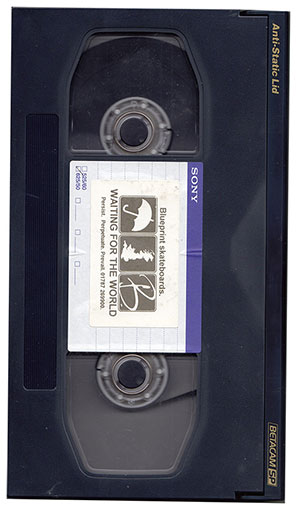 Never thought about it like that. Brilliant, absolutely. Totally, Dan saying to people, “That’s not good enough”, then it appeared that 411 were saying to Dan, “That’s not good enough,” and his reaction being, “I’ll show you!” I don’t think I’d ever considered that connection. But yeah, Dan’s clear that when that industry part got knocked back, it was like, “Right, it’s on! Fuck everybody, let’s make the most outstanding video.” And yeah, he came through, that’s a good point. It was important as well to have Chris Ortiz address that moment, not just having people saying, “Oh, that sucks, we don’t know why that happened.” Let’s find out, and have Chris Ortiz get the 411 side of things across. Waiting For The World’s got plenty of pages in this, people talk about Dan’s filming, and Dan talks about people’s skating and how people were, and it’s just great for me to see all this come together. Dan sent the master tape up of Waiting For The World as well, so I might do a premiere, I need to do a premiere in Sheffield of that, maybe. It would be good, a 40-year anniversary.
Closing the book, I guess you’ve got Waiting For The World, and then the continuation to First Broadcast, which is the video that sort of galvanised UK skateboarding in one place.
Yeah, it felt like First Broadcast had pretty high production values, and having everybody involved, it was clear that these brands, these company people, these skateboarders were friends. Obviously, Vaughan went from Unabomber to Blueprint; it started to become more of a single entity, maybe, than things going off in different directions. Although that said, Death skateboards existed, and continues to exist in a different lane entirely. Heroin’s now a kind of US thing, of course, but we haven’t mentioned Death, and I think Death is an amazing example of doing it for the love, and just like Nick Zorlac says, maybe his first line in the book is, “We didn’t expect this stuff to sell. We were just doing it for ourselves, for our friends.” But, it turns out people like it when you do something that’s relatable, when you do something totally uncommercial for yourself and for your friends. It’s admirable, and Death to me, now, is exactly the same as it was 30 years ago.
“It turns out people like it when you do something that’s relatable, when you do something totally uncommercial for yourself and for your friends. It’s admirable, and Death to me, now, is exactly the same as it was 30 years ago”
Hanging out with Twiggy at the New Balance demo it’s just like. “Oh my god, you just are Dan Cates.” It’s like he’s the new version, but not in a derivative way or anything. It just happens that these very unique people can find each other, and if they all happen to live in the same part of the world, that definitely helps, but it’s like Twiggy is the absolute epitome of a Death skateboarder, and it’s 2026. It’s just still got such an identity, it’s got such a realness to it, and you absolutely can’t knock that. As far as I’ve noticed, they’ve never changed their lane, they’ve never tried to do anything that’s not Death-like. With Fos as well, and Heroin, with these giant egg boards and everything, that’s what Heroin should be doing, that’s what they exist to do. It’s amazing, and both those things came out of you know, probably just spending all your gyro, all your dole money on getting some t-shirts printed or something, or trying to get ten boards made or something. But now, they still exist, and they exist on that kind of professional level now.
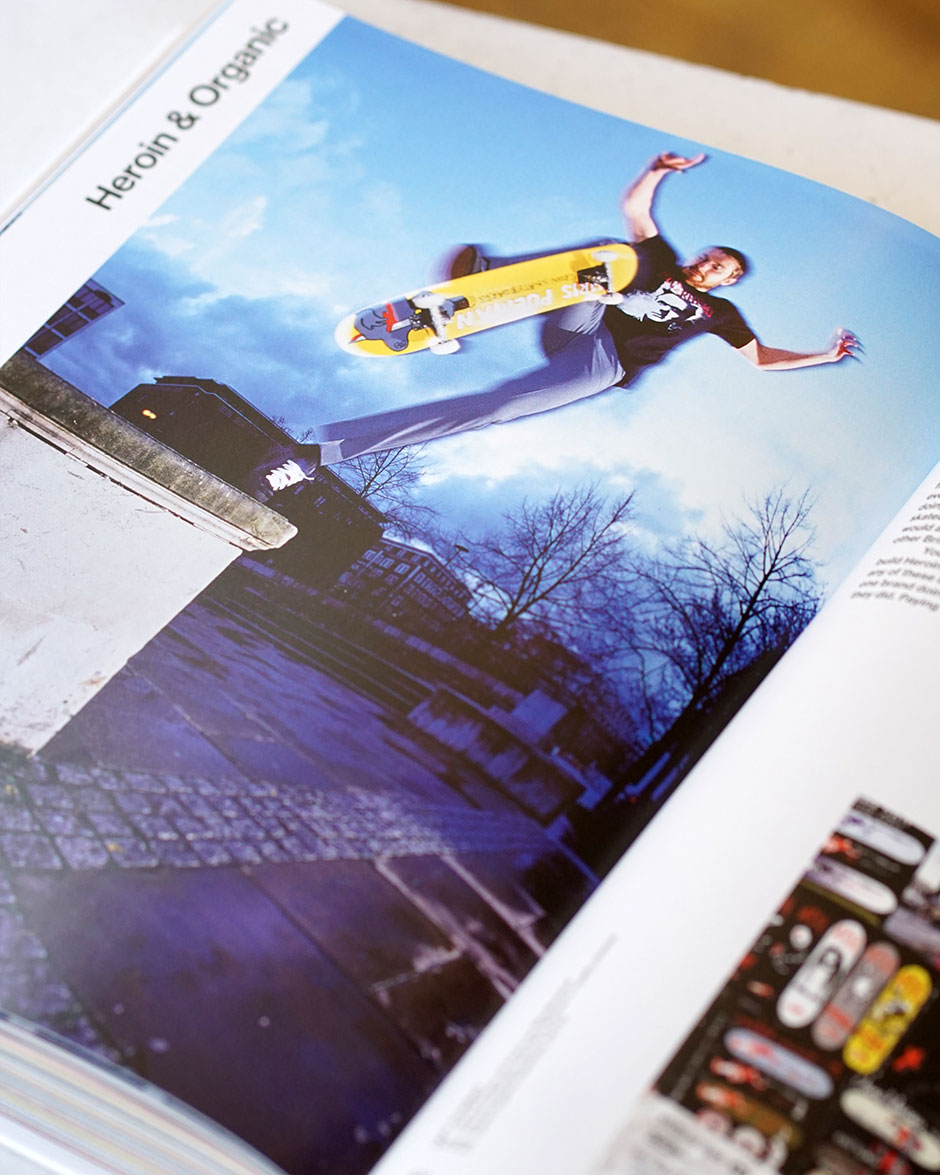
Chris Pulman on the pages of ELSEWHERE, a St Paul’s no comply for his Heroin ad. PH: Wig Worland
It all goes back to that DIY ethos, Fos starting heroin, or Nick starting Death, and figuring things out sort of product to product. Cates is a great ambassador of that as well. Obviously he loves American skateboarding, but what we see is his sort of interpretation of that, taking inspo from it, not just mimicking it or cosplaying it.
Totally, just all being themselves, and who that is happens to match up with who they all are. It’s like a gang, isn’t it? And yeah, Cates might be more Tim Jackson than Guy Mariano, and that’s a good thing, he should be, it needs that. The world needs Death and obviously needs Heroin, and it needed Blueprint, and Blueprint changed everything. It needed ‘Bomber at the time, and Insane, and Deathbox, and Bash, and all of these things that either just exist as a legacy or went on to become other things. These things were started in an uncommercial way, with probably very little optimism as far as what they could become.
And they are all inherently British in completely different ways. Speaking to Dan the other day, he was saying that Big Spin was kind of the opposite of that, pretending to be American in a UK market.
Yeah, we had that conversation the other day as well. It had a US address, and it had an ad shot at Huntington Beach High School. It was just fake American; even the guys on the team were told it was American. It wasn’t until that ad, with blatantly Alvin in it, came out that they kind of figured it out. I think that’s such a great point, a great example, it’s like you couldn’t be a UK brand, you couldn’t do it, or you couldn’t be another UK brand. But then Jeremy Fox and Ian Deacon certainly note that when they moved to Huntington Beach in 93, then shortly after Panic was able to begin, would you have done that if we were still here? And yeah, potentially not. And just as an aside, Deathbox did not turn into Flip. Deathbox turned into DB, Bash became Flip.
“Deathbox did not turn into Flip. Deathbox turned into DB, Bash became Flip”
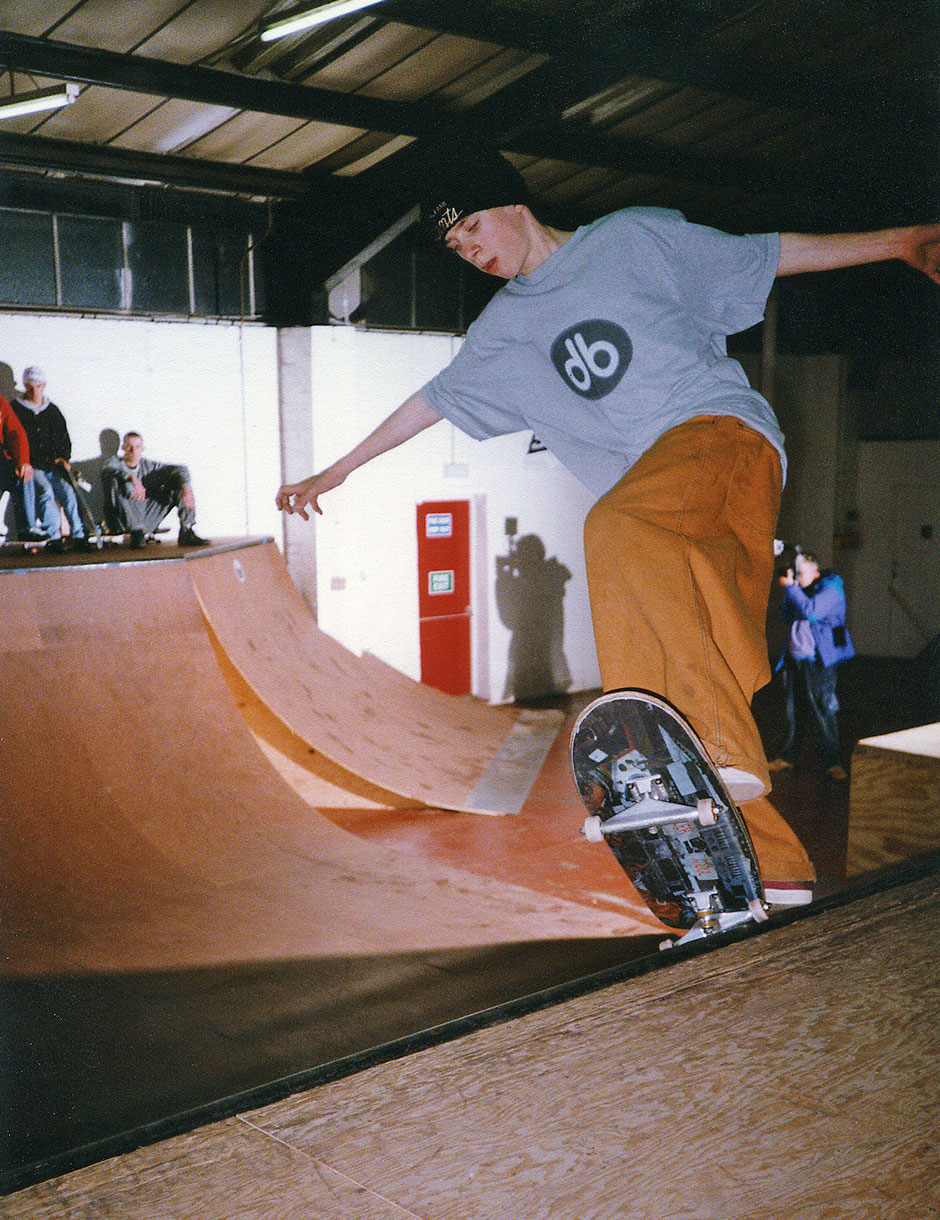
Tom Penny repping DB in mayday on the Radlands mini in 1992. PH: Jono Atkinson
You’ve got a picture of Tom Penny in the book, skating a mini ramp with a DB shirt on.
Yeah, he was on DB. He had a board on DB, and DB existed when Flip existed. The first Flip team was Christian Heitmann, Sami Harithi and Luke McKirdy. I think they had wanted Tony Luckhurst, but didn’t want to annoy Shane O’Brien, because he was Santa Cruz European TM. So they didn’t take Tony, even though it was announced that Tony was on. But Flip was this other thing, and then that team ended up not being the team at all, of course, then they eventually moved the DB people over to Flip because these things both existed at the same time. Even Alex [Moul] and Tom in the book talk about Death Box turning into Flip. It’s like, “Actually, can I stop you there?” But yeah, I mean, to all intents and purposes, it did, it more or less did, but it didn’t actually happen the way that people remember it.
It’s also really interesting, going completely to the other end of the book, the rise of Reaction, and the popularity of that essentially being its demise because of it being a conflict of interests, and it taking away sales from the distro.
Yeah, and bear in mind as well that New Deal UK had to start up Warrior distribution so that they could do Lakai because Lakai were concerned that them being distributed by the same people that did DC would be detrimental. So they had to start another brand to do that. So, things were getting complicated there. It’s debatable how much Reaction board sales were cannibalising World Industries sales or something, but you can see from the point of view of being a distributor, you want to keep your brands happy and on board. So having your own brand might not be the way. It’s not like Ray and Gary were these sort of happy-go-lucky hippies. Wig had to go into the New Deal office every month with proof of how much coverage their brands were getting in Sidewalk. In terms of ads, obviously, but also editorial. It’s like, all right, we’ve got this eight-page tour article here. We’ve got the competition here, we’ve got a photo of this guy here. That was just to make sure that the mag was possibly weighted towards New Deal UK brands. That’s how huge they were, although they did open in Nottingham in an attempt to knock Rollersnakes out of the game, and failed at that. Rollersnakes are still here, of course.
“certainly in the UK people became happier to own, and to back, and to buy UK stuff. It didn’t feel like it was a sort of budget version of the American stuff anymore”
I hope none of this reads as spoilers for the book. It’s a whole complicated tale, but all of these things that you’ve just spoken about are things which happened because the popularity of UK skateboarding was beginning to maybe not rival, but make a dent in what the US brands were attempting to do, or hoping to do here?
Yeah, certainly in the UK people became happier to own, and to back, and to buy UK stuff. It didn’t feel like it was a sort of budget version of the American stuff anymore. That was on Magee and then Pete Hellicar to have these brands with a uniquely British identity, and for us, the market, the skateboarders to be enthusiastic about that, and to want to back that. This guy’s skating in the wet, this guy’s having to wear a jacket, that’s like me! This is cool!
I suppose it’s undeniable that Eastern Exposure 3 was massive; it’s funny, Eastern Exposure 3 and Mixtape made me appreciate UK skateboarding even more. These are East Coast videos, and the East Coast is cool as fuck, but yeah, you can skate at night, and it is fine. You can look really cool. We can look cooler than those guys in Southern California easily because we’re wearing a North Face, a beanie, and big, thick cargo pants. That kind of emboldened the UK, I think. I don’t think there are many UK people who would say that they felt disconnected from what was happening on the East Coast of the US. You can be a fan of everything that’s happening in the West, but it did, and still does feel like one step further away. It feels like slightly alien.
Dan’s videos did a great job of highlighting that, sort of hammering home that these spots are not ideal, and then obviously the filming is good enough to show that.
Yeah, or you’re hearing the cracks, hearing in the slabs wobble. It’s like these places are not LA; these are potentially hundreds of years old, you’re skating over cobbles.
“you’re hearing the cracks, hearing in the slabs wobble. It’s like these places are not LA; these are potentially hundreds of years old, you’re skating over cobbles”
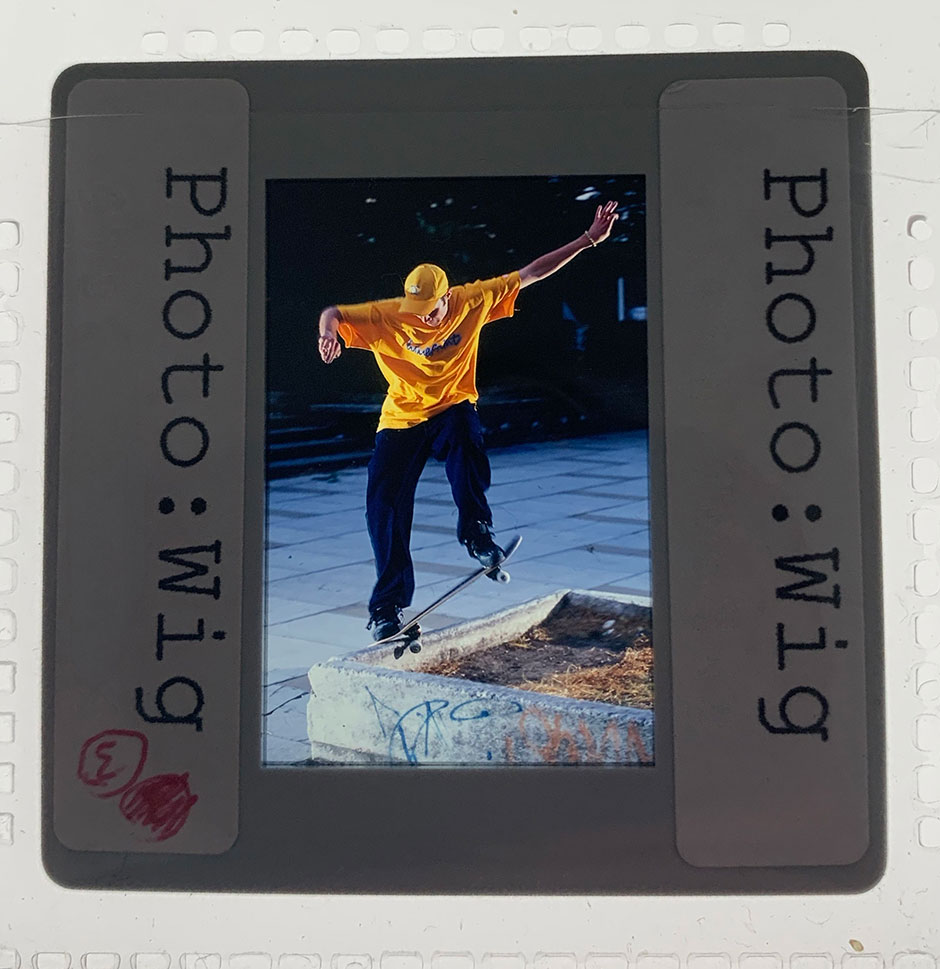
Paul Shier showing the world Fairfield Halls, an original Wig Worland slide
Fairfield is a good example of an imperfect plaza with a minefield of cracks.
That’s what I was thinking of. People had probably seen [Paul] Shier’s footage, and then showed up there thinking, ‘Cool, I’m going to get this and that’. No you’re not, you need to skate this every day for a very long time to know how to navigate it. It’s like Livi when demos would come to Livi and get out of the van and be like, ‘Right, let’s go, let’s go. Oh, wait, what, really?’ It’s like, yeah, that’s right, this is difficult. John Cardiel and Grant Taylor stand out, Bob Burnquist, but yeah, there aren’t a lot of people that can just step out of the van and skate Livi without having skated it before, or at least having been given a heads up that it’s a bit rougher than it looks.
It’s amazing to see in print the relevant people getting their flowers for not so much changing the game, but creating it.
Yeah, there are people who didn’t get enormous amounts of coverage, but were hugely inspirational. Ben Jobe and Toby Shuall spring to mind, probably because I’m talking to you, but it wasn’t necessarily always about the people who were the best at landing tricks and rolling away clean. It was people who were part of the scene who had so much to do with making things happen, inspiring people, and getting things done, and it’s the voices of these sort of background people. You mentioned Nik Taylor, he had a couple of photos, but the amount of other things he did was amazing. And the way he can speak about these things, the amount of other people who mentioned him, it’s like this guy’s a massive part of UK skateboarding, but there was very little coverage of him.
Really good skateboarder as well.
Of course, yeah, totally, but there was not an awful lot of cause to have him in the mag all that often, even though he was doing all this other stuff.
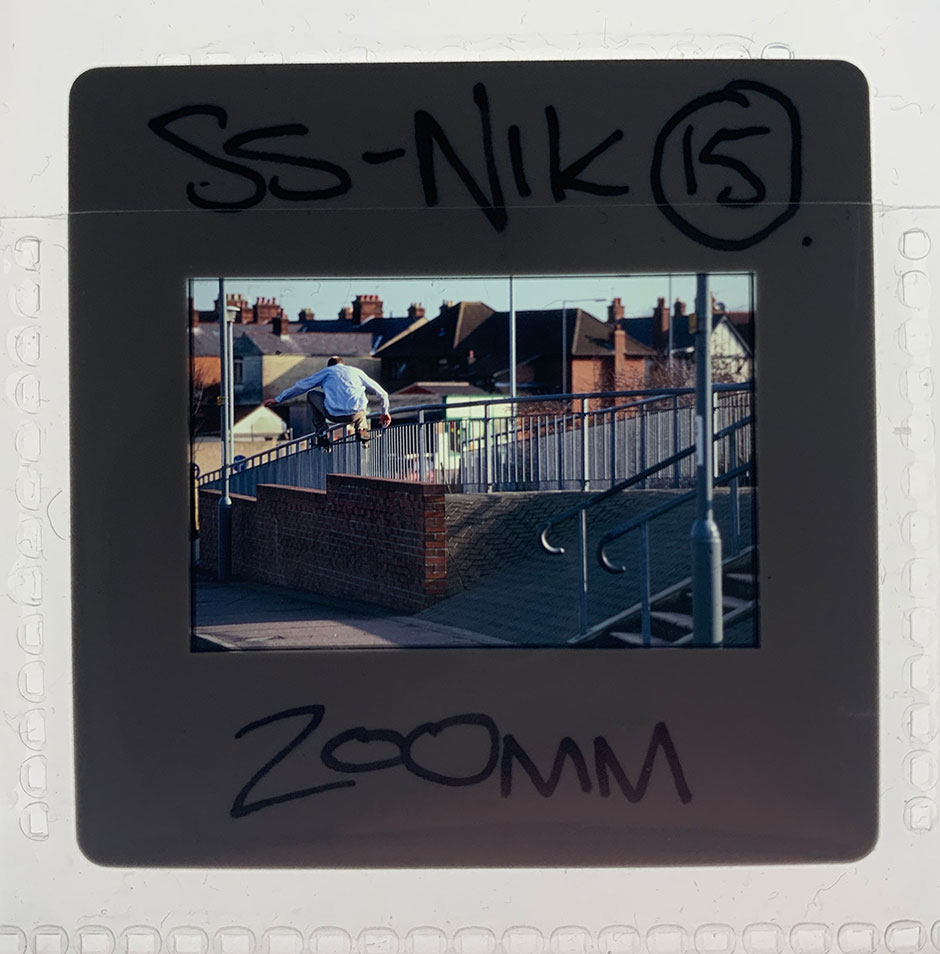
Slide from Wig Worland’s archives of a Nik Taylor ollie out of a tight spot
He was making those articles, and he was giving other people shine. Picking people from London and saying we need photos of different people. That 10 x 10 article was an example of that. That all came from Nik, I think.
Right, yeah, he was totally in the thick of it, like right in amongst it, but not in the limelight.
Working in Slam and trying to lay out Sidewalk while serving customers at the same time.
Yeah, and balance the politics that were going on, no doubt, between those two things. There are a few of them. Jonny Robson again. There are quite a lot of people who were frantically doing very interesting things behind the scenes that never got the coverage.
Before closing, let’s talk a little bit about Peter Lee’s involvement. It’s rad that a Fairfield style-master with some niche skateboard archives of his own helped facilitate the book.
Well, Ray Calthorpe was the first person I spoke to. I had arranged to meet Ray, who’s a mate anyway, I was just meeting him for dinner on a trip down to London, and between organising the trip and meeting Ray, I decided to do the book. Ray ended up being the first interview, or it was literally just a recorded version of the sort of conversation that we would normally have. Nick at Palomino was going to put the book out at first, but at least a couple of years later, the book grew into this thing that was a bit bigger than I think what Nick could offer. I love Nick; we’re still great friends, no problem there, but it sort of outgrew what could be done.
Then I thought, right, I need to get an actual publishing deal, probably, somehow. I Googled it, and I learned that you don’t just approach a publisher; you need an agent. So you need to write a letter to an agent, and they’ll go and approach the publisher. I think I’d mentioned this, or talked about this in passing to Ray Calthorpe, and he says, “Ah, I don’t know why I didn’t think of this, my mate Pete works for a publisher. He could probably tell you what to put in the letter to the agent.” So the next time I was down in London, I arranged to meet this guy, Pete Lee, just for a pint at lunchtime, and I started showing him some of the photos that were in the book and telling him about who’s been interviewed, and my kind of plan for it. About an hour passed, and he was about to go back to work. Rather than advise me on how to approach an agent, he said he thought “This could be one for us”, for Batsford Books. He said he’d go back to the office, and he’d speak to the boss, and stuff.
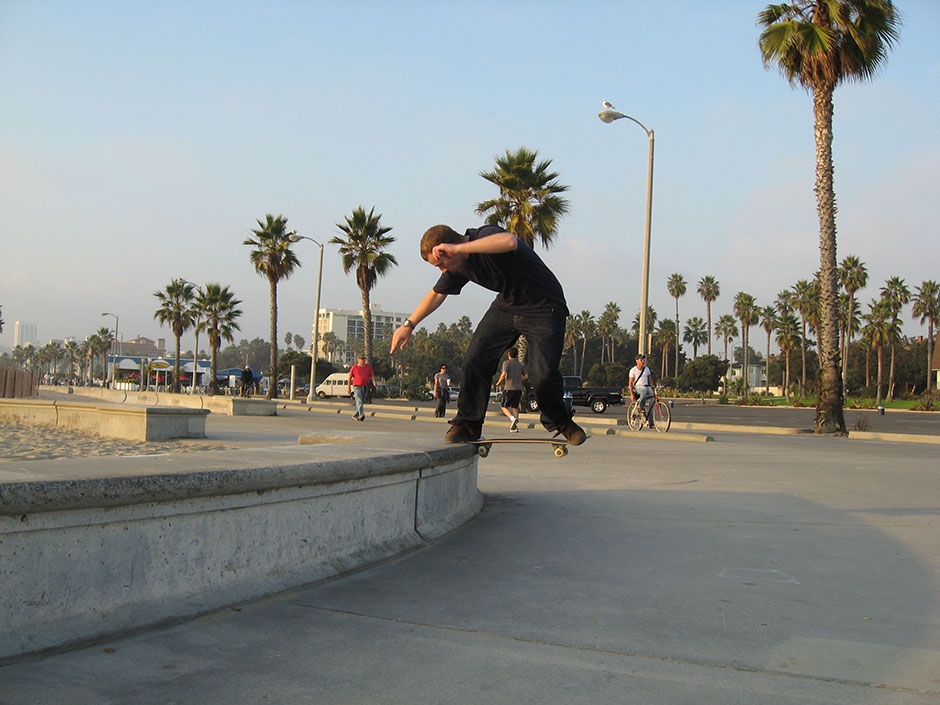
From Croydon to Venice beach. Peter Lee frontside noseslides, Paul Shier shoots
Then the next time I was down was part of the London Calling thing. I had just done the panel at UCL, and I had to skip out of that early to go out to Hackney to meet Polly Powell, the MD of Batsford Books. Polly’s dad was Geoffrey Powell of Chamberlin, Powell and Bon, who built the Barbican. She’s a brilliant, fascinating lady. Pete basically said, “This is Neil, he’s got this book about UK skateboarding, but it’s not a photo book.” So, I explained to her my plan for the book. She’s drinking wine, and I’ve got a beer in this jazzy restaurant, and she’s like, “Right, so let me get this clear. This isn’t a photograph book. This isn’t a book about skateboarders skateboarding. It’s a book about skateboarders”. That’s exactly it. What a great way of putting it. Then she was like, “So would you be happy with an advance, and we’ll give you this much on this day?” It was like, wait, this has just happened? This is it? “Yeah, just make this book.” A couple of days later, I got this e-sign thing, here’s your contract, let’s go. So I certainly didn’t need to shop it around or anything.
“Right, so let me get this clear. This isn’t a photograph book. This isn’t a book about skateboarders skateboarding. It’s a book about skateboarders”
But having Pete there was great. Pete does sales at Batsford, but he’s basically done everything because he knows the content of the book, he gets it, and Tijl Schneider is the designer. He’s a brilliant, brilliant designer, and obviously also a skateboarder; he grew up skating with Mike Degeus. So he knows, he was all about UK stuff because in Europe it was easier to get a copy of RAD than it was to get Thrasher or Transworld. So yeah, with the three of us, it felt like a pretty good team getting the thing actually made once the door had closed on adding any more content to it.
Pete has been an absolutely brilliant help, especially with speaking to Curtis McCann, because Curtis looked up to Pete and Ray when he was a little kid skating at Fairfield Halls. Pete still lives in Croydon, and Curtis is still in Sutton, so Curtis was always wanting to check his stuff; he would just want to double-check everything all the time. So Pete would drive to his house and show him everything on his laptop, I guess, on the PDF. And yeah, just be able to talk to Curtis, who isn’t always super keen to talk on the phone. He likes emailing and texting, but if it’s something that goes a bit beyond that, then Pete had that, and Curtis respects Pete. That was really helpful having Pete there for that, and for everything. Pete knows all about books, the publishing industry, and skateboarding, and as you possibly alluded to, he’s got one of the best sticker collections out there.
And the fastest half cab flips in the business.
Ah, amazing, nice. I do like a half cab flip.
Talking of which, at what point did you decide not to put any trick names in the book?
Pretty early on, I think, because I wanted to have, in terms of the credits, the photo credits needed for the person, the location, and the photographer. That’s already quite a lot. When I’m on a world limit, that’s the essential stuff. Also, there’s a bit of a kind of blurred line. Would you put ollie, or would you put tweaked ollie? Would you put backside tweaked ollie? Where do you draw the line? I never really liked it when the magazines would get too elaborate with the trick in the captions at all. There’s a photo of Colin Kennedy doing a kickflip, say hypothetically, and the caption would say something like ‘Colin Kinetic’s Irn Bru-fueled tartan legs take a kickflip over some medieval cobbles for a ride’ or something. It’s like, what? ‘Colin Kennedy, kickflip, Andy Horsley’ would be fine. I can see the picture, and if you know what the trick is, then you don’t need a caption, and if you don’t know what the trick is, then you don’t need a caption. It doesn’t matter. Something Tim Leighton-Boyce said to me once, I don’t think this is in the book, I think this was just kind of in conversation, but he said, “I didn’t shoot tricks, I shot movement and colour.” So, he doesn’t know what that person’s doing; it’s taken somebody else to say, “Hey Tim, turn around, point your camera at that guy, that’s the guy doing the good stuff.” And then he would take these outstanding, incredible photographs. If he doesn’t care what the trick name is, nobody should. Maybe it would be good to have switch in it if it is switch, but I think enough time has passed that these photos can exist as a snapshot of a moment.
Their own moment.
Yeah, I feel like it doesn’t matter. You can see what the trick is, and if you don’t know how that guy got up there and where he’s going, just enjoy the picture for the colours and the composition.
It’s probably counterproductive to the story as well, as it then becomes its own story separate from the story.
It makes it feel more like a reference book, or a photo book, and it’s not. This is a photo of Mike Manzoori; that’s what matters. You don’t need to put ‘backside 50-50’. It’s fine. That’s secondary to the fact that it’s Mike Manzoori and that it was shot by Wig.
Well, Neil, I know we could talk in circles about a lot more stuff, but let’s wrap this up. It’s a Bank Holiday, your end. I’m sure we’ll do something similar again at another point in the future. Thanks so much for the book. Is there anything else you’d like to say before we send people in the direction of getting their own copy?
Massive thanks to everybody who gave their time, their words, their thoughts, their photographs, or their artwork to the book. It couldn’t have been what it is without the contributors. Thanks especially to Wig Worland for being there every step of the way, and opening up his entire archive – which is way more than was in the magazines – to me. Massive thanks to Pete Lee of Batsford. Massive thanks to Seb, Mackey, Baines and Woody at New Balance for moral support, help with travel and letting me do a shoe. Thanks to Sofia at Aries for hosting pre-launch party and making the t-shirt. Everybody that’s helped this, every shop that’s ordered it, everybody that’s taken an interest in it, and to the people who are buying it. Special thanks to Wig Worland and Dan Magee for agreeing to be involved in the first place, because if those two didn’t want to be in it, it’d be impossible to properly tell this story, and for all their help along the way.
It exists because I wanted it to exist, I wanted to know these stories, and it’s great to know that other people care as much as well. So yeah, just thanks to everybody involved and everybody who will be involved by even just looking at it. Thanks to you, of course, for this and for the years of moral support.
More than welcome. It’s been nice watching it happen.
Yeah, I’m glad that it has happened.
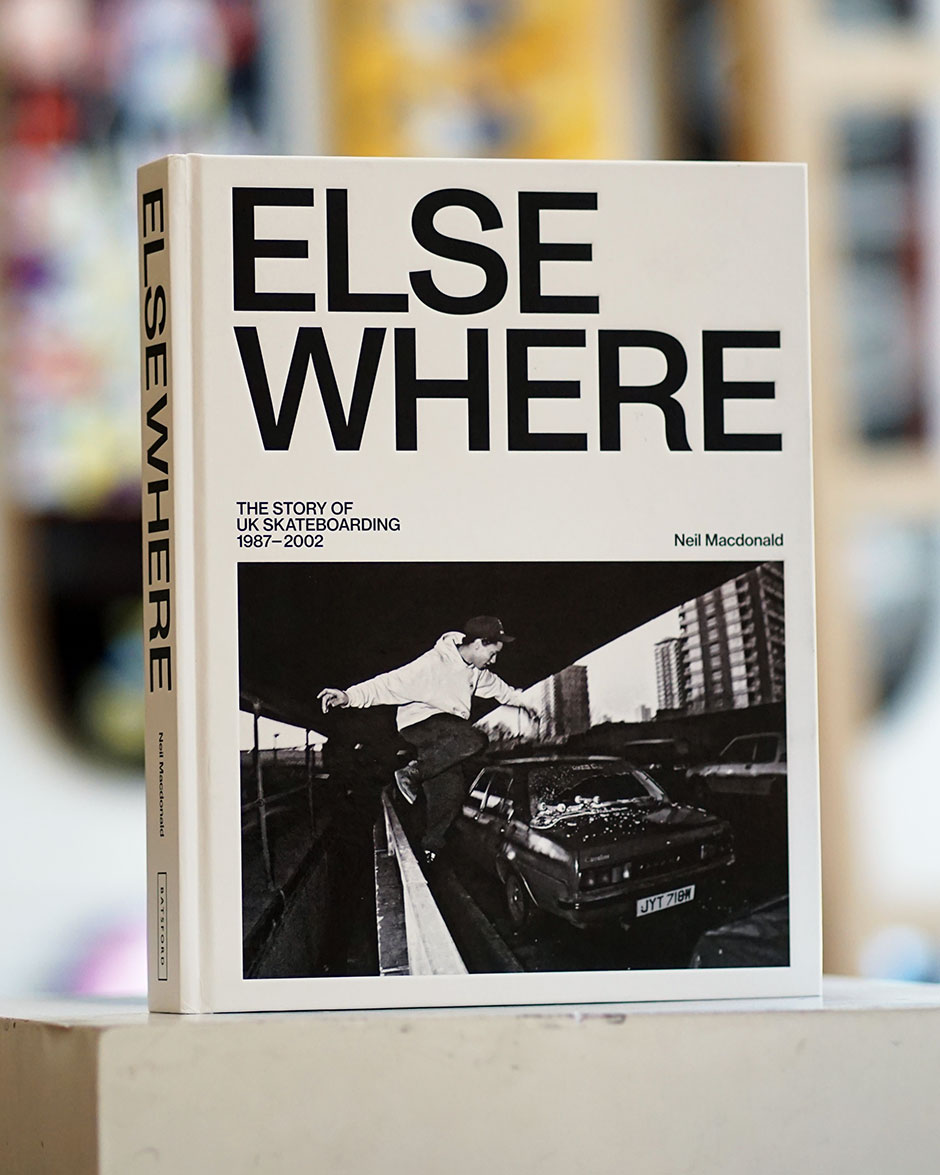
We would like to thank Neil for all of the time he has taken, both on the interview itself and supporting us with assets. We would also like to thank Wig Worland for his many contributions that furthered UK skateboarding, and the moments he has allowed us to share here.
Buy Neil Macdonalds book ELSEWHERE.
Read our previous conversation with Neil: Neil Macdonald Interview