

Our latest interview is with Chris Pulman, and it’s our deepest dive yet. This career-spanning conversation covers a lot of ground and brings us right up to date. Enjoy learning more about someone whose contributions to skateboarding have been delivering for decades, and continue to evolve and inspire…
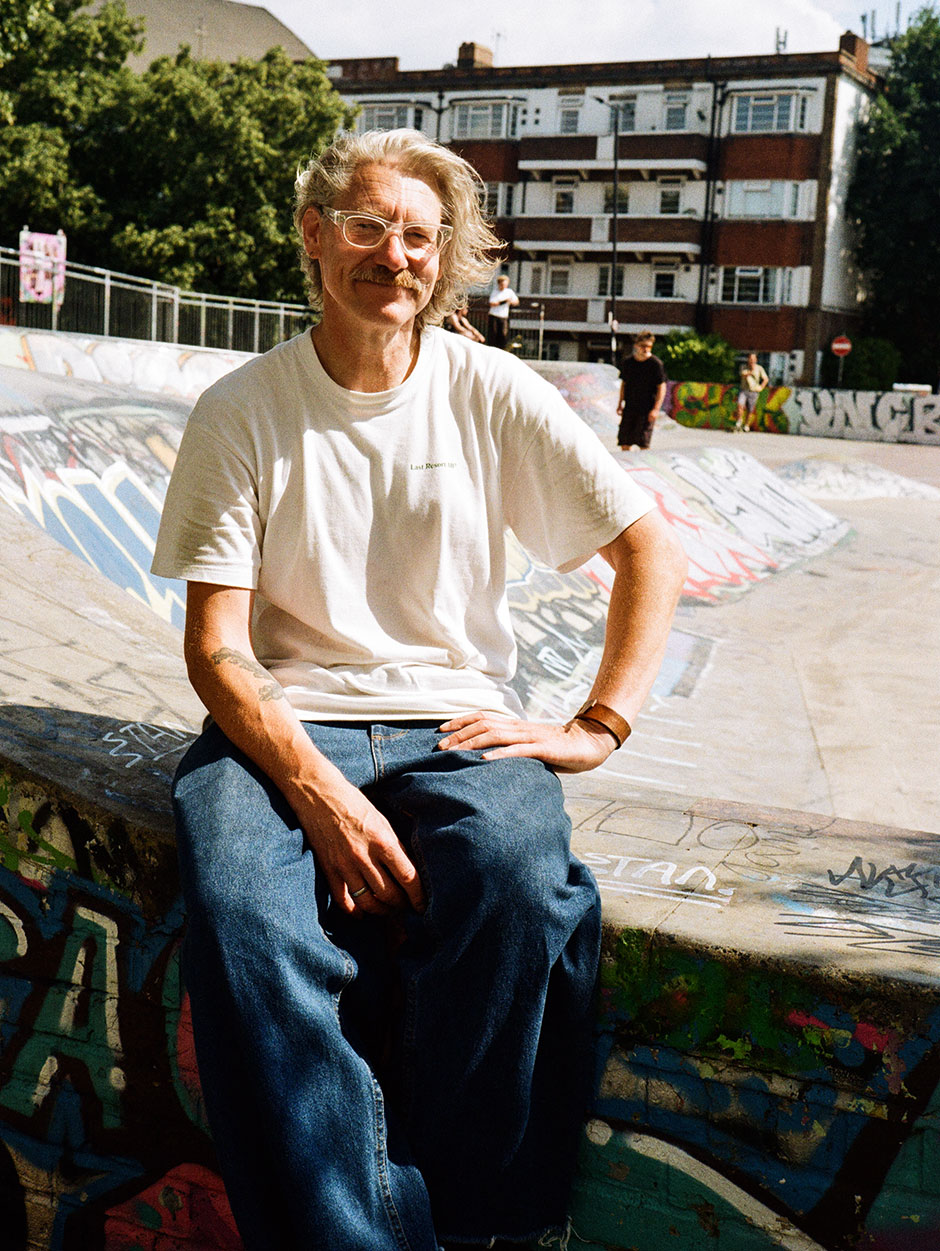
Words and Interview by Jacob Sawyer. Chris enjoying another day at Stockwell. PH: Tom Delion
You can check out an audio version of this article on our Listen In podcast. Available on Apple Podcasts, Spotify, and all other major platforms.
Chris Pulman is one of a kind, a dear old friend we have enjoyed working with over the years, whose output continues to connect with new audiences, young and old alike. Our most in-depth interview yet is extensive for different reasons. Chris has never stopped skateboarding since he stepped on one, and during the decades of dedication, he has done a lot more than most, from managing Slam during a booming period of time, working in the industry in different roles, turning pro, starting his own company, and turning pro once more years later. It’s not your average story; many eras needed attention, and unlike most career-spanning interviews, which close by looking back through rose-tinted glasses, this one finishes looking ahead as the pages of a new chapter leaf open. Chris is squeezing more joy out of his passion than ever before, and those clips keep coming.
We were thorough when approaching the story, and sure to acknowledge the many philosophies at play. Chris is a deep thinker, dissecting his feelings about our culture the same way he takes apart tricks, and there are a lot of gems in here. Also, despite many years of Shoo Goo inhalation, he has a keen memory, which makes for good reading. His story begins with a family trip to Cornwall, where a blue complete with a Ninja on it accompanied him home to Maesteg in Wales, and the neighbouring town of Bridgend would play host to his progression. New friends opened his young eyes to Powell videos, Swansea, and the West Cross park vert ramp, and a path arose he hasn’t deviated from since. His origin story involves many milestones, from the videos and music he was exposed to, and the boards he had, through to finding fellow Welsh legend Matt Pritchard to be a kindred spirit. His early days are expanded upon in much more depth in the Listen In audio version of this interview, which will closely follow this being published.
We jump into our conversation by dismantling the learning process behind Chris’s first no comply, a signature move he does like nobody else, which is inextricable from his career and appears throughout. What follows are the key moments that led him to manage Slam City Skates, beginning with a university degree that made Southsea a training ground. We discuss magazine appearances, his first eye-opening trip to the USA, and all that entailed, and eventually the move to London, where so many other prospects materialised. Read on to find out much more about a unique and fascinating experience within our culture, his years at Slam, the early days of Heroin and his first instalment as pro, his life on video, how working for Jamie Thomas at Black Box arose, his return to Slam years later, the intricacies of starting his own company Descent, and everything in between.
What follows is a dive into more recent years, his engagement with our community on a wider level, and the positive impact opening up about his mental health journey has had, from his sMiLe film for the Ben Raemers Foundation to the many messages his posts have prompted. We talk about the viral clips that have reverberated around the internet since a serendipitous trip to Sheffield, and some of the new hardware and footwear upgrades which have improved his roll, and prompted new missions. We also explore the pure joy of fathering with skatepark tourism in the mix, and much more. Closing out our conversation is an announcement of our own, welcoming Chris back to the Slam family in a different capacity. We’re proud of this one, and hope you enjoy the ride as much as we did…
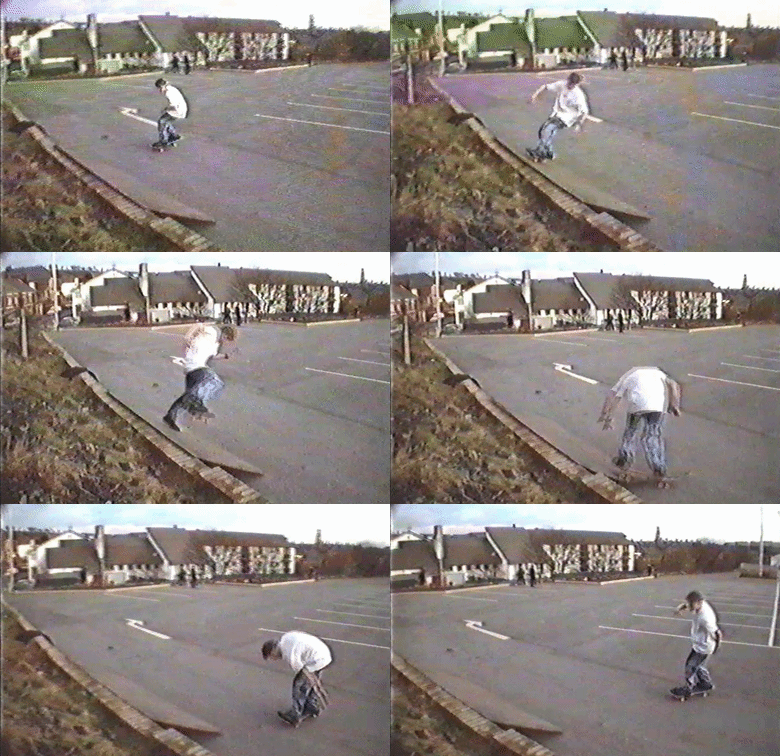
Some early evidence of a Chris Pulman no-comply in the wilds of Wales circa 1990
Was it a no comply in real life or one on tape that sowed the seed of this move becoming a lifelong companion?
I think Public Domain had been premiered, and everybody ordered their copy. Mine finally arrived, and I went home from school on a lunchtime because I lived near school. I had half an hour to watch the first half of Public Domain. I watched the first half of it in my lunch break, went back to school, rushed home, watched the rest of the video, and went straight out skateboarding immediately. I’d seen Ray [Barbee] do a 180 no comply in this video. He obviously did all the other no comply variations, but to me, the key no comply to open up everything else is the frontside 180. A straight one doesn’t teach you anything; it just teaches you how to do straight no complies, but when you do 180s then you can learn shuvits and shifty’s and 360s. So I went out, and I was like, “Right, I’m gonna basically do a frontside boneless without grabbing it”. That’s how I pictured it in my head. I need to do a frontside 180 boneless on flat without grabbing my board because that’s what a frontside no comply is essentially, right?
So I stomped my board, and turned, and stomped, and turned, and stomped it. Then I figured I was going to have to commit and try to jump on this thing at one point. You know what I mean? I literally, incrementally forced myself to pop and jump. Learning the timing to pop, jump, catch, and eventually land a no comply. It was nothing like the way Ray was doing it. I wanted to do a frontside 180; even then, I thought this could be off the ground. It doesn’t have to be skidding across the floor; it could be clean. So I made myself learn it that day, the first time I saw Public Domain. That’s why it stuck, because obviously, Ray in that video was mind-blowing. He was a massive inspiration, as were all those guys. Ray was the one who stuck out, though; he just looked so good on a board. He made it look like more than just tricks on skateboards; he made it look like that’s when it becomes dancing, that’s when it becomes art, that’s when it becomes fluid. That’s when it looks good. Anybody can do a flip trick, but only so many people can do a flip trick and make it look like it’s easy and nice.
I don’t want to reference Marc Johnson necessarily, but the fact that I could take something that was in my imagination and then turn it into actually doing it meant a lot. If you can do that with that, then you can do it with anything. I think that was my first realisation that you could take a trick apart, build it, and learn it. People have different approaches; some people are more timid, some people are much more gung-ho. But I found my way of learning there, and it’s probably a model for me learning in life; it’s probably the same way I learn most things. I go off into a corner and take it apart. For me to know how something works, I kind of have to break it. I need to demolish something to know what the innards look like and then put it back together. I do that with tricks. I kind of break them down and take them apart to see what makes it work.
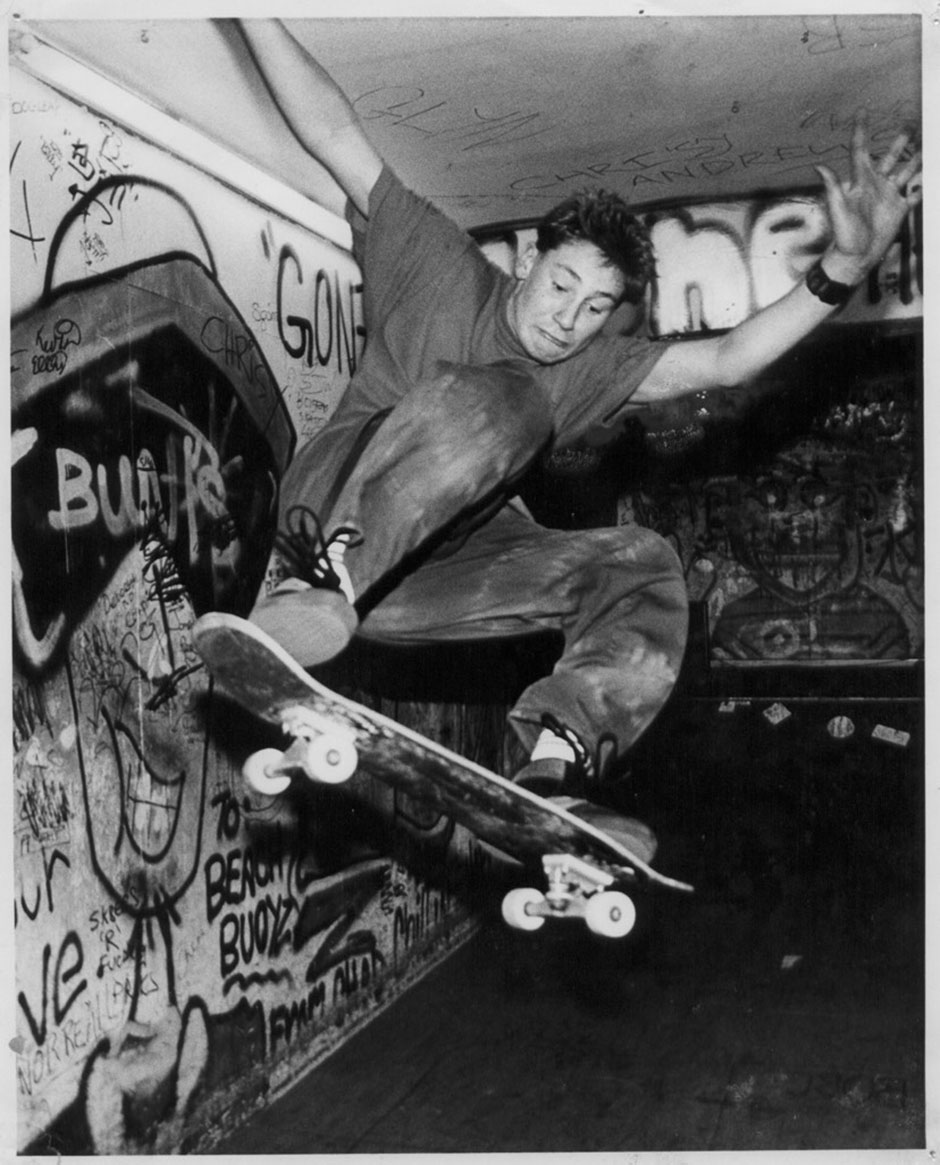
Chris floating a frontside ollie on the Port Talbot mini ramp. PH: Lisa Bowen
In 1992, you got a photo in Skateboard! magazine; how did that transpire?
Yes, it was the issue with Alex Moul on the cover at the ice rink in Oxford; he’s wearing a plaid long-sleeve. My photo is in the back, this little tiny photo. This was before I learned to drive. I went to Barrow in Furness, and I’m pretty sure I went with Andy Williams, who was a vert skater from West Wales who also lived in Manchester. He was a good vert skater who is not around anymore, unfortunately. Andy had a little Vauxhall Astra van, this little red thing, and we drove up to Barrow because they had a comp; it was a street comp. [Carl] Shipman was there, and [Geoff] Rowley was there, and it was really intimidating. I didn’t enter the street comp for some reason, but somebody entered me into the mini ramp comp. I tried to skate, and I couldn’t practice because it was so hectic. It was really hard; everybody was snaking on this mini ramp, which had a hip as well. The only time I got to really skate it was when they called my name for the comp.
So I dropped in and did all of my tricks, a 50-50, a crail slide, maybe a nosepick, and a fakie indy nose blunt, maybe a boneless, and some ollies. But I did my regular thing where I’d drop it into a 50-50, come back and do a new deal grind, then do another 50-50, and then do a one-footed new deal grind. I did that one-footed new deal grind in one comp run, and Kevin Banks got the photo. He was very kind, and he asked me what my name was because he really liked it. He made me feel like he’d seen something special that day, and he took time to find out my name. When it was printed, he actually put my name on it, even though I didn’t place in the comp. I was really grateful that he not only recognised it, and took the photo, but he bothered to get my name and do that side of the journalism too. As a kid, that could have easily been a postage stamp photo with no caption, couldn’t it? But he actually put my name, and that meant a lot. It just says Chris P, but that was good enough for me. That was a moment where it felt like somebody cared, so that meant something to me.
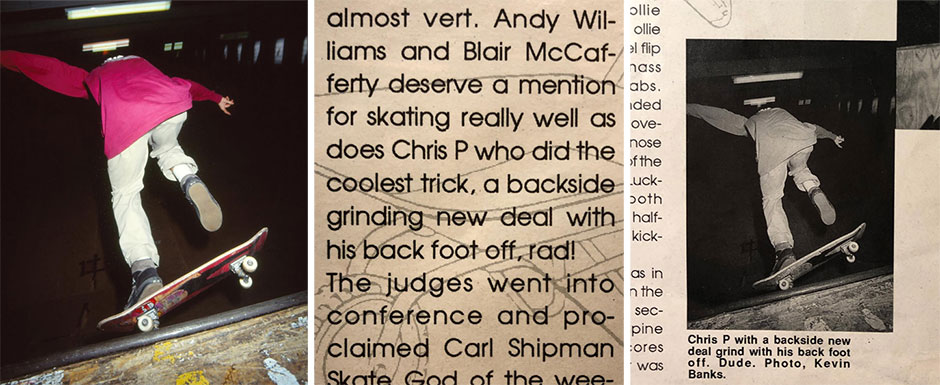
Chris caught mid one-footed new deal grind by Kevin Banks. This appeared in the April 1992 issue of Skateboard! Maagazine
Prior to that, you won another comp. What was the contest and what did you do to win it?
In 1990, Swatch watches were doing a big promo campaign because it was just coming off the 80s, and they were still trying to keep that 80s Swatch vibe going. They were sponsoring Rodney Mullen and a bunch of guys. They had this vert ramp, which was a pre-fab ramp they could put on the back of the truck and build quickly. They were taking this around the country and mainly to surf towns; there was a connection to surfing. So they had this Swatch ramp, and Neil Danns came, and maybe someone else. The local good skaters from around near us, like Greg Fabb, Jason, and Tomsk, were there, and maybe Skin [Phillips], and those guys helped judge this comp as well. I can’t remember exactly who the judges were. They also had this street area, which was built from local detritus, and they brought this to Porthcawl, which is a seaside town near Bridgend in South Wales, where there is actually surf. There are waves there, so it’s kind of rare. This quick street course had an upturned planter that was like a volcano. They dragged one of the seaside benches into the middle of it. They had a netball net, which is like a triangle, and then the post. They’d taken the net off and the backboard to make this down rail, which started at three feet and went down to the floor. That was it. They had the street comp, and it was like a freestyle comp. I think only four or five of us skated, two or three guys from Bridgend.
I had two runs, and I remember I did a nose pick on a bench, I did a backside bluntslide on the rail going down to the floor, which probably only slid a couple of feet, and then I did a kickflip shuvit, a varial flip because I had just learned them, and I did it first go. So I did a flip trick, and I used every obstacle. If you know anything about skating comps, if you want to win a comp, all you’ve got to do is one trick on every obstacle, and stay on. Back in the day, that would put you in the top 10 because everybody else would just be trying to land their gnarly trick, and then get zero points because they wouldn’t land anything. If you just skate every obstacle and land every trick, even if they’re basics, you get a high score. I didn’t know that strategy at the time. I just found it scary, but I did all my tricks, and it turned out that I won this competition. After they announced it, some girls who had just gotten Neil Dann’s autograph asked for mine. That was a trip.
Your first-place prize was memorable, too, right?
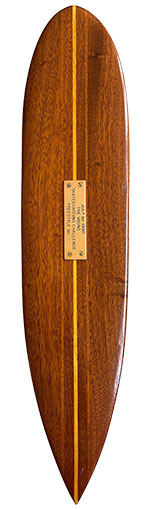 The prize must’ve been organized by the surf shop because it was basically a two-foot-long carved wooden surfboard. It has a concave to the whole thing; it’s curved. Somebody carved this with real love, and it’s got inlays, it’s got laminates in it, and it’s beautiful in a way. Then it’s got a brass plaque on it that says 1st of July 1990, freestyle, first place. So I’ve got this prize, and it came in a stripey duffel bag. My parents had taken me to this competition, and they’d gone off for a walk or something because it’s pretty down there. Also, it was hectic, and they probably weren’t super interested in skateboarding. When they came to pick me up, I showed the surfboard to my mum and said, “Look, I won!” She saw it, and she was like, “Did you steal that?” I had to convince her that I won the competition. Now that I’m a parent, I know how damaging that can be to a kid. When you take a massive achievement, and then instead of being congratulated, or even ignored, you get the exact opposite- you get accused of stealing. So that was weird, and probably if I ever went to real therapy, that would be something I’d be talking about.
This moment, and the mag appearance were portals of connectivity into another world, and that recognition wasn’t lost on you. Maybe this is a good jump-off to discuss your thoughts on sports, skateboarding existing in that world, and competitions.
It is a really good point because I did skate in a lot of competitions, but I also don’t like sport, I’m just indifferent to it. When I started skateboarding, competitions meant something different to me. There weren’t many of us around. It was an excuse to go somewhere, see people you hadn’t seen, meet people you hadn’t seen, and see good skateboarding. Skateboard competitions were essentially jams, weren’t they? There was no money, nobody went to win, I don’t think anybody really went to try to win, nobody went to win money, nobody went for glory. Maybe some people were thinking about being sponsored, but I don’t know what other people’s motivations were for competitions. What I do know is that I did go to a lot of them, and I do know that I entered a lot of them. Weirdly, I also know that I came first place in a lot of them. I won that competition, then I went to a comp at Wakefield, and I came first in that. I went to a Newport comp, and I came first in that. I went to a St. Alban’s comp; this was in 96, and I just stayed on, and I won that. I basically entered about six or seven competitions in my life, and I won four of them, so that’s odd if you think about it. From a competition point of view, that’s really strange, and they never did anything. It didn’t get me sponsored. It didn’t make me any money, nothing like that. So I can’t ever say I’m against competitions because I was involved in them, and I skated in them, and I had competition runs, and I placed well in them.
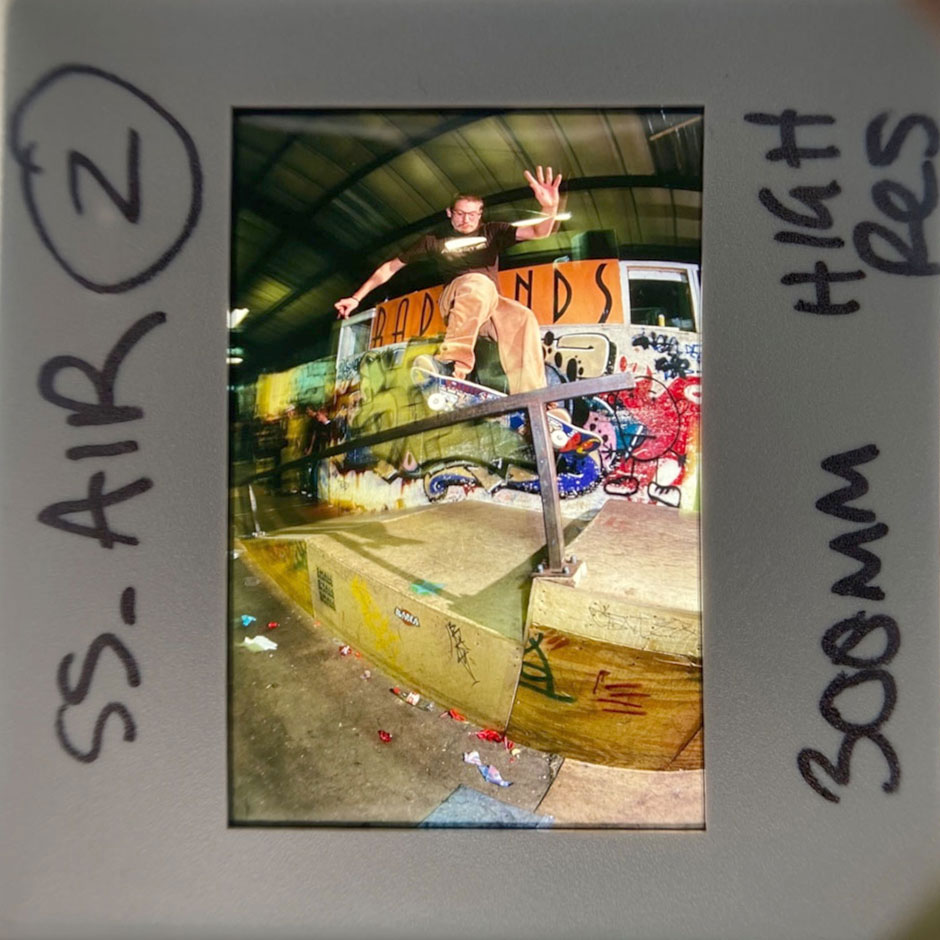
Smith grinding ascent at a Radlands competition many years later. One of Wig Worland’s Slides
Was that affirming for you, though? Did it change how you thought about or approached things?
Not really, because I knew what skateboard competitions were. They’re not skateboarding, are they? Really, they’re not. Skateboarding is skateboarding: rolling down a road on a skateboard- that’s skateboarding. Everything else- competitions, videos, photographs, everything else that happens is not skateboarding. It’s related to skateboarding, but the only thing that’s actually skateboarding is when you stand on it and roll along. Lots of other things get described as skateboarding, but they’re not. They’re talking about skateboarding, they’re photographs of skateboarding, they’re videos of skateboarding. For me, skateboarding is the act, so competitions are not skateboarding. The skateboarding is happening when I’m on my board rolling around. What I’m trying to do is separate from the two. Competitions for me were like a jam thing. Obviously, as time has gone on, skateboarding at some point decided it wanted to attract the mainstream. That’s a fact. It wanted to make more money, and there’s not enough people in skateboarding for lots of skateboard companies to make lots of money. If you want to make lots of money, you need to sell skateboarding stuff to people who don’t skate. That’s where skateboard t-shirts and skateboard shoes come into the mix. That’s where you get brands like DC taking off. That got big, right? DC got really big. And if you’re a shoe brand, a sporting goods brand, say Nike, or adidas, it’s very easy to see how you’d be quite worried that it’s going to take a significant market share from you. This new brand comes along, and it’s cool with kids.
I don’t think DC tried to make skateboarding mainstream. They were based in California, skateboarding was kind of mainstream there, and it was almost taken for granted. But I think other factors in skateboarding saw that skateboarding was going to attract the mainstream. They needed to be involved in skateboarding so they didn’t miss that mainstream audience. I think that’s the big reason why a lot of people, a lot of bigger brands that didn’t really, necessarily, have a strong connection to skateboarding, got involved because they were scared of losing a generation of customers. I’ve told this story about Nike SB over and over again, but if I worked there, it would have been what I would have seen. I would have gone into schools in the mid-nineties, talked to kids, and asked why are you wearing these shoes? They’re not skateboard shoes. The kids would have told them that they’re cool and that Nike was basically a jock brand. Nike would know they’re going to lose a generation of customers if they don’t fix this. That’s my theory of why Nike skateboarding came about. If that wasn’t their strategy, they really just got lucky, but I give them more credit than that. What I’m saying is that those brands, in order to make profits, they can’t just sell the skateboards. They need to have a larger customer base.
You need that logo presence in skate shops.
Yeah, you’ve got to get it out there, but what you need to do is realise you’ve got something. Skateboarding works, and you know that it has appeal outside of skateboarding, because you’ve seen DC do it and people like that, even shops like Supreme, and the appeal of streetwear. But what they really need to do is know their model; it’s sport. The thing with sport is that sport is very much not about doing sport. Sporting goods are not about sport. Selling a couple of tennis racquets and trainers, that is fine for people who do sports. That’s not your market, though. Sport is sold to non-participants. When you go to a football stadium, you’ve got 20 guys or so on the pitch, and then 20,000 people who bought the same shirts in the stands. Generally, it’s packaged for people who don’t do it. That’s the weird thing with skateboarding, because trying to sell something quite difficult, and quite hard to understand to the mainstream, is hard. It’s not like running, where you can; it’s obvious who’s the fastest. It’s obvious who can jump the highest. It’s obvious who’s the fastest cyclist. Skateboarding is not obvious; it’s very difficult to package into something that you can sell to the mainstream.
“Skateboarding is not obvious; it’s very difficult to package into something that you can sell to the mainstream”
That’s why you need things like a game of skate or Street League, which basically turns it into an obstacle course with scores, and lots of very good explanations from the judge and from the commentators because the people watching don’t really get it. It’s the same as when you watch figure skating on telly. I can almost appreciate ice skating or ballet, but I can’t appreciate it properly because I’m not a ballet dancer. You can make an Olympic sport of figure skating, but it’s not a sport, is it? Because it’s art. It’s dancing. It has some technical bits that they have to throw in there to get the points. But really, if someone’s got a good steeze, it wouldn’t be appreciated in the Olympics. Maybe in some sports it is; maybe in football it is.
It’s unquantifiable.
Yeah, and if you can’t quantify it, you can’t package it, and if you can’t package it, you can’t sell it. Well, you can sell it, but it’s much harder to sell art than it is to sell sport. Sport’s just obvious, and if you’re going for a mainstream audience where the lowest common denominator rules, then sport is the best way to package something up. And skateboarding is so close to being a sport, it’s very easy to take it that way. So that’s why skateboarding is huge, and there are corporate sides to it; that’s the competition side of it. Now we’re in a situation where some people start skateboarding as a sport, and they only ever view it as a competitive activity. Even people who skate in the Olympics, I’m sure they absolutely appreciate watching a Bobby De Keyzer part. Watching someone who is just a gnarly, brilliant streetskater. But their version, those Olympic guys, their skateboarding is training, being strong, having a coach, good nutrition, recovery, being consistent, then performing all the other lifestyle, social media stuff they have to do for the other sponsors they pick up. Doing watch adverts, doing these things, it becomes job-based; they become sports personalities essentially, and they become a product. The beauty is that skateboarding is huge now, and the weird thing is that because it’s so big, you can do it any way you want.
“The beauty is that skateboarding is huge now, and the weird thing is that because it’s so big, you can do it any way you want”
So, by those sporting goods brands and people taking skateboarding and making it mainstream, what they’ve actually done, weirdly, although they’ve made lots of money, which was their plan, is they have inadvertently made skateboarding very broad and very diverse and very open. That’s been the upshot of that; it’s actually been beneficial in the long run. I think for a lot of the older guys who thought they were protecting it from corporate involvement, it has actually turned out not that bad, really. The strangest thing, this is my perception, and I may get this wrong, so I hope I don’t get hated on too much for it. The people who are the most specific and the people who are the most elitist, the people who have the highest opinions, the gatekeepers, the people who want to control the ‘quality’ of skateboarding. Weirdly, it feels like a lot of those people don’t really want every Tom, Dick, and Jenny in skateboarding; they want skateboarding to be pure. The thing is with those guys, they often work at the sporting goods brands that were responsible for making skateboarding mainstream in the first place. So they can’t ever come back to people who are more diverse, or people who are a bit wacky, or people who look like they unashamedly enjoy skateboarding, like I do at this age. They can’t say that’s ruining skateboarding and making it not cool, because they are the actual cool guys. It was their plan to make it mainstream, so if they wanted to keep skateboarding cool, they shot themselves in the foot just because they wanted to make some money.
The comps you were participating in were community-building and tight-knit, fostering friendships and relationships that exist today. If you’re a kid experiencing that at ground level now, they enter a comp and do well, and someone takes their photo. It still has an impact on their view of themselves and their experience in skateboarding.
I’m a big believer in skateboarding being very personal to you. Donny Barley summarised it in a quote in his Big Brother interview. Obviously, I was a huge Donny Barley fan; he’s one of the best ever. He just looks so good on a board. I love Donny Barley; I can say that out loud, right? He said in a quote something along the lines of, “Skateboarding is just about you and your skateboard and what you do with it.” The fact that he used ‘you’ three times in that sentence. That’s exactly what skateboarding is; it doesn’t matter. I’m not disregarding everybody else, and I’m paying attention to everybody else. But fundamentally, the most important thing about skateboarding is when I go outside and stand on one and roll along. That’s when skateboarding really starts for me. So when you’re talking about kids having different experiences of skateboarding, I’ve always believed that everybody out there has a different experience.
With certain people, you can tell that their version of skateboarding is going out and challenging themselves to get that clip. They thought of a trick, they’re going to go out and film it and put it on Instagram. That’s skateboarding: you’ve gone out and challenged yourself and done that today. For some people, it’s just going and rolling along. Obviously, for some people, it’s… I’ve got to learn that trick. I’ve got to film that video part. I must learn switch tre flips this summer. Everybody has their own motivation. Some people do it because they get to hang out with their friends. What skateboarding means to you changes with time as well. It can be a social thing. It can be a reason to go places. It can be an escape from a miserable home life, or it can be somewhere where you can go just to think, to have quiet, almost in your own noise. But it can change; skateboarding is going to change for me. As you get older, you have to be very honest with yourself that it’s hard. You’re going to get hurt more, and you won’t recover as quickly; it may actually start to get a bit scary out there.
Let’s step back and acknowledge why 1992 was a formative year for you. This was the van life year…
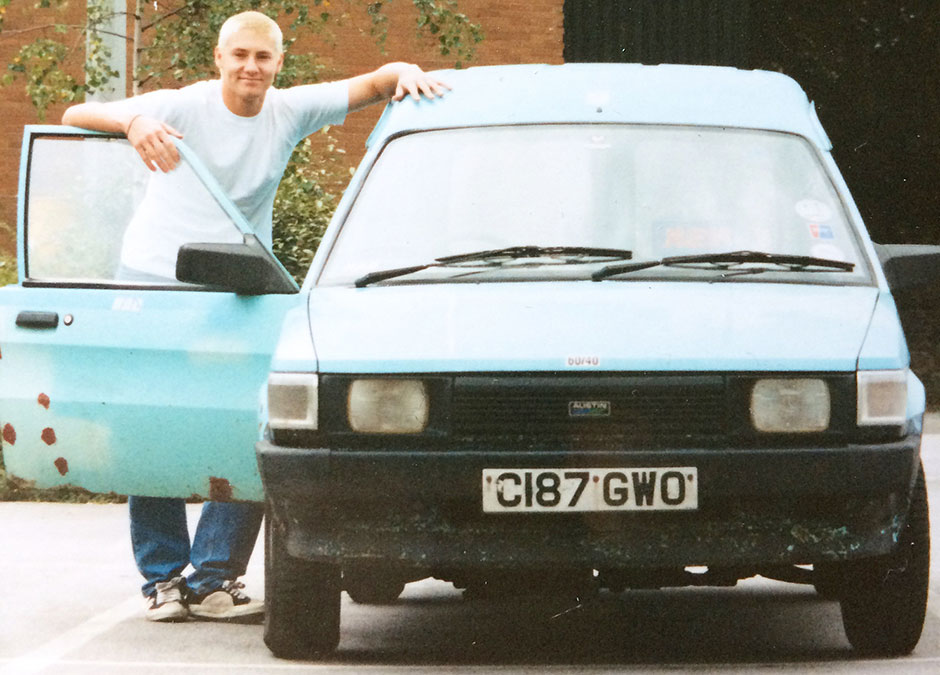
I finished my GCSEs, I started A-levels at school, and it was just skateboarding, skateboarding, skateboarding. I learned to drive. I passed my test in early February, and I bought this striking blue Maestro van; it used to be a British Gas van, and that was big enough to throw a mattress in the back. So we used to drive all over in this thing, and it only had two seats, but you could get another eight people in the back. You could sit three people along each wall, and have two people sitting on the floor facing each other, and then drive with one passenger. You could get 10 people in that thing, and that did happen, which was kind of reckless because there were no seat belts or anything. Anyway, we used to drive this van all over the place, and that’s how I got about.
Winter of 1991 set up that year; the 1281 video was Ron Knigge wearing those massive jeans, Chris Fissel driving his nose into the floor doing pressure flips, and then John Montesi shredding, and Ed [Templeton], who even then seemed like the kind of nerd I could appreciate. That video is where the clothes came from. So by the time Questionable came out, we all just wanted to have the biggest jeans. We would get the biggest jeans we could until we could get Big Deal jeans. So yeah, that was the big jeans era and getting whatever shoes you could. You could probably get old school Vans, but most of us were wearing adidas. I used to wear Puma States because they were cheap and you could get them for about £4 a pair. I liked Puma States because they had a nicer suede. The Gazelles had pigskin suede that used to wear out really quickly. Whereas the States had regular cow suede. They were just more durable, and I found they gripped better as well. We skated the bowling green car park in Bridgend a lot during the winter of 91. Learning late back foot flips, half flip caspers, and pressure flips. Every time I’d go there, somebody had learned a new trick. Like David Moore, who was brilliant at front foot impossibles; everybody had their own special move. Once I got my licence, we started going to Cardiff and just doing 1992 stuff. I used to go to Swansea a lot; we would just drive all over and skate car parks, and I would try to do back foot flips down sets of stairs everywhere.
Skating was very much everything you see of 92. People skating car parks with little wheels, egg-shaped boards, and massive jeans. That’s what happened. I wasn’t getting on with my mum very well at the time; it was very much two people who were very similar. I ditched out of school because I hated it; school was stupid. One day I just stopped going, packed myself into the back of my van, and just went and lived in it for a few months basically. While I was living in that van, we went everywhere. We went to Oxford that summer a lot. We slept at Abingdon BMX track under the van. We used to go to Oxford just to see the spots that we’d seen Alex [Moul] skate or Tom [Penny] skate. We’d go to Milton Keynes the first time we discovered that, and to places like Nottingham. I even drove to Southbank one time, just when I’d started driving. Looking back, I can’t believe I did that. But I drove from Wales to Southbank and parked at Southbank in my van.
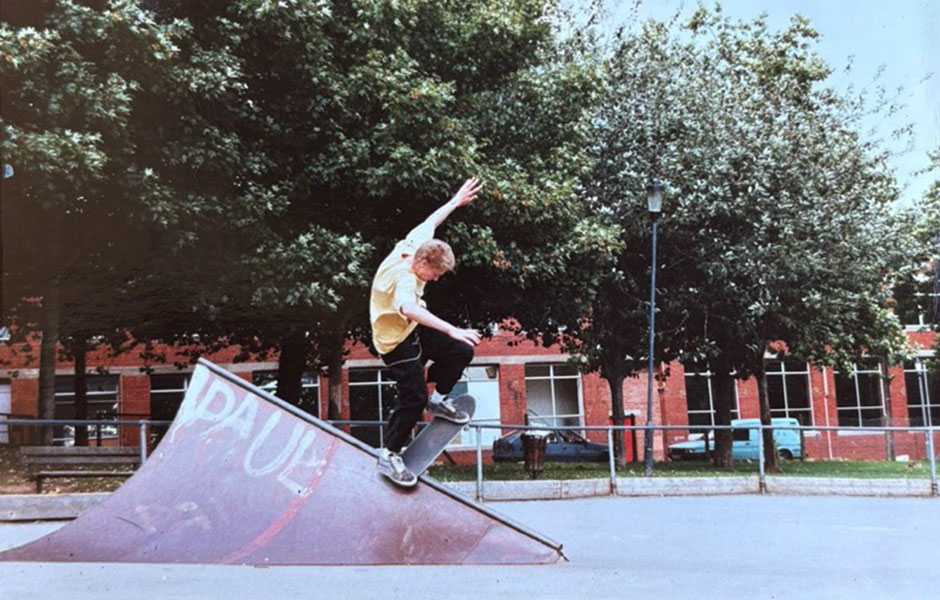
Chris bluntsliding at Dean Lane in 1992 with his blue van visible in the background. PH: Lisa Bowen
Next to the little banks.
Yeah, that was mad. I can’t even imagine doing that these days. I hate driving into London; it gives me the most anxiety now. I’d rather get the train. I’d rather get completely robbed by getting the train than drive a vehicle into London anymore. So Sadiq Khan, thank you; you’ve made it aggressively anti-car, and that’s a good thing, but I just wanna be able to park by Stockwell. That’s all I wanna be able to do without having to go through a thousand CCTV cameras.
 So in 1992 I had a little bit of savings, but I was trying to run a vehicle, put petrol in it, and get around. In the end, I started selling things. I sold a bit of scrap metal with David Moore. His dad had a company; we scrapped some metal, made a couple of hundred quid. Then I quickly had no money again, so I had to sell my records. I didn’t have millions of records, but I did have a pretty good collection of punk music and definitely California stuff like Black Flag, The Descendents, and Firehose. All the bands that would be in skate videos, basically. I had Iron Maiden albums from when I was a kid, and they were picture discs, a lot of rad stuff. I sold all of it, and I got nothing for it, maybe a hundred pounds; it was pennies. All I kept were my Dead Kennedys albums, and anything Jello Biafra; everything else I sold. I thought the Jello stuff was important, so I kept those.
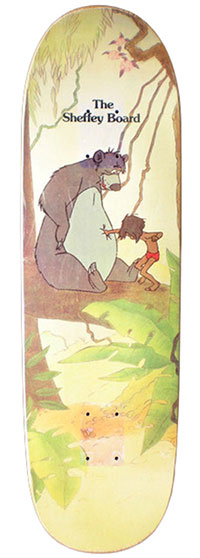
So I had this bit of money, and I bought a Sean Sheffey Jungle Book slick, and that kept me going that summer of 92 for a bit. Then I bought those Rodney Mullen’s Summer of 92 boards with the lady on the back with her top off and Rodney’s caning this bike down a lane in San Diego somewhere, I imagine. I had two of those, and it said Summer of 92 on that board, Rodney Mullen’s Summer of 92. This is the part of the story where I probably feel a bit like those old guys who still wear Pro Design pads and helmets at the skatepark. Those guys who went through the seventies and eighties, who like to reminisce about that time, skating the Farnborough ramp and stuff that I never skated. That time in 92 is my vintage back-in-the-day moment that is super important to me. I always got the feeling that era put a lot of people off, the small wheels. It was slow, there were the clothes, it probably looked a bit cliquey, and it probably looked a bit weird to older skaters. But it was that point in 92 where it really felt like we made skateboarding our own because there weren’t many of us. It was hard to get stuff, and most people had quit. I think that is absolutely fundamental to me. With 92, I think a lot of people are a bit ashamed of wearing big jeans. I think some people feel a bit weird about that. I always get a bit of a sense of shame around that period; they kind of don’t want to talk about it. But it was massively important.
“it was that point in 92 where it really felt like we made skateboarding our own because there weren’t many of us”
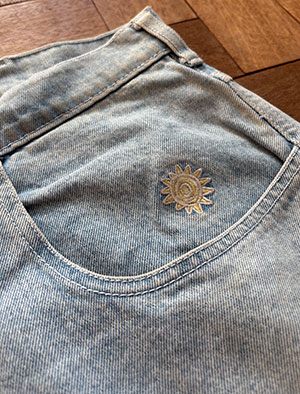 The other day, I finally dug out my Big Deal jeans, my New Deal jeans. They are a 40-inch waist, and I put them on and grabbed a pair of Keith’s Big Boys. I held them against each other, and it’s the same pant, the exact same thing cut slightly smaller on the waist, but a Big Boy is a Big Deal jean. So I got a large pair, and I cut them off, and skateboarding felt exactly like 1992 again! It was that moment. Obviously, the way I’ve dressed historically, I’ve been wearing polyester spandex pants to skate in. Everything looks quite formal, and that’s a challenge. To be seen looking like that on a skateboard. That’s deliberate, obviously. One, it feels good; it works really well for skating. But two, it also challenges not only the public’s perception of a skateboarder, but it’s also a way of challenging skateboarders’ perception of a skateboarder. I always thought it was important to do that in skateboarding because it keeps us on our toes rather than being complacent and accepting things.
We have got to keep shaking it up. Because if we don’t keep shaking it up, it’ll get stale and become established, and it’ll become as boring as soccer. I mean, it’ll become so boring and formulaic, it just won’t be interesting anymore. The only way to do that is to keep shocking skateboarding itself. So you need Andy Anderson to come in and just be such a strong personality with a strong vision of what skateboarding is, and he performs it, and he does it. Whether you like him or not, he is undeniably good at skateboarding and good at promoting skateboarding and pushing skateboarding forward. He’s contributing. You almost have to appreciate that because fundamentally, the most important thing in skateboarding is contributing to the whole general picture. Everybody contributes to it in some way. Even if it’s the kid who’s just learned to push, somehow he’s contributing to the entire picture of skateboarding. Anybody who skates, who doesn’t think they’re contributing, you are, I promise you. Anybody who’s out there reading this thing we’re putting together, just by doing it, you’re contributing to all of skateboarding. So you’re included, you’re included in that. Don’t let anybody tell you different; you’re included when you do that. So I think that’s important.
Anybody doing it is putting it in front of the eyes of someone who maybe wouldn’t have seen it on that day otherwise.
I think it’s important for people to feel like not only do they belong, but also they are part of it. I’ve done bits, and I feel like I’ve contributed to skateboarding. I’ve done some stuff, and I feel like skateboarding has given me an awful lot. I wouldn’t have been able to keep myself going this long if I didn’t have something like skateboarding. I wouldn’t have been able to live the human existence because it’s massively disappointing being a human being, I find. So, even with art and nature, I’m still having to navigate my existence through the world as a human. I would have much preferred to do this as a dolphin, a bird, or even a tree. The human experience of living is, I think, why we do all this other shit. That’s why we have art. Because our experience of it is kind of inauthentic and full of capitalism-engineered anxiety. A lot of people don’t really appreciate the beauty and the randomness around them. So they have to invent all this other stuff, which is basically some kind of mental masturbation.
Making sense of things through whatever paintbrush has arrived on your doorstep. Whatever life has dealt you, becomes your thing.
Skateboarding has been the passion that has given me a reason; it’s given me that motivation to eat well, to go places, to work, to be creative. I can’t imagine a life where I would have had a passion for anything that would have motivated me like that. I’m sure I would have just been more of a nature person or conservationist. I would have wanted to be an archeologist or an anthropologist or something more like that. But the life of being a skateboarder is crazy.
You can’t strip it.
Yeah. I can’t take it out of my story. Sometimes I think one day when I look back on my life, I’ll be like, “Oh man, was I stupid to have just focused that one chance of being alive and made it so much about that random skateboard thing?” Skateboarding is not even an authentic human experience. It’s a made-up thing. It’s a plank with wheels on it. It’s not even an authentic sport because it’s a copy of another sport. It’s a copy of surfing. It’s inauthentic in its inauthenticity. But it’s literally a vehicle that gives you music, travel, friends, and everything else.
It’s made all of our lives better. Forever changed.
It’s definitely made things more bearable.
The next mag appearance is your 1993 intro. How did meeting Thomas Campbell come about?
So 92 was crazy. I skated a lot. I skated loads and loads, but I did get injured at one point. I really destroyed my ankle, which was my first major injury. I destroyed my ankle and twisted my knee so bad I didn’t skate for two and a half months towards the end of the year. I’d kind of just gotten back on board, and I went to skate somewhere in Wales, and it just happened that Thomas Campbell was over, and he was staying with Skin Phillips. I’m not sure how it happened, but I’m guessing Thomas was trying to make a bit of money while he was over. Obviously, Skin would have suggested he write some articles and get paid for the word count at least. So he did an INTRO with me, and he also did one with Simon Dark. Simon is a really good skater from Swansea. He was one of the best. He was like Pritchard level, and he was the other skater I skated with who was really good. I don’t want to do anybody dirty in Wales, but some people just have that lightness on their board, and they’re just obviously technically gifted. He was like that.
“in colour, I probably looked like a fruit salad in this photo, it would be so bright”
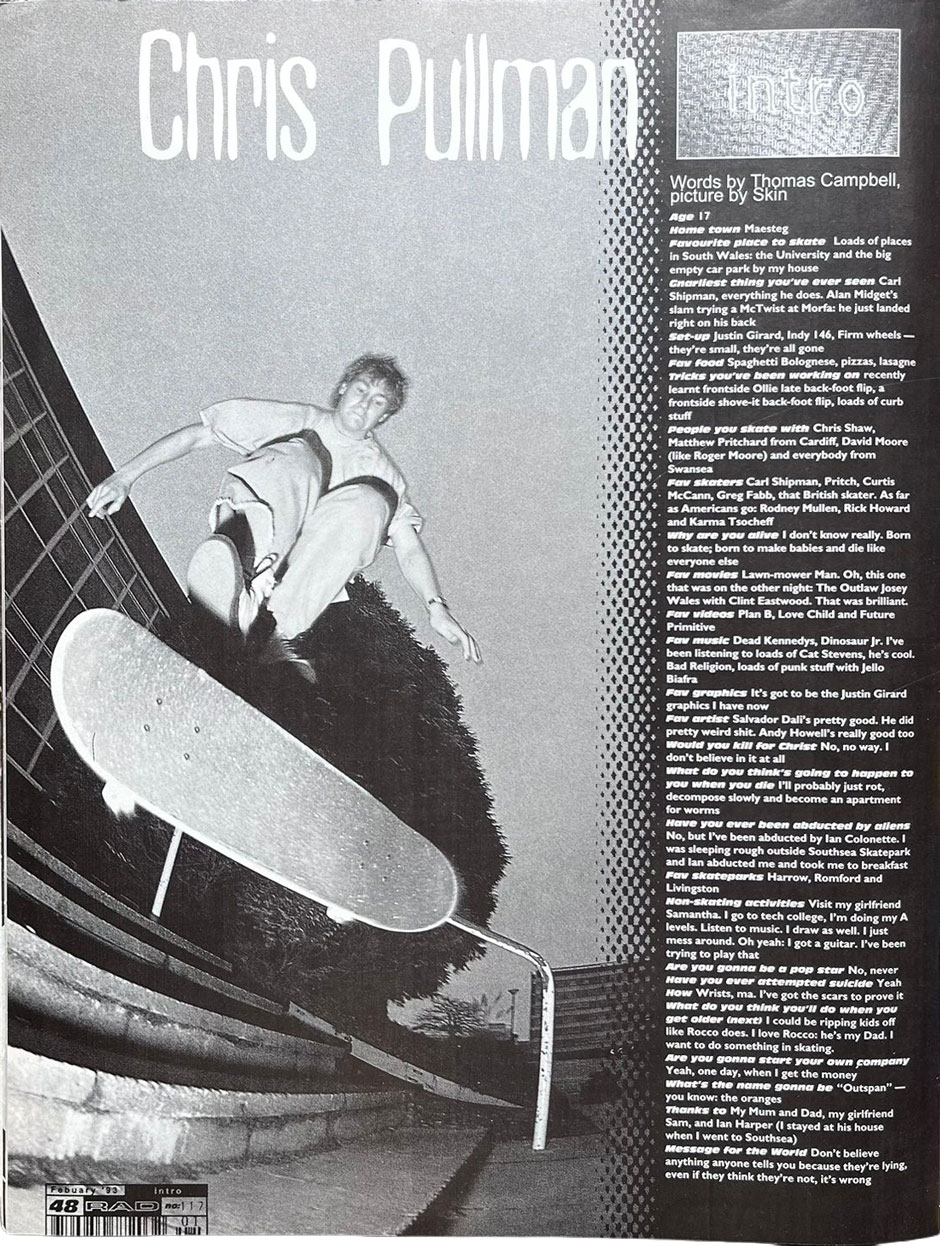
Inward heelflip at Swansea University in the February 1993 issue of R.A.D Magazine. PH: Skin Phillips
I was going to skate this car park in Neath with a few people, and Skin came, and he brought Thomas. I met Thomas Campbell, and I was skating good. I could do back foot flips and backside 180 back foot flips down stairs and pop shuvit late back foot flips. And I used to do lipslide 270 shuvs on curbs, and I could even do noseblunt slides and noseblunt slide shuvs on curbs and things like that back then. I think the day Thomas saw me, I was having a particularly good day, skating the Morrisons car park. Off the strength of that, he said we should do a little interview. You see people having intros in magazines, and you think it would be great; that one day that might happen. That was the moment where I realised it was actually happening. Thomas called me up, and we did this interview. I did it standing in the hall on a wired telephone, on my home phone in my mom’s house, standing in the hallway doing my interview with Thomas Campbell, talking a load of rubbish, pretty much, but some of it still is true. That was a mind-blower. We did that, and he dictated it all, and then Skin shot the photo. We went to Swansea University, and I knew I just wanted to do the most epic thing I could. And the best flip trick I could do down stairs at that time was an inward heelflip. So I shot this inward heelflip down six stairs at Swansea University.
If we saw your INTRO in colour, what would we be looking at?
I’m not sure what Skin’s setup was like; it’s a weird photo, but obviously it’s black and white. I let my hair grow out, so I look kind of crazy. And then I’ve got this bright yellow t-shirt on, these bright orange 40-inch waist New Deal jeans, and that orange was so good! I’ve also got these Vans Bluchers on, this really low-top shoe that Neil Blender used to wear. For a minute, you could get them here. The ones I’m wearing in the photo are camel yellow with a black sole, and they look really sick. Sean Sheffey had an advert wearing a pair if you ever want to see the colourway; it’s sick. So in colour, I probably looked like a Fruit Salad in this photo; it would be so bright. You can’t see the board graphic, but it’s a Sean Sheffey, a wood board; it’s not slick. I can’t remember what was on it, actually, maybe a kind of jungle scene. The INTRO eventually came out in February 93, but I did it in 92 right at the end. I think that was the last but one RAD Magazine. I hope I didn’t curse it. The one with my INTRO has got John Montesi on the cover. The next photo in a magazine was in Sidewalk on Pritchard’s birthday, I think. Or maybe the Southsea Cotton Eye Joe frontside 360 video grab.
I guess from photo to video, the next sort of footage touchstone outside of the 1990 Wales stuff is from 1996 when you moved from Wales to Portsmouth for university.
So in 94 I went to university in Portsmouth. That’s when I started my degree course. That’s real mid-nineties at this point. It’s very much Goldfish era, and we’re starting to wear smart clothes to skate like Guess jeans and stuff, wearing Calvin Klein jeans to go skating, and Duffs Stromboli shoes. When you see the film, Mid-90s, 1994 was very much what that film was depicting. That’s what we were wearing, and the music, it was like that. I was living in Southsea, and we were having a Mid-90s moment; we obviously didn’t realise it at the time, but everything was very much like that. It was brilliant. We were skating the flat, just doing tricks over benches or tubes, anything that looked like Goldfish, the Girl video, because that’s what those guys are skating. They’re just doing tricks up and down two or three stairs and skating ledges. This was when doing a fakie flip over a low wall was a big deal. I mean, that’s kind of tricky if you think about it. Doing a fakie flip over something’s hard, right?
Like the smaller brick walls at the top of Wallenberg.
Yeah, those ones, and the ones at the courthouse. That was what skateboarding was like. And then, Southsea had ramps, but skating a ramp at that time used to feel like when you’d see footage of people skating Encinitas YMCA. They had that big elbow-shaped vert ramp there, but there was a street course at Encinitas YMCA. It was one of those horrible California parks, Skatelite on tarmac, and it just looked so uninteresting. It was the kind of thing you’d see in a 411VM comp, and you’d be like, “Oh, man, I’d rather not bother than skate that”. Streetskating was hard in Portsmouth, but it had a roller rink where you could skate, and it was smooth. You could just skate flat ground all day long, and you could drag things into the roller rink: ramps, blocks, any obstacle, and pile them up and make stuff. So I spent a lot of time in Portsmouth skating, and doing this biology degree, which is what I was supposed to be there for, but mostly skateboarding.
There was a point where I went home; it was an Easter holiday from university, and I went back to Wales. When I came back, they’d had a UK King of Vert or concrete BMX competition, and someone had left bits at Southsea park. They had painted the ramps, and somebody had left a flat bar there, a 14-foot-long flat bar. This long-ass flat bar, and it was in the roller rink. Obviously, as a skateboarder, you’re fascinated by anybody who can skate a round rail. Even if it’s back to the early days when Brian Lotti skates one in Hokus Pokus. I understood coping, but how do you ollie and grind a round rail? It seems like tossing a one-hundred-sided die and expecting to come up with sixty-seven every time.
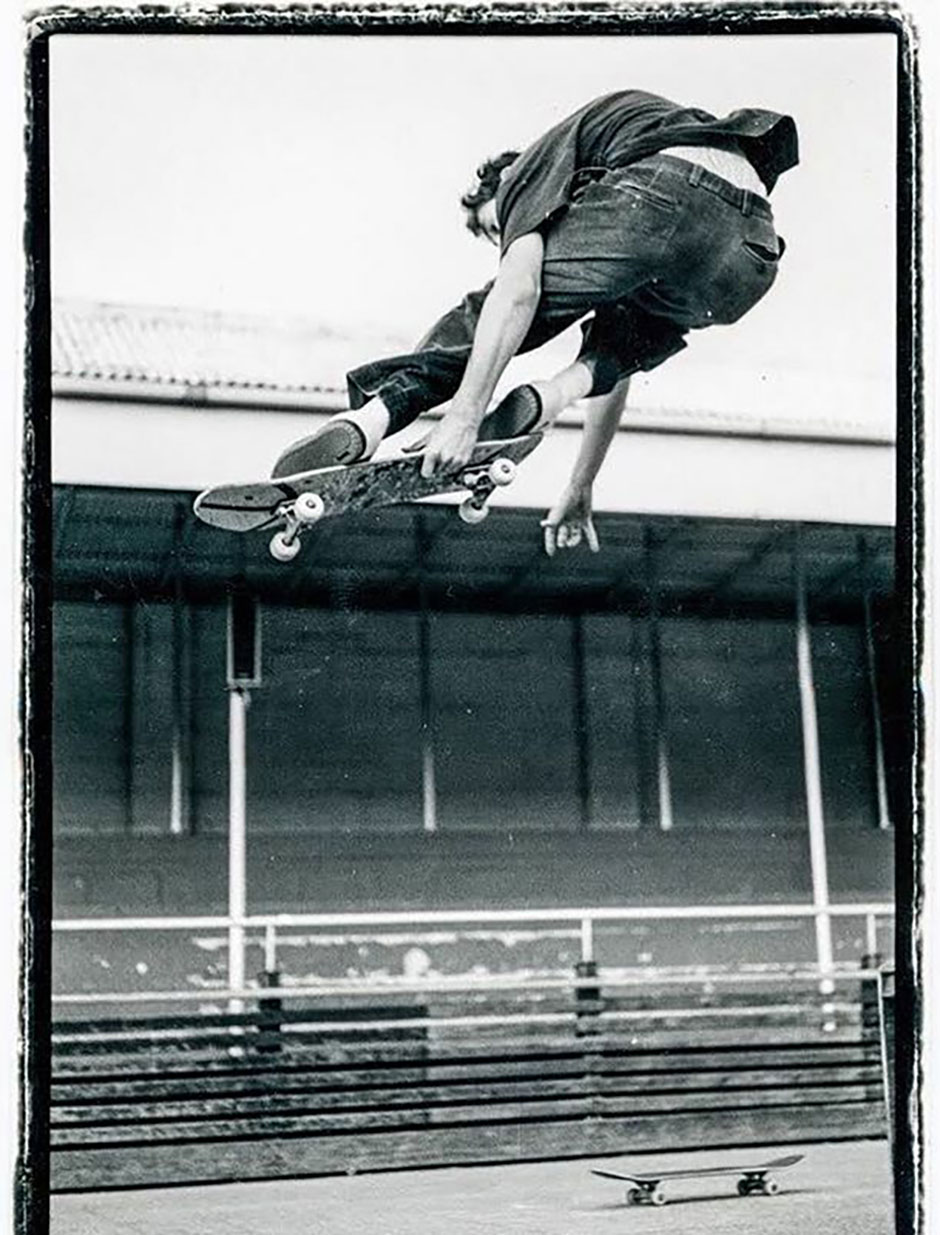
Duffs stromboli asssisted melon grab. Mid-90s moment at Southsea Roller rink PH: Ali Tollervey
It’s the odds of it; how do people do that? I couldn’t figure it out anyway. So there was this flat bar in the roller rink, and I was determined to grind it. So I made myself, just like I did back in the day with the no comply. I skated up to the flat bar, I literally ollied, and clanked my back track on the last inch of it just to feel what it would feel like. And then, this is so stupid, I ground the last six inches, but as a 5-0 grind. Because I was being so timid trying to learn 50-50s, just trying to ping the end of the flat bar, I learned frontside 5-0s before I did 50-50s. Then obviously, I kind of worked my way back until I could ollie and 50-50 this flat bar. Ollie, get on it, and stand up. That’s the trick: once you stand up straight, that’s when the balance kicks in. And that’s what people don’t realise about that. All you’ve got to do once you’re in the 50-50 is just stand up. If you watch Ronnie Creager, you’ll understand. Ronnie Creager, on that iconic 50-50, he stands up, and his arms go down by his side because he’s balancing. That’s when it happened. So I basically spent the summer of 96 focusing on skating flat bars. I skated a lot, but it became a really good focus for me to train and keep pushing myself. I had just split up with a girlfriend at the time; I stayed in Southsea for that summer, and I just skated all the time. I was motivated by skating, and from this breakup, I focused everything into skating. What happened was I just got better at skateboarding; I got much more consistent, and we had a new thing to challenge us, in the form of that slippery pole.
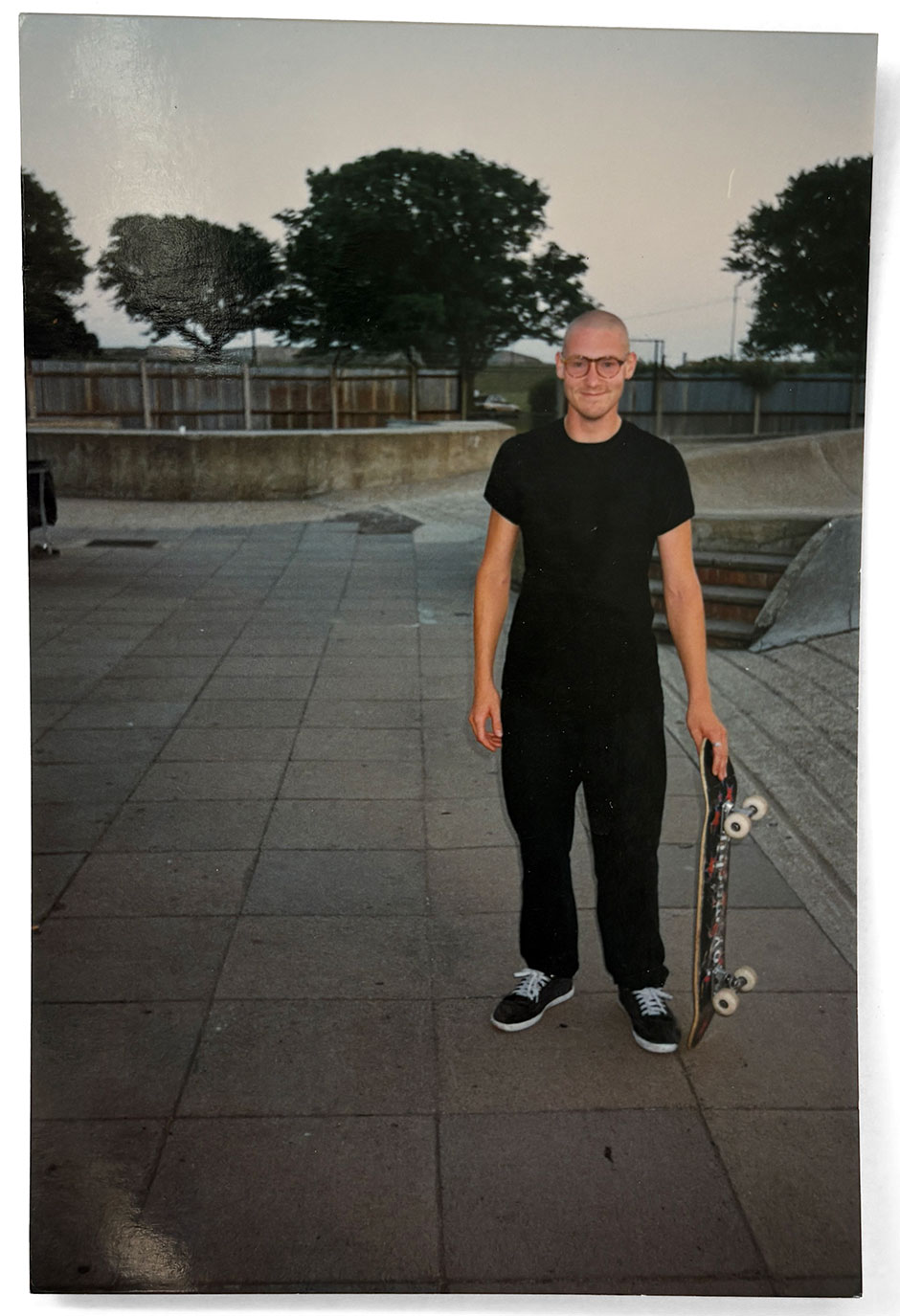
That was your window.
Basically, yeah, summer of 96. I’ve got a photo of me here, and I’ve got a skinhead; it is at Southsea skatepark, and I’ve got this Toy Machine stars board, and it’s like 8.5”, and it’s got 60mm Spitfires on it, and Indy 146 trucks. It’s basically the same board I’m riding now, eight and a half, big wheels, and high trucks. I had seven of those boards in a row, because I loved that Toy Machine stars board. That picture is from the summer of 96. I skated so hard because I was on a mission to either destroy myself or survive through skateboarding, as it were, with skateboarding as the focus. When it got to the end of the summer, we went back to university, and my friend Paul came back. I think he’d gone home to Essex for the summer.
This is Paul Gonella?
Yeah, we were in a pub. I’m pretty sure we were in a pub called The India Arms. I can’t remember how we came onto it, but it was like, let’s film, let’s go and film everything. Let’s just have a day, and we’ll film everything I can do on a skateboard and see what it looks like. So Paul was down, and we had a lovely sunny day; it was beautiful. We went to the skatepark early, and I said, “Paul, I’m going to just catalogue all the tricks I can do right now.” So I basically skate the flat bar, a couple of minutes of skating a flat bar, 50-50, 50-50 backside 180, 50-50 front board. It’s like that trick, trick, trick; it’s so boring!
“I understood coping, but how do you ollie and grind a round rail? It seems like tossing a one-hundred-sided dice and expecting to come up with sixty seven every time”
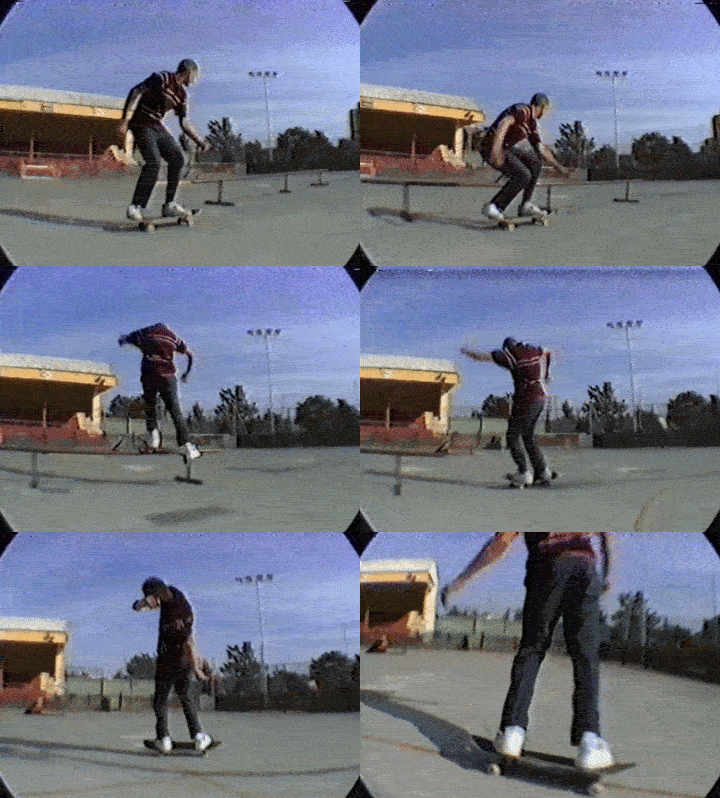
Flat bar skill fine-tuning at Southsea. Barley Grind filmed by Paul Gonella
There’s a good Barley grind in there.
Yeah, there’s one Barley grind in there. There’s a really terrible front feeble. It’s more of a salad if you see that; the rail doesn’t connect. I’m somehow in a front feeble position, but my rail isn’t down. It’s really weird. I don’t know if we ever intended it to be a sponsor me video as such, but it might have been. I’d be lying if I said it wasn’t to try and get sponsored, but I can’t remember that. I do remember it being a mission to get everything on a tape that I could, and we did. I did everything I could do at the skatepark. I invented a whole new trick that day. I did that nollie varial fence plant. That’s the first time I ever landed that. It’s a weird trick, but it just works. Nobody’s ever seen anything like that, right? Nollie 360 shuvit fence plant. You throw it back in forwards. When I got really good at it, I used to hand flip it in, too.
So we made this video, and it came to like seven minutes of footage we got in one day, and we just edited it chronologically, trick by trick. I made a little title for it. wrote this thing on a bit of paper to say thanks to people. It was written on an envelope, and I’ve still got that bit of paper somewhere. I made a few copies of that video, and Wayne, who used to work at the skate shop, helped me. A copy went to New Deal Skates, a copy went to Slam, and a copy went to Sidewalk. And I think Ben Powell must have seen that, or somebody saw that. It’s not a very good sponsor me video for a few reasons. Not the obvious reasons. It’s got no music, and it’s just raw footage, pretty much. That’s actually not bad for a sponsor me video because the worst thing you do on a sponsor me video is put music on it. If the guy who watches it hates that music, he’s going to hate your sponsor me video. So that’s really important. Kids, if you make a sponsor me video, just make it real and don’t put music on it. Unless it’s a video part, just give the guy your raw footage, and then the person sponsoring you gets a much better idea of who you are from that. Our video wasn’t edited in an exciting way, I think it could be re-edited into something shorter and more watchable, but we just put the tricks on the tape in chronological order. Have you watched it?
Yeah, I watched it the other day. My takeaway was that you had the best day of your life at the skatepark. You have a nice backside flip on that brick bank later, too. It’s a good record of the time.
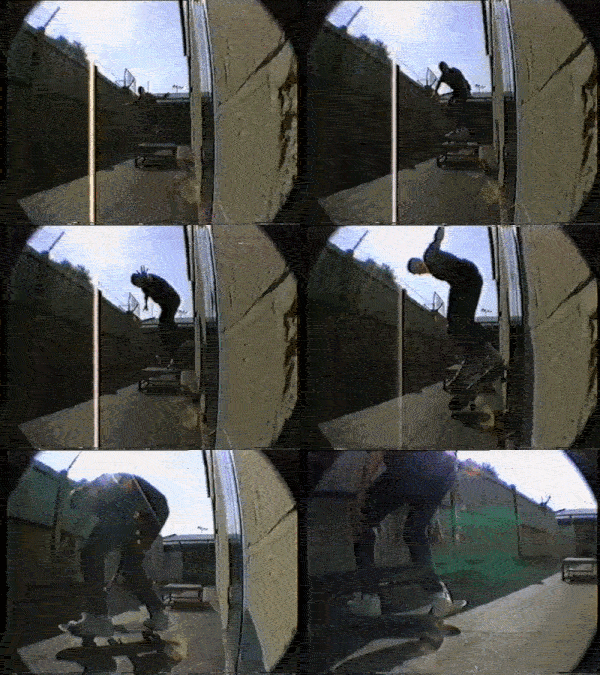 You’re right, actually, because in a weird way it is very honest. Everything I try to do is an attempt at the authentic version of me. I did a melon on that brick bank at the end of the day, and bruised my heel stomping it into the corner of that brick bank. I was wearing white leather MC Raps I got from Soletrader for £40. I’m wearing a Foundation shirt, which I loved; I still have it, which was the shirt that [Heath] Kirchart and Josh Beagle and all those guys wore in those old Foundation videos. That stripey shirt, it’s expensive. Then I wore my dad’s old RAF trousers, which is basically where the creased pants came from. They’re RAF issue dress pants like marching pants. People are happy to watch raw footage these days, aren’t they? I would never put that in front of someone and say, watch it. But if you want to skip some of the first two minutes of flat bar at the beginning and get into the bit where I somehow managed to wallride right off a three-foot-long coffee table, you’d be like, “How the fuck did you do that?” That’s probably one of the better things I’ve ever done; it’s the most Eastern Exposure 3 thing in there.
That’s a video that was the soundtrack to this time exactly, right?
Yeah, Eastern Exposure 3 was so important because it showed a different version of skateboarding, which was much less about the bits in between rolling along. It made the rolling along bit the important bit. Before, skateboarding would be rolling along, then you’re sliding a ledge, or you’re rolling along, and then you’re flying down some stairs, or you’re rolling along, and then you do a flip trick. Eastern Exposure was about the rolling, the continual movement, the four points of contact, the Four Wheel Drive aspect of skateboarding. It became about using the terrain rather than trying to find the perfect terrain. Finding imperfect terrain and trying to make something happen on that. Let’s take this shit thing and try to do dope stuff on it.
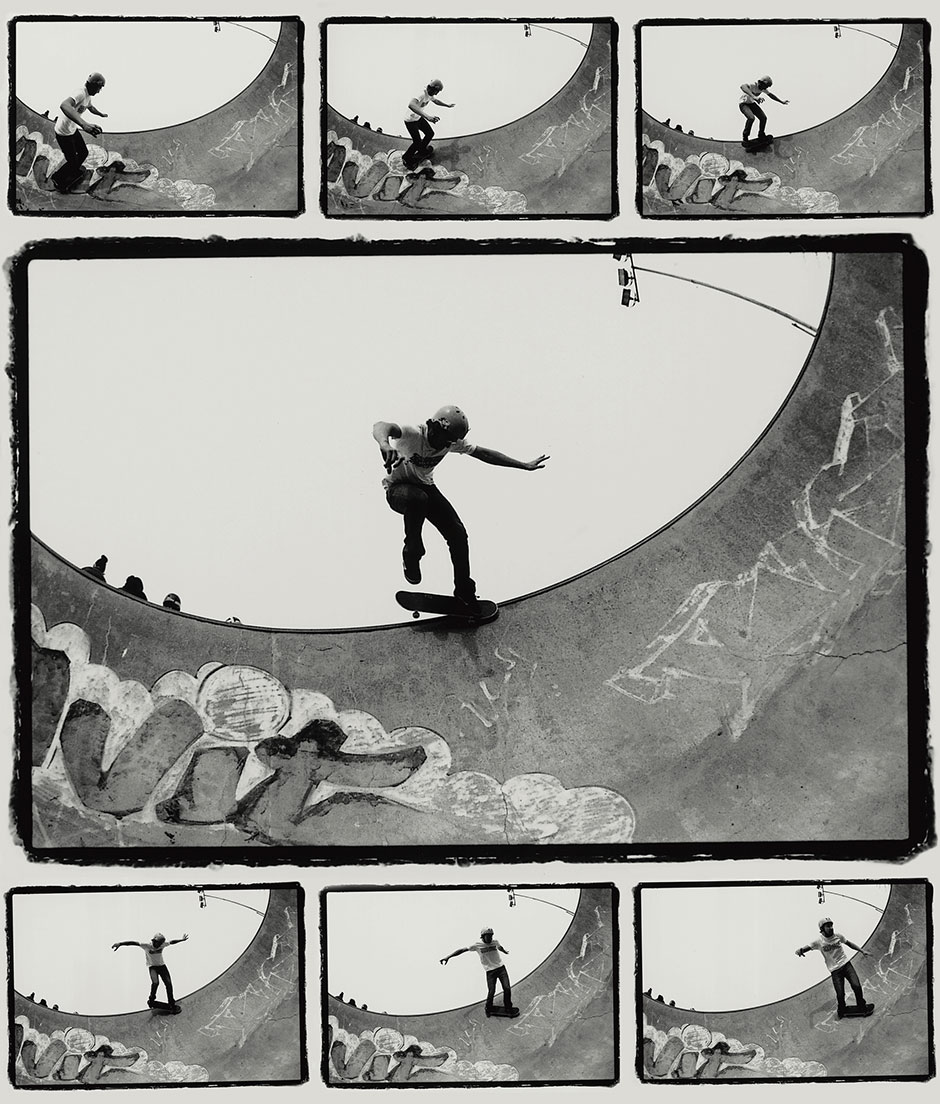
Taking the one-footed new deal grind for a spin in the deep end at Southsea. PH: Richie Hopson
What undocumented tricks were you throwing around back then that you wouldn’t dream of doing now?
That coffee table I was just talking about, I could do shuvit nosegrinds on that, pop shuvit frontside nosegrinds. They would bounce; I knew how to do them, so that was a weird one. I had a mean switch inward heelflip. I could do them good, I had a mean nollie inward heel too. I vividly remember having this blue Guy Mariano board; it had a boxer on it in a geometric style. I remember doing a nollie inward heel on this thing. Sometimes you do a flip trick, and it flies up in the air, and it slaps your feet. I did a nollie inward heel, and it must have been like two feet high on flat. There are little memories like that, just being able to skate flatground, being able to do backside flips every go, backside heelflips. Flatground tricks aren’t that important to me anymore. I could do bigspin flips on that big, eight and a half inch board. I could comfortably do a bigspin flip just as an afterthought. So I miss things like that. I miss being able to do that.
“There’s plenty in skateboarding to enjoy without having to be good at it. I learned that really early on by necessity”
Eastern Exposure was more about using the terrain. I don’t want to belittle it, but it was a bit more brute force skateboarding. You could barge up a wall, you could wallie something. It was a bit more caveman almost. It was much more aggressive in a weird way. It felt much more like attacking the terrain rather than trying to finesse the terrain. So it appealed to me because even then, when I was better at skating flatground, I was surrounded by people who were so much better at that stuff. So I have always known that being technically good at skateboarding wasn’t my destiny. But I’ve always known that there’s so much more shit in skateboarding to find. You don’t have to be good at it. There’s plenty in skateboarding to enjoy without having to be good at it. I learned that really early on by necessity.
Ben Powell, seeing this video, then leads to your HAUNTS in Sidewalk.
I think Ben could see that it would be worthwhile because the whole thing of the HAUNTS format was about picking a guy who’s out doing his thing and going to visit him. I was almost like one of those Out-There things they did at R.A.D, but it was more focused on a specific person.
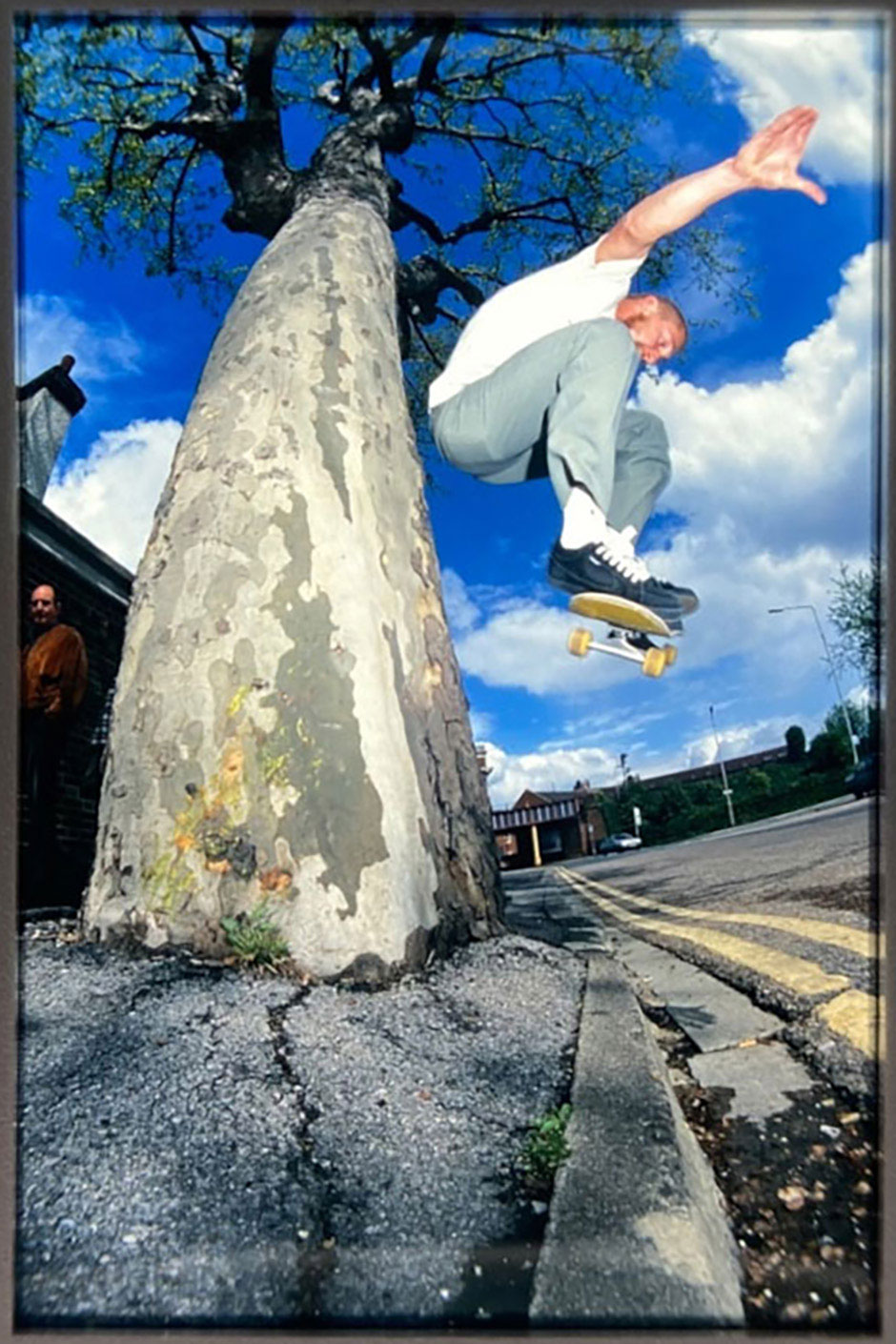
Wallie out of a tree for the Sidewalk HAUNTS article, a Wig Worland slide
The TLB approach, but honing in on a scene via one person.
Yeah, and it was so good. Ben [Powell] and Wig [Worland] came down; Pin came as well. They all stayed in this little bedsit, and we had a weekend. It felt like all my friends were involved. You know when you see a GIRL video, and someone does a trick, and the whole team is there cheering and shit? When I was taking photos for that, because I shot a few bits of the skatepark, it almost felt like everybody was there. It felt like people were cheering me on a bit to do this, you know what I mean? It felt nice to have those guys come down. It was a real honour to have Wig and Ben come down, and they came for me; I’m the talent here. I was scared, but we shot that HAUNTS in two days.
For everybody else there, it’s also super important. It’s shining a light on their lives, too.
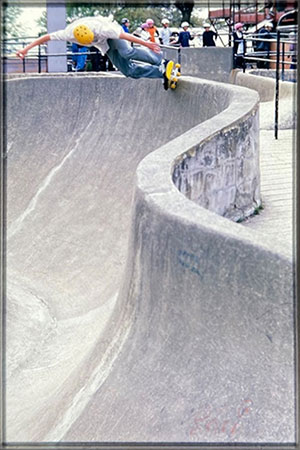 Yeah, I think it did. It’s hard to know. I’m not brilliant at reading people, generally. And I’m always at a loss whether people actually like me or not. I really struggle with it. And I don’t know whether that’s a neurodivergent thing or something, but I often don’t get jokes. My go-to with people is, I don’t think that person likes me; I assume someone doesn’t like me before I start really. But there have been moments, like I said, in Southsea where it felt like I was appreciated by lots of people at that time.
When I knew the HAUNTS was happening, they were obviously coming to shoot it for a reason. At some point, I was going to have photographs in a magazine, and whoever gives me a board is going to have a photo in a magazine, right? So I got my boss to try to get me a board from New Deal. I wanted an Anti-Hero board, and they didn’t give me one; they wouldn’t give Wayne this board for free to give to me, but Wayne gave it to me for free anyway. I made a point of spraying it, so that’s why that board’s yellow; it’s an 8.5” Anti Hero ‘Get-in-the-van’ graphic, and it had an orange top stain. I cut ‘ASIMOV’ out of the griptape. I cut the font of his name from the Asimov book series out of the griptape. I really wanted to get this photo by Mori in there. Wig wasn’t super into it, and they printed quite small, but I liked Mori at the time, and I had kind of a Cornish connection. So I really kind of forced them to include this little stalefish ollie Playing Place in there as well; that’s the only thing in there that wasn’t done during those two days. It looked pretty good, I think.
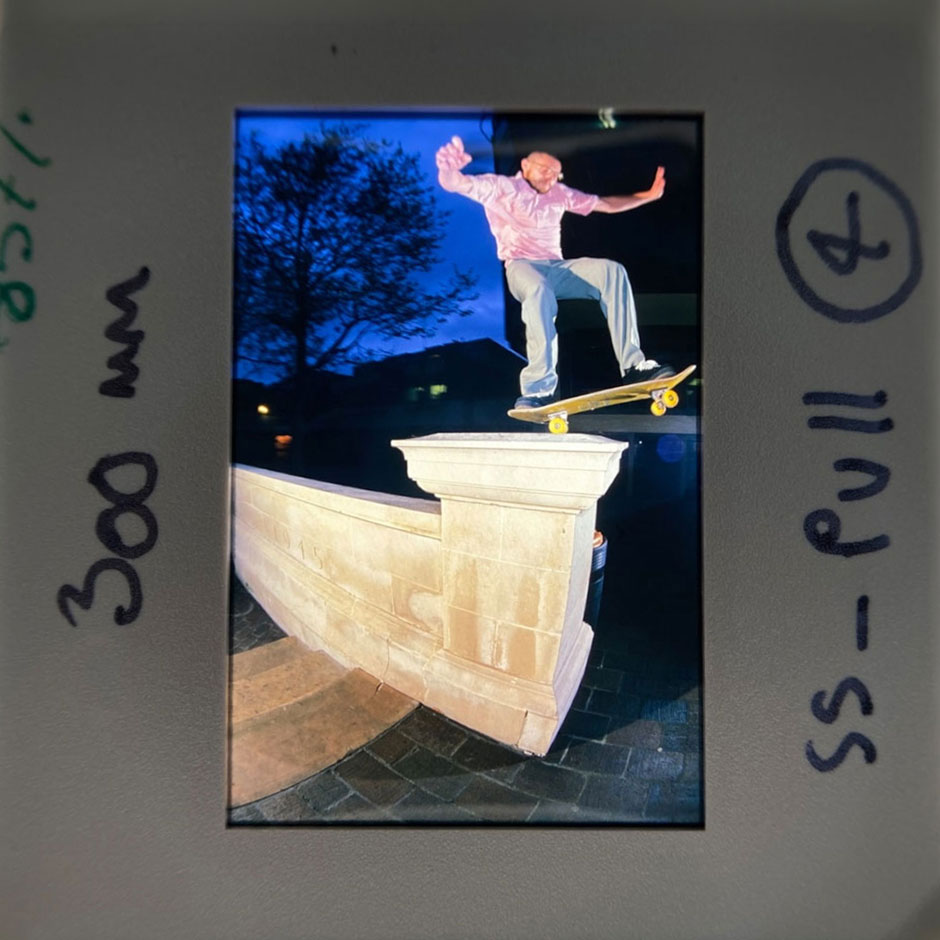
An abrupt Southsea manual for the Sidewalk HAUNTS article, a Wig Worland slide
The portrait is sick too.
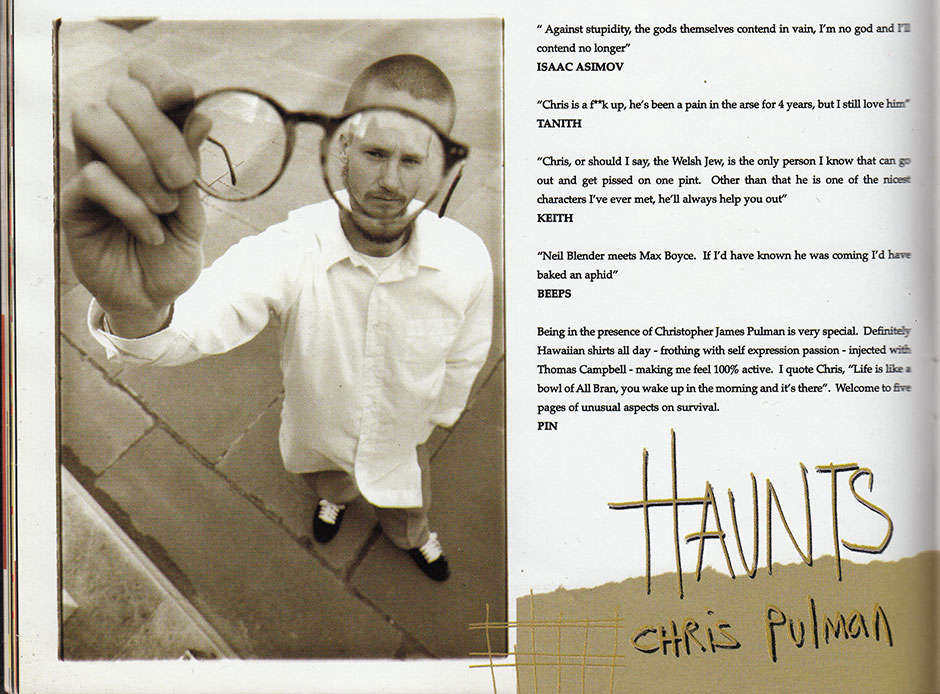
We shot that by the D-Day monument in Portsmouth on the seafront because it’s a massive expanse of white stone, and it’s got high ledges so Wig could get high above me to try and get that focus on the glasses. Wig said he really wanted to shoot it, and I think it looked really good. Wig was so great to shoot with. I’m so apologetic because I hate wasting people’s time. I don’t like people wasting my time, so when I go filming I feel so guilty if it’s taken me ages to do anything. So I’d be constantly apologising to Wig, but Wig was always so cool. He would say, “Dude, just chill, seriously. This is what I do. I get paid to lie here”.
Your HAUNTS comes out, and a week later, you take yourself to America.
I decided once I finished my degree I would go; I had always wanted to go to America. Obviously, if you skate, most people want to go and see it once. At the time, the UK passport basically gave you a visa in America. You could stay out there for 90 days without having to have a work visa or extensions; it was just a privilege of the British passport. Because it was 90 days, I bought a ticket into New York, and then one out of San Francisco 90 days later. That was it. I had two tickets in and out that were on different sides of the entire continent. So that was quite a claim. But I knew I could do it. I’d just hitchhike if I had to, but I knew I could do it. When I got off the plane in New York, I spent the night in JFK, because I basically, I didn’t know what to do. I stayed in the airport until the sun came up. My HAUNTS had come out a couple of weeks earlier, and I brought a copy of the magazine with me; I don’t know why. Maybe I took it with me as some evidence that back home, I was like somebody awesome, or who had achieved something in skateboarding. I didn’t take it to get sponsored. I didn’t go to America to get sponsored; that wasn’t the idea at all. I just went to go and see it.
What did you see? What were the highlights?
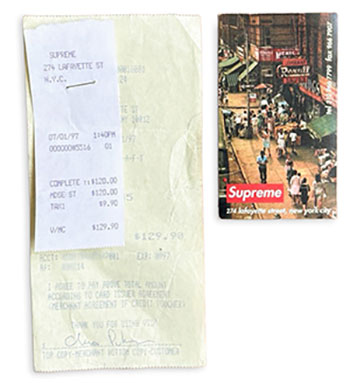 So I got to New York, and I went to Supreme. I showed up wearing brogues, school pants, and a white shirt. I went in, and I said, “I need that Sean Young Anti-Hero board, eight-and-a-half. I need some 60 mm Spitfires, and I need some Indy’s, and I need those white Koston shoes.” The guy behind the counter was looking at me like, “Is this like a fake it till you make it thing or what?” He didn’t think I was a skateboarder, really. So I bought this setup at Supreme on Lafayette, which I still have the receipt for; weirdly, I just found that. Then they didn’t have any mounting hardware at Supreme. So the guy directed me to a rollerblade store a couple of blocks away. I bought a setup at Supreme, but I had to go to a rollerblade store to get truck bolts, which was wild. I set it up, and I went straight to the Brooklyn banks.
I skated the Brooklyn banks all day long. I had a white school shirt on, white Kostons, and these tan Farah pants, school pants. Later on, I skated back, and I was staying at the YMCA on Amsterdam, which is on 100th Street. It’s way up Central Park, like two-thirds of the way up Central Park. I skated from Brooklyn Banks back up to Amsterdam and 100th, and on the way, I saw the guy who was at Supreme, and he looked at me. I’d gone from showing up looking like some English businessman who bought a random skateboard to being someone who’d obviously been at Brooklyn Banks all day because I was filthy. I had a white shirt, and it was so dirty because of the car fumes. Back then, when you would fall at Brooklyn Banks, everything would be black because of the car fumes. All my clothes, including brand new white Koston ones, were black. I was filthy. It was crazy. I had the best day. It was the first day in New York, and I’d skated Brooklyn Banks, I’d got a setup, bought some shoes, and just was blown away. Then I got a slice of pizza for a dollar on a corner somewhere. That was the first experience.
Then where?
Then I met up with Mori, who was his with his dad and his step mum or his mum and his step dad. He was staying in Paoli, which is in Pennsylvania, just outside of Philadelphia. So I stayed; it was just convenient. He was there, and I could stay with him and get some photos and stuff. So we went back into town, and we went to Love Park, and we went to City Hall. We got a couple of photos which we’re trying to track down. So I did a day out with him, and we went to other places around there. Then I went to Westchester and met some people, and we went on some trips to Maryland, Delaware, and other places like that. We went to Bethlehem, where that rail is, a flat rail that Kerry [Getz], Bam [Margera], and Mike [Maldonado] used to skate. It’s at a church in Bethlehem, and I think Kerry does a 50-50 body varial on it. We also went to this big, long ass rail in Wilmington that Bam did a crook down, off a ledge, and onto a big, long rail. We went to all these mad places.
“Ricky Oyola comes around the corner, ollies up the stairs, skates past me, ollies down the six, and back up, and skates off. It just happened; he just went by me, like a scene out of Eastern Exposure“
Philly was amazing. I was lying on a bench one day, just lying at City Hall, because it was early in the morning, I was up, and I was just lying there. It was quiet; it wasn’t a weekend, but sometimes it was just quiet down those echoey streets in Philly. I just heard this rumble, like this Eastern Exposure type rumble, this really loud, bassy rumble, and it got louder and louder and louder. Then it got really loud; it was obviously coming towards City Hall. I’m lying on this bench, and I hear the person is coming around. I look just over to my left, and Ricky Oyola comes around the corner, ollies up the stairs, skates past me, ollies down the six, and back up, and skates off. It just happened; he just went by me, like a scene out of Eastern Exposure. I was still lying on the bench; I had my skateboard, but I was just having a rest, I’d just had food. He was on his way somewhere, but I witnessed Ricky, and I vividly remember the sound, long before he appeared. I knew it was going to be Matt Reason or someone with big wheels; it was gonna be Sergei [Trudnowski] or someone coming around that corner. But it was Ricky Oyola, and this massive board, and he did Eastern Exposure stuff right in front of me. It was great; it was like a dream.
From Philly to?
Then I went to Ohio, and I hung out with some people I met, like Nate Jones. I also met and skated with Mike Hayes, Lazer flip Mike Hayes. I went to Cowskates in Dayton, Ohio, and they gave me directions to all those spots. I went to that spot [Rob] Dyrdek skates in G&S Footage, a gap onto a table and back across. It’s a table sunk into a pit. I went to all these Ohio spots.
And this is just meeting people on the fly, right?
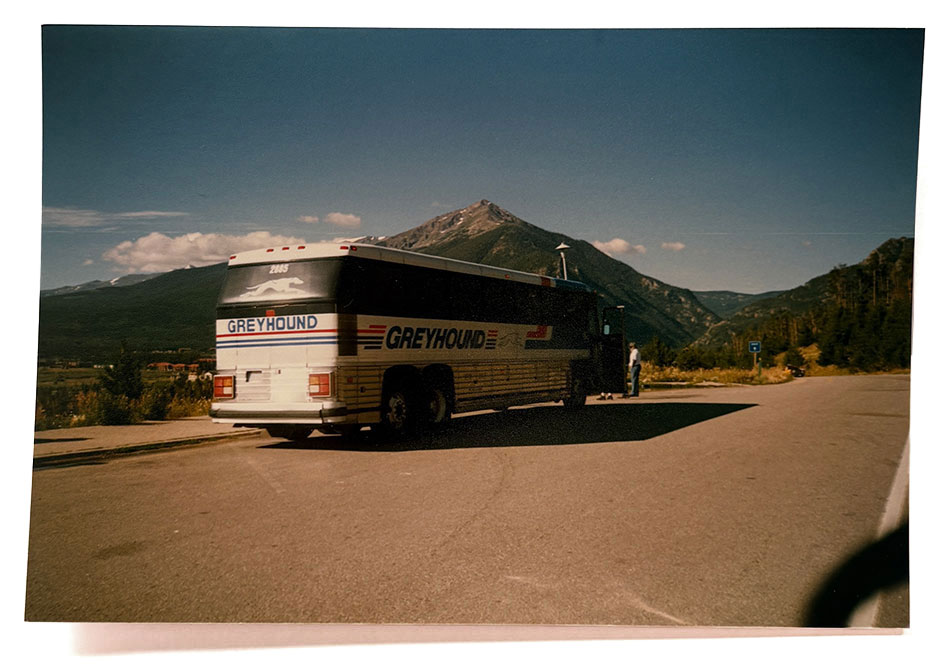
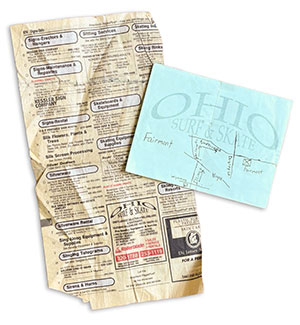
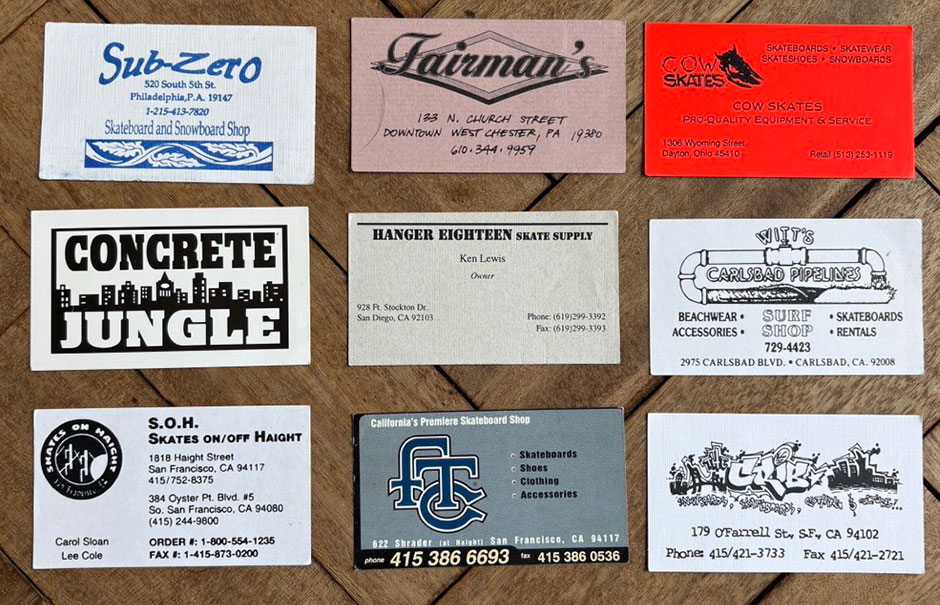
Literally, I’d get a Greyhound bus, get to the Greyhound station, and find the skate shop. They always used to have a phone book, a Yellow Pages. I would find skate shops, I’d tear that page out, and I’d just go. I’ve got all the business cards from all the shops I went to: FTC, Fairman’s, Concrete Jungle, Sub-Zero. I would basically get the bus, go to a town, get the Yellow Pages, and go to the skate shop. Every time you do that, it works. You just ask where the best place is to go skating. You get chatting, someone asks where you’re staying, you say you don’t have anywhere, and the next thing you know, you meet someone new with a place to stay. I stayed with a bunch of guys. I stayed with John Buchanan, who used to ride for Alien in Ohio. I stayed with him for a week. It was really hot. It was so humid. I think we just sat in the swimming pool because it was too hot. Then I went to Chicago after that, and I got a ride because they were going to skate a spot in Columbus, this ledge spot, and there was also a Vans Warp Tour thing going on as well. So we all went to that, and then they left me in Chicago.
 We were skating at Federal Plaza in Chicago, where that Alexander Calder sculpture is, when the Ohio guys left. There’s a long ledge there, and because it was a nice ledge with good ground, I was just doing the biggest 180 no complys off the end of it, stomping the things. This guy came by skating, and his name was Tony Allen. He used to shoot photos for Big Brother. We got chatting, and he said I could stay with him, as I had nowhere else to stay. So I just stayed with this guy, Tony Allen, who knew Gonz and knew Matt Hensley. He had all these lovely photographs of Matt Hensley and Gonz. He gave me a couple of prints. So I stayed in Chicago for like a couple of weeks like that and met a good crew like Nate Lyons, Reggie Destin, and Jesse Neuhaus. Jagger was there chefing at this point; he had stopped skating because he was injured, and I went and hung out with him one day, which was nice; it was just nice to go and hang out with an English person.
Chicago was sick; you could skate around because it’s flat, you could skate everywhere. There’s endless skating there. Skating the Art Institute and those ledges that show up in Timecode, all the spots in Chicago that show up in Welcome to Hell. The first spot in Mike Maldonado’s section, he does a backside 50-50 on this thing riding the Barge board, which is another board I love, the Toy Machine board, that’s in downtown Chicago. Loads of Jamie [Thomas]’s section is filmed in Chicago. That big ass long rail at the end he skates,
The long downhill one in the credits.
The slow motion credits, that’s in Chicago, which is two rails. It’s never been filmed to show that that’s two rails, but it is two rails, so he could stand on. Someone did that years before Jamie did it, anyway. I think someone boardslid it. Eric Murphy boardslid it. So, I was in Chicago, which is only a third of the way across America, if you look at it on the map; I’d only got a third of the way across, and I was five weeks into being in America. I had seen enough of that kind of America now, I kind of wanted to get to California. So at that point, I kind of fast-forwarded through a lot of the states like Nebraska, Colorado, Utah, Arizona, and Nevada. I did a much quicker Greyhound trip, a bit of sightseeing, and not much skating. In fact, I think I did the whole thing in 48 hours. When you go on the Greyhound from Chicago to there, it’s basically this same bus. You get on the bus in Chicago, and that bus goes to San Diego. But obviously, the drivers can only drive for a certain amount of time. You end up stopping at terrible places, and you eat terribly. You’d sit in the same seat on the same bus for two days, but the driver would change every six hours or so, or nine hours because they have to rest. So I did the same bus all the way across, and it was just terrible. You get to sit by all kinds of people; there’s a whole story about the Mexican Begbie, which I want to save for the book. I want to save that.
Because you’re on your own too, all of these experiences are embedded in your head.
Yeah, all of these moments, seeing Ricky, the Mexican Begbie, playing pool with Mark Heintzman. When you skateboard, and you don’t record it or photograph it, all those moments are gone, but this random stuff you never forget.
Did it measure up to your expectations? Were you sold on the dream at that point?
I think when you grew up in England or Britain, America’s where it looks like all the skateboarding happens. So, to want to go there makes total sense. But what nobody tells you is when you go there, you then have to deal with not just skateboarders, but you have to deal with Americans. And they’re different. The way they act, their demeanor is different to us. Their worldview is different from ours. That manifest destiny shit. That makes them act differently as a group of people, which is fine on the whole, but when you get out to the Midwest, that starts becoming a much heavier sense of entitlement, and that was a real wake-up call. Seeing how a lot of people in America really thought they were the masters of the universe. You know what I mean? You can’t really claim that because you’re handicapped by the fact that you’re one of the worst species ever to exist, by being a human. You can’t be a master of the universe if you’re literally the worst species ever. That’s a whole philosophical thing I could go down.
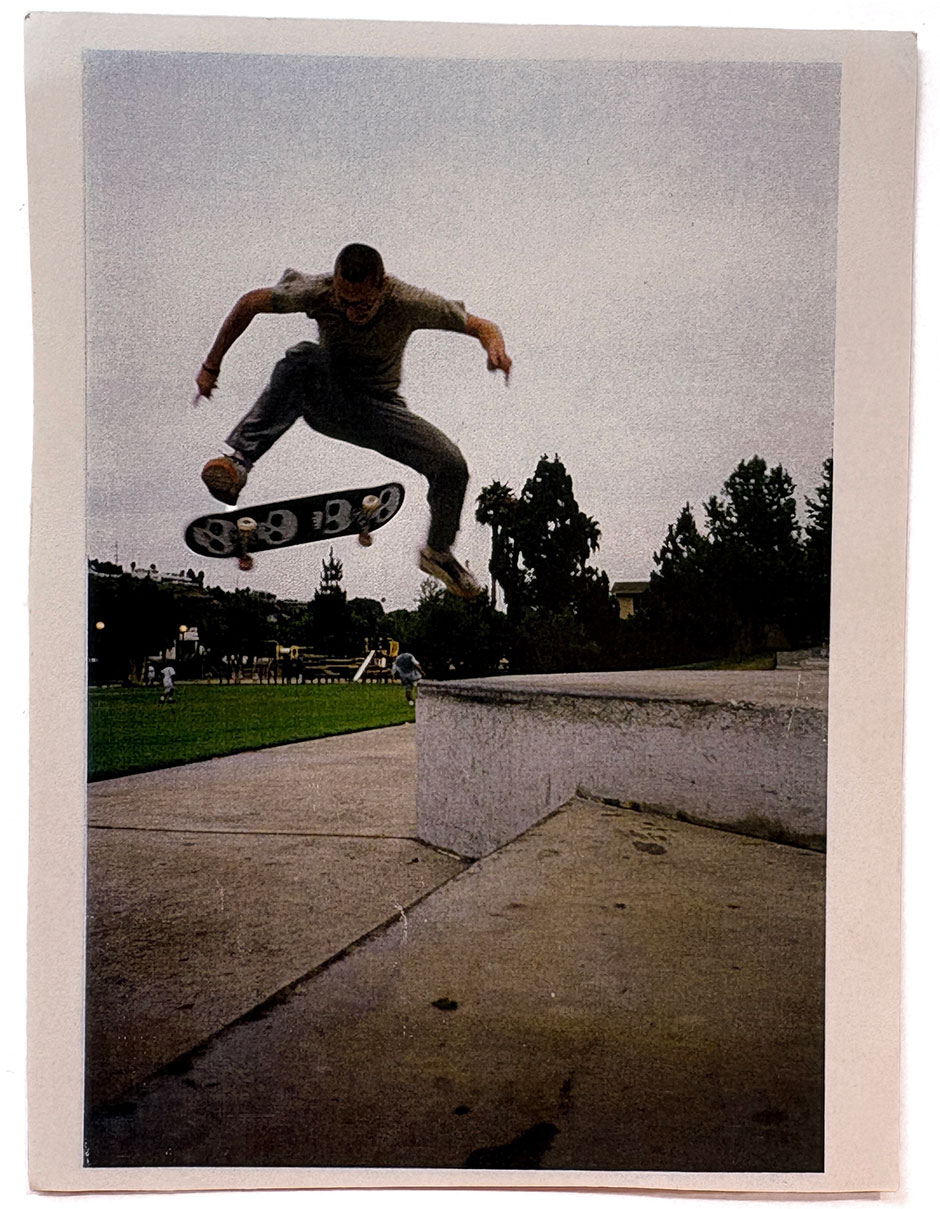
Chris applying his signature no comply to the EG Blocks in San Diego
But that was a wake-up call; obviously, skateboarding was different out there. Did it fulfill the dream of what I thought it was going to be? The East Coast did as far as skateboarding. I’d only seen some of these spots a year before in Eastern Exposure 3, and now I’m at them, grinding them. The ledges are still crispy and skateable. Everything was just almost how it was in Eastern Exposure 3 still. You’d go and see a pole jam that was in the video, and it was the same pole jam, but now it had like been knocked down a few more degrees because it had been hit a few more times. But it was the same thing. You see that rail; I think they used to call it a dinosaur rail. It was the rail that Quim did a switch backside 50-50 on, and they welded little triangles onto the top of that thing.
The big thick rail.
Yeah, the big thick one. I’m not sure whether, in my head, someone called it a dinosaur rail, but I went and skated that. The kerb cut that Donny Barley does the switch hardflip out of, all of the spots, to see them, it was crazy. So yeah, as far as expectations, as far as skateboarding goes and the spots, it was exactly what I expected. Meeting skateboarders was pretty much how I expected it. The most time I spent hanging out with skaters was when I actually got to San Diego. That was when I stayed with Dayne Brummett, and he was a handrail skater, like a proper gnarly handrail skater. In the sense of Jamie Thomas, the mission today, the first thing we’re gonna go and skate is a nine-stair rail. That’s the warmup. I’m like, “I wanna go skate a flat bar, a block or a bank”. And the warmup was a nine-stair. How could you get out of the car and start skating that? It’s crazy. So a lot of the close-up, sponsored skateboarding I saw was in California. It was seeing sponsored skateboarders trying to get on Zero. Dayne rode for a company called Enemy Skateboards. We were going to all these spots and then hanging out with people who were trying to become pro skateboarders. So that was gnarly. I went to the Tracker Warehouse and saw one of those CASL competitions or whatever they were called, the California Street competition series they had, which was almost like Little League Baseball, the way it was put together. They had those at the Tracker Warehouse.
I went there and saw Jamie Thomas and Adrian Lopez. Patrick Melcher was very obviously trying to get Jamie’s attention. He rode off the roof. He was wearing a black t-shirt with army pants, Jamie Thomas shoes, and he rode off the roof of the Tracker Warehouse. Things like that, seeing that close up. Skin worked at Transworld, so I went to Transworld briefly as well. I’m jumping around terribly here but you asked me what my experience of seeing skateboarding in America was. I want to say that it proved everything I already knew. I didn’t ever feel out of place, or not safe, or that anything was weird or anything crazy. Nothing really super blew me away. It was all kind of to be expected. It was just nice to see it firsthand. Going to UCSD, Point Loma, and seeing the Scripps rail- how do you skate something that high? Seeing the long ledge at UCSD, Elissa [Steamer] slammed skating.
The nollie tailslide slam.
Yeah, then there’s the rail Maldonado skated; I’ve got a photo of me doing a throw on grind on that, just a snapshot. Going out to America was what I expected, and it filled in some gaps, but it wasn’t mind-blowing. When I came back, it made me realise that skateboarding doesn’t just happen in California; it happens wherever I put my skateboard down. This sounds really selfish and really antisocial, but the most important thing in skateboarding for me is when I get on it and roll. When I can’t skate when I’m injured, I almost feel like I need to take a step back. I almost feel like I don’t want to be taking up the oxygen in the room from people who are actually actively skating. You know what I mean? If I didn’t skate anymore, I wouldn’t be around it, and I don’t think I’d have opinions about it. Because I think that takes all the oxygen out of the room for the young guys who are doing it and are passionate, and have new things to talk about. I promised myself that when I don’t skate anymore, and I hope that never happens. But if it does, I’ll probably stay out of it.
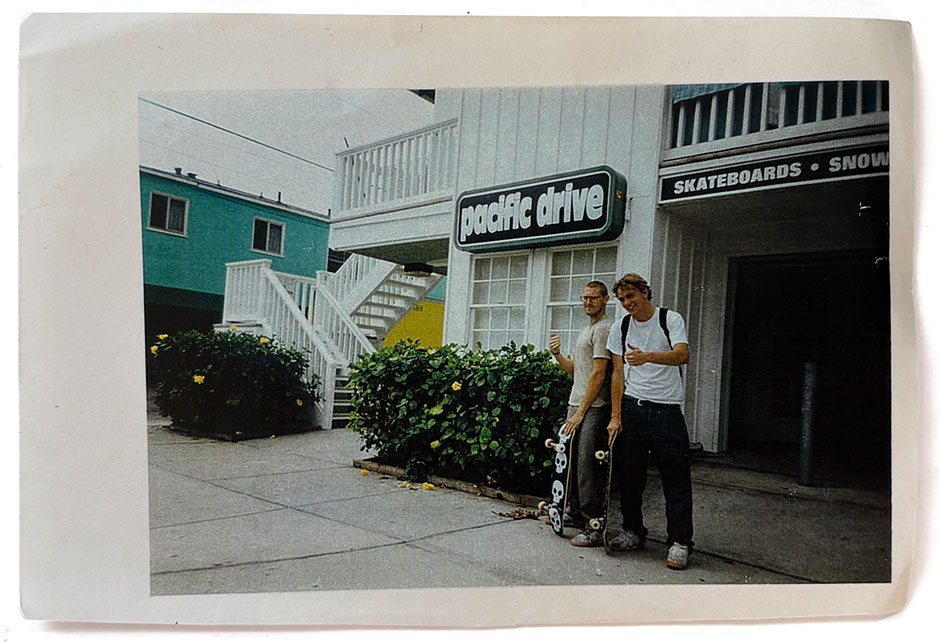
Chris and Steve Bevan outside Pacific Drive captured by Tidy Mike
But revisiting these experiences is valuable for somebody younger experiencing it now.
Something I’ve always believed in skating, and it’s a mantra for me in skateboarding. I want to see it move forward. I want to see the new stuff. I remember 411VM got kind of boring towards the end. We wouldn’t even take them out of the shrink wrap towards the end. When they first came out, you put it straight on. I would always watch them because I knew that there would always be a trick that I hadn’t seen before, and what I wanted to see was the NBDs. I can remember the first time I ever saw someone do a kickflip feeble on a flat bar. I had been waiting to see someone do that, and Jerry Fowler did one in a warehouse.
Back to your America trip, you go to San Francisco, and you’re experiencing that with Pin?
I was only in San Diego for a bit. I stayed with Skin for a couple of days, and I stayed with Dane. I also met some guys from Swansea, who were randomly there, Tidy Mike and Steve Bevan. I’d been in America for like two months. I was tired, and I hadn’t been eating well. I was eating crap, traveling around, and trying to eat ramen, Twinkies, and shit. The odd banana and a milkshake, but mostly rubbish, and food seemed expensive in America. So I was tired, I missed my girlfriend, and I really wanted to go home; I was done. When I was in San Diego, with three or four weeks left on the trip. I decided I was gonna skate so hard that I either got hurt and had to go home early, or I’d have an epic time. For the last four weeks, I skated so hard every day. I was going to get every penny’s worth out of it, and I was either going to have a good time from skating, or I was going to get injured. Either way, it was going to work out. I got a bus up to San Francisco and went across the high plains. That was a really nice journey, seeing cattle, miles of fields of cattle. I kept thinking of High Plains Drifter when I was up there. Then I got into San Francisco, and San Francisco is gnarly. I got off the Greyhound bus, came out of the station, and walked up Market Street. I’d been off the bus for about 10 minutes, and I saw an old guy trip off the curb and pop his head open on the kerb. That was the first thing I saw.
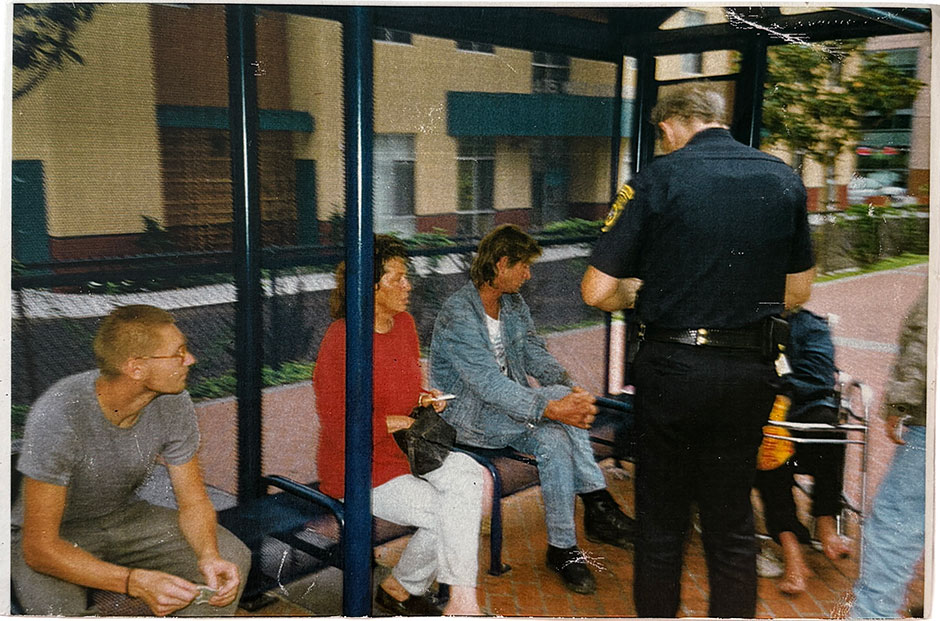
Chris having the authentic Zero S.D. experience with Lynn “I am Zero!”. PH:Tidy Mike
I remember it was filthy; Market Street was dirty, especially around the Greyhound station. It was vile, stinking, smelly. It’s got the subway, I guess, and there are trams, but it was like going back to New York straight away. It was super dirty, much dirtier than San Diego. I did have somewhere to stay. Some guys were staying up just from Union Square in an apartment on Geary. I stayed with those guys, and then Pin showed up. He was staying with someone that Toby Patterson knew, a lady called Akemi Akamoto. We stayed with her for a week. And I got the vibe that she probably had better things to do than have two English guys in her house. On Pin’s first day, we just had a chill day; we sat in Yerba Buena Gardens down by the MOMA in San Francisco. Pin either ate something or got a sunburn, and he had a really bad allergic reaction to either the sun or food. His face swelled up in quite an alarming way. At the time, we were kind of chuckling about it. But looking back, it must have been kind of scary. He had just gotten to America and had this allergic response in a minute. We probably could have gone to a chemist and gotten some antihistamines and fixed it.
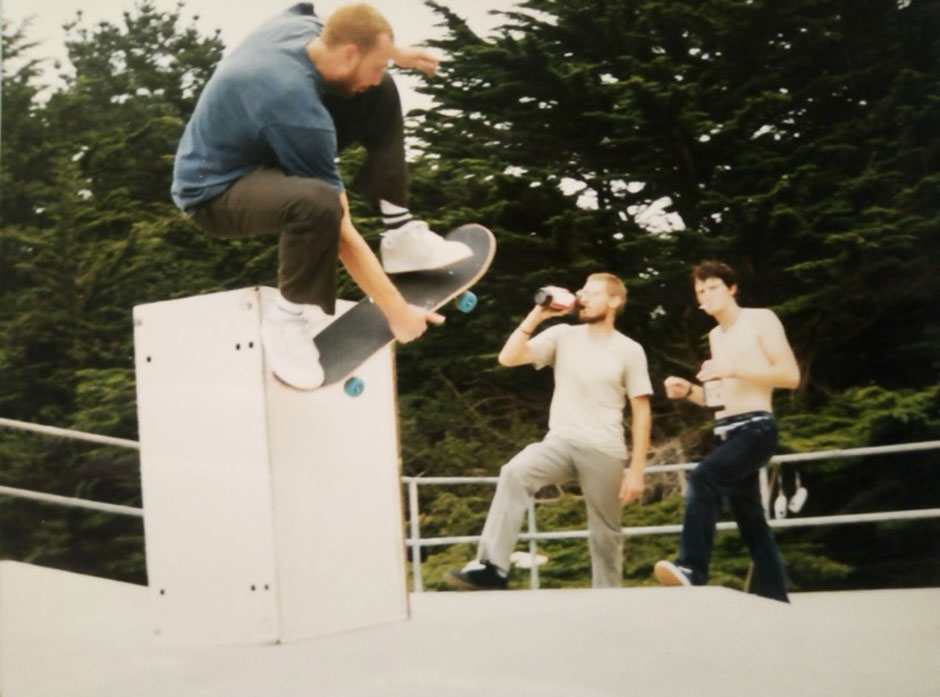
Pin gets creative and wallies at Fort Miley with a King Of Beers Pulman BGP
Anyway, Pin had this for the first couple of days. Then we were bombing a hill somewhere; I think we’d been to Wallenberg. We were bombing a hill, and I ate the most shit bombing this hill. I learned the hard way that you don’t really want to be falling and sliding on your back on a hill when you’re going that fast. I burned my back off; I had such a big scab on my back, it was the shape of Africa. I was in shock from it. That was the first realisation that these hills are not like back home in Wales. They’re long tarmac hills. And you build up a lot of speed to the point where you’re going so fast, there’s no way you can get off your board other than sliding. You can’t run. You’re going 30 miles an hour, and you can’t run at 30 miles an hour. If you try to step off, you’re eating shit. The only thing you can do is slide and be on your arse or whatever; that is, if you don’t get speed wobble. If you’re skating down the hill in San Francisco, the only way to moderate your speed at all is just to hold your arms out; just creating a bit of drag with your arms can actually count, you’re going so fast that it actually helps. I was staying at Akemi’s house, and every time I went to bed, the scab would stick to the sheets, so I’d have to wear a t-shirt to bed, because I didn’t want to mess up this girl’s house and her bedding thing. Then when I woke up in the morning, the t-shirt was stuck to me, so I had to get in the shower and have a shower until the t-shirt soaked off. That was my San Francisco experience. I took a good slam, but it could have been so much worse. I learned the hard way, skating those hills.
There’s a good photo of you from that trip, skating a Jersey barrier.
It was the summer that they had that barrier spot down by the waterfront just up the road from where that handrail off the cover of the first cover of Slap was, that curved handrail. Paul Gonella shot some photos, just point-and-shoot photos. The spot was a basement of a car park that went up, and they had knocked the building down. Then they had a Jersey barrier at the top of this bank, so it was perfect: this long run up, then a bank, and then a Jersey barrier on top. Pin and I would spend a day there often with this guy, Shawn, who we had met, and I was hanging out with a lot. Quim Cardona and all these guys would show up, Brian Anderson would show up, or you’d be there with Dan Drahobl. All these guys are so good at skating, so we had these demos. Justin Strubing was there one day; all these amazing San Francisco people came, and we’d skate this Jersey barrier together. There are lots of photos from that summer, me and Pin skated that a lot, and it was hard to skate. We were definitely learning how to skate a barrier. I figured I could wallie over it, land, and manual off the pavement, or wallie and do tuck knees out of the top. Because of the nice shape of it, I learned switch backside wallrides on the back of it.
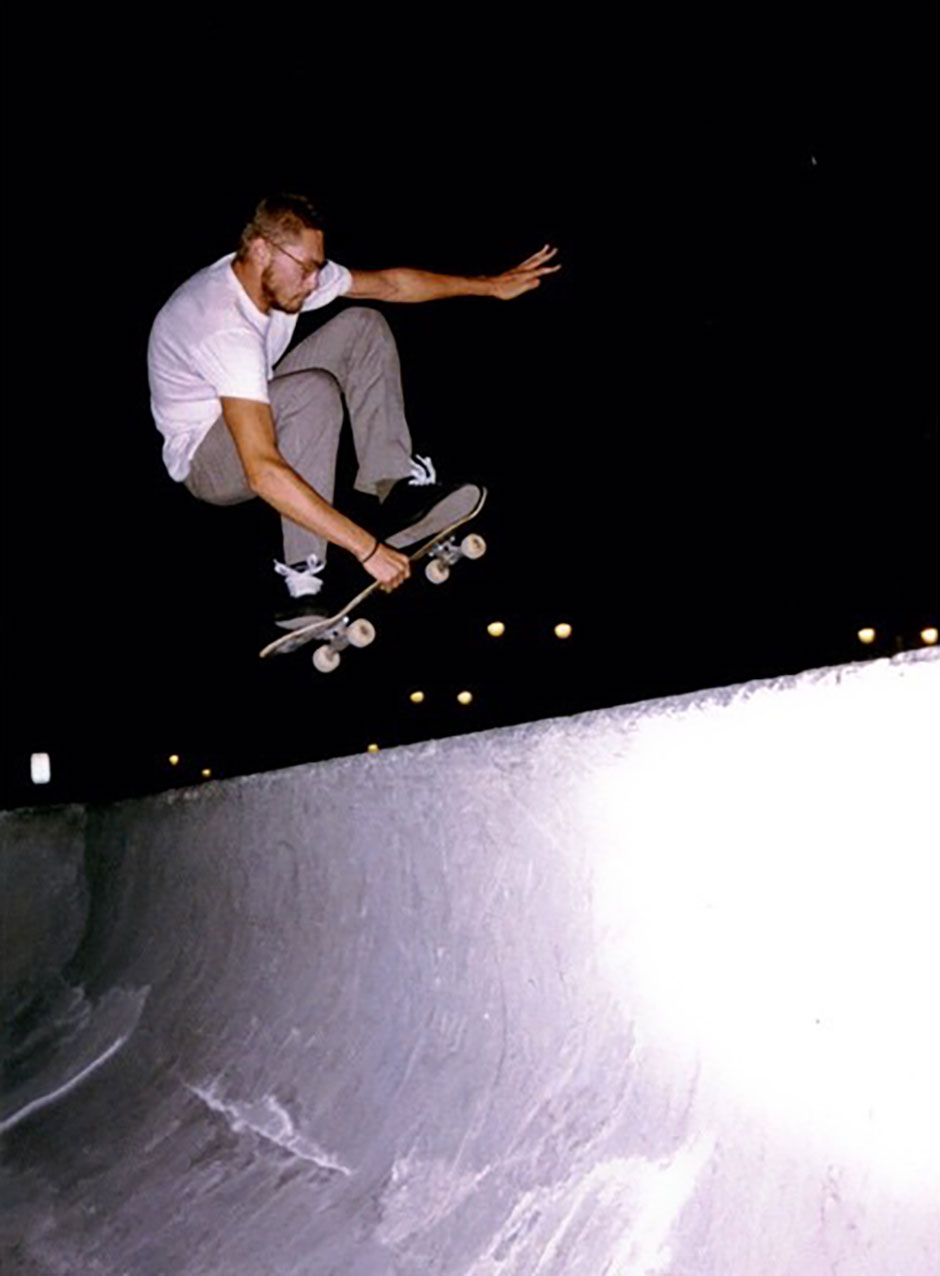
Jersey barrier experimentation in San Francisco shot by Paul Gonella
What happened when you got back to the UK?
When I came back, I went back to Southsea to live. I had a job in the skate shop, potentially. It wasn’t long after I got back that Bored opened their shop, but I was already working in this kind of Air Circus shop, which was a franchise, which actually later became Route One, but it was called Air Circus back then. It used to sell kites, rollerblades, and juggling balls. It wasn’t a skate shop; the only other skate shop was Offbeat in Southampton. The reason they sold skateboards is that they already sold rollerblades. I suggested they get skateboards, so it’s probably my fault.
Soon after returning, you win the competition at Newport.
I did; there was also the St. Albans comp that I won, which could have been after I got back from America. I went to the St Albans comp, and I didn’t practice; it was too hectic, so I couldn’t practice. I just rolled around the street course. Then when they called time, I was like, “Amazing. I have a minute to myself.” So I skated, and I did this run: 50-50 the flat bar, crailslide on the quarterpipe, pivot to tail, all basic stuff, but I did all my tricks. I remember that [Dan] Cates was there and Chris Oliver was there, but I ended up winning because I think Chris was trying to ollie the driveway to front board down the handrail. Something crazy, but he didn’t do it. So he didn’t score any points, and Cates probably fell off something. They’re the two other people I remember being there. I just landed all my tricks. It was a long day, and they announced the results really late as everybody was leaving: “Unsponsored Over-16 Street is Chris Pulman.” I won an 8.5” Reaction deck with the professor on it.
The Newport comp was when I had all these Toy Machine boards, so that was maybe the summer of 98. Dave Jeffries, who worked at Addict, saw my winning comp run and got in touch with the skate shop. He said he knew I didn’t like Maharishi and that kind of clothing, and that I could wear what I wear, but he wanted me to ride for Addict. So, through Dave, Addict was my first sponsor. The very first person who gave me anything was actually Thomas Campbell. He had a tiny little company called Go Dog, and when he was over here in England, he gave me a hoodie. But Dave saw something; he liked my skating, and he asked me to come on board with Addict. He kind of had me as an unofficial team manager. A team sensei, if you will… Then obviously once you’ve got one sponsor, you might as well get other sponsors because if you’re going to do the work, you might as well do it for everybody. Do you know what I mean?
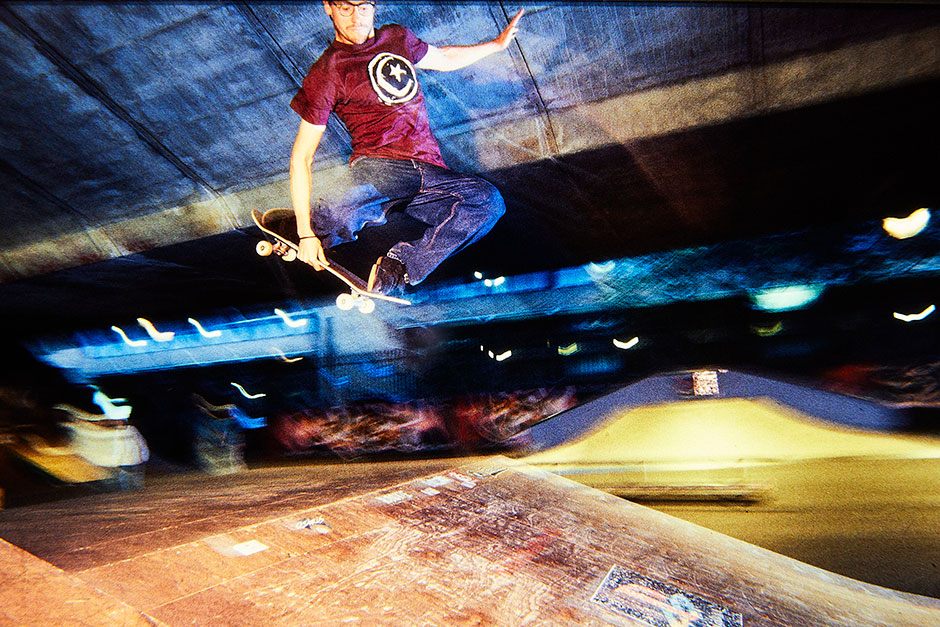
Tuck knee contortions beneath the Westway for Richie Hopson’s lens
This is where shooting photos with Richie Hopson enters the picture.
I connected with Richie because Andy Humphreys knew Dave Jeffries, maybe, and I think Richie was living with Andy Humphreys at the time. Andy is probably quite fundamental in the background of lots of stuff I did in a way. I don’t know the details, but there were a bunch of people in the background there: Fos, Andy, Richie, and Dave Jeffries were all paying attention to me at that point. So I owe something to those guys. I wanted to ride for Emerica. I wanted to get Sheep shoes, but I wanted to get Emerica shoes, really. They weren’t interested, though. They gave me some Etnies in the end, but I loved Emerica. I would have given anything to ride for Emerica, but it just never happened.
This is Jamie Thomas’ first pro shoe era.
Yeah, I basically wanted that pro shoe. There was even a second shoe that came out after he quit. The Jamie Thomas two was called the Phocus because he’d left by then. It was obviously a Jamie Thomas shoe with his name taken off, or a version of it, because it was a rubber-toe shoe. Then that became the Heretic, and that shoe has been around forever with the rubber toe. Fallen even did a version called The Reliant, another rubber-toe skate shoe. Anyway, Richie was the right person; he was friends with Gorm [Ashurst]. We did a two-page spread for Document together; Brian Sumner’s on the cover, doing a smith down some stairs. It’s got a tuck knee over the spine at Stockwell with blue jeans. There’s a shifty at Wimbledon BMX track in there, and it’s also got a sequence of me doing this 50-50 backside 180 out transfer at Southsea Pier. There’s a tre flip photo on a bank too.
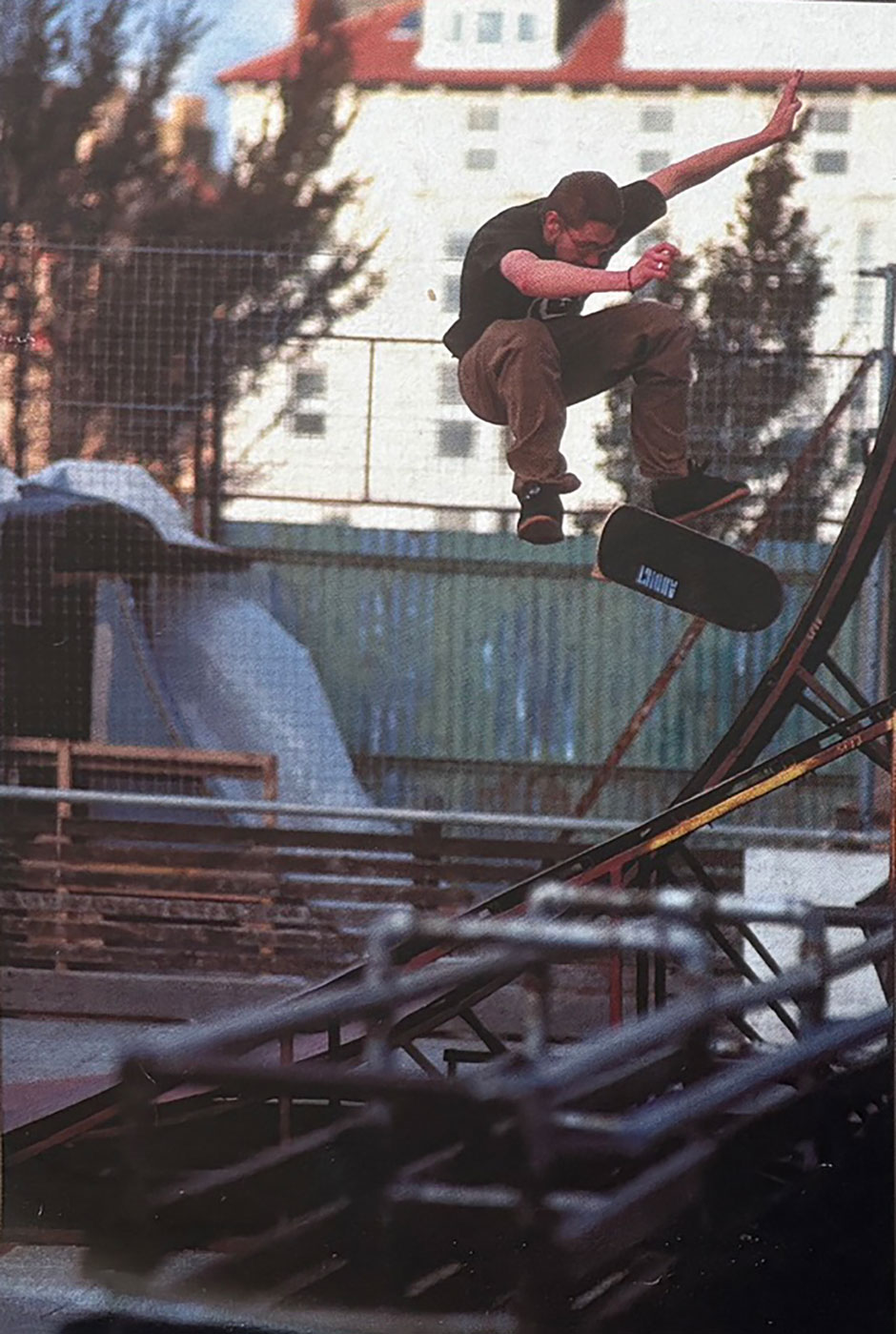
360 Flip at Southsea for a two page interview in Document Magazine. PH: Richie Hopson
How did a board sponsor enter the picture?
I loved Toy Machine boards. I really wanted to get Toy Machine boards, but Seth [Curtis] was getting flowed Toy Machine boards from Slam. Andy Humphries called me up and said they couldn’t sort out Toy Machine because Seth was getting flow. I thought I was their biggest fan at that point. I loved Ed, because he was a nerd and all that shit appealed to me; it was just perfect. The blood-sucking corporation, loyal pawn shit. I loved that. But as Toy Machine wasn’t on the table, Andy said I could get Foundation boards. At this point, when you saw the Foundation page in the Tum Yeto catalogue, it was a bit of an afterthought; even though it was Tod [Swank]’s main thing, it was obvious that it didn’t sell anymore. It had gone from the years of Ronnie Creager and Heath Kirchart, into the post-Rolling Thunder years when it was all starting to be a bit of a mess for a minute? It was right when Ethan [Fowler] was getting on, and Ethan Fowler’s skateboarding was important to me. I stress ‘skateboarding’ there…
Mike Rusczyk era.
Yeah, Ethan Fowler and Mike Rusczyk. Basically, Andy called me up and said Slam couldn’t do Toy Machine; should we go do Foundation? I knew that Ben Bodilly was already riding for Foundation, and he suited it. He’s from that era; he’s from the Super Collider era, and Ben looks like he fits in with that world. Andy said Ben didn’t really want to do it anymore, but I wanted to double-check with Ben because he was one of my best friends. I asked him, but he was genuinely over it. I don’t think he wanted to be a sponsored skateboarder; that was a world that was just not particularly rewarding for most people.
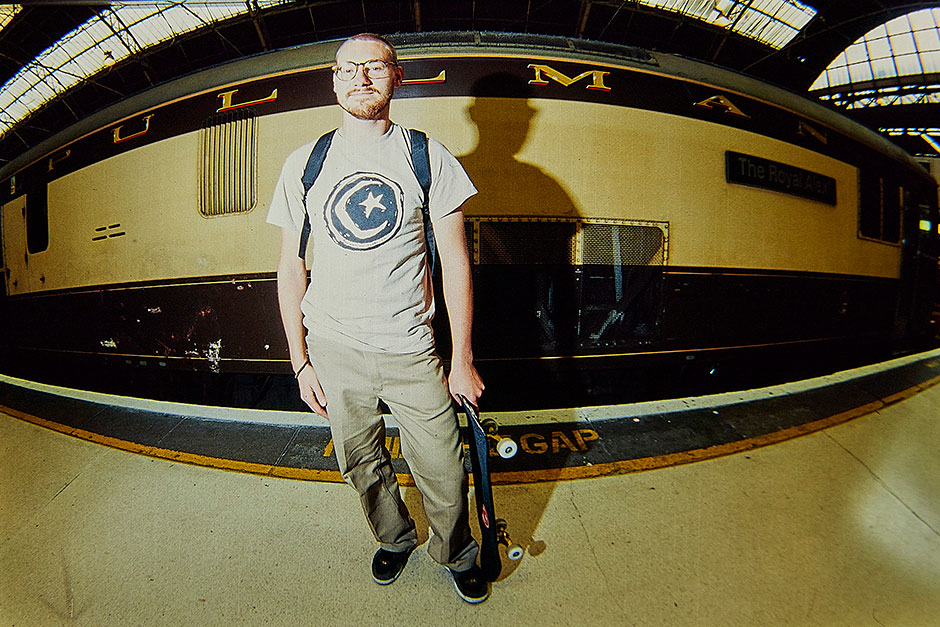
Foundation pride era in front of some namesake rolling stock. PH: Richie Hopson
I went to the warehouse and picked up a couple of boards. They didn’t have eight and a half; they only had eight and a quarter. So I had to go down a size of boards. I did that, and I got really into that. I threw everything into Foundation. I just loved it. I liked Tod [Swank]. I loved Josh [Beagle]. I liked the old team, I liked the new team. I loved Mike Rusczyk. Even Dan Shimizu was getting on. I remember going to see Beagle at the warehouse with the giant skateboard in the corner. We were talking about footage and said, “Check out this guy”. And he showed me this footage of this guy doing feebles and hurricanes to fakie on a handrail. He said, “This guy Dan Shimizu, he’s gonna ride for us”. The next thing I saw, he was in 411VM, and it was that footage. I had just come from Chicago where I had seen this Progression video, and I was telling Josh about someone in it. I told him he’s really good, and he suits Foundation. I loved how he skates, kind of Eastern Exposure, but also a bit California. He had more to him than just obstacles. Josh said that they had a guy called Mike from Chicago, they were thinking of putting on, and I said that was the guy I was talking about. So when Josh was having that conversation, during that decision process, there was a moment when I know I was there. I didn’t make that decision, but it was just nice to be another person championing Mike getting on.
During this era, before the no comply made a resurgence as a must-have trick, you had one in Nervous Breakdown. How was that received?
I went out to America again, and I got a chance to film. I actually don’t remember who filmed the clips, but I filmed a bunch of stuff at one school near Balboa Park in San Diego. There was an outdoor auditorium, and it had this lovely stage with a brick floor and a privet hedge all around it. So you could do tricks over this nice hedge down this drop. It was the most beautiful San Diego spot ever because of this huge auditorium in the background. So I went and shot a 180 no comply over this privet thing. Then another time we went to this other spot, which was called the College Gap. It was literally in a proper American college campus accommodation, where it had an apartment block, and they had half a basketball court outside the block. You could skate along a ledge and do tricks down it. Everybody skated it, and it was in all the San Diego videos. I went there, and I was like, “Well, I’ve only got one trick I can do down that drop, so let’s go!” So I went, and I did a 180 no comply. It was quite hard, but it happened. I’m riding this Zero Dark Man board covered in Foundation stickers, and wearing these big chunky globes. I landed it right away, and I gave the clip to Josh. I gave him a bunch of other stuff, which was stuff we’d filmed here, which I then converted to NTSC, and I don’t think it fit. The Americans never liked to use PAL footage. That’s why I figure the old Andrew Currie video parts used to end up at the end of Foundation videos, I think, because they hated the format maybe…
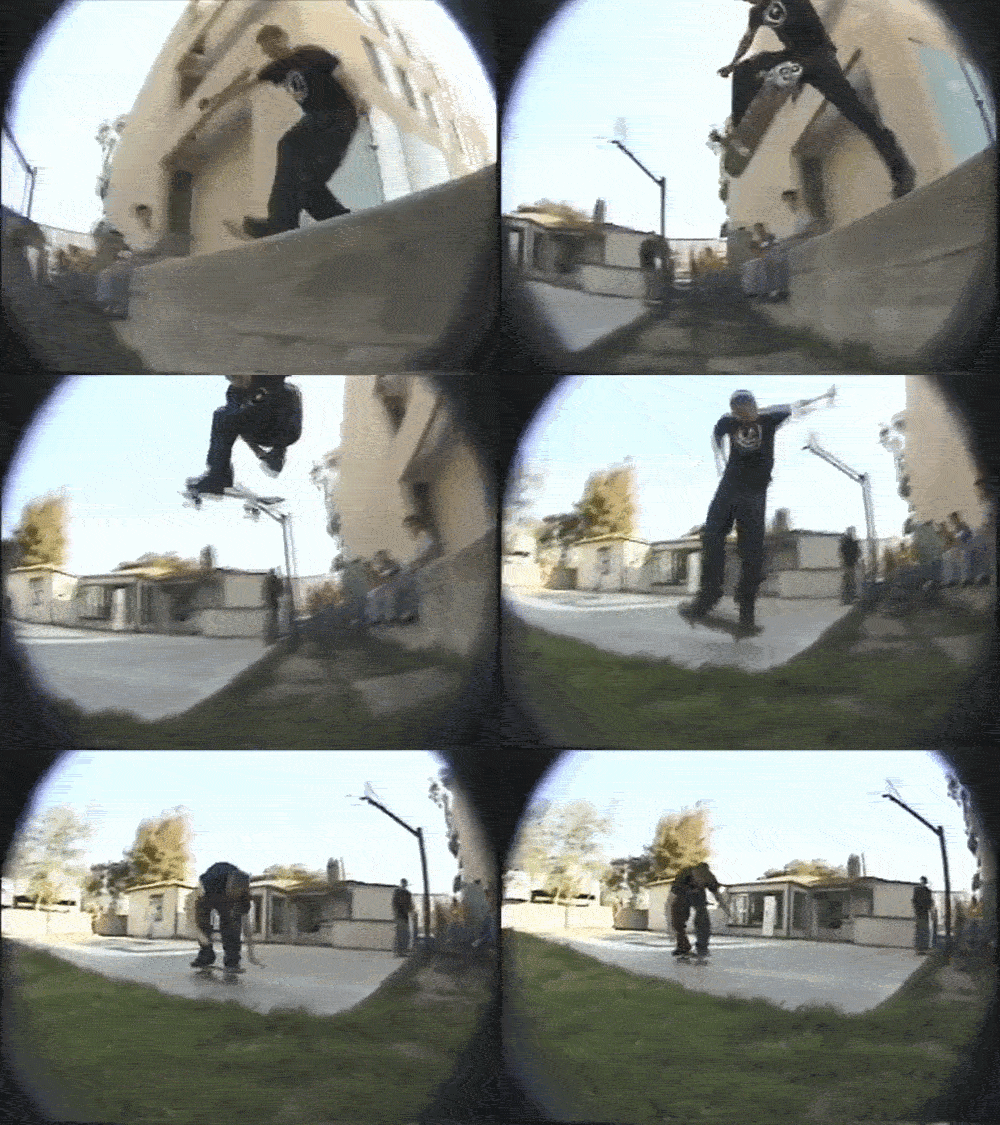
signature no-comply down the SD college gap from Foundation’s Nervous Breakdown video.
Anyway, I gave Josh the clip; he used this trick, and it was in the Foundation video. I didn’t make it to the premiere because it was at Spreckels Theatre in downtown San Diego. It’s the same place where they had the Zero Miseld Youth premiere, one I did go to years later, which was bonkers. I spoke to Josh another time, and he said at the premiere, my trick got the loudest cheer. He did slow-mo it to be fair, but I will always have that. Even though I wasn’t there to witness it, I’ll always have the fact that Josh told me it was one of the highlights of that whole video. My tiny contribution, and the only time I’ve ever been in a proper American video, actually had a response. That happens to me; things like that happen to me all the time. When someone actually gives me a chance, it works. Nobody ever gives me a chance to do my thing. But I’m so lucky, generally, that every time I do something, it works.
You shot a no comply down the seven at Southbank around this time, too.
[Matt] Pritchard was riding for Globe, and he became the team manager and asked me to ride for Globe. I’d been trying to ride for Emerica. Dan Cates was trying to get that whole Vans thing going. He actually came down for one day when I was shooting my HAUNTS, and he said, “You should get on Vans”. I thought Vans sucked at the time. This was mid-nineties Vans. Do you remember? It was all the Pro Series, and those fucking terrible adverts on 411VM. It had obviously completely lost direction. They were making shoes that looked like that Wavee shoe, but they were making them in the nineties. I never understood why they brought some of that shit back. They were the Vans wilderness years. They only had one good shoe, and they couldn’t get it to anybody. When Pritchard became team manager, he asked me to ride for Globe, and I tried really hard, but from the get-go, they didn’t make any shoes that were good to skate in or well-designed. Nothing in the range was good to skate in; they were all terrible shoes. They just weren’t for skateboarding. They had the airbags in the front; you will never need them. You want to feel the board; I don’t want air between the board and me. I wanted the thinnest shoes I could get.
So it was a bit of a mess, but I tried, and I was obviously so flattered. Steve Charles at Globe was paying to get us around the country and take us to things. We went to Stratford skatepark and opened it. We did some demos and bits and bobs. None of us were getting paid; it was just shoes, but obviously, with another sponsor on the pile, every time you go shoot a photo, you’re not just keeping yourself happy; you’re keeping three other people happy. You’re also keeping yourself in products. I was starting to learn what you needed to do in skateboarding to make it- I don’t want to say a job, but a way I could trade my labour for the stuff that I needed, basically. It’s like having a job, but without that money getting in the way in the middle. How do you trade skateboarding for product? That’s essentially what it is. If you think about it, skateboarding has a very anarchist way about it. The way that we exchange our labour for product, instead of exchanging our labour for money to buy the product. I love that model, and I really love that part of skateboarding. A lot of people see it as hustling, but basically anything you do where you’re trading your labour, and it doesn’t include capitalism.
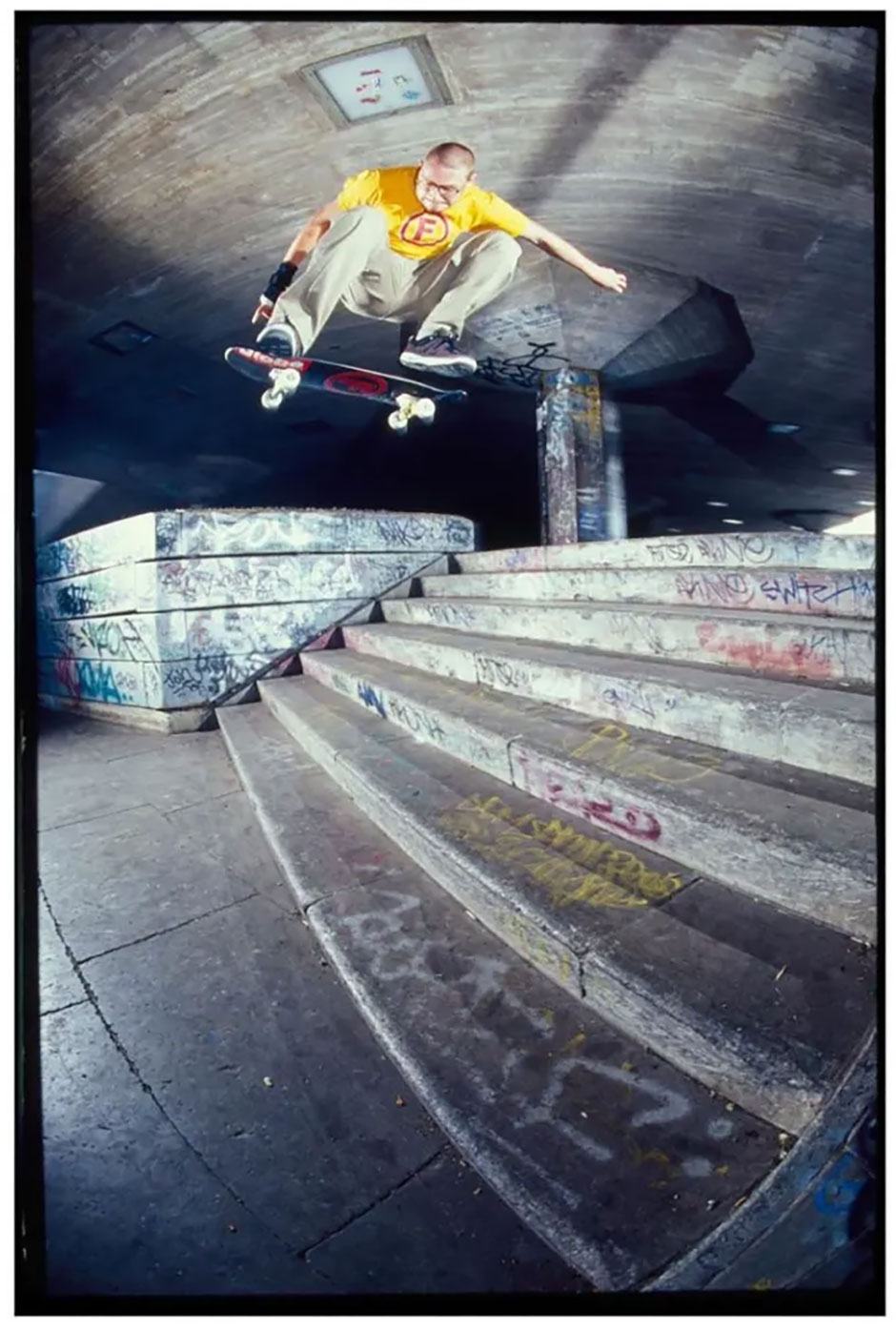
No Comply flight down the southbank seven. PH: Wig Worland
Exchanging your labour to keep labouring.
Yeah, whenever you exchange your labour for money, you will always get ripped off because your time and your labour are literally priceless. It’s priceless; you can’t take £50 and create labour from thin air. You have to have a human, and I’m the only human that can do the labour I can do. So theoretically, it’s priceless. It has an infinite value because no money can actually create it. The part of skateboarding that was trading your labour directly for products, that made sense to me in an anarcho kind of way. There is a hierarchy of sorts, but it’s mutually beneficial, so it makes total sense. This made total sense back then because there wasn’t any cash. You couldn’t even think about getting paid because not many people were actually getting a cheque every month back then. So money, a wage in skateboarding seemed impossible. It seemed like only about 10 people on the planet actually got paid to go skateboarding.
We were going on a Globe trip to Amsterdam for Freeride magazine, with Richie Hopson, and Freeride
We had someone to stay with in Amsterdam, so we went. I had to go to London to stay for a night and then get the flight; I was staying somewhere random. So we were doing this Amsterdam trip for Globe. I called up Wig and said, “Hey, I’m going to Amsterdam tomorrow, but I’m going to be in London. Can we go and shoot that photo?” We were going to shoot a sequence of how to do a no comply, and I said I’d get a no comply for him at Southbank. I went and shot the 180 no comply down the stairs, and I also went behind Shell, and we shot a couple of sequences of a straight one and a 180 one for the how to do it. I’m skating a black Ethan Fowler board, with yellow trucks, and a yellow T-shirt, tan pants, and these horrible Globe shoes.
Big Globe sticker on the board.
Oh man, stickers all over everything back then. I was wild with that stuff. I didn’t care. In that sequence of the 180 no comply, there’s one frame in that, which is my favourite; it’s one of my favourite ever skate photos. It’s the one where I’m like 10 feet off the ground doing the no comply and the 180 no comply. One of the frames is banging. It’s kind of like that one Evgeny shot of me outside the portrait gallery. I called up Wig, and Wig came. I remember it because this is when I was super into everything Foundation. I had Pig wheels. Pig bearings, Pig tool, Pig wallet. I got the trick down the stairs, but I blew up all my bearings. Those brand new Pig bearings just exploded. Wig took me to Slam, and I didn’t even know how to get there from Southbank because I was so rookie at London. We went, and I think Seth gave me some bearings; that was one of the first times I really met Seth that day. The next day, we went on the Holland trip, and that was an article in Freeride magazine. There are a couple of photos in that, and that was the one where I actually got a cover. On the cover, it’s me grinding along this black ledge. It’s like an out ledge, and then it goes down in a tiny photo. The photo is printed even bigger inside, like a double page spread, but it’s an alternate angle where Pritchard and [Lee] Dainton, and everybody is in the background with their arses hanging out. They’re all in the background, and they obviously couldn’t put that on the cover. That’s the only cover of a magazine I ever had.
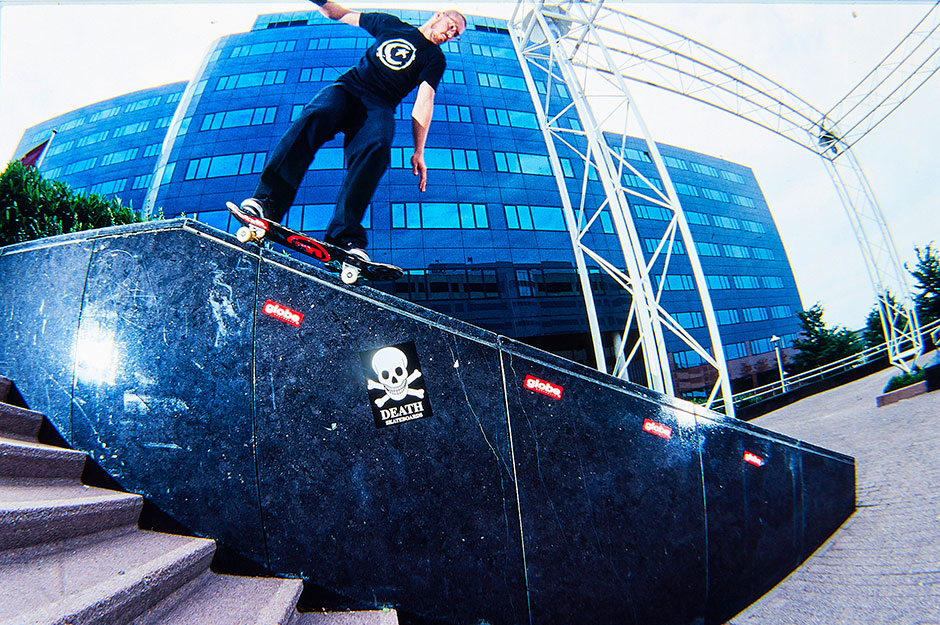
The Dutch backside 50-50 that graced the cover of Freeride shot by Richie Hopson
Let’s fast forward a little from that Slam visit. While you’re in America with Foundation, Paul Sunman emails you to offer you a job.
I wanted to move to London. My girlfriend at the time actually worked for the government in some capacity, so she had a chance to move to London easily. We were living in Portsmouth anyway; it wasn’t like we were living in Wales. I knew I was going to be close to something, but I needed to get a job. You can’t just move to London; you’ve got to have a job before you go. You can’t just pitch up and try to make it work. That’s really hard. It makes much more sense to secure some kind of job. Just renting a flat in London is a nightmare, isn’t it? Sometimes you can try all day and never even get a viewing. I asked Fos if I could get a job at the warehouse, and they could have given me days, but I needed four or five days a week. I needed a solid salary job because I was going to rent a house.
Fos, Andy Humphries, Pete Helicar, Kirsty, and Paul Sunman were the four people there, and Brent [Pontin] was working in the warehouse at that point as well, the old Latimer Road warehouse. I loved that old one. There was a little cafe, and we had dinner one day, me, Paul, and Kirsty. They didn’t really interview me. They were just asking me what I was doing and where I was at. I was very honest. I said, ” Look, I want to ride skateboards. I want to do whatever it takes to do that”. I explained I could do anything, whether it’s to do with business or not. If it’s a skill you can learn from a book, I’m always going to be confident that I can do that. You know what I mean? If it’s learning to be a plumber or a nutritionist, it’s not that those people are magicians. You can learn those things. It might take time and a skilled teacher, but you can learn. I’m a big believer in that. So when I had this meeting with Paul and Kirsty, I was like, “Hey, I’ve never managed a retail shop in Central London before, but I’ll give it a go!’ Hahaha.
I said, ” Look, I want a job. I don’t want too big a job, but I want enough of a job, and I’ll do anything to see what fits”. I got on nicely with Kirsty and Paul, and they knew I had a biology degree. If you’re college-educated, you can do that shit, can’t you? Basic maths for retail. Paul asked for my email address, so I set up an email address. Then I went out to America, took my girlfriend, did a couple of bits, went to see Tod and people like that again. Then I got an email while I was out there, and Paul said they wanted me to manage the shop, to be retail manager of Covent Garden. That was crazy. It felt big, and it seemed much bigger than it was. I didn’t follow fashion; I knew of brands, but I wasn’t into clothing brands. I obviously didn’t live in London; I wasn’t around, and I’ll be honest. I wasn’t that interested in it because I was just interested in skateboarding, and all those other brands looked like they were hanging off the back of skateboarding, which pissed me off a bit. So it was a bit intimidating. Then the mail mentioned the salary at the bottom. I looked at it, and I called my mum, and I said, “They’ve offered me this job, and it pays this much”. She said, “What? That’s more than your dad gets!”
“I wasn’t that interested in it because I was just interested in skateboarding, and all those other brands looked like they were hanging off the back of skateboarding, which pissed me off a bit”
My dad was a Sergeant in the RAF. He was a chief technician, like a mechanic in the RAF. He fixed Tornado jet engines, and helicopters, and shit. He was good at that shit. Like nerdy, good at that shit. I was going to run a skateboard shop in Central London, and I was going to get paid more than someone who’s a Sergeant in the RAF. I thought, I’m doing it for that reason alone. It wasn’t because I wanted to one-up my dad, because he was a good dude; there was nothing like that. There was no rivalry. It was just the fact that all these people had told me my whole life, you need to get an education, and do all this shit to make money. You can’t just ride skateboards and get paid more than somebody who has done that. I was doing it on the principle that I’m going to get paid a stupid amount of money, and it really wasn’t stupid. It was such a stupid amount of money that within two years, I’d managed to double that salary.
When I came in, the profit margin at Slam wasn’t great; I just tidied it up in really obvious ways. I just did some weeding in that business mostly, as I was finding my feet. I wasn’t very good at buying stuff at the start. It takes a minute to get used to that without computers because you’re freestyling it. You’re doing it all on guesswork. But with a bit of weeding, I tidied it; I was tidying up bits of money stuff and making sure we were getting the discounts we were supposed to get from quantity buying, real basic stuff for retail. It just helped you get better margins. The gross profit almost doubled from having a terrible to a really respectable GP. They asked me how I did it, and I said How did you guys not do it? Because it seems so easy. This is the rent, these are the wage bills, these are the rates, this is the stock cost, this is the electricity cost. That’s pretty much everything there, and so we’ve just got to make more than that. It’s a simple equation, but you’re always aware of those costs. Retail seems really quite simple to me. Seth stayed on as an Assistant Manager. He was an acting manager when I began, but I don’t think he was ever officially titled the manager. When I came in, I thought Seth might have been bummed that I took his job, but I quickly realised Seth was massively relieved that he didn’t have to do all that stuff. He didn’t have to think about money, and spreadsheets, and margins anymore. He could get on with doing the fun part of retail, which is selling stuff to nice people.
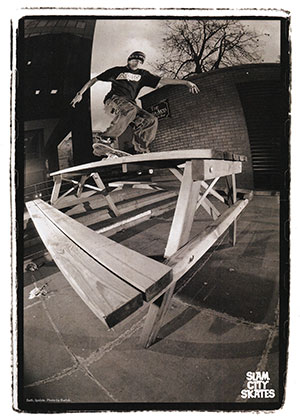 Seth was the ultimate assistant when it came to that side of things.
I came in completely rookie, knowing nothing about fashion, and not really knowing much about quantity buying, having never bought that quantity of shoes before. I’d done shoe orders, pre-orders for shops, but I had never ordered that much. I was getting used to that. Going to order Stussy, that’s the maddest thing. The first time I went to buy Stussy, I went and looked, and there were rails and rails and rails. There must’ve been about 500 pieces in this line; there were so many pieces. I was looking at it, and thinking how could you possibly pick this and know what people are going to wear next summer? I realised I was going to have to get good at this real quick.
While juggling distro brands as well.
Yes, there was a little bit of that. When you have a wholesale business, and you have a retailer attached to you, from the outside, it looks like you have very cheap stock going in at a high margin. It wasn’t like that at Slam. I paid the full wholesale price for everything. I wasn’t getting stuff on a discount from Slam. It was all invoiced and done properly, but as a result of that, there was a massive push to have the brands the distributor represents represented in their own retail space. So there was a massive push to have brands in the store that we sold quite well to other retailers, but probably wouldn’t do so well in Central London. The shining example was a brand called Freshjive, which we sold. It probably had a moment at one point, but I don’t remember selling any of it in the shop that wasn’t on sale. It just didn’t sell. Andy Humphries was the rep, and he really wanted to get that in there, but it just didn’t work. Nothing you could do with that brand sold.
There were other brands that came along like that, Zoo York clothing; we had too much of it, and the T-shirts and prints weren’t done that well. Also, there’s trying to deal with the overflow from their own distribution. When people didn’t pay their bills, things became a bit tough. If you’re a distributor and you’ve got a lot of product that you’ve pre-ordered, then someone doesn’t take their order, or they go out of business, you’re stuck with a lot of product. You’ve got to put it somewhere, and the easiest place to put it is in your own shop because it’s the simplest. There was often a lot of pressure to take certain products. In my head, I knew If I had that space and I could spend it with Shiner, I would just spend that money on Indy trucks, Reds bearings, and Spitfires. Then I would turn that into money so much quicker than having a rail full of Freshjive.
There were concessions. Covent Garden was a small shop, and every inch in that shop was prime real estate. If something sat on the rail for more than a month, then in my head, in my mental spreadsheet, that was cutting into the margin of that. When I sold that product, I was making less money on that day because that product had to pay rent for that month. It was essentially paying rent while it was there. Some of the electricity bill was due to lighting that product. It sounds crazy, but the longer a product sits on the shelf, the lower your profit gets because it takes up rental space being there. Then you’ve got the quick turnover in retail; you want to turn over stuff quickly because of your cash flow; you need to put money in the bank to pay a bill. So it’s about making the Benjamins quick.
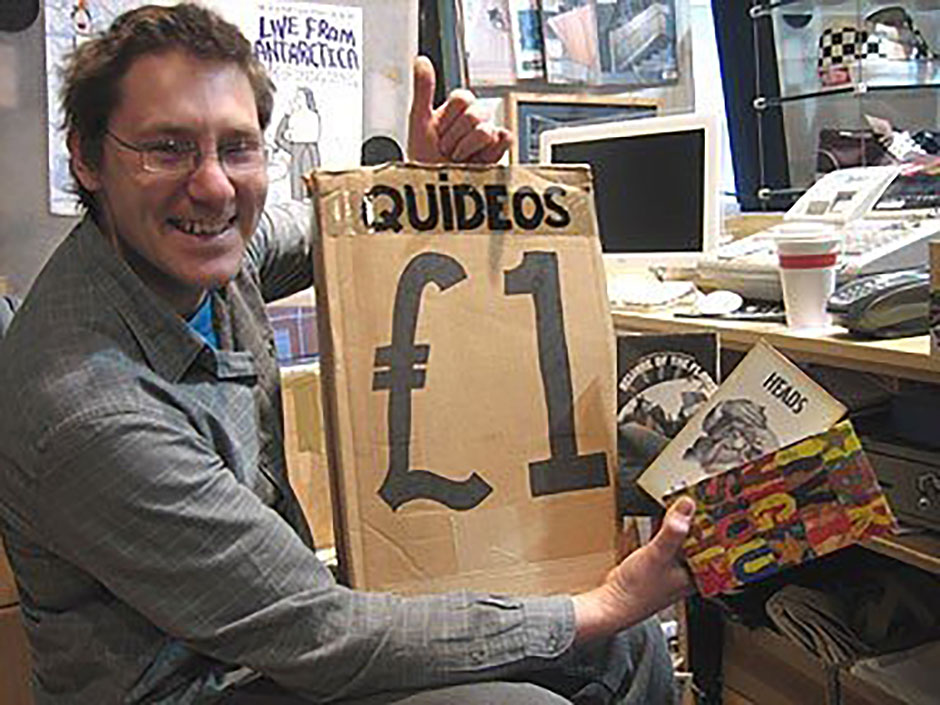
Quick benjamin generation in Slam Neal’s Yard, and some banging quideos
Starting at Slam was a much faster turnover with much more footfall. Most shop owners will know that the busier it is, actually makes things easier because you can do better science when you’ve got more results. If it’s busier and you’re selling the product, you have a much better idea of what’s actually selling. Whereas if you’re in a shop and you only sell one deck, or one set of wheels a day, and unfortunately some shops have struggled like that. Then when you try to find your best seller, that will be this one set of wheels and this type of board because that’s all you’ve sold. Whereas in Slam, if you sell 50 boards in a day, 20 of them are Blueprint, and everything else is random, then we know Blueprint’s the winner.
We were uniquely blessed in that we had the skate scene, we had tourists, we had the record store customer, so it almost involved ordering for different audiences, didn’t it?
Yeah, absolutely, it took a while to figure that out, but you’re definitely looking at different demographics when you’re ordering. There are plenty of things you do as a retail manager when you’re buying. You have to make sure that you always have a size 13 black shoe. Somebody will always come into a skate shop and want that because they can’t find big shoes somewhere else. Somebody will always want an all-black Accel-type shoe because they work at Pizza Express and need a black shoe for work; these things you learn. It was much easier to learn and apply science because it was quite easy retail with quite a high turnover. I had lots of examples to learn from every day, and obviously, there were lots of mistakes, but it was a good place to learn retail. You had to hit the ground running.
Also, we had a brand like Silas that had a completely unique appeal which bridged demographics. There were people walking upstairs from Rough Trade who were definitely repeat Silas customers who wouldn’t have been interested in other stuff
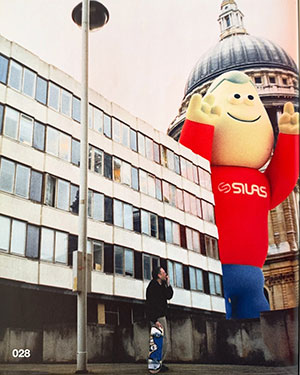 Yes, to have Silas in the store was great because we had a premium brand. We could talk to the people there, with Russell [Waterman], Sofia [Prantera] and Malcolm and everybody there. We could talk to those people and look at the production. When Seth and I used to buy it, we knew this was good stuff, and it was made by people we know. It’s really nice to be able to sell something with people from your community, but also something at such a high standard, with such high ambitions to make something clean. Silas was really good; it was another kind of Blueprint in a way. People close to you, doing good stuff, and that gives you such a strong desire to support them. Plus, they made good clothes that you would wear. I thought Silas was brilliant. I’d never come across them; it was new to me. I was out of the loop; I missed Holmes a little, so when I came into Slam and saw Silas, I realised the stuff was really good. I’d sold Addict clothing, and Chris was on it with that stuff. He had a very strong technical eye for making good products. I’d had good product, good clothing. Addict was very much in that Maharishi style, Stone Island type style, whereas with Silas, we used to call it posh GAP. I think that’s, in a sense, really derogatory, but it was very clean and well-made, using good fabrics. It was stuff that lasts. My Silas coat that I got in 1999, I still have it. It’s falling apart, but I still wear it. My Silas jumper, which I got in 1999, I still have it. The only thing I don’t have is the jeans, because I had three pairs and they just fell apart after years of wearing them every day.
What Slam history was imprinted on your psyche before even meeting Paul?
I had this vision of Slam being the same as everybody who doesn’t live in London thinks it is. I grew up in Wales, and I liked Slam; it was obviously the epicenter of things, it appeared in the magazines, and they would advertise. I was a massive fan because I loved Will Bankhead, and everybody associated with it, like Rob Dukes. But I also had this thing, like most people outside of London, of thinking of Slam being probably not a very nice place, and being quite vibe-y, and fashion-y, and cool guys. Just the outside opinion, without really knowing it, I just got the impression it could be like that. So I thought it was going to be a kind of cool guy event going in. I knew that I didn’t know much about fashion, and that I’m not very cool, but Paul had asked me to work here. So there was this disconnect. I thought Slam was very cool, but Paul is like me; he’s a nerd. He’s very nerdy, and he’s into his things. I’m sure he’d admit that, and it’s not a diss to say that Paul is not cool in the same way that I’m not cool. We’re nerds, we’re passionate nerds.
I didn’t believe that Paul had deliberately made a cool guy shop. I didn’t think that attitude was part of the blueprint, and I didn’t think that attitude was part of the mission statement that Slam had. I think it was just something that evolved because of the people who worked there or because of the fashion industry. So anyway, when I started at Slam, I knew I wasn’t cool, and I knew I didn’t know much about fashion, but what I did know was skateboarding. I knew that through and through. I knew what it was like to be a skateboarder, and I knew what it was like to be a skateboard consumer. So I focused on that, and I knew that would kind of get me through until I learned more about fashion. You learn about fashion quickly; you meet certain reps, and they’re very well versed in technical specifications, like Colin at Volcom. He was great, and he taught me because he was so knowledgeable about the products and the technical side of textiles. I learned an awful lot from Colin at Volcom. He was brilliant, and I loved spending time with him because he was generous with his knowledge.
Deep denim knowledge.
He had it; he knew everything. I learned terminology from Colin. I’m sure he was very stoked to be in Slam. He was in there anyway because Seth rode for Volcom and the brand was very much the Remy Stratton, Devo, punk vibe. Black and white, a little bit of Winston Smith style, almost like folk art in there. It was kind of good then. I think maybe it lost its way a little later on as it got bigger. When I came in, I was about skateboarding first and foremost. I wanted to look at the costs of these things, how much we sell, and tighten up margins. We were a skateboard shop, and if we couldn’t make money selling just the boards and that stuff, we were going to struggle. I wanted to make sure that for the main thing that we sold, we were doing okay on that. I didn’t want the skateboarding hardware part of the business to be essentially a loss leader. We didn’t make much money on skateboards, but people would then come in and buy the clothes. We needed to get by on the skateboard hardware sales alone so that all the clothing sales and the footwear sales were additional. That’s the way I planned it. But it’s not that black and white; it’s not so cut and dry in retail. You just have to do the best you can and push forward. Something always happens, and trends change.
Paul loved that level of consideration behind what products were there, and what was working, but he was also a great facilitator, and he was building. Even with the newsletters and things like that, he was trying to build and contribute to skateboarding, the bigger picture, and the community, right?
I think there was always an intention with the culture. When I started, one of Paul’s first things was that he was adamant that online retail would do well, adamant that online retail was the future. We had a Mac in the shop, and we did have an online store when I came. The orders would come through to the shop as an email confirmation. We wouldn’t check the online store every day because there was nothing on it, and nobody was buying anything regularly. It wasn’t particularly up to date at the time, but Paul decided we were going to really focus on this. He wanted it to be a big part of what we did. So we were getting one mail order a week at one point, and very often we didn’t have the product and couldn’t fulfill it. So I could see that online retail was going to have to be something that really needed to be tightened up, where everything was on the site. You had to have it. You can’t have a customer order, put their money through, and then the product isn’t there. That’s not going to work in the long run; people are going to hate you. I’d rather offer fewer products but definitely have them. So I fine-tuned it down to have really good fulfillment. Trying to speed things up and have good customer service. We did that in the shop for a long time and made the mail order go from nothing to being 10 orders a day to much more. I saw it go from nothing to being a job for several people to do.
[Chris] Massey actually came in to do the mail order eventually, but pre-Massey, I had been given the lion’s share of the mail order to look after. When it was Christmas, I was literally phone call to phone call to phone call. We were taking those orders, and we were writing them.
Oh, yes, of course.
We were posting out a lot of skateboards every day, having to put them together and speak to people, and take down their card details verbatim. Some people are more difficult to understand; maybe somebody is speaking very quickly with a different accent, it can be complicated. A lot of stuff can get lost in the mix, basically, so that was a difficult time.
What did get lost in the mix was that I completely forgot that we had to take telephone mail orders like that, and take people’s card details, and use the old carbon copy credit card things. We used to have to fill in the postage slips by hand, and all of that takes time. Now it’s just all on the computer, people’s details, but it used to take time to fill all that stuff out. I’d forgotten about taking all those mail orders manually.
Those ads were in Sidewalk, and New Deal kind of set the scene for that, didn’t they? But that ad would have 50 different setups on offer. That was fine-tuned to stuff we would have, but fairly often we wouldn’t. It wasn’t an exact science.
It was hard to make; it was hard to have a printed ad like that. In the end, you have to just look like you had everything, but it was actually a very narrow selection of what you could keep in stock to fulfill that, compared to how many boards are actually available. But it worked.
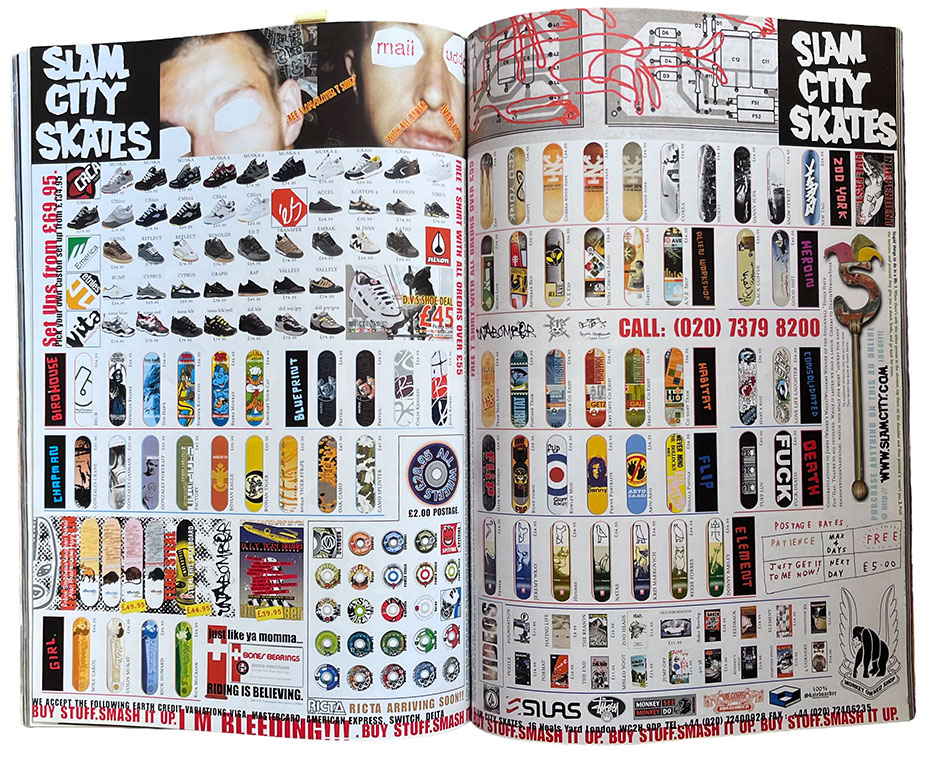
It was Blueprint and Heroin heavy on the completes, and shoes were mainly Slam distro.
Yeah, because you can imagine with a warehouse across town, if you don’t have a size and you want it for mail orders, it makes sense to put those on because the availability of stock was so much better from someone we knew. We could ship it that day from the warehouse. I could get Jagger to ship that out for me if I wanted to, or whoever’s there. I’m going to apologise, because I had kind of forgotten that with the mail order, there were a couple of steps in the process to separating out the mail order business. I think you basically got worked into the ground to get it to a point.
I got worked, we got Massey in, and I was assisting him. Then Mark Jackson took over from Massey and really fine-tuned things.
Basically, you got worked into the ground, and there was a point where this had been happening full-time. I knew we needed an actual dedicated person whose job description is the mail order. I think Massey came in to be the transition person who basically got it out of the shop. His job was to get that mail order out of the shop, essentially. I don’t think we ever fully succeeded in that, but he did make it to the warehouse, and then Mark [Jackson] was in the shop, but by the time Mark was in the shop, we didn’t have stock at the warehouse to ship out anymore because the warehouse was kind of finished. So Mark was in the shop, but that was hard because there was no designated space, so he had to essentially do office admin stuff in a retail environment.
The one thing in retail, it was always hard to get the bosses to spend the money that I knew deep down was justified. Because I’m very tight with money myself, I was very controlled with spending other people’s money, and some bosses understood that. It was almost like I was spending out of my own wallet. What I was doing was trying to get people to trust me, so when the time came to go to the boss and say I need some money now to build a new shoe display because shoes are doing really well, or I need to increase the wages because I know I need somebody extra on this day so I can do office work I can’t do in a retail environment. I was very much trying to convince the bosses to invest. There were so many times in different businesses where I knew in my gut it was the time to invest because we were firing on all cylinders, and if anybody is going to get a loan for a couple of grand to plow into the business to grow it, this is the time. I always have trouble explaining that because what they want to see is a spreadsheet, and you can’t always have a spreadsheet. You sometimes have to rely on the manager to have that gut feeling that it’s the right time. So that was quite hard.
With mail order though, the writing was on the wall, wasn’t it?
Yeah, I could see the mail order going where it was going, and I could see the only way to convince anybody was to just let it keep growing until it became unworkable. There was a crisis basically, and this problem solved itself in a way, because it was so busy, it had to get out of the shop, because it was getting in the way. It didn’t just happen by fluke; we all did that, through shipping the orders and talking to the customers, buying the stock, and processing the returns. We all made that happen, but it was really intense as we accelerated. Basically, we put the mail order on a launch pad and just fired up the rocket, and then eventually we got it to shoot off into space. I bet if you work in retail now, the phone hardly ever rings, if they’ve even got one.
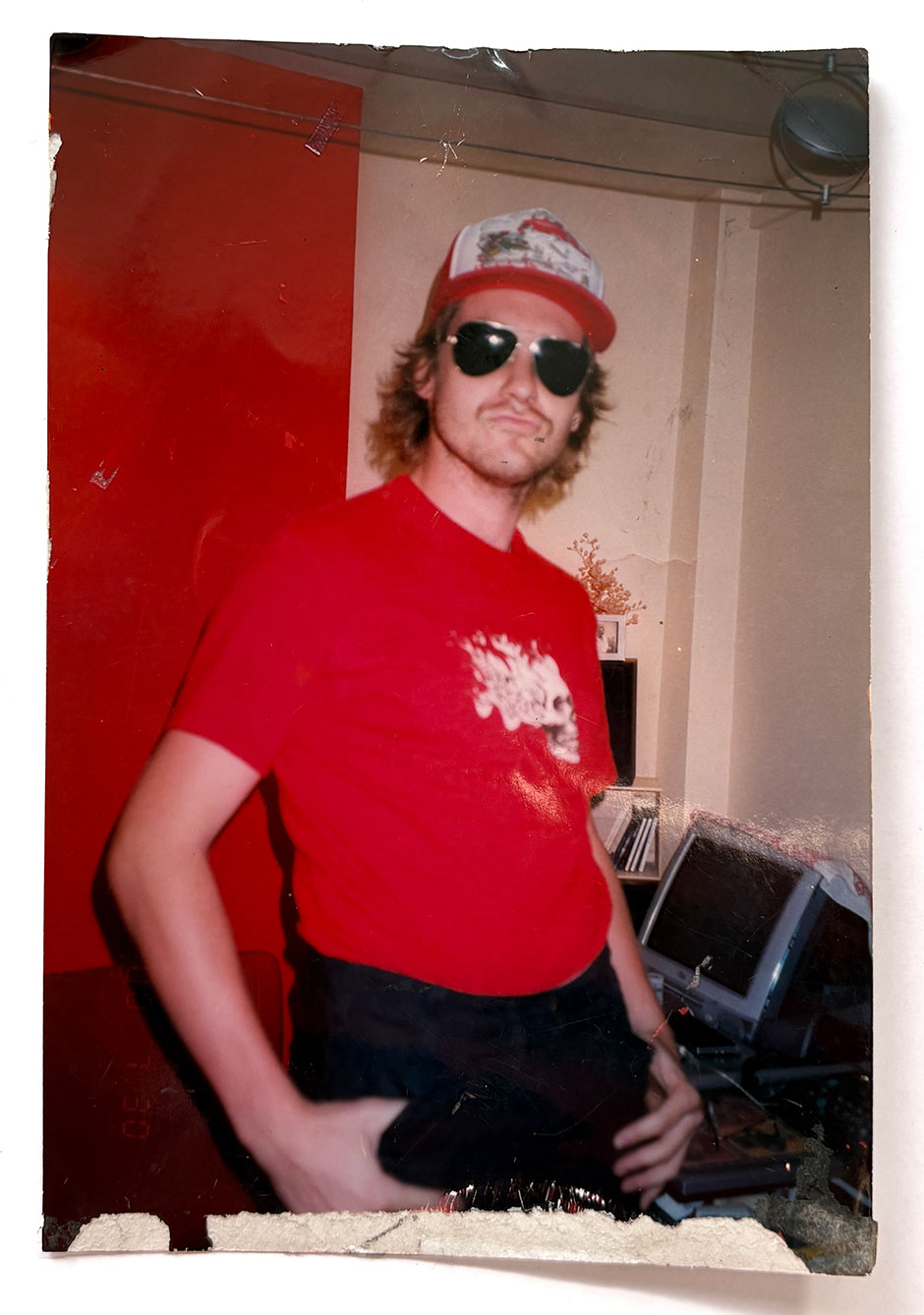
Chris during the early days at Slam. A photo with the word “Fired” that lived on the wall for years
We had a lot of fun working in the shop. I fondly remember one day when Seth went out to lunch, and we turned it into the 80s before he returned
What did we do? We must’ve gotten the boards off the wall. Put old school boards on the wall; we had some that were lying around. We put shorts on. We put Animal Chin in the video player. I’m pretty sure we were trying to find the most primary, pinkest t-shirts and yellow shorts. I can’t even remember if I had hair; I probably would have tried to comb it into a McSqueeb kind of haircut.
I think we might have had helmets on.
I’m pretty sure we did; we committed to the bit as it was.
Seth came back from lunch and was just like, “Dicks!”
Probably, there were so many things like that, just endless, stupid little things.
It was a good crew. Chris Massey, rest in peace, was handling the mail-order phone nightmare, but that ties into another story of you filming one of your favorite tricks with him the day after Slam lost the Tum Yeto distribution. Can you describe the gut punch of losing those US brands and how that day turned around?
Oh wow. It was really hard. At the time, I was getting flowed Foundation boards through Slam. Seth was getting flowed Toy Machine boards through Slam, and Seth’s brother Joel was getting flowed Zero through Slam. The Slam distribution had Tum Yeto, which was all three of those brands. Either we weren’t doing the numbers, or we weren’t paying our bills. I don’t really know. I haven’t ever spoken to Tod about this; I will one day. I owe him that for him to explain his side of things. But skateboarding was getting bigger, New Deal obviously had money, and they were investing. They were eager to grow, and they wanted a larger portfolio of brands. To Tum Yeto, it seemed like it could improve, from their point of view, and I guess somebody convinced Tod that they could do more numbers. So Tod emailed me to say they were going to go with a new distributor, but that’s business, and he would love for me to continue riding Foundation boards. I thought about it for a couple of minutes, really, but decided against it because it just felt wrong. I felt a bit bad for Paul, actually, because of the way it all went down.
A conflict of interest.
It was a kind of conflict of interest. Obviously, we had to buy stuff from New Deal, but it just seemed harsh. I know that happens over and over in skateboarding, but it was my first experience. I was riding for Foundation, and I absolutely loved Foundation, from the early days to when I actually managed to get some stuff. It was really hard, but there was nothing you could do about it. Seth and I both had our Tum Yeto boards; we were going to go skating, and we both got Zoo York boards, remember? We got a tin of black Buntlac spray paint from London Graphics Center and sprayed them black. I think I stuck a massive Indy sticker on mine, and Seth probably did a dope sticker job because he’s good at that shit. Then we went to Southbank, and we both skated these black spray-painted boards. It was very surreal, going from being a flow-sponsored skateboarder to feeling like I had no board sponsor at all. It’s quite hard to get back into the mindset, but I know it felt rough. But that board was sick; skating that board, the freedom of having a non-board, a different wood shop, a different shape, was sick as well. It was quite inspiring to have something new and different. It pushed me.
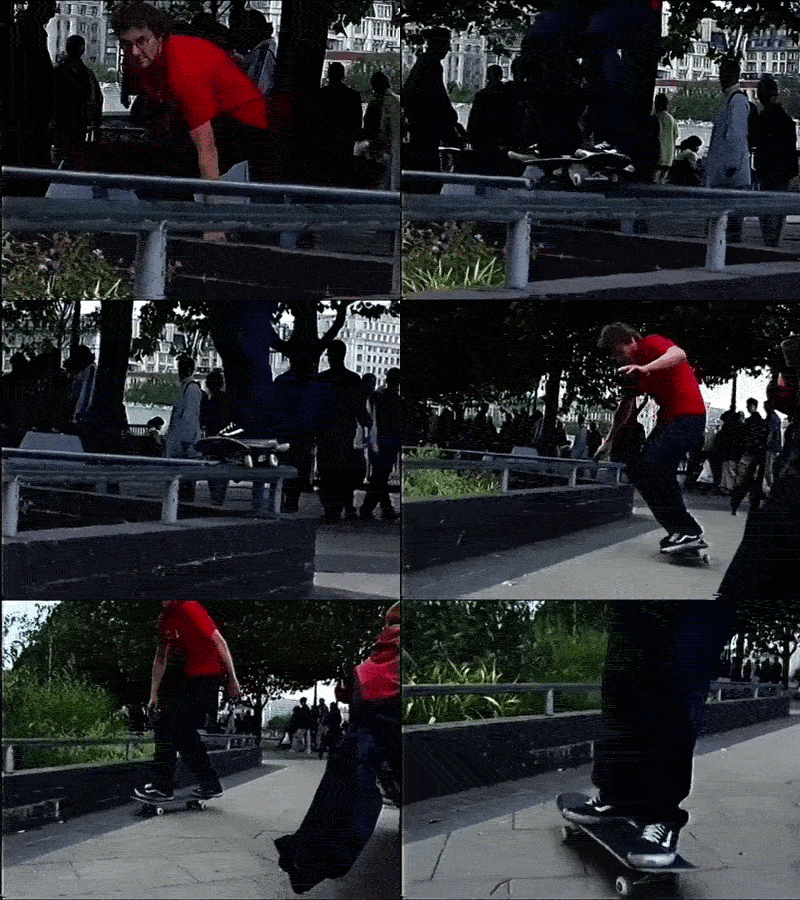
Chris frontside 50-50s the curve before exiting with a frontside shuvit. Filmed by Chris Massey [RIP]
Massey is on a hype at this point; Massey was out as much as he could be, all the time.
I’m trying to think how we did it, but Massey and I went down the river, down past the National Film Theatre, and down to that corner where that flat bar is sitting on a wall, and goes around the corner. I think Alex [Moul] skated it, and Frank [Stephens] 50-50’d a lot of it in a straight line. It’s a round rail on a brick wall; it’s about two feet high, and gets waxed; rollerbladers must’ve loved it there because it’s perfect for those guys. But it goes around a corner, and I don’t think I’ve ever seen anybody really go around the corner. At the time, I was still super confident at skating flat bars. The thing about skating a round rail is, once you get over the initial fear and the mystery of the fact that it’s riding on a round rail, you realise that once you ollie, connect your trucks and stand up, once you stand up straight, the balance just kicks in; you’re automatically balancing.
I went there with Massey, and I knew I could do that 50-50 around this corner. So I started hopping on it and got that. Then, I don’t know why, it just seemed completely natural. I did the whole thing, got around the corner nicely, and I just managed to get a frontside shuvit out. It just seemed natural the way my weight was sitting on the board. I figured if I’m going to make it all that way, I might as well just do it, add a little flair on the end. So I’ve got that bit of footage of that 50-50 around the corner, frontside shuvit off, and that’s peak my skateboarding. That makes it look like I know what I’m doing. Now, anybody could do that, but at the time, that felt like quite a hard thing to do, and I managed to add some level of technicality to it as well. So that’s still one of my favorite clips of all time. I mean, I’ve done other things. Most of the best things, in inverted commas, I’ve done on a skateboard were done on flat bars. The one I did in Southampton, where I ground around the corner and dropped off nine stairs, that’s the gnarliest thing I’ve ever done, but the only footage of that is at the end of Viewfinder 2 and one photo in Sidewalk.
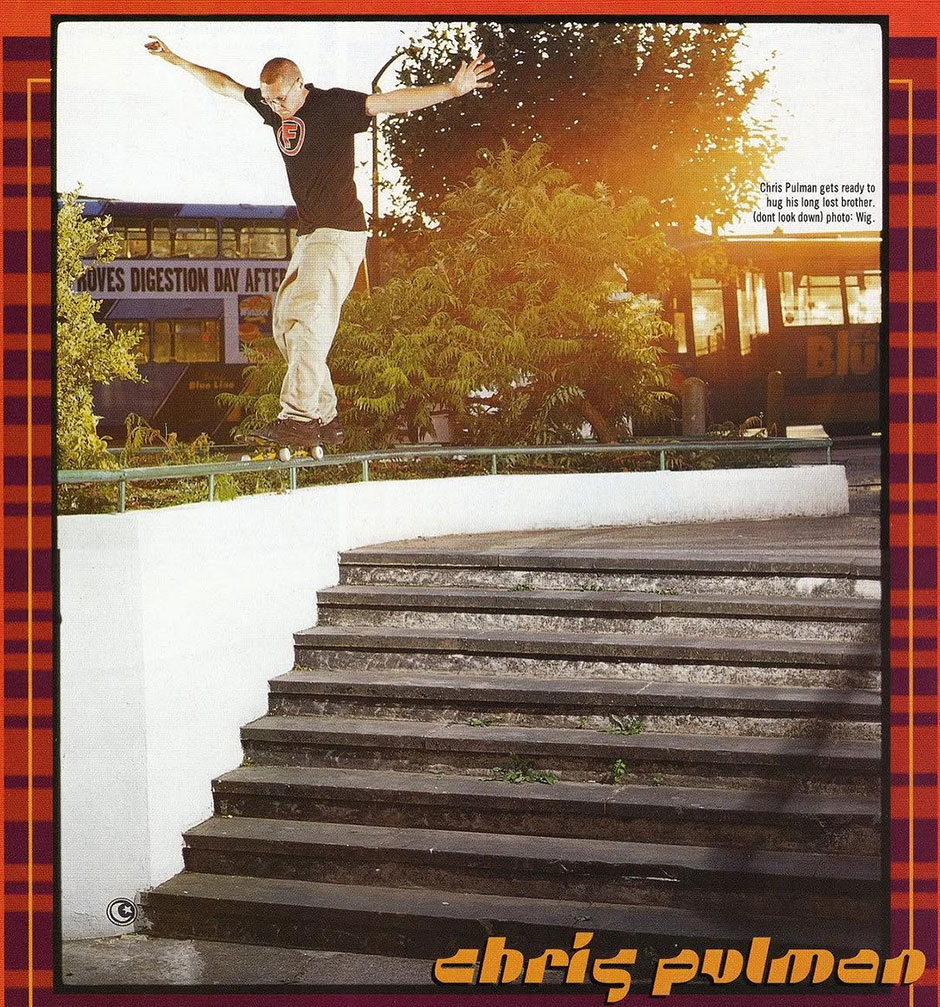
Bracing for impact with a frontside grind in Southampton. PH: Wig Worland
The Massey clip precedes you getting on Heroin, but it’s your last trick in Everything’s Going To Be Alright.
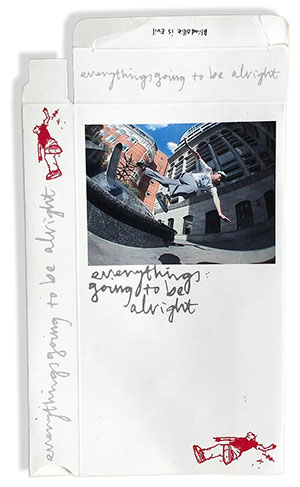 So you are right that that is actually filmed before much because obviously it’s filmed on that board and it’s filmed just before I got on Heroin. There’s another story with that clip because of the shoes I’m wearing. Riding for Globe happened right when I started at Slam, but I really struggled with the shoes. It got to 1999, and they would send you the catalogue of what’s coming out next, but there wasn’t a single shoe in the catalogue that I could skate in. At that point, I thought it was silly. I was supporting a brand, and I didn’t fit on it mentally. I didn’t fit on it, or fit the style of skating, so I was kind of looking for an out. Then this Transworld interview came out with [Geoff] Rowley, and there was a tiny, tiny picture of that Rowley Classic pro shoe. Geoff even made a comment on it saying, “Messed up skate shoes look rad”. It’s a Pro Spotlight, the one where Geoff’s on the cover. I saw the shoe, and I instantly wanted it. Vans had finally come around. Vans had fixed it.
Christian Stevenson was the Vans team manager at the time in the UK. He had done RAD TV with Mark Churchill, but he also did voiceover work, and he would often go to a studio in Soho somewhere and drop by Slam on his lunch break. When the team manager of Vans stops by the shop on his lunch break once or twice a week, it’s very easy to say, “When’s that shoe coming out?” I don’t think, at the time, he’d even seen it because I don’t know how connected he was to the product. He found out that it would be in line the following summer. I told him I really wanted those shoes and explained that Globe wasn’t working out for me. To begin with, he got me two pairs of all suede Old Skools in navy. They were from the regular line, because this is before the skate program. They didn’t have canvas sides; they were all suede, and they were ever so slightly big for me because they had no padding, but I just started wearing these things. I had lost the board sponsor, but having a new shoe sponsor at the same time kind of helped that momentum keep going.
As I said, when you have one sponsor, it makes you want to go out and shoot photos. But obviously, if you’re out shooting photos for one sponsor, you might as well have a bunch of other sponsors. If I’m out shooting photos for a t-shirt company, I might as well be out shooting photos for a board company or a shoe company. Once you have one sponsor, it’s an incentive to say I’m already out doing this; do you want to get involved? I think that transition over from when we had that bad news about losing our board sponsors, to having new excitement about a footwear sponsor, and a potential rad new style coming out just down the line. That really carried me personally; that carried me over and kept me motivated. So that clip that Massey filmed where I’m skating the Zoo board, I’m also wearing the first pair of Vans I ever got from Vans as well. That’s the first pair of Navy all suede Old Skools I’m wearing. So that clip’s kind of important for that reason as well.
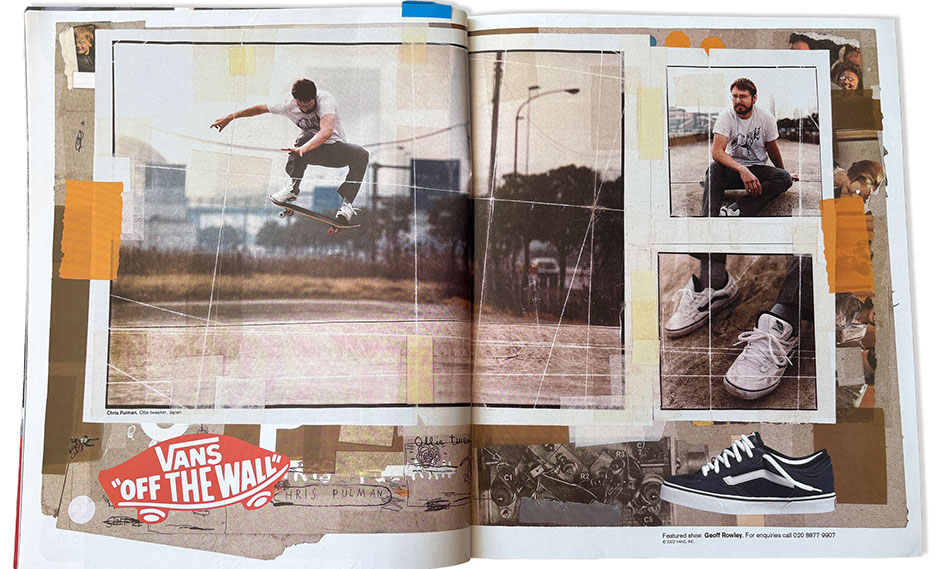
When Chris began entertaining riding for Vans because of the Rowley he didn’t expect he’d have an ad for the shoe. A Wig Worland and Nik Taylor collab
It was a new chapter for Vans, wasn’t it? Before that, every new shoe they were bringing out was blocky.
In the mid-90s, Vans were just not really doing it. Then they got back into the waffle sole. They realised their heritage was that waffle sole; they had a great time with the Rowley, and they got really lucky with checkerboard Slip-Ons at the time. They sold thousands of pairs of checkerboard Slip-Ons that summer. They had a massive waffle comeback. Everything before that was a cupsole, a version of their £45 Sole Trader shoe, which was called a Blend or something like that. The colourway was navy and grey; it’s the most British trainer ever. Nobody ever buys that colourway apart from British people from Sole Trader. They just had chunky cupsoles, and it wasn’t what skateboarding was.
They were trying to do something they weren’t good at making.
Basically, yes. I think that’s what it was. They were trying to step outside of their heritage, and that doesn’t work. Look how well Converse does now that it’s Chuck Taylors compared to what it looked like in 96, or 97 when those things literally looked like space ships.
The Chany Jeanguenin shoe.
Yeah, three hundred different textiles in a shoe with so much stitching it’s crazy. You know, a skateboard shoe needs to be as simple as possible with as few seams as possible. Every seam is a weak point. You want fewer of them, not more. So, you know, in the simplest way, that’s why a Slip-On is the best. It’s one of the most durable shoes because you have an even wear area. But we can get back to that.
Vans lit a fire with the sponsorship, but this also coincides with Fos deciding to put you on, and turn you pro for Heroin.
I don’t remember the exact series of events that made that happen. I don’t remember if I went cap in hand to Fos and said I want to ride for this, or Fos asked if I wanted a Heroin board. But what did happen was Fos said, “Let’s get you some boards and see what you do with it”. He dropped me off a board and a long sleeve. And that was the day I went out with Wig and got that thing.
That’s the gas banks photo you shot with Wig?
It was my day off; I think Fos had come in first thing in the morning and dropped off a board which was called the Black Coffee Graphic, this rad graphic Marke Newton drew with a skeleton, he’s wearing a beanie, and he’s drinking a coffee. It had this pistachio coloured bottom; the main background colour was pistachio. I went to get the board, I set it up, and there was a tin of white spray paint. I sprayed Heroin on the griptape because if you can’t see the graphic in the photo, you’re going to see the griptape. I’m super aware when shooting a photo that I want it to be a statement in my head. I thought on a nice crispy board, I could go to gas banks and really try and get the highest ollie I possibly can out of that thing, and still land in the bank. I think what some people don’t always get about that photo is I’m ollieing high, but I’m not ollieing off it like a kicker. I’m deliberately trying to land four wheels down on the other side. You have to realise that in order to ollie over a hip like that, you have to ollie backwards. You have to almost jump backwards in such a way that it then sends you up in the air vertically, and then you can come back down into the thing. It’s quite a trick to learn to ollie over a tight hip with no transition bottom or anything. There’s a knack to getting the timing. I knew I could do it, and then Wig said he was going to shoot it from behind the fence. Whenever a photographer wants to do something experimental, I’m always keen to shoot one normal, and then they can play around afterwards. But Wig told me not to worry, and that it would be fine. He went behind the gate; he got that great effect with the fence, and it’s just so perfect. There’s something meaningful in that image. The only thing I hate about it is the shoes; outside of that, it’s great.
“Wig made me look so much better than I was on a skateboard; he just knew how to do it. Wig was very kind to me over the years. He made me look good so many times, and I really appreciate that. I owe a lot to Wig”
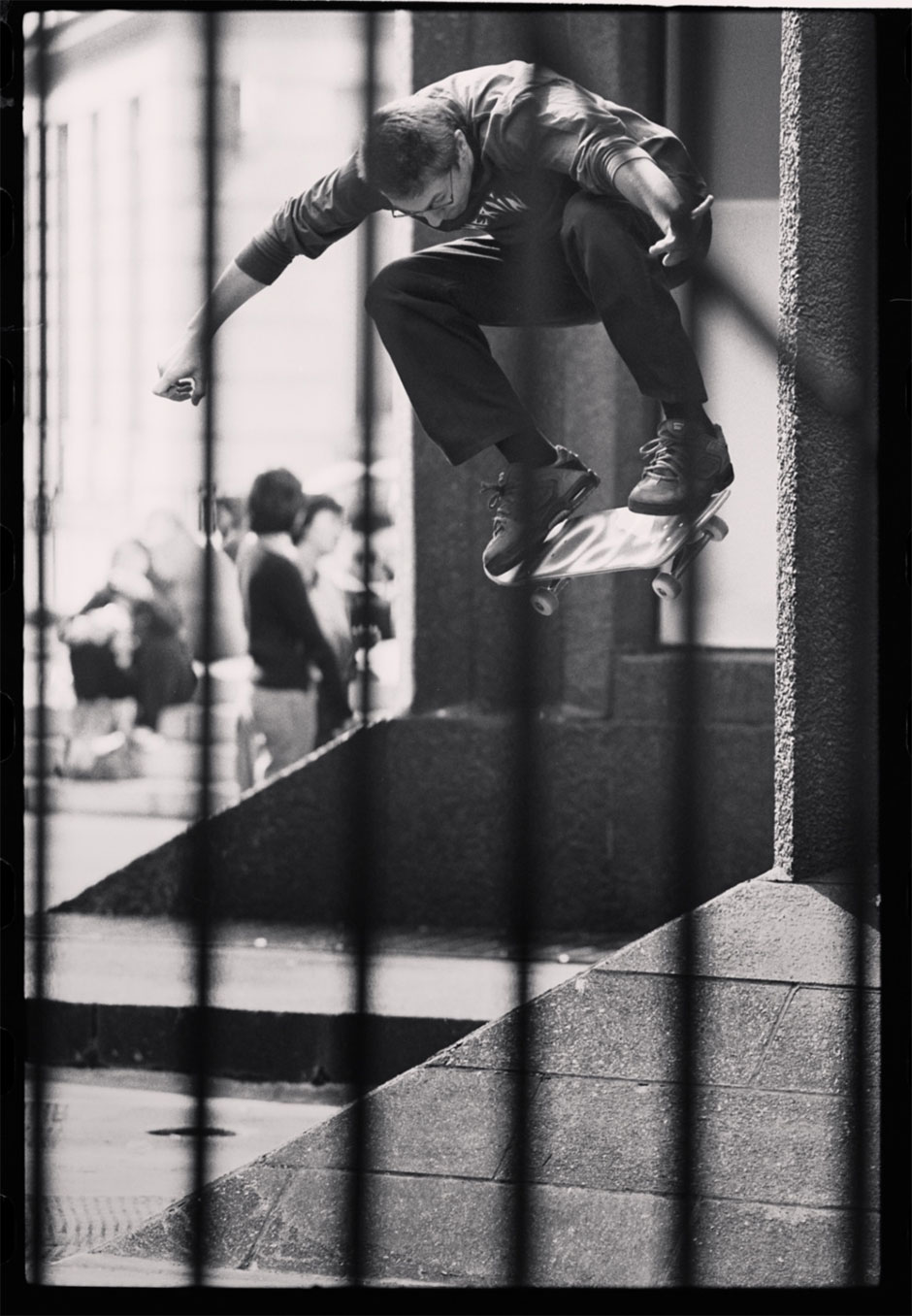
Chris’ first photo on a Heroin board. Ollie at Gas banks. PH: Wig Worland
It was a collaboration.
It really was. Wig made me look so much better than I was on a skateboard; he just knew how to do it. Wig was very kind to me over the years. He made me look good so many times, and I really appreciate that. I owe a lot to Wig. He was so good at mentally soothing me when I was trying to do things. He’d be lying in the gutter, and I’m stressed, and I’m like, “I’m so sorry, next go, I promise, next go”. And he’d be like, “Dude, I get paid to lie in the gutter. I get paid to lie here”. But if I can minimise that time for someone, I want to do that. I think skateboard photographers are halfway qualified to be therapists because of the amount of emotional support and assistance they provide to people who are trying to do something quite dangerous, and are obviously in an anxious state. Your inner chimpanzee when you’re trying to skate is well awake because you’re doing something scary and dangerous. So that limbic part of your brain is really awake, and it can be a nightmare when you’re trying to film or shoot a trick. You’re so focused, you’re hyper alert, and you’re in a dangerous situation. Your brain is acting like a Saber-toothed tiger is chasing you, but what you’re actually trying to do is kickflip down four stairs, hahaha. Your brain can’t tell the difference; it’s just acting like a chimp in there.
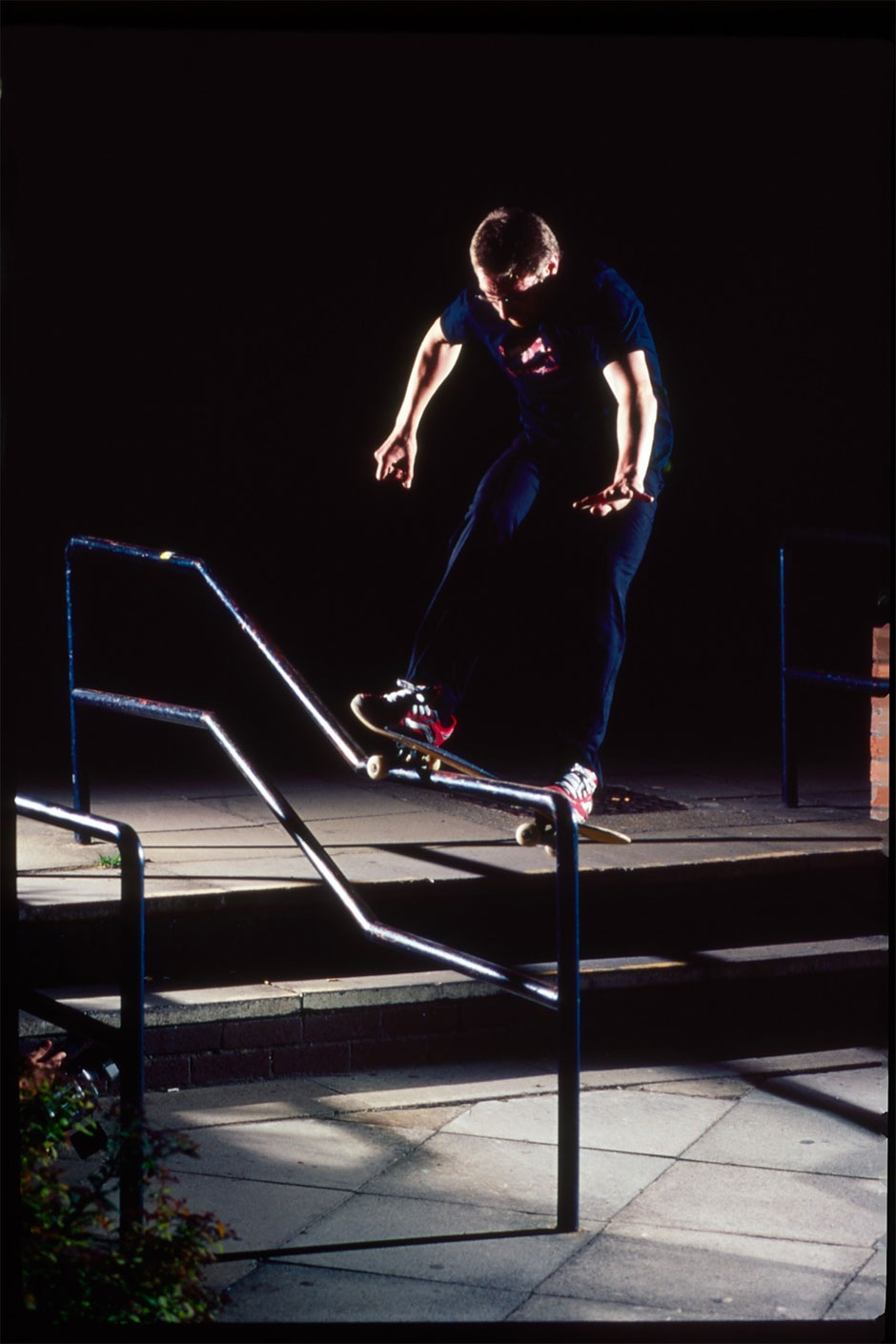
Chris battles his inner chimpanzee for long enough to smith grind this rail. PH: Wig Worland
While someone who isn’t dealing with that is trying to capture you.
Yeah, they’re wondering why they’re literally dealing with a different human being right now, the different personalities.
Your relationship with Wig is a good constant. He steps away from skateboarding at a certain point, but he was quite a consistent collaborator from that period on.
Yeah, I think Wig was a go-to; we worked really well together. I worked really well with Richie [Hopson] too. Richie was busier doing other things, and it turned out that Wig was more available to shoot stuff because it was his full-time job, so the relationship I had with Wig was fundamental. Leo [Sharp] is another person I shot with who was an example of a photographer who wanted to do something experimental, whereas I was keen to just get the trick. We shot a sequence of a frontside 180, fakie 50-50, frontside 180 out on a flat bar over a driveway in Newport at a comp. Leo didn’t want to shoot a sequence; he wanted to shoot it with a strobe. A single frame flashing a strobe, so you get multiple images in one. This was an old one. I was riding a Foundation board, and I showed it to Billy Weatherford and mentioned that if I were getting photo incentive, in this photo, there are like 40 logos. If I were getting photo incentive, this photo would be expensive because there are literally 30 or 40 logos in this one photograph. That was a good example. Wig was the person I think I shot the most photos with for sure. Sam Ashley shot some in London as well; we shot some at Meanwhile, A crailslide. That’s a nice photo; it got used for a subscription ad in Document. It’s a really nice, vibrant photo with a big piece of graffiti. Wig really did the lion’s share of the photography. I think when I got into filming, photography became quite secondary, but there were moments. Henry [Kingsford] shot a few photos with me but it was mostly Wig who shot photos. Then it became mostly filming. I was filming on weekends with Fos, but mostly filming with Massey on my days off, or whenever we could get a day off together
Fos turns you pro around this time. Having a pro board on the wall while running the shop, how was that psychologically?
Fos had this skateboard company that had gone from being elaborate joke skateboards, because it was Good Shit, and it was just very authentic. Fos was making product and needed to move more. Things started to become more like a business and more serious. A little less avant-garde than it was at the start, and a little bit more like what other skateboard companies were doing. I was riding for it, and I think Fos was going to need a pro skateboarder at some point. I’m pretty sure I offered it up and said that if he wanted to put someone’s name on a board, I’d be down to be that person, if it works. I’m pretty sure I suggested it. Obviously, if you’re that close to that happening and you’re a skateboarder, and there’s a chance to have your name on the board, I think you’d be lying to say you wouldn’t jump at that opportunity just once, just so that when you’re 40, you’ve got a board on the wall with your name on it. Just so can say you did that. I think I did say in the first place that if it goes down that way, I’d be happy to do it. Then we had conversations about what it meant to be a professional skateboarder, and I probably had some doubts and cold feet, but we rationalised it.
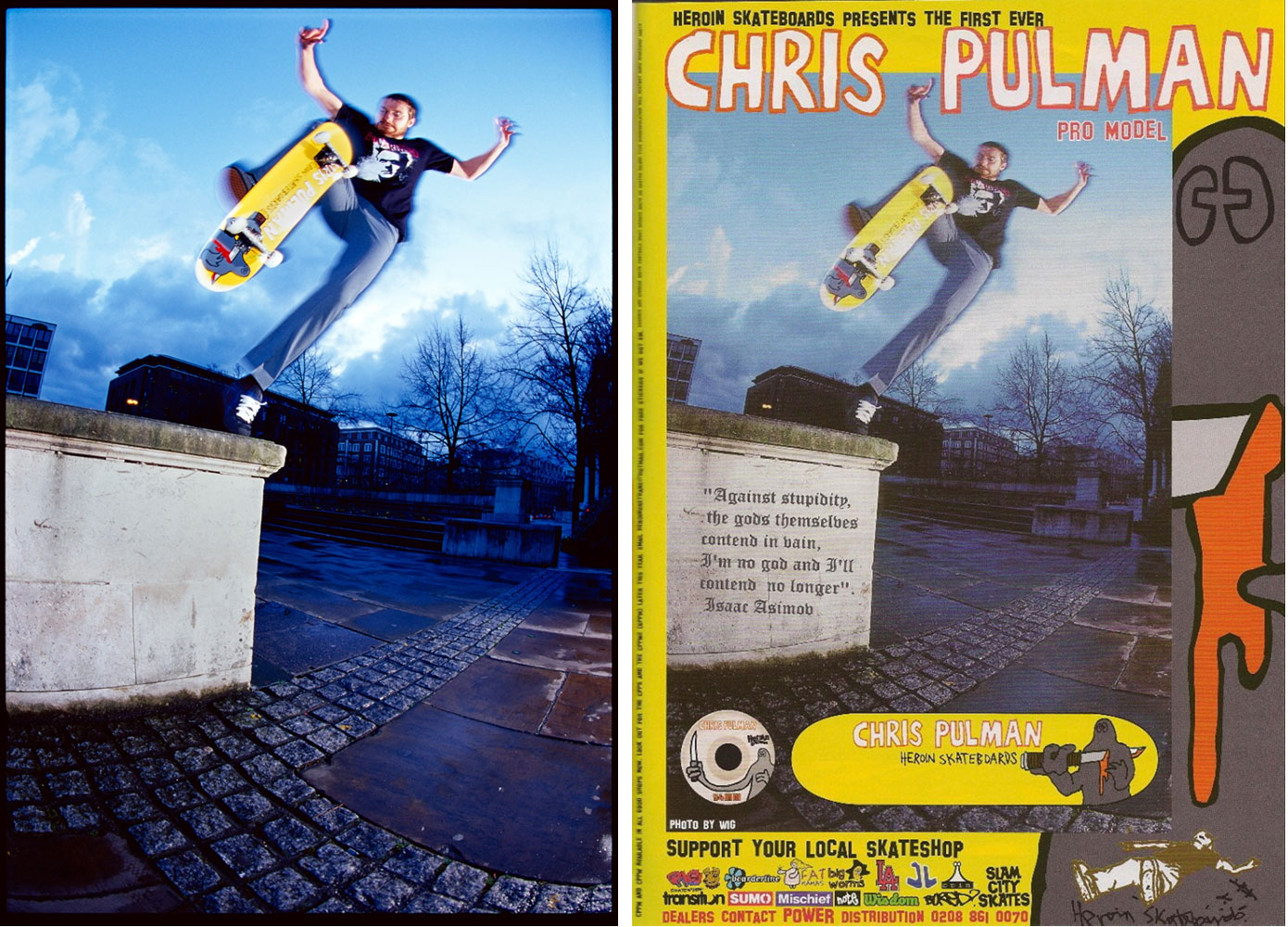
Chris takes a different route at St. Paul’s to announce his pro board on Heroin. Ph: Wig Worland
Fos basically said if he puts my name on a board, and then you put it on the wall in a shop, and someone buys a board with your name on it, then you’re a pro skateboarder. Because people are buying a board with your name on it, hopefully it’s because your name’s on it, but putting your name on it isn’t putting them off from buying it at the very least. So, if you contribute to skateboarding, and you put your name on a board, and you’re hopefully doing something different, so you actually contribute to the general picture of skateboarding, then putting your name on a board is valid. If having your name on a board inspires someone to buy a skateboard, or enthuses them in some way about skateboarding. Either the way you dress, the way you skate, the tricks you do, where you skate, who you hang out with, or anything. If you create an aspiration, if you give someone some kind of inspiration in whatever way, I think that’s what being a pro skateboarder is about. You then have a massive responsibility, I think, to contribute in some way to skateboarding. You need to give back something to skateboarding, whether it’s just being a good person and pushing it. Being a good employee as a skateboarder seems a bit boring, but to generally take your skateboarding and try to push skateboarding forward by thinking about new tricks or different angles, or improving a spot, or thinking about what we can do? What’s the next pole jam? What’s the next popped-up drain cover? What’s the next thing we can do to push skateboarding forward? DIY spots, it’s all those contributions you make. I think as a pro skateboarder, you have to be doing that. You can’t just be chilling unless you’re super cool, and again, I’m not, hahaha.
I guess that the pro board itself kind of ties into Day In The City. That year is peak White Stripes on the stereo, and that’s a video part, and an intro that embedded itself in the public consciousness and really got that first board out there. That’s skateboarders around the country ingesting media in a different way. Those Day In The City things really were a moment, right?
Yeah, they were a real moment, and they were a moment pre-YouTube as well, which is why they’re important. To this day, most people who come up to me who recognise me from back then tell me that Day In The City was their favourite video. I put out two actual video parts after that, but they remember Day In The City, and they remember it because it was free. At the time, Sidewalk circulation was between 50,000 and 70,000 copies, or something nationally. So they made 50,000 copies of that VHS tape, right? This is before YouTube, and no skateboard company had ever made 50,000 copies of a video. So everybody who was in that got seen over and over and over. Every kid is stoked, as much as we used to get excited about free stickers, a free video on the cover of a magazine was unheard of. It doesn’t happen now, ever.
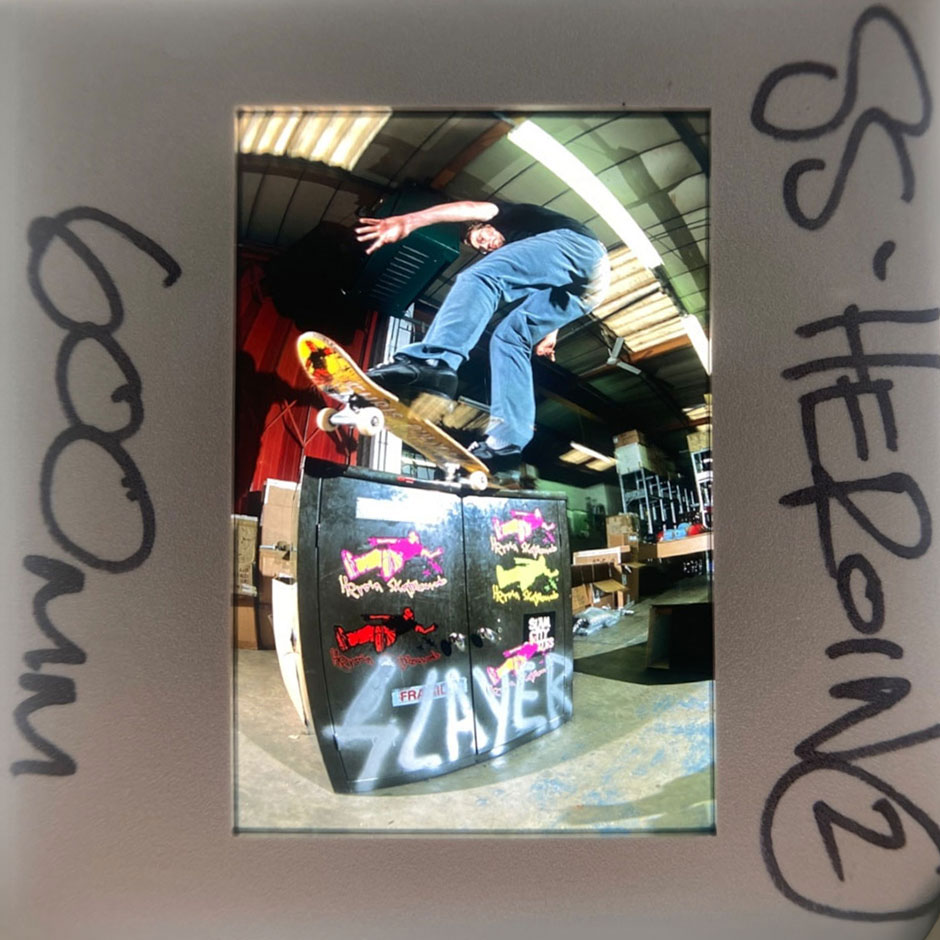
Chris 5-0 Grinds a filing cabinet at the old Slam Warehouse for Day In The City. Ph: Wig Worland
There’s a really nice Nick Jensen part amongst it too; it was the first time they did that?
Yeah, it was the first ever one; it was for G-Shock or something, I think. Jensen’s was filmed at night. I think Dan [Magee] and Jensen put it together at night, is that right?
Yeah, and it was edited to a Kristin Hersh song.
Yeah, it was obvious that Dan was bound to make the most beautiful, well-thought-out one. He was bound to do that. And then you had the video Alan Glass and Blind Ollie Softrock made.
Ollie’s wearing a Beatles coat?
No, the Beatles’ coat was in another video. I went to Hammersmith to film one day with Fos. I’m not sure if Greg Finch was there because Greg used to come out and skate those Hammersmith ledges as well sometimes. He used to skate there with Andres Holguin. Very often I’d go to Hammersmith and see Greg or Andreas or someone out there. But one day I wanted to meet Fos because I thought I was going to do a frontside 50-50 on the ledge and then up into a frontside wallride, because the ledge hits the wall at an angle. I had regular wheels, and in order to do that, you need softer wheels because of the way the frontside 50-50 hits the wall. To do that frontside wallride, afterwards you slide down the wall. I needed filmer wheels basically. But that day I went there, and Blind Ollie showed up in a Welsh Guards uniform. There’s that footage of him in the Heroin video saluting the fisheye. I think Ollie loved uniforms. I think he collected uniforms from fast food restaurants; that was something he did at one point.
Ollie’s wicked; he’s really into Hacky Sack right now. He mentioned that Hacky Sack now is like skating in the early 90s. There’s an underground scene surrounding it, and they all meet up in the park.
Legend, I think that when I see rollerblading. When I go skating in the city, and I see two rollerbladers, I’m like, they are having a 92 moment, but the thing is that rollerbladers have been having a 92 moment for the last 10 years! If you go into the city, you’ll see two rollerbladers out there shredding, killing it, but it’s literally only two of them, and you’re like, who sells rollerblades anymore? Where do they get those things from? Anyway, the Blind Ollie Softrock part I was talking about was a Black Metal part; he had full Black Metal face paint, and it was a hot day. I’m pretty sure he copied the face paint of Euronymous. He rips up a Bible and eats it, and it’s just gnarly, but it’s obviously an act. It’s what a Black Metal guy would do if he went skateboarding in London for the day. He does lots of those weird, odd foot placement flips he did. Ollie was just brilliant, and he was hectic and excited, and he was exciting to be around. He was kind of like Nathan [Clancy] now; Nathan’s exciting to be around because of his energy, and he just doesn’t follow the rules. I love that. That’s the whole point of skateboarding, I guess.
You mentioned when we were speaking earlier about your son Keith really liking the Pocket Mag Followed format. Day In The City tapped into that. Here is this person, here is this person in the house, and here is this person out for the day.
Yeah, that’s true, you’re right in a weird way. I’m pretty sure the whole format of our Day In The City was very similar to something Daewon [Song] did. I think it was a Daewon 411VM Profile or something, with him choosing his outfit. I don’t remember; I didn’t deliberately copy it, but obviously it was in my head, and Fos went along with it. But it worked, and it was fun because I got to say things in a Welsh accent. Fos definitely remembered the Daewon thing, but he was thinking it’d be so funny if he copied this, and had Pulman do it with his wacky clothes and his Welsh accent. So we did it, and it was kind of nice because it’s funny, and Fos found a nice bit of comedy music to put over it, and it was really fun getting to mess with that and talk about the products.
Click on Chris’ brogues to be transported to his day in the city part
I totally understand what you say. It was very much an insight into something beyond a video part, beyond a photo in a magazine. Because obviously we know everybody who’s in a photo has a life, and a girlfriend, and a house, and a dog, or they like books, or they still live with their folks, or they go to college. But you kind of have to guess. Knowing there’s more to that person than the smith grind, it really helps us. From a marketing point of view, it helps obviously, but it helps the community side of skateboarding. You relate to someone because you do the same tricks, but when you discover that they also read the same books, or like the same music, or have a penchant for really strong tea, it forms a better connection. So from a marketing point of view, it’s brilliant. That’s why they do it, because then you feel more committed to your avatar in skateboarding, which is why most people have favourite skateboarders. They’re an avatar; they do the shit you can’t do. The other side of it is the community side of it. That guy’s just like me, and as a skateboarder who’s not sponsored, you see that stuff, you see they’re just a regular bloke. There’s nothing special about him, and if he can do it, then there’s a good chance I can do it. So by being authentic and by being kind of more real in skateboarding, you actually make skateboarding much more inviting because people see it, and think “I could do that!”, and that’s what you want.
It’s a leveller, and that’s what your sponsor me video was, wasn’t it? Here’s what I did in a day.
Yeah, there is that. I’m sure most pro skateboarders, they don’t choose to because they don’t have to, but if you said to Casper [Brooker] tomorrow, let’s go and film as much stuff as you can in a day. He’s such a professional; he would try to make that happen, and it probably would be pretty epic, but these days it’d be a job. But if you said to him, said, what can you get in a day? Like, let’s have a competition. See who can film the most stuff in a day and then put that out. So you and I right now, we’ve just invented Slam’s next competition, that’s better than The Berrics. You invite pro skateboarders to film everything they can in a day with Rich [Smith], and then you put them out. There’s a whole new concept for you. Wouldn’t that be cool to be that? Ask the pros who’s got the balls? Who’s got the balls to go out and show what they’re gonna do in a day, knowing it’s gonna be compared against what Casper did in a day?
It would demystify the process. That’s why people like Rough Cuts and all that stuff, because it’s not what you’re presented, it’s what happened for that to be presented.
The beauty of it is, sorry if I’m selling you a business idea here, but the beauty of it is, one, you only have to commit the filmer and the skater to one day of work, as it were. It’s levelling, so if you don’t get the gnarliest stuff ever, or you snap a board or whatever, then you get that little jaunt to the shop to set up a new board. Maybe you don’t get the real trick you’re trying, but you’ve got footage of the attempts, for example. It’s still very honest, and I don’t think anyone will think someone sucks because they’re trying to do all that shit in a day. I think that’s a good concept. You can have that for free if it works. You’d have to find people who are willing to do it. Very quickly, sports brands would be like, “Oh, I heard you’re doing your day out. We’ll send your package and make sure you have an Uber to get around, and we’ll send a guy out ahead of you to fix all the cracks and sweep up”. It would get ruined real quick because of how skateboarding is; it would get inauthentic overnight, almost. If you put that in the interview, someone will nick it, so don’t do it!
Day In The City is an interim pro board appearance, but Everything’s Going To Be Alright was your debut pro part.
Yeah, that’s the part; it was introducing their new pro. That was what Fos was saying. This is our pro, and this is what he does. As the only pro that was highlighting what the whole brand was about, at that point. I guess that was the intention.
Was having that on the cards an all-encompassing thing for you? I know you think a lot about how your setup looks in a photo, for example. Was it a lot?
It wasn’t daunting to do. I don’t remember feeling stressed. I don’t remember feeling anxious during it. I always get anxious when I plan to do something. If I say I’m going to go to bank ledges today and I’m going to get a feeble grind around it, I’m already anxious because I’ve told myself I’m going to do that. So, then you have that; there’s what you want to put down to film, then there are a whole lot of logistics around that. I can go and film that trick at any time in the middle of the night, but I’ve got to go and do it in daylight, and I’ve got to organize a filmer. Then there’s a station, so there are lots of pedestrians. I’ve said this a few times, but as soon as I commit to something down the line, then the anxiety starts building because at that point, it’s not just me in control of the situation. There are a lot of variables, things that can go wrong. I’ve started talking about anxiety now, but there’s a lot of anxiety in that process.
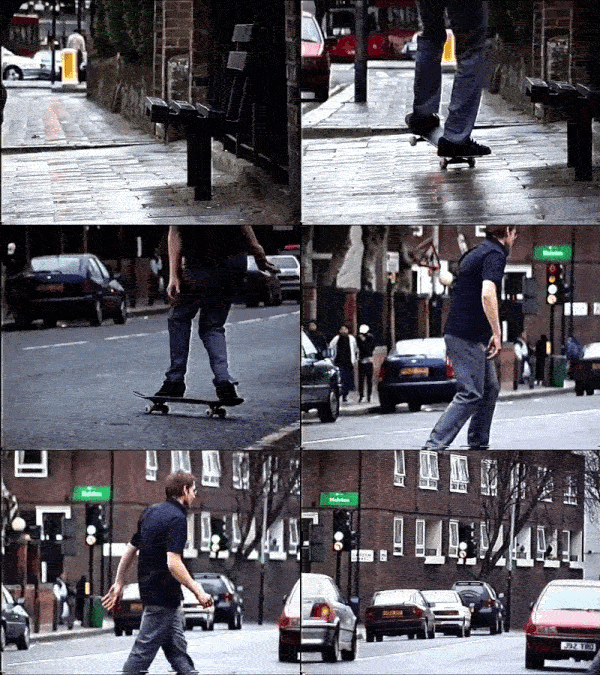 But during the filming of Everything’s Going To Be Alright, I don’t remember a lot of anxiety. I do remember going out in groups a lot more, going to Vic Bench’s or going up into Camden. We went up to Camden one time, and I spotted a metal bench that was on the side of the road, and I was like, “Can we stop here? I know it’s raining, but can I get a quick smith to manual on this bench?” I knew it would sound good; it was raining, and I did a smith grind on the metal bench, manualled the pavement, and I kicked my board away afterward because the road was wet. It was a mission trying to do that because I kept slipping out, but it was kind of organic. Let’s do a trick on that. I can get a trick on that. Let’s go skate those steep banks that are up the road from the benches by Scotland Yard. It was very organic, and it didn’t seem too stressful. I don’t remember it being stressful.
I’ve got a photo of us all at Victoria Benches. I just took it with my T5, and there are probably three crews there. It’s a Sunday morning, and so many people are there. There’s a young Lucien with his friend, probably about to go home. Toby [Shuall]’s there. Magee and everyone is there. Eventually, after that moment, everyone disperses and goes their own way for the day. It was cool bumping into everybody on those jaunts.
We did feel separate from the Blueprint guys, but only because we knew they had their own project going on. We had our own project on, and they were very, very different things. But yeah, as a group of people, Lucien went off and became his own entity. Lucien’s bigger than any brand he rides for; Lucien is a brand.
This is Lucien learning to 50-50, that kind of era.
Lucien was quiet; he’d come into the shop when he needed things or to pick up packages. Everybody went off in their own direction from that and formed groups and different subgroups. And if you have that photo, then you see us all together. It’s probably quite a good one. Yeah. It probably doesn’t look like the Alva team photo, where everybody’s got dreadlocks and leather jackets, but it probably looks a bit like that.
You are quite prominent in the photo, and you’ve got a classic black Heroin t-shirt and a black Harrington.
Farah’s, that was a Pig Harrington with the logo taken off maybe?, with a red check lining, I would have had a white studded belt too I reckon.
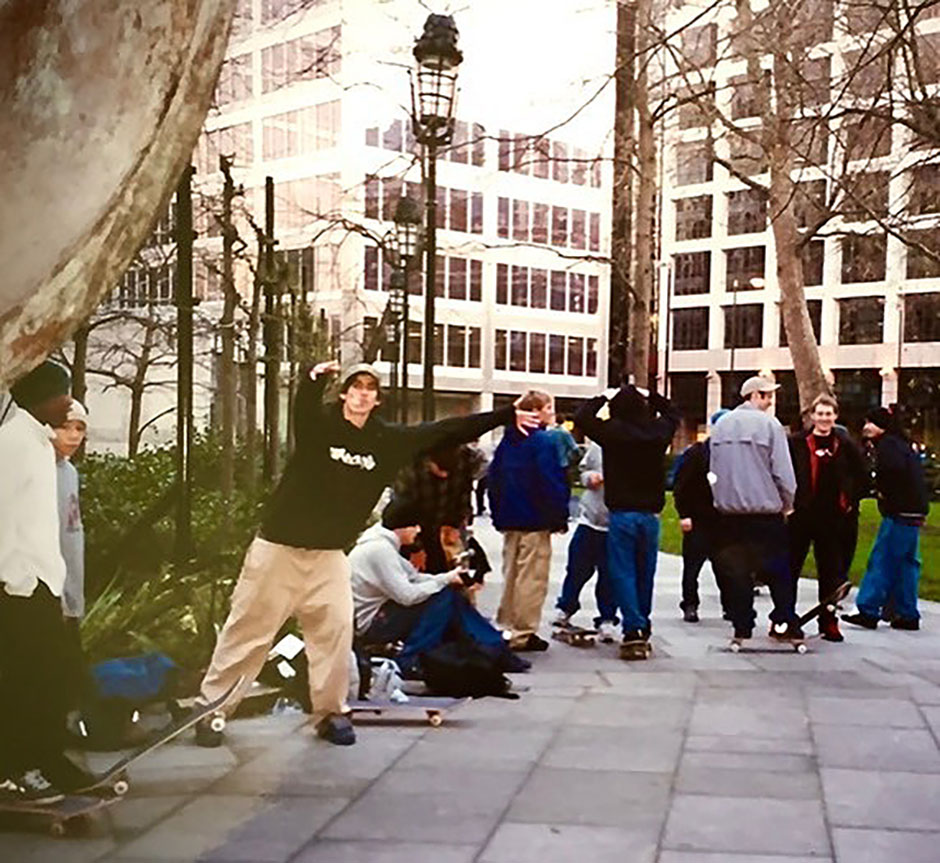
Chris Pulman second from the right amongst a crew that includes Lucien Clarke, Toby Shuall, Chris Massey (RIP), Oliver Barton, Marshall Taylor, Paul Shier, and Rob Ransford. PH: Jacob Sawyer
Seth Curtis’s quote in Neil Macdonald’s book Elsewhere was something along the lines of “Working at Slam was like an education”. I felt like that just from visiting during earlier days when Tickler [Nik Taylor] and Marke Newton were in there. Then you’ve got lunchtime visitors, you’ve got Rough Trade stuff, and you’re being exposed to lots of different perspectives. What takeaways from that time still improve your daily life?
I’m not much of a consumer, really. I have never really been somebody who buys a lot of stuff. Working in retail, it taught me the value of things more. It made me a much more discerning consumer because you can see which brands care about their customers and which ones don’t. You can see who uses good-quality fabrics and factories, and who doesn’t. I think I learned a lot about being a consumer generally in the wider world, and the way companies perceive us as consumers. It made me much more wary about where I would spend my money. Now I only spend my money on a product that I know is tested and durable, and the company behind it cares about me, or at least looks as though they care about me, do you know what I mean? It taught me to be more wary as a consumer, but as a retailer, it taught me respect for my customers, which I understood from being a kid. Kids would come into the shop, and they didn’t have a wallet because they were too scared to be mugged. They’d have a £20 note rolled up in their skate shoe, and it’d be sweaty. They’d pull it out to pay, and I’d be like, “Oh, dude”. But I know what effort it took to get that £20, whether they had to work for it or do the dishes for it, or beg a parent, whatever it took to get that. That £20 for a kid, that might be all the money they had for the day, and they’ve got to eat out of that and everything.
Depending on their perception, they’re leaving the house and taking their life into their own hands, too.
Yeah, it is gnarly. So when those kids made it in, and they wanted to buy stuff, I remembered it was a mission to go somewhere and spend money that seemed like a lot of money at the time. You don’t have a job; you don’t have a wage going in every month. So every time you get £20 in your hand, it seems like you’re winning. So I respected those kids who spent their hard-earned or acquired money there. And I wanted everything we sold them to be worth it, and last. Other things are different. If somebody wants to spend a lot of money on a shirt, which is just fashion, it’s not functional. That’s fine if you’re an adult; you can choose to buy things you don’t really need. That’s fine. The kids don’t have that disposable income, so every penny they spent was very much respected. I think Slam has always been that because you need to be the authoritative place, and the skate shop is the authoritative place. The reason those brands are in the shop is because they are the best brands. The guys in the shop know best because they’ve been skateboarding a long time, and chances are every single one of those guys has tested all of those products. So when you go into a shop like Slam, you’re getting an authoritative view on what you’re buying. You can trust those guys; you really can.
“when you go into a shop like Slam, you’re getting an authoritative view on what you’re buying. You can trust those guys; you really can”
I wouldn’t buy a phone in a phone shop because the only bit of bargaining power you have there is to just rob the guy of his permission. Do you want this sale or not? If you want the sale, you’re going to have to give me the discount of your commission. Otherwise, I won’t do this today; I’ll just go and do it online. The only way you can make a deal in somewhere like a phone shop is to make sure the guy who’s making commission makes none because that’s the only margin he’s got. Whereas in a skate shop, there’s nothing like that. The skate shop is a relationship, and people come back over and over and over again. If your skate shop is good and they look after you, you’ll spend money with those guys for years. You’ve spent thousands of pounds over the years with those people. You think if I’m gonna put my hard-earned money somewhere, I want to go to these guys because if I need to re-grip my board, those guys will do it. If I snap a board, those guys will potentially let me have one of their boards. A skate shop will help you as best as they are able to within the rules that they have in their business. I think Slam was always like that. That was what I tried to do.
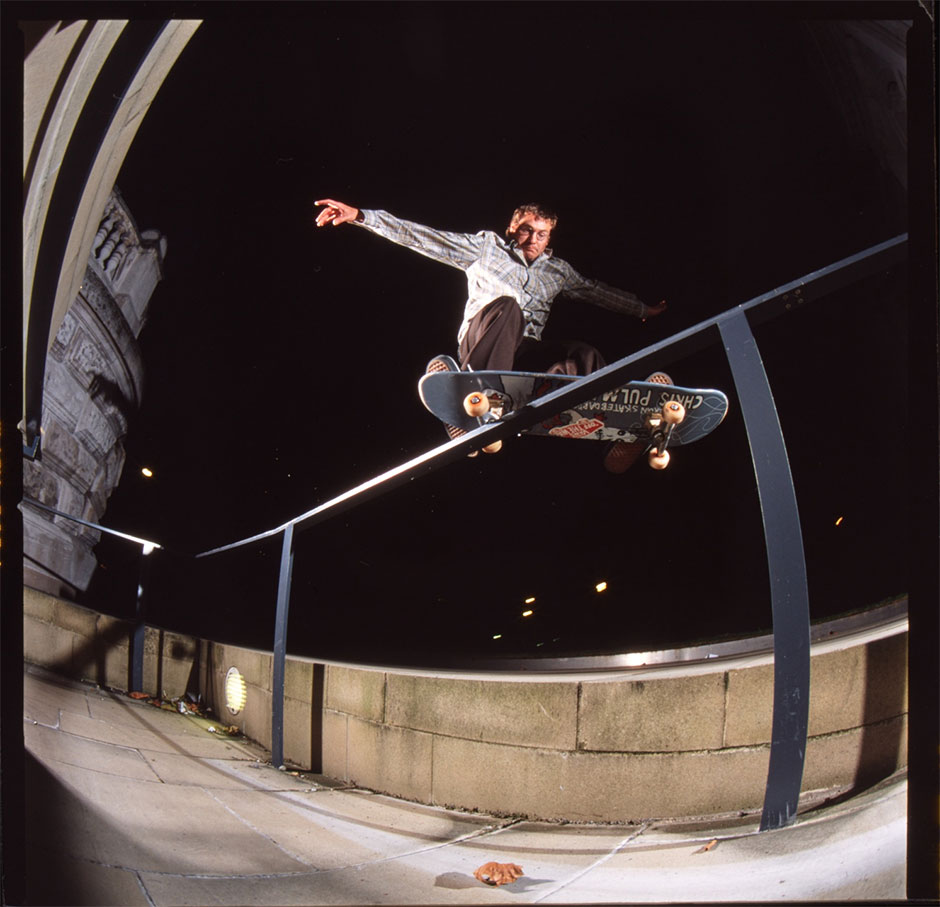
Chris Pulman smith grinds the Tate Britain rail in 2012. PH: WIg Worland
What’s the best gig the Rough Trade hookup ever delivered you to?
Oh my god! It’s definitely going to be The White Stripes at the 100 Club. That was the first gig they played when they came over, as far as I know. That was because of Rough Trade; the music reps would come in, and they would give us CDs to play upstairs. A couple of them were friendly enough that you could get on a guest list, or you could ask someone in the record shop to get on the guest list for pretty much anything that was happening at any given moment. You could almost go and see a live band every night; that’s what it felt like. If it wasn’t a live band happening, it was a free booze party happening, but that’s another story. The White Stripes at the 100 Club was when they’d just come out; we had just started to hear the music, and it was really exciting. There were a lot of people there, but it was just two people making the most authentic, real, in-your-face noise. Sweat coming off Jack White onto us in the front row, his cardboard-fronted guitar getting visibly more distressed as he played it. It was just wild. That’s one of the best gigs I’ve ever been to. I was lucky enough to see Tom Waits in Edinburgh years later. But as far as Rough Trade goes, having access to that was brilliant. We saw so many other people; we got to see so many gigs. We got to see J Mascis and the Asheton brothers with Mike Watt doing Stooges covers at the Astoria. I saw The White Stripes three times through Rough Trade that first time they came over. We always used to go and see Belle and Sebastian if they were playing.
I remember going to a Jello Biafra spoken word gig at The Astoria with you.
That was amazing because he talked well over time, if I remember right. They physically had to pull him off the stage because he wouldn’t go. Jello was firing on all cylinders that day; it was amazing. He was supposed to finish at 10 pm because it was turning into a nightclub. I saw Rufus Wainwright at Sadler’s Wells through Rough Trade. Whether you’re a Rufus Wainwright fan or not, that guy has a talent. I’m a massive Loudon Wainwright fan, and Martha Wainwright as well, but I really liked seeing Rufus Wainwright. There were endless gigs. If there was a band playing, somebody at Rough Trade could get you into it, or at least get you a ticket, but very rarely. We were almost always on a guest list; it was unbelievable.
What video do you have the fondest memories of watching on repeat on the fuzzy 1993 slam TV above the staircase? You needed to skilfully avoid the rotating fan and hit it with a hammer to sort out the connection beforehand.
Oh man, that thing, that telly with all the leads and just dust. There was a 14-inch colour portable stuck in the steel, and it didn’t even point towards the store; it pointed behind the counter, so we could also watch telly. It wasn’t for the customers. Let me think, videos we used to play, I’m pretty sure the Transworld videos used to get a lot of airtime. We played the CKY videos a lot, late 90s, early 2000s. They got played a lot, the CKY videos. Whatever our favorite videos were at the time, I think we must have watched a lot of Zoo York videos like Mixtape because the music and imagery were great. The music was brilliant, especially in Mixtape, because it has all those studio cuts where you’ve got all that old footage of those guys in the studio. That was just visually brilliant. It wasn’t the music I was most enthusiastic about at the time; it wasn’t what I was listening to, but it was sick. It was East Coast, and it suited us. So I think those got played a lot. What do you remember?
Whatever the newest video was, really. I remember Foundation videos got quite a lot of play; Photosynthesis got rinsed for years, but videos were missing because we just didn’t have the physical thing there.
Yeah, there were probably endless things we’d lost, or had been borrowed. I can’t think of one standout video because we just had them on all day long, didn’t we? So if a new video came out, every single one got rinsed, really, didn’t it? the newest one would get played 50 times and Photosynthesis, we definitely wore through one tape.
Artbars Subtitles And Seagulls was on a lot I remember.
Artbars again, obviously, I was super into Foundation, but the music choice in that as well, probably. I think a lot of it was music choices. And then we did have the stereo going, because we had music from downstairs. It’s hard to pinpoint one video, but I remember having Mixtape on, and I remember the music and that being a really nice vibe in the shop. I never actually deliberately tried to create a retail environment, but a nice atmosphere, and it always felt nice when things were like that were on.
That still stands up as a whole.
Oh man, that, probably Eastern Exposure 3, and probably the videos we’re all fans of. I know for a fact that every time I wanted to watch Video Days, I watch Video Days most times before I go skating. I watch Gonz’s part in Video Days before I go skating more often than not. When I get to the park, very often, if I’ve got a speaker with me, I’ll put that Coltrane track on and skate to that. It sounds kind of illegal, but it’s true. So with Video Days, we didn’t have a copy of it, so I used to play that on the computer on YouTube; it was on there somewhere. Maybe we had it on a DVD, eventually on a World Industries box set or something. I love Video Days; I watch Gonz’s part from 1991 on now, and it stands up. If you put that out now would not be shameful to put that part out today. There are very few switch tricks in there, there aren’t a great bunch of flip tricks in it, and there’s not loads of ledge skating in it, but that part stands up.
There are a few undeniable hammers, too.
Ridiculous, actual hammers in it as well. But that part, if you filmed that today and put that out, I don’t think anybody would say it’s not very good. It looks banging now; it’s 36 years later, and it’s still so good. You got me on my Video Days speech. Sorry.
So what you’re trying to say is the Gold Wheels video, La La Land, and LA County were your most-watched videos?
Duck-Cinema by Daryl Grogan was actually a good film; that’s got Marc Johnson footage in it. I need to dig that out because he filmed a lot with Marc, but that’s before this time. La Luz was another good one. Also the Blueprint videos, they got rinsed out, and they were on in the background all the time. The people in the videos, the guy on the screen there who did that, that’s his board on the wall there; that’s Paul. That guy doing that thing inside the planter there, that’s his board there; that green and gold one is Paul’s. So there was a little bit of that. This is that guy skating; it’s worth buying his board.
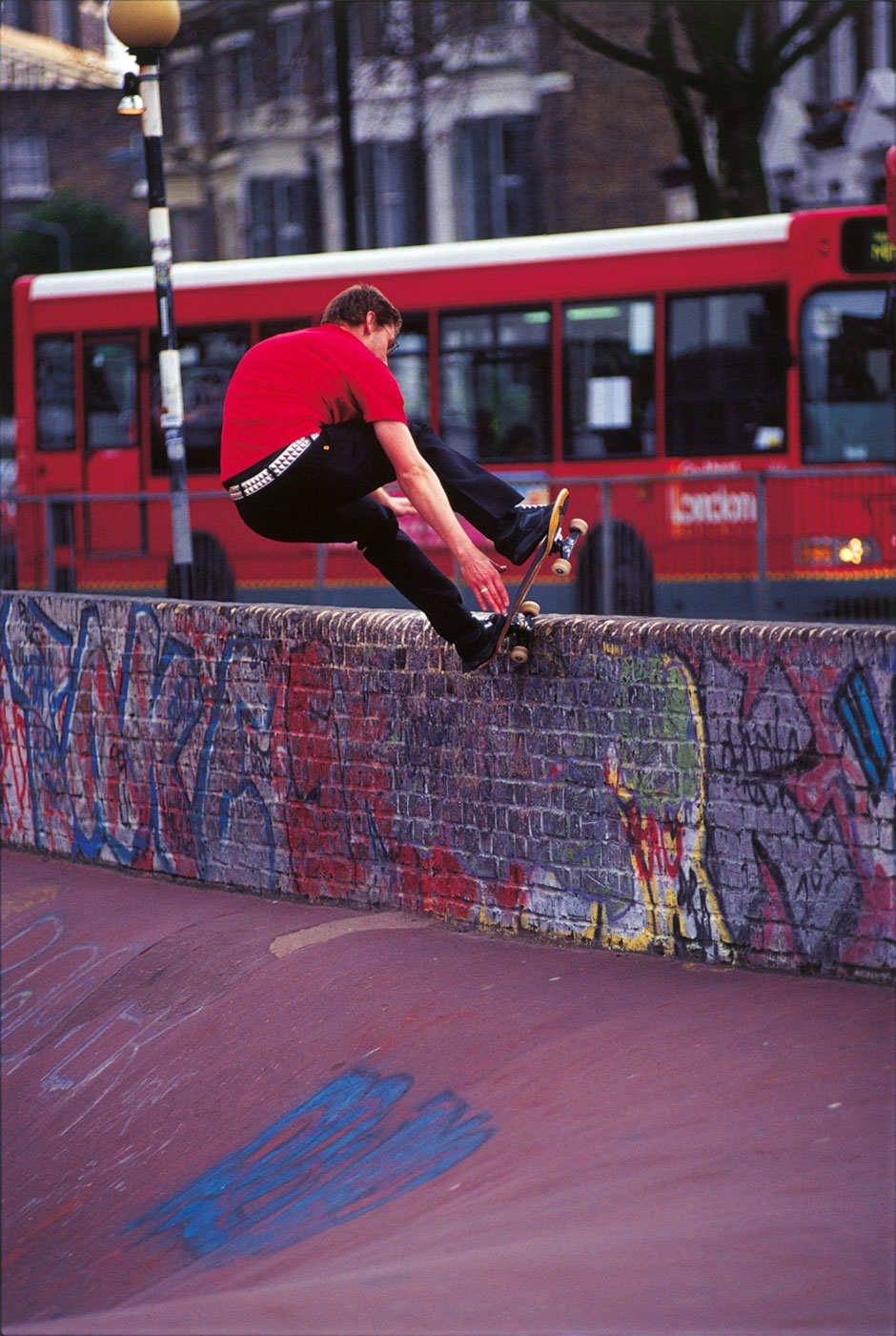
The old red Stockwell surface propelling Chris into a phoptogenic nosepick PH: Wig Worland
What is the Mark Gonzales story you mentioned?
I was at Stockwell skatepark, and I was just loving it. When I’m loving it, the blinkers go on, and it’s like, there’s nobody else there. When I’m really feeling that, I kind of go loose, and I start doing layback things, dragging my hand on the floor, surfing, and doing that kind of stuff. I just let go completely, and it probably looks a bit weird, but I’m just really feeling it. So I was skating at Stockwell and wiggling around. I did a little carve, and I dragged my hand on the floor, a little surfy move. It looked like the one Gonz does at the start of his Video Days part, where he’s skating at Shell Centre wearing a two-tone blue shirt, burgundy cords, and some red high tops. He does this thing; he goes up to the red tarmac, and then he does this little turn, and he goes to drag his hand on the floor. So I’m at Stockwell, and I’m wiggling around. I think it was still red at the time, and I did that. I did this little turn, and I dragged my hand. I stand up, look up, and Gonz is right in front of me. I had literally done the Gonz thing in front of Gonz, and I didn’t even know he was there. I don’t know Mark, and Mark’s a reasonably quiet person, but I was standing against the wall near the road where people ollie over, and Mark stopped by me, and he said, “I really like what you do”. Just a quick thing, and I have that. In all of skateboarding, I have that, the Gonz saying he likes what I do. That’s the ultimate. I’m quite adamant that I don’t really care what anybody else thinks because, as long as I like what I do, that’s really all that matters. As long as I’m not hurting anyone. But to have someone come up and give you a genuine, short, honest compliment. I’ll always have that. It was just nice because I felt seen and I felt understood, weirdly. I’ll never forget that.
Back to your time as Slam manager. Two Heroin videos bookend that time period. What else have we got in between? You shot an interview with Dom Marley, filmed with Josh Stewart and Chris Massey for Static II, went to Tokyo with Heroin, and there was a Vans tour…
For Static II, I went to Southbank, and I had this moment. I said to Massey, “Let’s go and get these bits. I’ll go and knock out some stuff for Josh. We’ll do a day, and then I’ll know that I’ve given Josh some stuff”. So I went to Southbank to knock some things out because I had never filmed them. We tried for the straight no comply, and then I got the 180 no comply. It took me a minute to get the 180 no comply because I kept sliding out for some reason. I couldn’t ride away that day; I kept falling off, which is odd. Once we got that, I suggested we go up to the top to have a look at that handrail above, the one on the wall. I think Mike [Manzoori] had done an ollie and ridden down it backside; I know Joey [Pressey] frontside boardslid it, the actual hubba. There is a lovely brass rail next to it. It’s still there; you can look at it, but I don’t think you can ride away anymore. It’s down eight or nine stairs, a brass rail on the hubba, which is too close to the wall to grind. There’s only about a three-inch gap between the rail and the wall. It’s the kind of thing where you see Brian Anderson cut his tail off to do a tailslide, that kind of thing. But there’s nothing you can do with a 50-50 to make it easier, apart from doing the 50-50 with your wheels touching the hubba.
My trucks are on the hubba, I’m on the rail, and my wheels are grinding down the hubba. So my board was at a funny angle, and it was really awkward coming off the rail. When you 50-50 a rail, it throws you into the floor. You get pounded straight down to the floor. Trying to come off with my board at an angle, and controlling that took a minute, but we got it. I’m not a big handrail skater, but the one handrail I’ve got footage of is really awkward to skate. It’s another example where I wasn’t able to do the hardest, most impressive thing, but I was able to make a contribution because, within my abilities, I was able to do a hard thing on quite an awkward obstacle. I take my skill level and try to adapt it to things. I had to think a little sideways because I couldn’t skate the twenty-stair rail, but I can skate the awkward nine-stair rail, which nobody else would bother with, really. I’ve actually got some good tricks in Static II; I’ve got those two no complys, that 50-50 down the rail, and then a line in the street.
“It’s another example where I wasn’t able to do the hardest, most impressive thing, but I was able to make a contribution because, within my abilities, I was able to do a hard thing on quite an awkward obstacle”
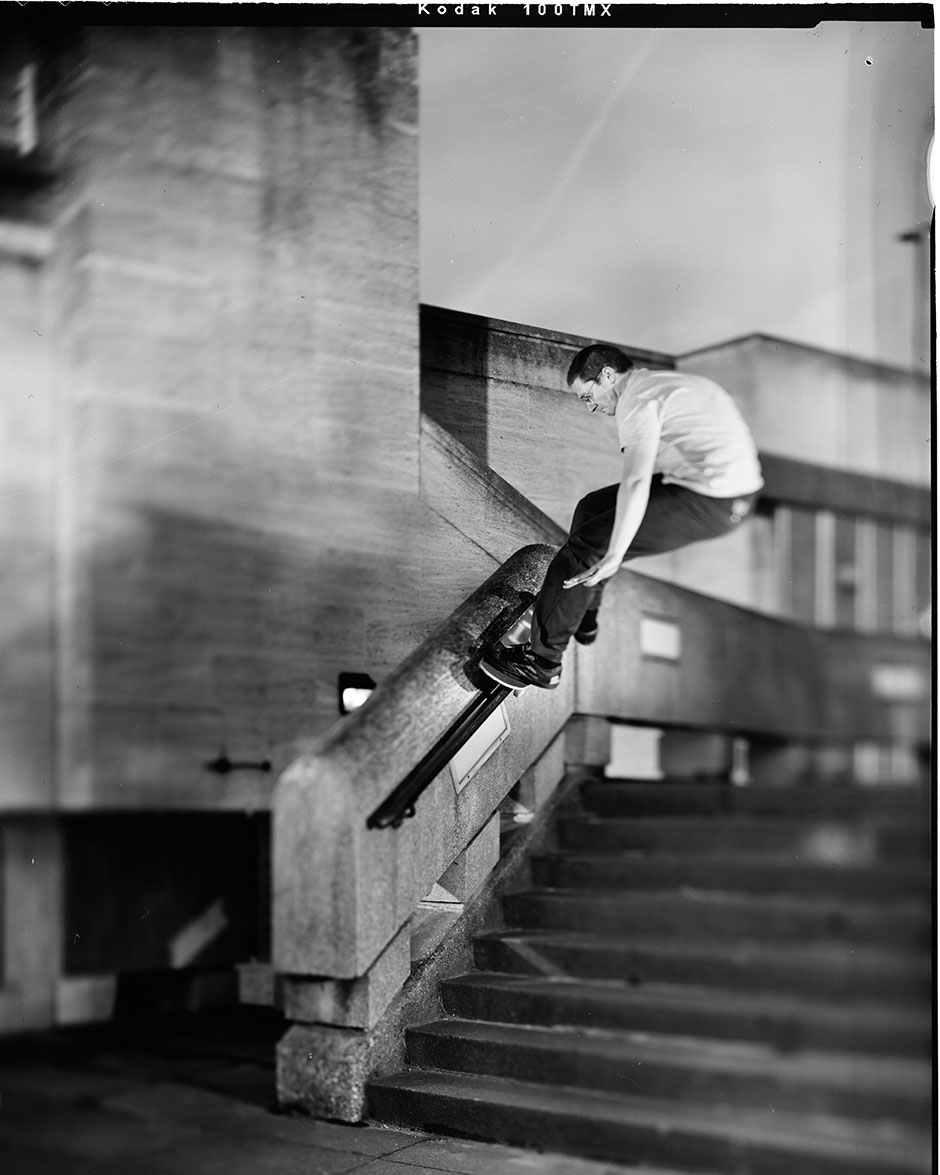
Chris grinds an awkward one above Southbank for Static II. PH: Dominic Marley
I remember Josh being really stoked on the line as well.
Before we went to film that line, Massey and I had gone back downstairs to Southbank, down to the Undercroft after filming the 50-50. So imagine me, I’m buzzing at this point. I’ve got two tricks down the stairs, and a handrail trick! I was telling Massey at the time that this is better than anything I’ve filmed for a video, and we were just doing it in a day for Josh. When we get back down there, [Mike] Manzoori shows up, and he is there with [Tom] Penny. You need to double-check this with Manzoori because I don’t want to think I hallucinated this, but Penny was spinning switch frontside 360s down the stairs, and it looked very much like he was trying to rotate them another 180. Let’s say that. Penny was in full baggy gear, full Penny, early 2000s style. It looked like he was trying to throw switch frontside 540s down the stairs. Because if you think about it, technically, if you can spin it, that’ll work because you’re landing forwards. It’s much easier to throw yourself into something if you’re gonna be riding away in the natural direction. He was spinning them, and I don’t know if Mike was filming, but I thought I was going to witness a switch frontside 540 down the stairs. I think he was just kind of playing with it, but that’s what it looked like was going to happen.
After that, Massey and I left to get some food, and then we went into town, and we were looking for something to do. I thought that one street was good; it goes from Trafalgar Square down to Embankment Station. That road is quiet, it’s quite wide, there are lovely wide pavements, and they put in these kind of baguette-style looking benches with these brass rings, and there are a couple of those in a row. There’s also a curved set of stairs that you can use as a manny pad because it starts from nothing or one step, and then if you use it to its full extent, you can drop off four or five stairs on the other side. We got this little line ending with a 360 no comply down some stairs. When you do a frontside 360 no comply, you can kind of get it to almost 360, and then land on your back two wheels for the last bit and turn it. Even though it feels kind of sloppy, the fact that it whips you round, and you’re actually committing to landing on those back wheels at the bottom of the stairs, makes it quite a nice feeling. Obviously, you can’t do that down eight or nine stairs because it’s gonna snap the board or your leg. I’m glad Josh liked it, and that Massey filmed it. If I were ever going to be in an American video, that was the highlight of being presented well. Josh really cares about skateboarding and the people he involves. Those brief moments where you feel cared for and included in this whole thing are kind of nice.
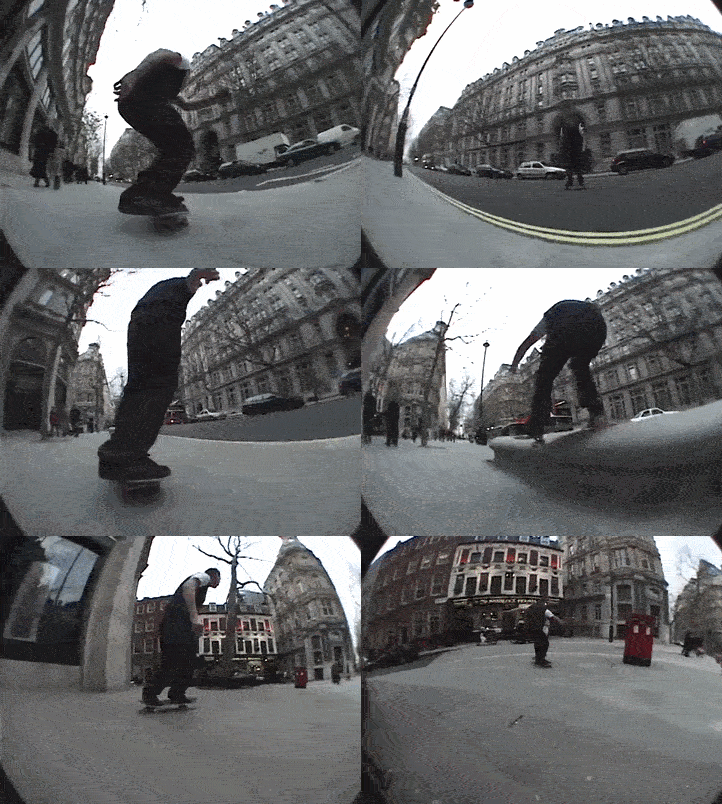
Line from Static II filmed by Chris Massey (RIP)
Then you were also working on the interview with Dom…
When Everything’s Going To Be Alright came out, and the pro board came out, then you do the real work of being a pro skater. Keep shooting photos, keep filming, and get out there representing the board that you’ve worked hard to get. You’ve got to then support that; you have to be doing the work as it were. I wanted to shoot photos, so it made sense to try to do an interview. I think I asked for that. I’m a pro skateboarder; I’m in a good spot; this might be a good time to do it. I think I asked Sidewalk if they wanted to do it, and they thought it would be cool. Marley was the obvious choice because he was close. I liked working on the project with Marley. He’s such a lovely bloke, and he’s fun to be around. Hanging around Dom really lightens my mood; he’s so happy, and his mood rubs off on me quite a lot. He would give me the right amount of ribbing as well. He could see I was a bit sensitive, but he’d be really good at encouraging me; he was good at that stuff.
Dom was somebody that we would see pretty much every other day at that point. He used to get his photos developed in the lab around the corner by the Cross Keys pub. We would see Dom when he came in to drop them off; he would hang out for the afternoon, pick them up, and we’d often see them on his way out
Yeah. Dom was working really hard, and he had really good access to photography equipment. He could get rentals, or, because of where he worked, he could borrow a camera and come and play with it. The photo we shot of that trick that Massey filmed above Southbank is a Hasselblad photo. I’m sorry for my technical knowledge, but it’s a tilt-shift photo. When you look at it, it’s only focused through a diagonal line running through the middle of the photograph. The rest of the photo is out of focus deliberately. The plate is basically bent inside the camera. So it gives you this nice effect. Obviously, when you’re trying to skate a handrail, and someone is trying to achieve an artistic effect. It’s another of those ones where I would like to just get the photo, and then mess about afterwards, but he got it, and it turned out great. I’ve got the Polaroid test print that you do when you shoot medium format. I’ve got the Polaroid he gave me, and then he made a nice print, which Keith has in his room. It’s nice to have the photo, and the footage, and the evidence of me being the best pro skateboarder I could probably be. In my head, I’m probably slightly past my prime in a weird way, past my best skating, but still trying to knock out those big tricks. It’s stupid; I was trying to skate stairs for Static, that’s crazy! You don’t need to skate big stairs for Static; you just need to skate dirty kerb cuts and cellar doors; that’s what he wanted. I just couldn’t help myself because it felt right. I shot some good photos with Dom, and a lot of them are medium format, nice square photos. I think I interviewed myself for that, which is odd as a concept, but I wanted to do it. There’s a little homage to Paul Sunman in there, too.
Homage to Slam founder Paul Sunman. Paul’s TWS cover shot by Dobie and a Pulman tip of the hat shot by Dominic Marley
That all kind of led into the London Bridge no comply as well, right?
I could go to Southbank and straight no comply the stairs every time because it’s easier to land on it right away than it is to bail that trick. I was looking at London Bridge, and there wasn’t much difference between doing a trick down the Southbank seven and doing it down London Bridge stairs. Because there is a kicker at the top of London Bridge, and because it lands on a down slope, it’s a very forgiving set of stairs to skate in a weird way. It feels like you’re in the air for a long time, but it’s actually quite a forgiving set of stairs. I thought I could easily do that given the right set of situations. So I went that one time with Massey; I think Alan Glass was there too, and I thought, I’m gonna do it, it’s gonna happen, we’re gonna get this. This could be my ender if I get this; that’s the way I put it in my head; I focused on it being an ender. If you could take a known spot and do an NBD down it, and if it’s interesting enough to get people’s attention, then it’s gonna be a winner, you know what I mean? I tried it that day, and it didn’t take very long until I did the one I did. Obviously you don’t want to be jumping down stairs a lot. I landed on it, I landed on it and whipped out, and then I landed on the one that clips the bottom step and throws me off my board. Then it either rained or I broke my truck, so that was kind of the end of that for the day. I knew it was possible, then I went back again to do it, and I either broke my board or bent a truck, and I was kind of pissed off. That annoyed me. Then I started to get freaked out by all the pedestrians, and people coming around the corner of the road, and people on buses. In the end, I couldn’t do it with Alan or anybody who was my regular filmer. We had another guy who was filming called Tim.
Tim Kitchin?
Yeah, Tim Kitchin was lovely, and he was willing to meet me. I told him what I wanted to do, but that it had to be a special set of circumstances; I basically needed to do it quietly on a Sunday morning. I was living out of town at this point, so I had been commuting into London to go and skate. I was getting there for like eight or nine o’clock in the morning on a Sunday to try and get this trick. I did that four or five more times, and I just couldn’t do it. In the end, a bus would be coming up over London Bridge. I’d be standing at the run-up, and if somebody on the upper deck of the bus looked at me, that would put me off. I developed this absolute madness around this focus of making this my ender for the video to the point where I didn’t film anything. I couldn’t film anything else for months. My legs would hurt, so I’d rest up all week so I could try it again the next weekend. In total, I went there seven times, throwing this no comply down them, and the irony is that the closest I ever got was the first day we tried it because every other time it was impossible. If you had taken those stairs and put them in a warehouse away from any people, I could have done ten and picked the best one. But because of where it was, I just couldn’t do it; I couldn’t conquer the mental battle of doing it the way some people do. It was probably the first thing in skateboarding where I thought I could do something, and I couldn’t actually do it. So I did it, but I didn’t do it the way I was happy with, and to me, that’s what counts. There’s fun in doing it and riding away; everybody knows that. The way I slide, you can see I just got bad luck there, and on any other day, I probably would have ridden away. If I had landed and ridden down the road, I probably would have put both arms in the air and gone around the corner with both arms in the air just for the shits and giggles of it because it would have been a legit self-congratulatory moment, I think.
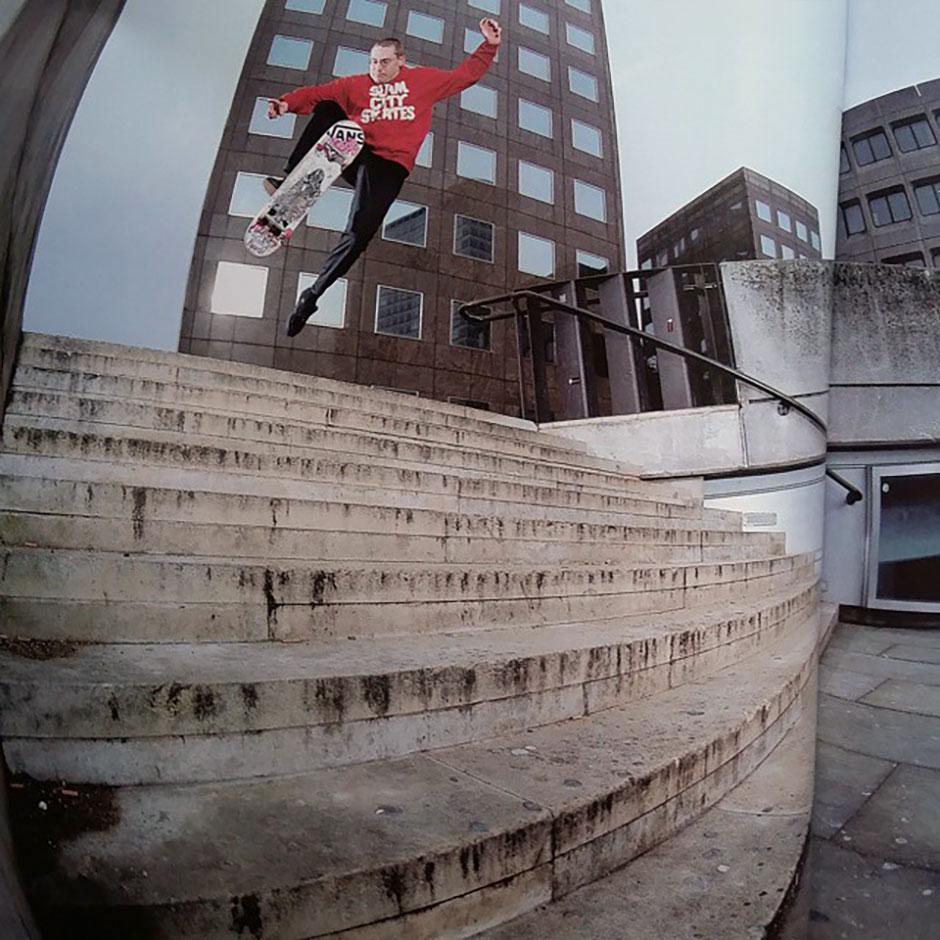
Slam hoody in straight no comply flight down the London Bridge Ten. PH: Dominic Marley
Anyway, I didn’t get it. It was a moment in skateboarding where I gave up, and I rationalised it. I was potentially going to do something to damage myself so badly it might be the end of my end of skateboarding. I don’t want that; it is not worth it. It was a shame, but I really made peace with that. Then that was the point when I really started to film for the video. Tim would meet me at London Bridge, but where I hadn’t been able to do it, I felt so guilty that I’d got him out early in the morning that I’d go and film stuff with him. We would film at Knightrider Court, or Holborn, and around Bank. Unfortunately, because he was filming with a Canon, the footage didn’t look right to Alan, and the sound was a bit different, so a lot of the stuff Tim filmed is the really bright footage, and it’s in the Live From Antarctica extras. There’s loads of good stuff in there, and Alan edited it to “Time 4 Sum Aksion,” so I even got hip hop on my bonus part.
How was going on tour with Vans?
 It was a great success. I had a time because I’m the kind of person who has a regular life with a regular job, but you put me in a van on a tour and all of a sudden I’m on holiday mode, but we’re on a mission to go skateboarding and do demos. I remember getting picked up at the end of Latimer Road by the old Slam warehouse. Christian gave us an envelope with our per diem in it, £100 for the week or whatever, and I just got in the van. I put a mesh hat on and decided not to think about Slam for two weeks. That was amazing; we did demos, we went to Rampworx in Liverpool, and we did a demo there, and I had one of the best skates ever there. I used to love Rampworx. The next year, we were going to do another Vans Tour, and it was a bit more organised. Christian had printed up hoodies with our names on, and stuff. It was going to be the ‘No Home Comforts’ Tour, which is a way of saying we’re not gonna have money for hotels; we’re gonna sleep on people’s floors, tour. I think Nik Taylor did the artwork for it all, but then I got chickenpox at 27 for the first time, the day before the tour started. My GP gave me cream and these tablets that looked like the kind of tablets you give to a horse, and told me I just need to rest and stay away from people. I missed that next Vans tour because of that. I was living in Kennington on top of this block of flats. It was a regular block of flats, but on top, it had these prefab granny flats looking over Kennington Park. They’re still there; there are four of them, and mine was the one with the chimney. I had a private patio on top, on the 16th floor. I had chickenpox, and it was hot like it is at the moment, a really hot summer. I couldn’t do anything, so I was sunbathing naked on top of this block of flats on this private patio, covered in these chicken pox blisters and calamine lotion. It must have been the Queen Mother’s birthday or something because as I was lying there naked looking straight up in the sky, Concord and the Red Arrows, and a Lancaster bomber flew directly over my flat. I’m lying there naked, spread-eagled, looking up, and they must have flown and then gone down the mall. It was a surreal moment.
Busted.
Yeah, busted from 10,000 feet. I had booked time off for the Vans tour, but I got chickenpox, and Henry [Clay] had to come in one day, and nobody had keys. I had to come into central London and open the shop because I was the only person around, even though I had chickenpox. I basically had a hoodie up and dressed like a leper. I remember I got to the shop and opened the door. I had my hoodie over my hands, so my fingers were just poking out, and my hoodie was over my head. I dressed like I was in a plague. That was a funny moment.
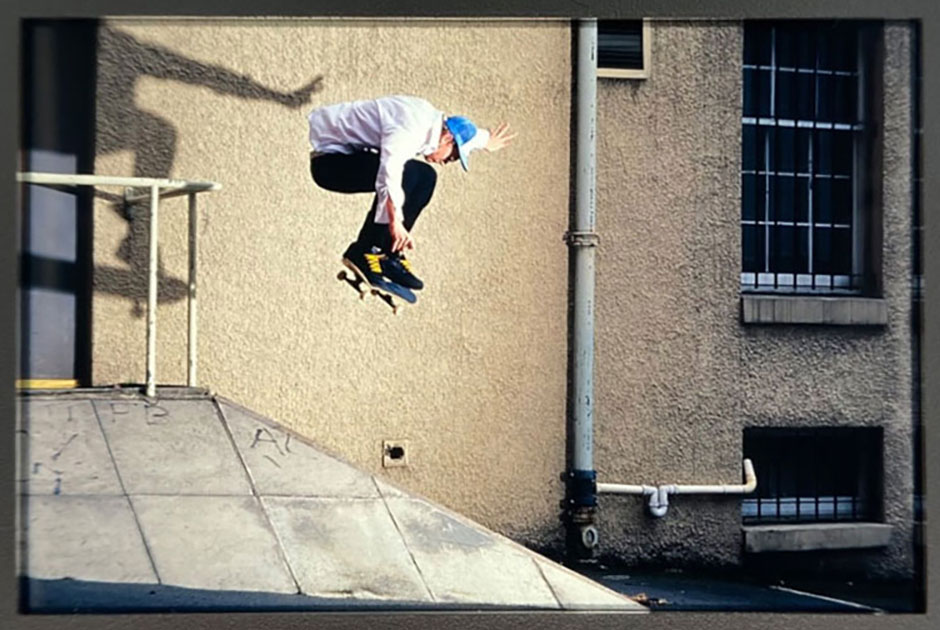
Chris snaps one over a hip on the Vans tour, a Wig Worland Slide
So you’re finishing off filming Live From Antarctica.
Yeah, think Fos and Alan had kind of given up on me filming that video, but once I got rid of that no comply-fixation, I was free to carry on and just enjoy filming that part. I went to Barcelona with Fos; we had a week there and hung out with [Paul] Shier, skated loads, and got absolutely knackered. That was cool, it was nice to do that. Then so much other stuff happened during that time. We had so many film premieres; it was endless. If you look back at that time period, all the skate videos came out, all the film premieres we had that Robin helped to organise at The Prince Charles cinema, all those things that happened. From 2000 to 2005, skateboarding was popping off, and there was a lot going on. Lots of products, lots of tours. We met so many people; people came in the shop, we had signings, it was a really exciting time to run a shop, a really exciting time to be in retail. It felt like I was in the right place, at the right time, almost by some happy accident. I’d gone from being a kid growing up in South Wales to managing, arguably, one of the most well-known skateboard shops in the world during a time when skateboarding was really popular. You can’t make that stuff up, can you, as far as luck goes?
Click on the James Jarvis illustrated Live From Antarctica Poster to be transported to Chris’ part
It was a good time.
The story of my life really is that I’ve been incredibly lucky. Obviously, I’ve got the privilege that comes with being a white man; there’s a massive privilege with that alone, but I’ve been really lucky with other things that have fallen into place. I think of Two-Face in the Batman movie saying you’ve got to make your own luck. So when I think I’ve been lucky, I realise I have actually made my own luck. I’ve put myself in places, and I’ve gently suggested to people that I’d be interested in doing things if they were so inclined. So I have kind of made my own luck in a way. I do believe any white man has got a head start on everybody else, unfortunately, because of the way the world has been set up, and I’m not unaware of that privilege. Outside of that, I’ve also been really lucky that people have given me a chance.
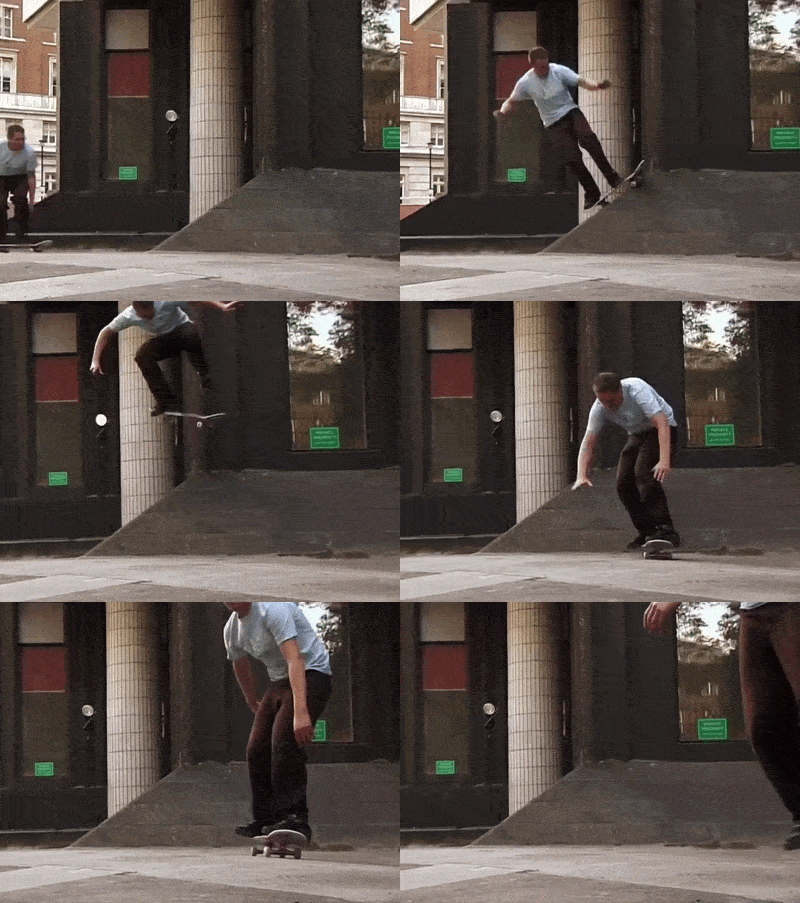
Gas Banks Hip Revisited. Kickflip from Live From Antarctica
Let’s move on to somebody giving you a chance. From Live From Antarctica to the Black Box era.
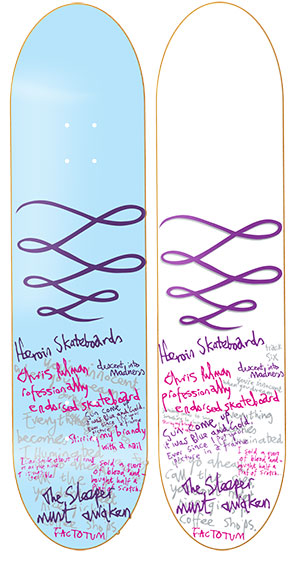 In around 2004, people were looking for new distributors for their American brands. We had such a strong domestic market; Blueprint was doing so well, and Heroin and Death were doing so well. Reaction, Organic, Landscape, Unabomber- we have the list there. All those brands were doing great. There was Clown, so many British brands, little things, and big things. Shop brands and shop boards were doing well, too. Jamie [Thomas] obviously had a footwear brand, which is a huge investment, and some hardware brands, which are less of an investment, but they’re super important if you’re a skateboarder. They had no distributor for Fallen, and Jamie wanted to get back in the UK properly. There was no way they could set up their own independent entity, even though it was a footwear brand, which is what you would normally do. He decided to do the distributor model, where you sell your stuff to a distributor, and they distribute it in the country. There were various options.
You had Nick Zorlac, who was a distributor. Power sold lots of hard goods. Shiner were a huge distributor with a massive portfolio of brands. They were focused on hard goods and things like roller skates and scooters, other sporting goods. Shiner just had a much broader demographic as a distributor. Slam was gone as far as distribution, and then there was Faze 7. I guess you have Rock Solid or Out of Step starting just after that time. Faze 7 as a distributor had lots of really good qualities. One of the main ones was that Faze talked to every skate shop in the country, and like Shiner, Faze had a product that was essential. You had to have Blueprint boards. If you didn’t have Blueprint boards, you were pretty much blowing it at that time, right? Because they were the best-selling boards in the country. So Joe [Burlo] dealt with everybody regularly because those boards not only sold, but they sold quite quickly. So those customers, those shops are buying and selling regularly. Their cash flow was tied to the Faze cash flow, and they’re in contact weekly. Jamie knew that if you want to get your brand into shops, it makes sense to go to the distributor who talks to everybody regularly, and that was Joe Burlo. Joe was very serious; he was very serious about business, and he could talk the talk. He could convince you of pretty much anything. Joe could sell really well to somebody who could be sold to. I think Jamie came and met with all the distributors. And he thought Joe was best placed to do this because he didn’t have a footwear brand, but he had an idea of how footwear brands work. I think Joe may have distributed Evol for a minute, didn’t he?
I remember them having Evol, Edward Sebastian, and a few other things at the same time.
I can’t speak for Jamie, but my assumption is he went with Joe because he had a big distribution and he had the hottest product, which everybody had to get. You had to spend money with Joe if you were a skate shop. That’s a good place to be if you’re an American brand. I think Jamie knew by then that American brands like Zero, Mystery, and Slave were really struggling in the UK. If you had an American brand, the numbers on sales were not going up anywhere near the rate of our domestic brands. I think the Americans almost resigned themselves to the fact that they were not going to sell loads of boards, but they still wanted to be on people’s walls. Obviously, if you have Zero boards at the place where you sell Blueprint, if someone’s going to buy 20 Blueprint boards, it’s pretty easy to get them to take a single skull board, and then they’ll always have a board on the wall. Unless they’re fans and they buy loads, but for some shops, it just wasn’t their thing. So with Fallen, footwear is the moneymaker in any business. Footwear makes so much more money than Hardware, and it’s a much larger outlay with more involved. You’ve got to do pre-orders, you’ve got to do long production timelines, ship things from China on boats. It’s heavy dealing with shoes, but Jamie’s business was doing great. They had just won the Ernst & Young Business Entrepreneur of the Year Award. Jamie and the people at Black Box won that in 2004, I think. They were in a business magazine; they were on it, a skateboard business where people make money and don’t wear ties. I’m a massive fan of Jamie Thomas. I fanned out on Jamie, just his determination. Jamie is a skateboarder who had to work at skateboarding to get good at it, whereas some people have a more innate talent. I think Jamie worked and worked and worked. When you see Jamie Thomas skate, it is determination in skateboard form. That is inspiring to see someone make something happen. Jamie just made it happen, so that was inspiring to me as a person, inspiring to me as a skateboarder, and I was a fan. I liked Zero when it came out. I was all about it. I wore Zero t-shirts for like two years straight.
So Jamie wanted to have a distributor, and he couldn’t do his own thing. He wanted to work with a current distributor, and he picked Faze. Jamie asked me which distribution I thought would be best. I told him the same. Shiner does what they do. Faze does what they do, and I agreed with him. He had met with everybody; I think even Fos considered starting his own distribution to deal with it at one point, but it probably sounded too heavy, and he would have had to re-mortgage or something. Jamie told me he had decided to go with Faze on one condition: he needed somebody in the building to keep the reins on it and make it work. He asked me if I wanted to work at Faze with Joe to do Black Box UK. It was a no-brainer for me. One, I was a fan. Two, I didn’t have to set up any of the logistics. It was all set up already, because Joe had his own distribution. I knew it was going to do well because we were always selling the hardware, and I could piggyback footwear sales off the hardware. I knew I wasn’t going to sell loads, but it was footwear sales, and I was excited to get to be a footwear rep. I knew I could do it because I’d met so many footwear reps and just knew I could do that. I quite like it.
So I went over to Black Box; Jamie flew me out to America. He came and met me, we went to Black Box, and he took me down to the showroom. In Black Box, the showroom was basically set up exactly like a big skate shop that only sold Black Box products. So the wall had every deck, all the shoes were laid out, and the cabinet had everything in it. Every Zero skull ring, every piece of miscellaneous stuff was in there. Every sticker was laid out as it would be in the shop. Jamie sold me the line like a rep would come and sell you the footwear line. He sat me down, and he sold me the line like I was buying it. He explained every shoe, every stitch line, every different layer of plastic in an insole. The foam in an insole, all the types of leathers used, why you use a certain type of nubuck. Why do you need a medial arch support on a shoe? Because it helps to keep shape, it helps to keep structure. I didn’t know what a medial arch support was. I learned that shoes are reinforced on the inside and not on the outside, and all these mad things. I’d been wearing skate shoes a long time without knowing what was in there. Jamie armed me with this massive shoe knowledge that I hadn’t been able to get from the reps we’d had in the past.
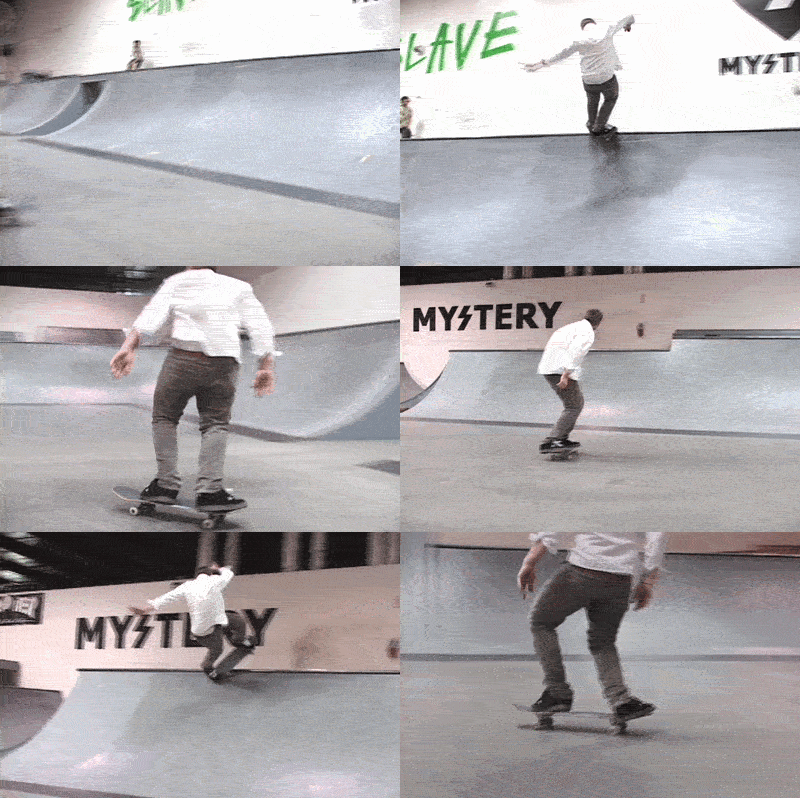
Making the most of the Black Box park on a lunch break
I remember different reps bringing shoes to the store, and you were always asking questions.
Yeah, I always asked, and I don’t know if the reps liked it. They probably found it quite difficult, to be honest. Also, at Slam I always wanted to order stuff from the catalogues that they didn’t have because of minimums. There were loads of products we couldn’t get because the other shops in the country didn’t have the balls to get them in. Jamie armed me with this info, I got my sample set, and I got a van. I bought a Chrysler, went out on the road, and sold shoes easily. I just went out there, and I took the product, and I went to shops all around the country. I went to see nearly everybody. Everybody wanted to see Fallen shoes. Whether it was Aberdeen or Penzance. I went everywhere in the UK. Northern Ireland was the only place I didn’t make it to, but I went to everywhere in mainland UK that wanted to see the shoes.
Dropping the science.
Just dropping the knowledge because I would go into a shop and tell them that I know what it’s like to be on the other side of the counter. I’ve been there; I’m not like another shoe rep. I’ve been there. I’ve sold shoes like you sell shoes. When you’re selling a shoe, if you can tell someone that this leather is really durable, or this shoe is really good for this, or it has this special feature, it helps. Even if you tell them a stupid anecdote about why Tommy Sandoval wanted rasta laces with his pot leaf shoes, and the fact that it cost 25 cents extra to put those rasta laces in than the regular shoes. I would tell them all these things, all these stupid little anecdotes. But when you’re in a shop, and you’re dealing with a customer, and you’re desperate to tell them something real about the product they’re buying, it’s best if you’re not just telling them some sales pitch or a bullet point. I gave the retailers good ammunition to have genuine, authentic conversations, and I think they appreciated it. I think they saw that not only was I telling them how to sell the product, but I was also selling them the product at the same time. Instead of bullshitting them, I was telling them all the good things about shoes from a skateboarder’s point of view and from a retailer’s point of view. I think they found it quite easy to buy from me because I was making it easy for them. I hope I wasn’t overwhelming people. Nobody ever said, “I don’t care, just show me the yellow ones”
Didn’t you annoy some other reps?
I bumped into Emma Reynolds at a trade show, and I think it was up in Edinburgh at the football stadium there. She asked me what I had been doing with all the shops she had been to see. They had all started to ask her questions that she didn’t know the answers to. Questions they had never asked before. Questions about fabrics and EVA plus latex insoles. Why are your insoles only EVA? Why have Fallen ones got latex in them to make them better, and you guys use the cheap insoles? There was a little bit of that. I was giving these shops all these insights into things where other brands weren’t pulling their weight. You kind of had to show them the magic trick, almost. I just told them about the shoes. I’m rubbish at selling stuff. If someone truly doesn’t want something, I’m not going to change their mind. I’m rubbish at that, at convincing people. But I can present the facts that I think could convince you. They’re facts then; they’re nothing I’ve made up, they’re just what I’ve remembered that are true. So it’s very much a quest for authenticity, I think, and just being as real as you can,
That was a role you very naturally adapted to.
Yeah, honestly, selling shoes was the most natural job I ever had. I liked things; I liked the product. I liked the brand, and I liked driving around to see people. I liked to go and see people in their shops, to see who their customers were, and what their local scene was like. Very often, if you’re a sales rep, especially if you’re just selling only hardware on the phone, you don’t know what that shop really looks like or how it works on a day-to-day basis. The guy on the phone is selling the hot shit that’s come from America, and the guy on the other end of the phone is in a shop, stressing about scaffolding being up and nobody being able to see the shop. Or the bins haven’t been collected, or there’s a water leak, and the road’s closed for the week, and he’s losing footfall. Retailers have totally different things that they’re concerned about than the sales guy. The retailer is literally in the trenches, and you have to remember that. I’d be speaking to them on the phone, but I always said if a customer comes in, hang up and call me back. The customer who comes in is more important than me selling on the phone, and I don’t think other reps did that stuff. I wasn’t a perfect rep, but I did it in the most respectful way I could, and to me, the most respectful thing was to go to people’s shops. That’s the very least you can do, so I did that, and I loved it. I really enjoyed driving around doing that.
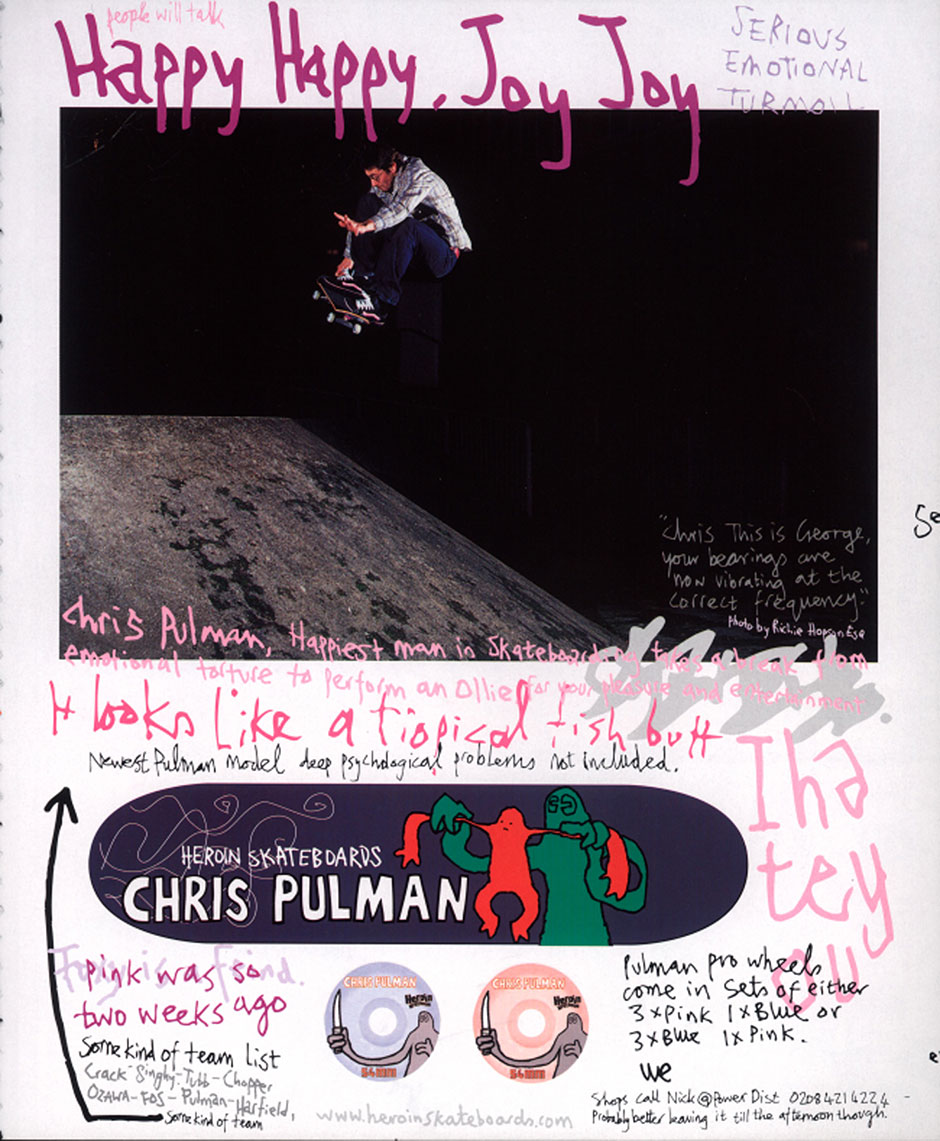
Advert for the Fos illustrated board of Chris’ puppet being stretched. PH: Richie Hopson
Before the financial crash in 2008, while repping for Black Box, you also retired as a pro for Heroin.
When I started working at Black Box, Jamie had a conversation with me, and he was like, “What are you gonna do about Heroin and Vans now?” I had really just figured that I was going to keep doing that stuff. Vans was a weird one because I didn’t really need it, and it was weird talking about the shoes. The Vans part wasn’t as essential as the Heroin skateboards thing. Jamie asked me what I was going to do, and so I said the proof is in the pudding. If the shoes are any good, I’ll wear the shoes. He gave me a pair of Chiefs, which were his pro model. They were basically like a Rowley one, so they just worked straight away. The Chief felt pretty much like a Rowley one, so the shoes were a no-brainer. Once I’d had one pair and figured out all the differences. They were much better quality than a pair of Vans. Although they were relatively generic-looking, they were made in really good factories. The production was some of the best production in core skateboarding brands, probably the best production in core skateboard brands. I don’t know if Don [Brown] or Pierre would argue with that, but I think it was, it had the best fabrics. I thought if the shoes are as good or better than Vans, I’m obviously going to wear them because you can get better shoes whenever you want, you know, and get samples ahead of time.
With Fos and the Heroin stuff, I was thinking this is going to be a full-time job. I was married, and I was going to have a kid in a minute, so it seemed like a good time to ease off. I wasn’t in London, so it was hard to shoot photos, and I was getting a bit more kind of midlife, I guess. Getting a bit sloppy, putting on a bit of weight, and not being as fit and stuff, so it made me retire, although I kind of didn’t want to. We did the Big Push, and I think that was the last thing I did for Heroin while I was working at Black Box. I slowly retired after that, but it took two years to really retire and for Fos to put out that final board.
That was done really nicely because we revisited my first graphic, which was the guy stabbing himself with a knife. That was originally actually going to be a Kerry Getz or Bam Toy Machine graphic, but it got switched, and Fos let me have it. I loved that character, so we revisited that original graphic. I wanted to adapt that in some way. We’d already adapted it as kind of a series, so we turned the guy into a stretched puppet. It was really easy. I felt rung out. I suggested getting the guy and having him rung out. For some reason, Fos wasn’t up for drawing it. I don’t know if he didn’t think he was technically up to it, although he obviously was, because Fos, believe it or not, can actually draw really well. I know it looks like sketchy scribbles and all kinds of nonsense, but Fos is a brilliant illustrator. He didn’t want to do this graphic, though, so he suggested Todd Bratrud could do it. I was blown away. I was retiring, and Todd was going to draw my graphic; that’s the ultimate! Todd quickly drew it up. I don’t know how much time it takes him to do stuff; Todd seems like someone who could knock this stuff out pretty quickly to a massively high standard. He drew it, and something he’d done is where the guy’s arms are twisted; he twisted them the same way. Now the physics part of my brain knows that if you twisted the guy, it wouldn’t look like that. You have to reverse one of them. So he redrew one part of it just because of my technical nerdiness to get it right, and he was really gracious about it, I think. I wasn’t sure if Fos wanted to ask him to redo it, but I said, “Look, this is my retirement board. He’s already got this far. For me, let’s just fix that so it looks right”. So he re-drew that bit.
It would have been more folding than ringing otherwise.
Yeah. He looked more spun. It looked like if you could grab his hands and spin him, he would be like one of those PG Tips monkeys, but I wanted him to look like he’d been twisted and rung out; his face is all rung out. That’s how I felt; I was being pulled in lots of directions, and I was rung out by being the sponsored skateboarder. You’ve got to remember nobody was really getting paid at this point. I mean, if anything, we were getting board royalties, but nobody was getting a salary, and I wasn’t getting a salary from Vans, so we were all saying we were professionals, but we were actually amateur. We weren’t getting paid for any of this stuff. If I’d been able to turn skateboarding into something that made money, then I could have looked at maybe just being a skateboarder, or a team manager, as well as a part-time job, you know what I mean? But I had to maintain a full-time job in order to be a skateboarder, and there’s no time to be a professional skateboarder if you’re doing a full-time job. Especially if you accidentally keep promoting yourself from retail staff to sales manager for a global skateboard company. I accidentally became that; it just happened because of my knowledge and whatever skills I had. I just evolved into that; it wasn’t my ambition to do that because that’s too much work. I didn’t want to do that much work and have that much money; I wanted to have more time. Time is what everybody really needs, and time is the precious bit. So it took some time to retire from Heroin, then I did, and it was done really well.
By then, I was always just riding whatever Zero boards I could. Working at Black Box was a treat because we had Mario Rubalcaba working down in the production, and all the team riders’ boards were custom. They could have whatever shape, whatever concave, whatever graphic on whatever they wanted, basically. Their boards would come gripped and shrink-wrapped over the grip. That was so if you’re out skating, and you need to set up a board quickly, you’ve got one gripped and ready to go. These guys are skating handrails; they’re breaking boards all the time. So the boards came gripped; it was really weird. As an upshot, working there, as a member of staff, you could get anything. You could get Mario to make you anything. I would ask Mario to make me 10 of Jamie’s shape, an 8.1” with a specific concave, and throw Rattray’s graphic on it. I could make them exclusively with yellow top stains. So there was a point where, even though I was just a sales guy, I was ordering custom boards the same as the guys were. That was nice. That was another perk of working there, and there were lots of perks.
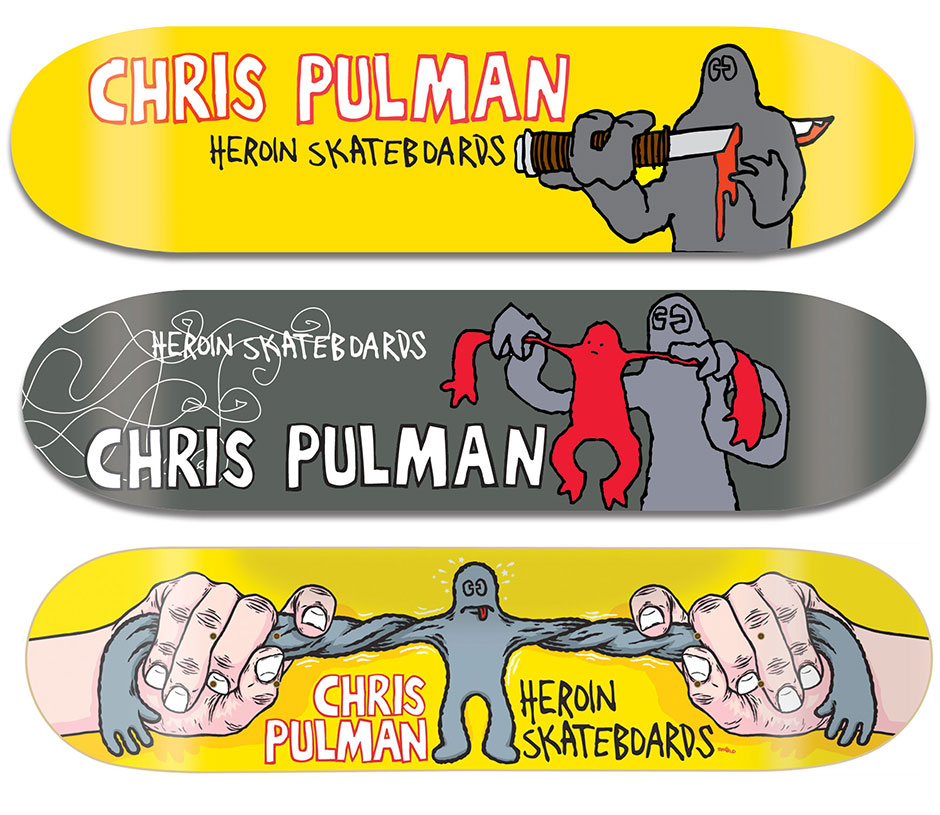
Which must have been a dream from your perspective.
Yeah, for me, or for anybody who’s technically specific about that stuff, anybody who has that slight neuro-spiciness about their product or their hardware, or is very exact in standards. I also used to go there four times a year and skate the Black Box park. It was a huge warehouse, and the skatepark is massive. More often than not, it’d be a lunch break, so I’d be in the warehouse with maybe Mario or Hodge, who worked there, or John McGuire, Tommy Barker, and David McSween. Then I’d have a lunch break, and it’d just be Brian Emmers and me. He’d be doing switch tres over the hip, and I’d be doing no complies; it would be the weirdest session. [John] Rattray would be there sometimes, and a lot of people; they had bunk beds at the park. So Tommy [Sandoval] would be there or someone like that. Every time I saw Lindsay Robinson, he was on a BMX. It was crazy; there was an adjustable 11-stair rail you could make as low as you wanted, and a perfect mini ramp. They had barbecues every Friday, half-day Fridays with barbecues. Black Box was really cool.
So your time with Black Box runs for five years, and then the financial crash hits.
Yeah, I was working at Black Box from 2005, and we had the crash in 2008. Faze 7 goes out of business at that point. Joe had a real cash flow problem. This is complicated business stuff, but Joe had a factoring company, which meant that his cash flow was good. Even though some of the retailers would pay a bit late, Joe had always had money to pay for things, but the crash basically put the factoring companies out of business. We had to go back to 30-day invoices in the shops, hoping they’re gonna pay their bills. A lot of people didn’t pay their bills on time or were late, and that gives you a cash flow crisis. So when you’re trying to book orders, pay for shoes months in advance, and then they show up, it just made for a terrible cashflow crisis. Plus, he was trying to finance Blueprint at the same time, pay for adverts in magazines, and pay for production. Joe just had a massive cash flow problem.
He couldn’t rely on that factoring company, basically.
Yeah, it wasn’t there. I think he’d relied on it, but the reason he had to rely on it was that we dealt with a lot of small retailers. No disrespect to them at all, but a lot of smaller shops are well-meaning amateurs. That’s not a diss because the well-meaning amateurs are the most important people in the scene. They’re the guys who keep it alive. They’re the guys who stay late and build the quarter pipes. They will bring a board down to the skatepark quickly if you need one. They are the guys who really do it. But when it comes to business, they’re not always the strongest. And as a result, they’re not always the best at paying their bills on time. That just creates a cash flow problem. You would love to be dealing with clean businesses that order a lot and pay upfront, but that’s not what skateboarding is. Skateboarding is about core independent retailers who, unfortunately, are a little less professional in the business part and much more super professional in making skateboarding rad, which is the important bit. So you give them a bit of leeway. We had this cash flow problem, and then Joe called me up suddenly to say it’s all over. He said that it’s finished. I had thousands of pounds of commission owed to me at that point, which I never got paid, two years’ worth of footwear commission that I let Joe keep because he didn’t have the cash flow. I lost a lot of money there, but I also lost the job as well. Keith wasn’t even a year old, Faze 7 went out of business, and I had no job.
I was missing commission, which I was obviously counting on at some point, because it was factored into my home domestic cash flow, so I spoke to Jamie. He called me up and said everything’s good. He could keep paying my wages; whatever my salary was, they would keep paying that money. He said to give them a couple of months, sit tight and have Christmas, then we’ll come back in the new year and figure something out. So after Christmas, Frank Messman came to meet me, and we had a very frank discussion about what we had to do to make things work. One part of it involved getting rid of 40,000 pairs of Fallen shoes from Europe into the UK, which is gnarly. I wasn’t selling that many shoes a year, but I had to sell 40,000 pairs of shoes into the UK to get rid of them because we needed the cash flow. That was an interesting experience in how you deal with TK Maxx, because obviously nobody wants to do it. You know that every shoe brand deals with TK Maxx because you’ve seen Etnies and DVS; they all end up in there eventually. The reason they end up in there is that they’ll buy whatever you’ve got. Broken boxes, they don’t care; they’ll buy every single thing, but they want it all for six bucks a pair.
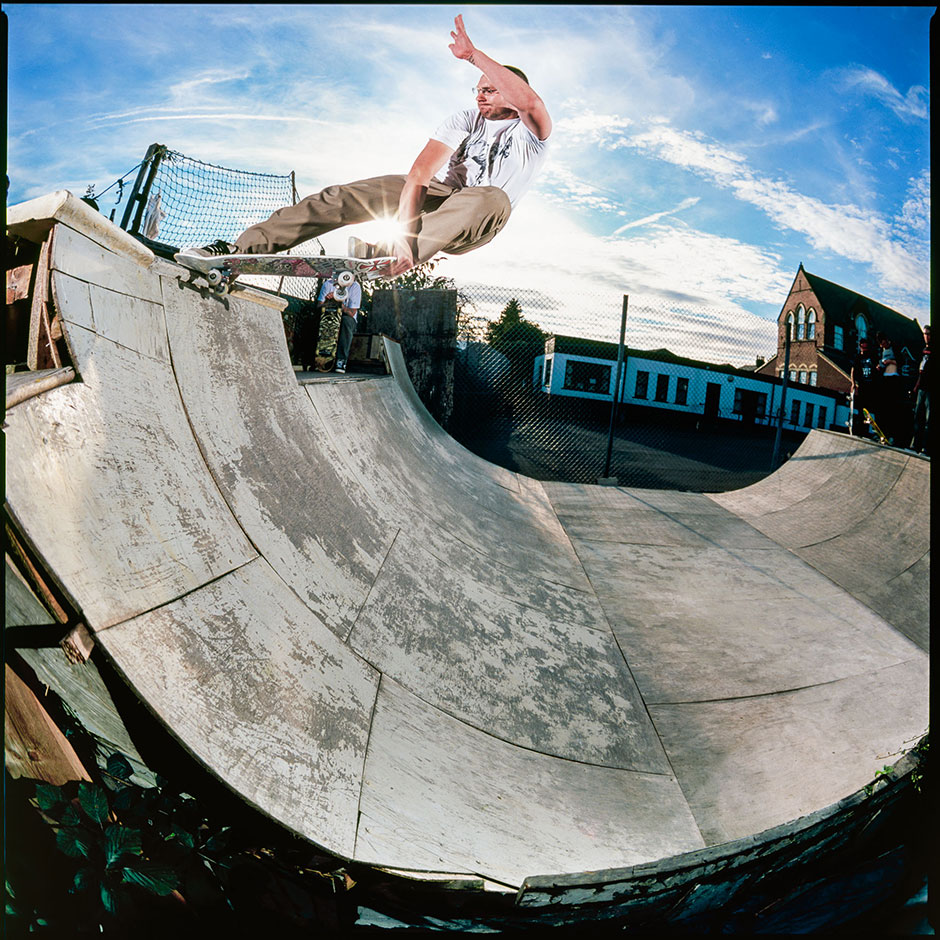
Crailslide on the extension wearing Fallen shoes during the 2007 Big Push shot by Sam Ashley
For that, they’ll take it all, and they’ll come and get it. So if you just want cash in the bank and some space, it’s a temptation to use someone like TK Maxx. When I first dealt with them, I told Frank that I couldn’t put 40,000 pairs of Fallen shoes into the UK because people were going to hate me. He said that nobody was going to know and not to worry; he had done this before with various brands and seen it happen. They put me in touch with a guy called Shaq who worked at TK Maxx. In Europe, they don’t have TK Maxx like we have, but in Britain, there are 329 stores. He said you can put 40,000 pairs of shoes into those stores, and nobody would even know they came because they’ll be put into shops far away from skate shops, and most people will buy them to do the gardening or some crap. He was right, so it was gnarly. I asked Shaq if I could protect the shoes and not have them in 11 specific TK Maxx stores. If it was a TK Maxx within 10 miles of a skate shop, I excluded it, but that was only 11 out of 329 shops. I felt terrible about it, but it just showed me that we don’t know what the full extent of the market for skate shoes is. So that was interesting.
Once we had done that, Jamie wanted to set up Black Box UK. I set myself up as an agent, self-employed, and did Black Box UK on my own, trying to sell hard goods. We didn’t have a warehouse here. So everything was shipped from Europe, even the hard goods. It was impossible. It was really difficult. The footwear was fine, the footwear was good, but the hard goods didn’t work so well. We had a company called Camino in Holland, and they did the logistics side of things. But I did all the sales and invoices from here. I dealt with Michelle in America; she was the controller at Black Box. So I dealt with Michelle mostly and Chad Foreman, who was the general manager. Chad’s a legend; Chad is worthy of a book on his own. So we set up Black Box UK, and I did that for three years, all on my own, just doing that, driving around, just being everything Black Box. I think that was doing okay, but the brands, especially Fallen, were doing better in other countries; it was growing faster in other countries. I think the logistical nightmare of Holland meant that they basically needed to go back to a distributor model again.
So Jamie and Frank said they were going to go back to this distributor, a guy he knew from back in the day, who used to work with New Deal. I said I thought they were going to ruin it if they went back with a distributor. I had worked so hard to keep it a core footwear brand. That was the selling point; it was a core footwear brand inside a market that’s trying to be dominated by sporting goods brands. That was my opinion, but I couldn’t control it. I said I would have a look at working with those guys, but I knew the kind of sales guys it was going to be. Some salespeople, they just don’t seem like they care about skateboarding, and they don’t go skateboarding. If anyone had talked to me about skateboarding who didn’t do it, I’m not that interested, really. It sounds vicious, but I’d much rather buy skateboarding stuff off someone who goes skateboarding regularly. I know they go to the park, and they know what my customers wear, rather than talk to someone who hasn’t skateboarded in five years and works in a warehouse.
So Black Box went with a new company, and you left.
Yeah, Jamie went with a company called The Rolling People who sold laces. They sold laces to every skate shop in the country and had a huge customer base.
Was that Mr Lacey?
Yeah, they just sold laces, and if you know anything about production, a pair of laces costs about 10 cents to make, probably 50 cents packaged by the time you get it in your hand from China. So if you can sell that for a tenner, the margin on things got stupid; they cost nothing. That was the end of that. I was very lucky because I had a kid, Keith was quite young, and I had a period when I wasn’t working, so I was very lucky I got to be a stay-at-home dad for a period. That time without a job is potentially quite scary, but I viewed it as being so valuable. I felt so lucky. I got to be a dad with a very young child; a lot of dads don’t do that so much because it’s normally mother time. I was very lucky that I got to have Keith for a bit. After I quit Black Box, I had six months with Keith, just hanging out with him. I broke my wrist at Stockwell right before the end of that. I was just kind of pottering around, and then Marshall [Taylor], Gareth [Skewis], Mark [Baines], and Dan [Magee] bought Slam essentially, and set up their own company.
They were looking for a business manager, right?
Yeah, they needed that because everybody there was busy. Nobody could work that shop; they were all partners in a business, but none of them were going to be able to run the thing. So Marshall asked if I wanted to come back to Slam, but obviously, now there was Palace to deal with too.
This is the exact point where they had just started Palace.
Yeah, it would have been 2011; we had the warehouse, we had a shop in the basement of Carnaby Street at the WESC store, we had Neal’s Yard still, which Henry [Clay] was managing, and we had just opened a new store in Bethnal Green. I came back to Slam as the business manager for three things: Slam retail, which was the shops and the mail order, two very different businesses although they share the same stock potentially, and there was also a small wholesale business with brands like Commonwealth Stax, and The Quiet Life. We were selling Supra too; we had a warehouse full of sale-or-return Supra stock because we had a basement store in Covent Garden. It was just everything jammed together. You had a retail business, a mail order business, a wholesale business, and Palace, which was a new brand with its own production and its own separate distribution network.
I was brought in to keep the shop going, make it better, and improve it because I knew the business, but I also needed to separate Palace and Slam so they could become separate entities, go off, and thrive in their own ways. That’s basically what I did, apart from helping to do production and doing the POs for the hard goods and some of those things, dealing with some of the international distributors, shipping t-shirts out to Rihanna, and doing all that kind of stuff. Apart from doing that, mostly what I was doing was just sorting out the business back end. It was an inherited business with past debts and four new owners; it was obviously going to be complicated. Some of the people I had to deal with on a day-to-day basis were very unavailable, which made it hard. But I did it because I knew I could do it; while juggling the day-to-day business as well, it just took a while.
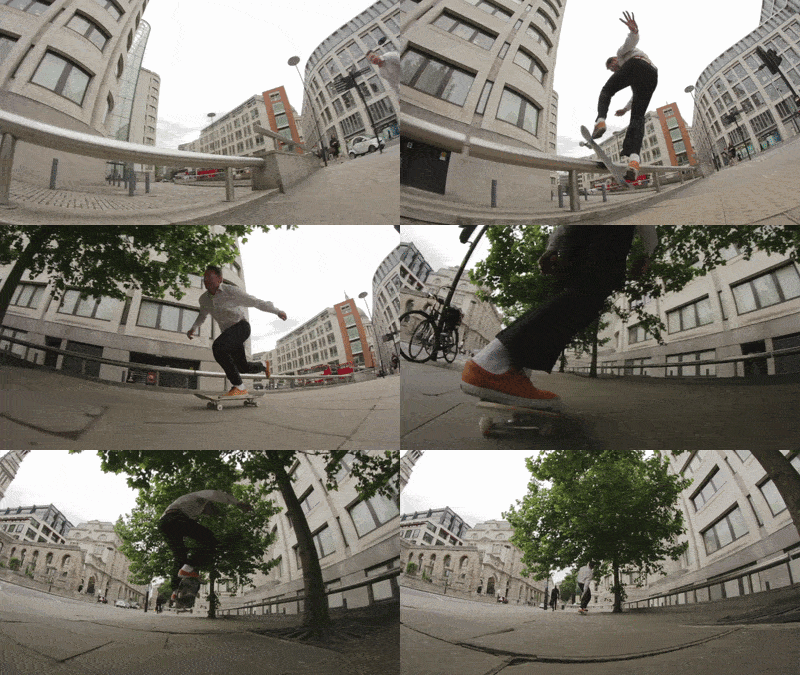
Chris maximising a crack nollie in the Vans x Slam Syndicate Derby
There were some fun projects like the Vans Syndicate collaboration and video.
Henry Edwards Wood was making City Of Rats at the time, which is a Slam video, a real, actual Slam video. That was a big thing because everybody was in it, and it was done nicely, produced nicely. That was a really cool thing. The Vans Syndicate video was a great look at the team, too. At Slam in Covent Garden, where the Rough Trade store was originally, they had gone from that building and left a basement. It’s not the best thing in the world having a basement space in Covent Garden; nobody goes down the stairs. It’s a fact; it’s weird. The ground floor or first floor works, but it was hard to get people downstairs. If you’re going to send people downstairs, there has to be an incentive. When I came back to Slam, we had a Supra pop-up store, and Supra was doing really well. They had very striking shoes, and it was done out really nicely. Sahar [Khosravi] ran it, and she was brilliant at doing that. She was the right person, right time, right product. That was brilliant; then when they finally left, we had Vans go in the basement.
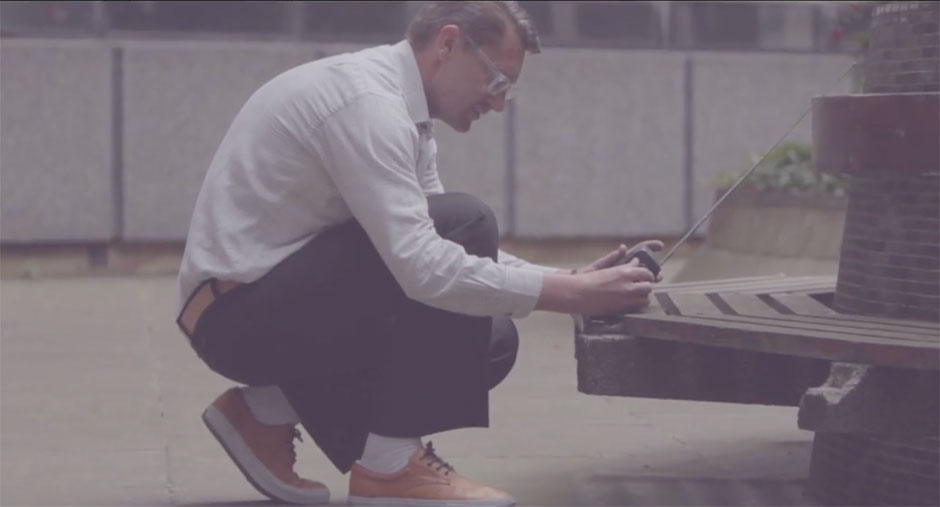
Vans did a really nice fit-out. They didn’t do anything really outrageous because everything they did was pretty much in line with what they were doing elsewhere, but they did fit the store out really nicely, and we got to do a collab shoe with them. We did a shoe called the Derby, which was part of their Syndicate line, and we got to do two colours of it. I was hot for brogues at the time, so I just wanted to take that regular shoe, which was just almost like an Oxford style shoe with a toe cap, and I wanted to put a baroque pattern on it and try to get that kind of London tan orangey leather to it. We did a white nubuck too, which was really nice, and we made a video. It was really good fun going out with Mark [Jackson] and filming that. There’s a lovely little soundtrack at the beginning of that. I found a radio and turned it on, and Reverend Richard Coles came on; it’s comedy. I just looked over at Mark. Some builder had obviously left a radio. I literally turned it on, this sound bite came, and I looked at Mark, so we had this magic little clip at the start.
Yeah, it’s at those kidney banks.
I was stoked about that because I always wanted to get that frontside feeble grind, and I got it. That was quite awkward to do because it’s so small. That video was sick, a really nice project to do. Paddy [Jones] was in it a lot, and I love Paddy; I like the way he skates. Everybody was in it; everybody who rode for the shop who could wear those shoes was in that video. Good times.
Coinciding with that, while working for Slam as business manager, you started Descent, which was an idea that seemed too attainable not to go for, right?
Descent was a weird one. I’m running Slam, I’m doing production, and I’m obviously skating through all this. I’m skating all the time, trying to stay skating; I’m getting injured, I’m getting older, but I’m skating of my own accord.
Going to Mile End every lunch break and cycling into work from the station.
Yeah, I was fit and skating a lot. Riding that Pashley, I love that bike. It’s still going; I’ve had that bike for 21 years. I’ve been run over on it. I’ve run into the back of vehicles in traffic with it and bent the frame. It’s had new gears, a new gear hub in the back, but that Pashley bike is solid.
Trigger’s broom.
Basically, Trigger’s broom. It’s had new front forks, but the frame is there. I was into leather work, and I made a saddle bag for it, and I made my own grips and all kinds of stuff. It was a really nice project. Having a bike is a dream, isn’t it? You can’t go as far as a car, but it’s so much less hassle than a car. It’s quiet, and you see more. Bikes are just the perfect vehicles. If human beings ever achieved anything, I think the bicycle is the pinnacle of our achievement. It’s just simple, no pollution really apart from manufacturing, which is minimal, and they get us about at a pace where we can enjoy the world. I think it’s perfect.
Back to Descent.
 I’m dealing with people at Creative Urethane making wheels for Palace. I’m dealing with people at DSM Woodshop at Dwindle making production for Palace. I’ve got contacts everywhere for stuff. I got in touch with Lukas in Poland, who was doing production for Polar a little later on, too. I was already dealing with all these people, and I always had ideas. I had some money because I had a reasonably good job. I had money to put into this thing and maintain it. I knew I could do the business side of it because it’s a small brand, and as long as I sell every board, I’ll be doing just fine. Luckily, I got the DSM contact so I could make resin wood boards, the same as World Industries and Palace boards, out of the gate. Dwindle is great; you get the tech sheets and lay them out. You can choose the layout of the laminates, so you can choose the colors of the plies. If you want a yellow top stain with a pink one underneath, a clear one, a black one in the middle, a clear one, a pink one, and a yellow one on the bottom. You can choose that. It’s crazy that level of production. We could actually choose the ply colours, and I love that. For my nerdiness, that was brilliant.
I was making wheels at Creative Urethane, who at the time made the best wheels. This is before Formula Four, but at the time, Creative were making the best quality wheels. Pig, Toy Machine, Alien Workshop, Autobahn, Heroin- everybody made their wheels there. So I had contact with those guys there; I had all the connections. As you said, it was a no-brainer to start this brand, and I had this idea that Descent was going to be the opposite of a lot of brands. It was going to reject the way that skateboarding was being pushed into the mainstream. By pushing skateboarding into the mainstream, what I really mean was that I felt like the industry was trying to mold skateboarding into an actual sport. I felt the reason they were doing that was that, from their point of view. It’s much easier to sell a sport than it is to sell an art form. I will die on that hill, as it were, that skateboarding is much closer to art and ballet than it is to a hundred-meter sprint or rugby. It really is. You don’t have to have a brain or even eyes to see that. Skateboarding is much closer to dancing and martial arts than it is to a competitive war-type sport with two teams trying to rip each other’s heads off under the guise of trying to score a goal. That is basically men fighting on a pitch.
You are your own opponent basically.
Yeah, the best opponent, you know all your tricks, so you really have to think to beat yourself. You know all your special moves, so you’ve got to think twice as hard. Descent was really obvious. I didn’t have a lot of team riders in mind. I did a mail-out that was talking about the descent of skateboarding into mainstream culture, and the descent of culture and society generally. If you have ever read the Foundation series of books, or even watched the kind of okay Apple series, you realise that the main character, Harry Seldon, can see the future. The world is thousands of years in the future, and one empire runs the entire galaxy and is connected to every planet in the universe. He can see that it’s falling down; it’s going to collapse, and it can’t go on forever. He knows it’s going to collapse and there’s going to be chaos. So he tries to negate it by setting up a foundation of people who will preserve the knowledge after the chaos of the collapse of civilization. That’s the premise of Foundation. In my head, with Descent, what I was trying to do is assemble some people, not in an elitist way, because that didn’t need to be done; the very high-end skateboarding was already being done by people like Blueprint. They were already doing the elite pro-level skateboarding. Descent was going to try to retain the spirit of skateboarding, being up to you, the general populace.
“Descent was going to try to retain the spirit of skateboarding, being up to you, the general populace”
I wanted to highlight that we’re different, we have a different perspective, because we have literally seen shit that people have never seen. We’ve sat in car parks and watched the world go by; we’ve seen and experienced stuff they’ve never seen. Skateboarders have a slightly different worldview than most people because they’ve experienced humanity in a slightly different way to your average person. I’m not saying they’re unique, but they definitely have seen shit that other people haven’t seen. You’re hanging out with drunks or addicts. Most people don’t do that, but we do because they’re sitting on the ledges at Southbank or at the car park where I used to skate. I’d be hanging out with Billy Irish, and he’d have a two-litre bottle of cider, and I’d be trying nose grinds. I think the original intent of Descent was to maintain that, to preserve some of those thoughts about why skateboarding is important to me. Challenging the mainstream, but also challenging skateboarders, which is a big part of it. I’ve always thought it’s important to keep us on our toes, as it were, even if it’s Fos bringing back the Skate Wing. I think that is mental, that’s so gnarly! I think he’s gonna do a collab down the line where he puts Polarizer trucks on the little wings so he can like lean out and carve and shit, hahaha. Anyway, Descent was about that.
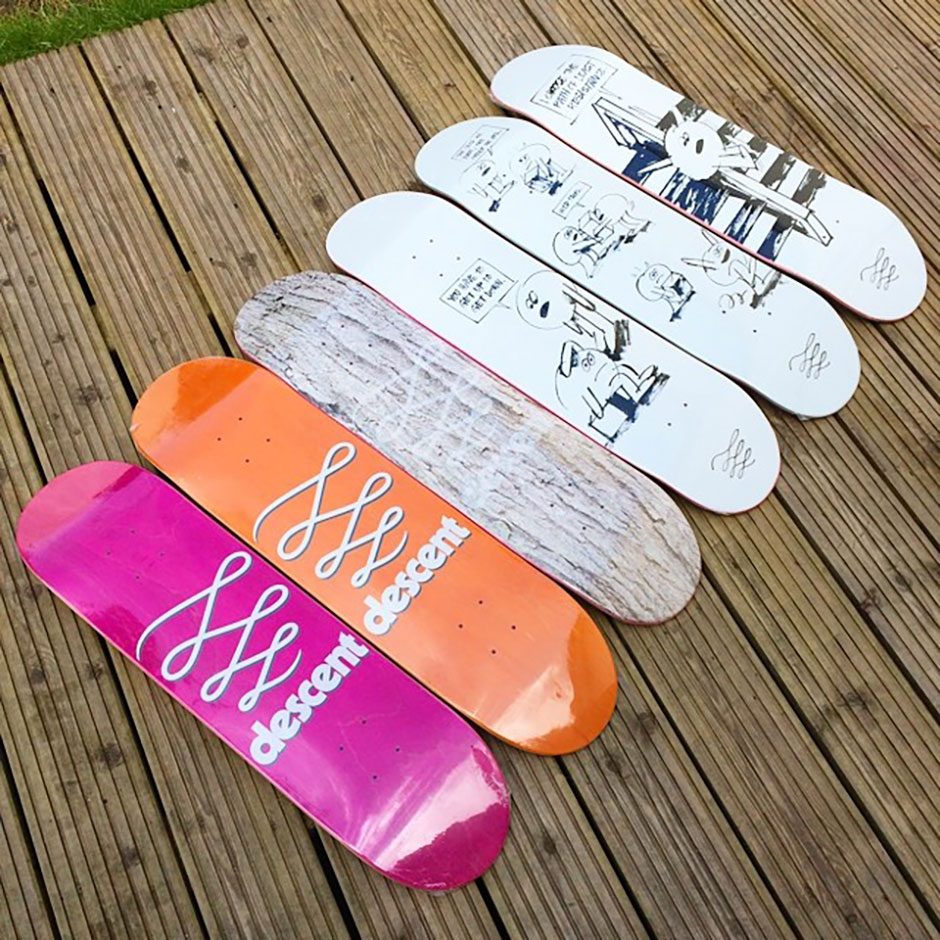
I had enough product that I could afford to sponsor some people. The person I saw skating, who was my favourite skater at the time, was not getting anything from anyone; that was Curtis Pearl. I’d go to Mile End and see Curtis and Sam [Sitayeb] skating. Curtis was one of the very few people to catch my eye. I’m very blinkered when I skate. It takes a lot for me to watch someone else skate. They have to be striking for me to take my focus off my own skating because I’m very insular when I’m skating. Curtis blew me away; he was very striking, he charged, and he looked sick on a board. So I started giving Curtis boards, and Tom Tanner, too. Tom is a beauty on a skateboard. I can watch Tom just roll along; he has it. I gave Tom boards, but I don’t think he was that interested in being a sponsored skateboarder. I don’t want to speak for him, but I think he would have preferred someone a bit more serious running things. Tom and Curtis were the first team riders, and they were the best. Tom left because I don’t think he wanted to be sponsored. With Curtis, it was obvious that if Dan Kreitem ever made boards, he was gonna ride for Yardsale. When he started Yardsale as a board brand, Curtis told me he was going to go with Dan. He told me at House Of Vans, and I think I could tell he was a bit nervous about telling me. I told him it was an obvious decision. Dan is his best mate; you see each other all the time, he’s your age, and he needs your help more than I do. I wanted him to ride for Descent, but if his friend was going to benefit more from his help, and he would be happier, go do it. He would be helping me too, but you’re never gonna help me as much as you can help your best friend. So Curtis went off and did that. Other riders came along: Chris Mann, Myles Rushforth, Will Creswick, Joe Paget, Jay Johnson, Joe Roberts, Jasper Pegg, and John Wildsmith. Joe Roberts did a series of graphics for me too,
Once this began to grow, Keen started to handle distribution.
The first delivery of boards ever got delivered to the Slam warehouse. I was still working there when they first came. I’d been at Slam for a couple of years, and I’d been at Slam before, so I decided to go off and do my own thing. I did Descent on my own for a year. I had to set up a DPD account, get the ship stuff shipped, and chase invoices. When you’re an independent, people just don’t pay. They pay you so late if you’re just one guy with one brand. Especially if they’ve still got a Descent board left on the wall, they’ll pay you when that one’s gone. Doing Descent on my own was hard. It worked, and I could do it, but I had to be very careful who I sold the product to. A few people left me high and dry as well, with big amounts. It was just disrespectful of a small business striving to do something good. Like I said, some folk care about money more than they do about anything good. It was getting harder as I was selling more stuff. More product was out in retail stores in the UK at risk, so more money was out of my pockets, and the risk got bigger.
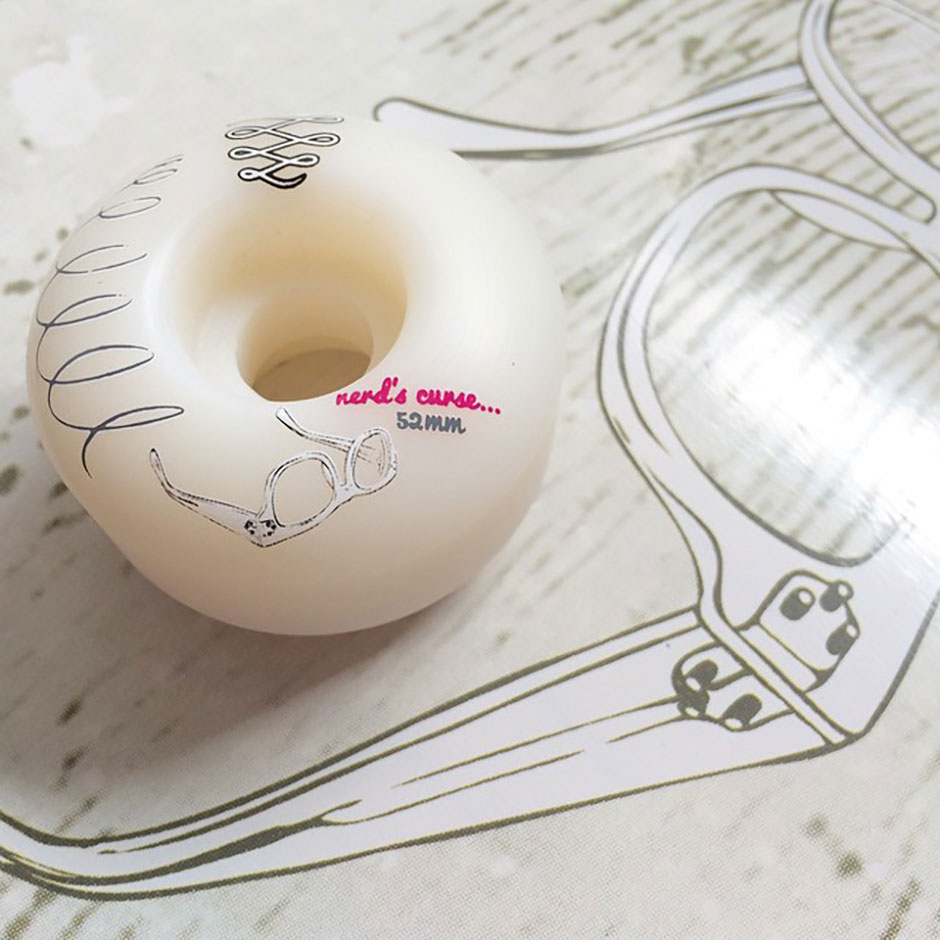
Mike [Halls] at Keen offered to distribute Descent but also said they needed someone to come and work as a sales manager. So, Mike had me come and work at Keen, and he brought Descent into the building. Then I was able to concentrate on just doing the production side of Descent. Doing production and doing sales orders together doesn’t take very long at all when you’ve been doing it so long. It’s really easy to knock a spreadsheet together, put in a production order, and do your tech sheets. Once you’ve got the graphics finalised, it doesn’t take five minutes once you’re good at doing it. With Keen, I could just concentrate on doing that bit; the product was going to stores, they wanted it, and they were paying on time because they had to deal with Keen. Then I was able to step up my production. That’s when I started making better clothing with Lukas in Poland, who did a lot of the Polar clothing. That was great; we went from being a skateboard company to a skateboard company that makes wheels, then makes truck bolts, then it makes t-shirts, and then it makes a shirt, and then it makes a sweatshirt. You start as a brand with one thing, and then you can afford to do t-shirts. Then you take that money and put it into making your first custom sweatshirt. Then you take that money, and you put that into your first jacket. Somewhere down the line, you’ve got enough money to order a thousand backpacks. It’s incremental as you grow a brand. It’s a formula; anybody can do it. As long as you’re tight with your money and put the money back into the company, you can grow it pretty easily, as long as the product doesn’t completely suck.
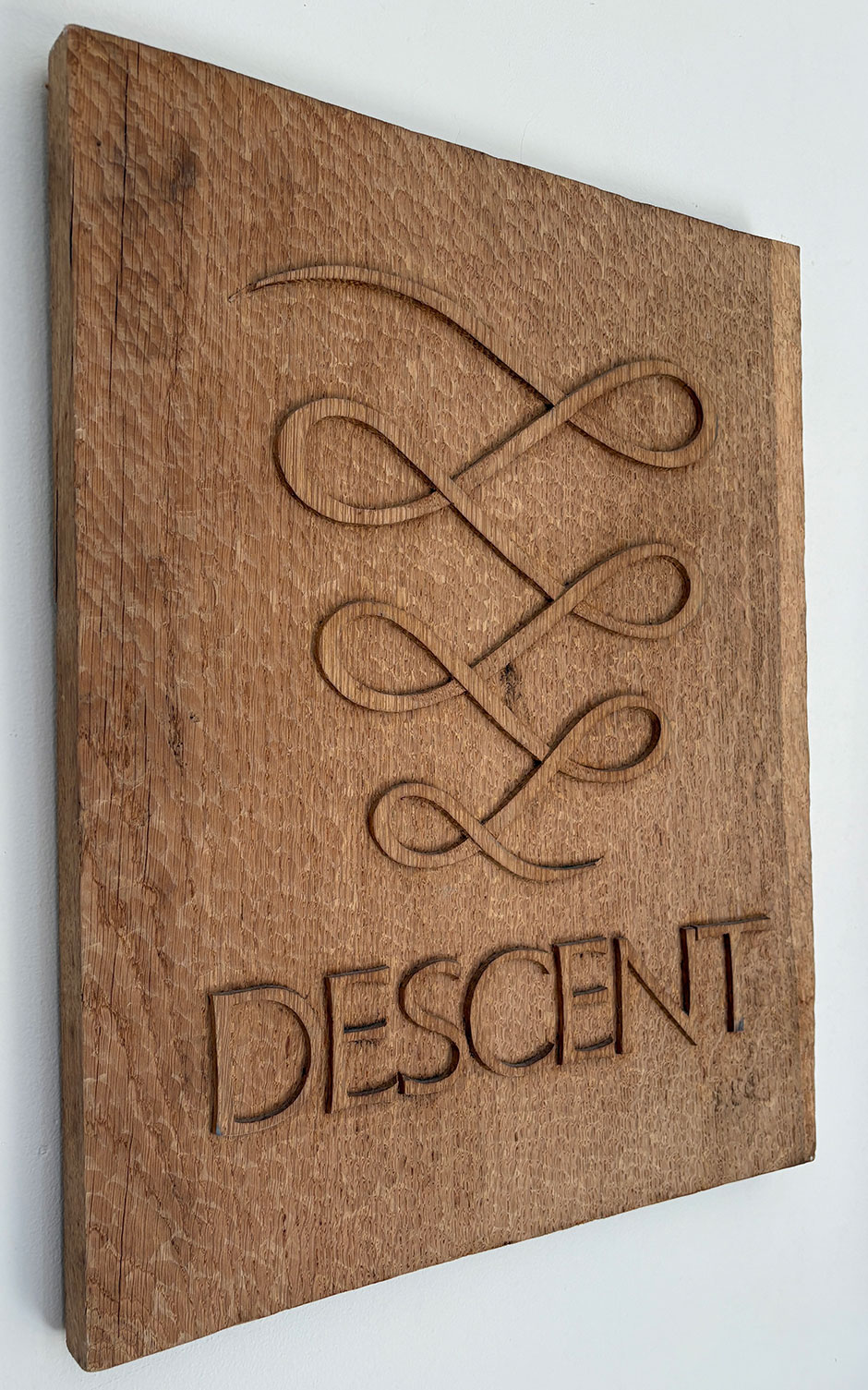
Oak carving for Descent Skateboards by Tom Ball
You took a lot of consideration when creating graphics.
There was one series where I asked a friend, Tom Ball, to carve actual physical logos. One was on slate, and one was on oak. I took those and attached them physically to things. One was a railway bridge, and one was a wall. I physically attached them and took photographs of them. The full photograph without any editing was the board graphic. That was nice because I got to involve a real craftsman; he was carving that stuff. I got to involve an actual artisan in skateboard making. There were little things like that I wanted to do. Isle did great stuff like that, those bookshelf boards where it was a physical thing, everything was considered, and artistic. To make a physical thing and photograph it, and put it on a board, felt nice. Doing a bit more than just a cartoon picture of a half-naked Japanese woman or another basketball team’s logo redesign. It was more like back in the day with something like the Black Label sweets wrapper board. Somebody put some thought into that. I tried to be more thoughtful with the graphics. Having a rider like Joe do a series of board graphics for me where there was a real meaning to how he illustrated them and how he inked them, and we took time picking the background colours.
James Jarvis was involved, too.
James had drawn my best-selling pro board for Heroin because he did the graphics for Live From Antarctica, Fos used all those characters as our pro boards, and they looked great. I have one on the wall here, I’m not ashamed to say, and I think it looks sick. The colours, just everything about it. I remember being at the premiere, and taking a photo at the Prince Charles cinema with James and the poster in the frame behind us. James was involved, and I like James’ stuff because I like Amos and I like Silas, I like James and his philosophy. At the time, James was doing these spherical dialogue drawings. They were philosophical, and kind of comedy, and almost in the style of the humour of the Back to B.C comics. Do you remember those? They were cool, back in the day, very much the Snoopy era. It was about cavemen, but they had comedy shit going on. James was exploring philosophy with these spherical dialogues. They were black and white and simple, and they were just perfect. I told James I would love to use one of them, especially the one that said, “You have to get up to get down”.
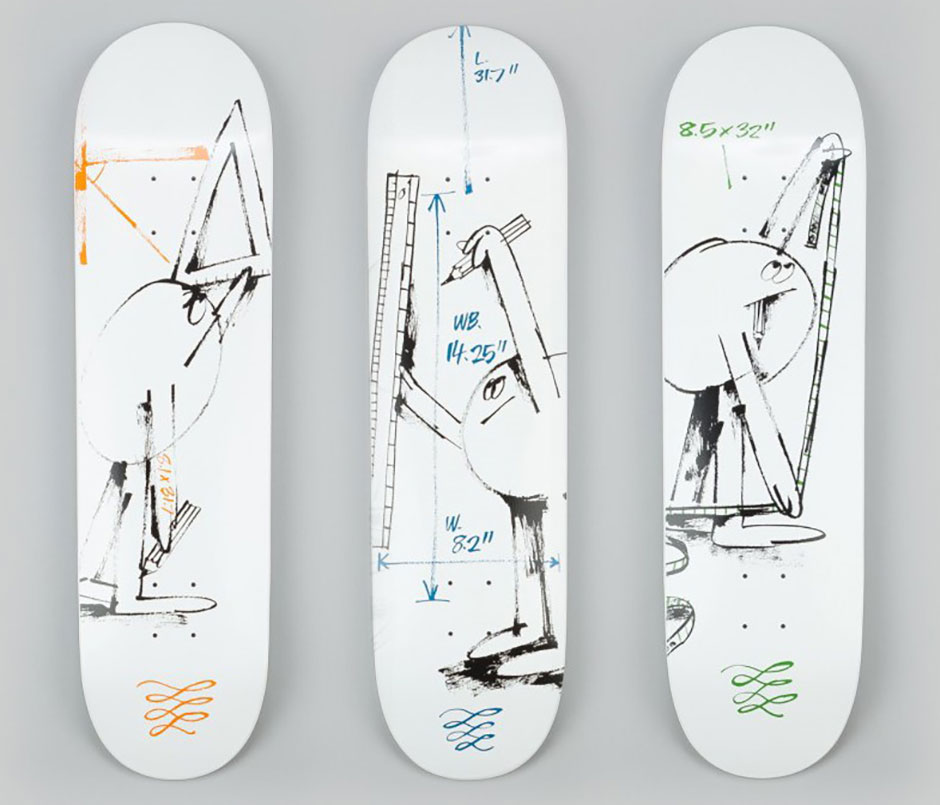
James Jarvis Precision Series for Descent Skateboards
That was perfect. Everybody moans all the time, but if you really want to make a change, you have to get up and make a change. You can shout and organize and protest all you want, but what really makes change is the person who throws the brick. That’s what makes change. You can hold up a placard all day; the government will let you do that because they want you to let off steam. Having a protest stops you from doing what they did with the poll tax. There are ways to protest that work, and there are ways to protest that don’t work. The Poll Tax riots worked, and recent protests don’t work. You can make of that what you will, but I’m a big fan of getting up off your ass and actually doing something if you want to see a change happen. It’s very unlikely to happen if you don’t, and it definitely won’t be the change you want if you don’t get involved. Anyway, James’ artwork appealed to me. James did those graphics, and he basically gifted them to me, which is crazy because James is a huge artist. He was very kind, and I think he liked what I was doing. I get on well with James. He’s lovely; he’s a beautiful human, isn’t he? He gifted me those graphics, which blew me away because it was going to help. It was so much more than a gift because it was going to really help. That was a rad series of boards. I made t-shirts with them, and I still wear that t-shirt. I wear my Descent t-shirt because it still has the same meaning to me. James did another series of boards too. As time went on, I still had other philosophies, and the whole point of Descent was about trying to preserve something about skateboarding for future generations.
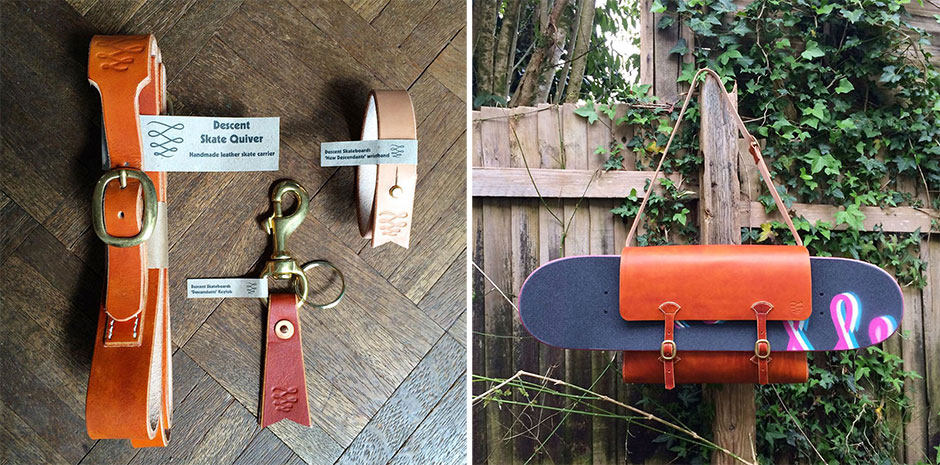
Hand made leather goods fashioned by Chris Pulman for Descent Skateboards
You mentioned that your favorite series of boards was the Chris Foss series. You brought your love of Asimov into the skateboarding world, but it kind of went over some heads when it came out.
There was something in the ethos of the time, which isn’t there anymore because skateboarding has evolved since then. What happened is I wanted to include the Foundation, something about Isaac Asimov, and the Foundation series of books. What made sense to me was that I was doing boards as trilogies, often in sets of three. The Foundation series of books is a trilogy. The first three, which he wrote, and the covers all match up in a lovely picture. Chris Foss painted the original paintings for the covers. Chris Foss used to draw the covers for science fiction books, but he also illustrated the first Joy of Sex book from the seventies. He illustrated this sex manual, which is cool. It’s really good. Everyone’s got loads of pubic hair and big beards, and it’s really nicely drawn. But he did these books, and I wanted to do this properly. So I spoke to Chris’s daughter, and we paid for and licensed it all. We made t-shirts and did the boards. We put his logo on them, embossed them, and did it all properly. But by the time they came out, I wasn’t working at Keen anymore, my marriage had collapsed, and I was probably drinking a bit too much as well. I could always function when I was drinking, but it was a combination of a relationship breakup and having to parent as a single parent, which was all new. I was juggling, and I ended up getting a job at a chocolate factory in Wales. So I was trying to run a skateboard brand, which was doing some really interesting stuff, from a chocolate factory in 50% Welsh-speaking West Wales.
Trying to do that as a business manager was fascinating, but it was hard to keep focus on the skateboard side of things. I did manage to do it, and that series of boards, the Foundation boards, I thought they were great, but it didn’t translate, and they sold really badly. They sold so badly that they got stuck; there were some left. When you have a skateboard brand, and you don’t sell everything, what’s left, the bit that you haven’t sold, that’s all your profits. If it’s a lot of stuff, that can be not only the profits you were expecting to make, and the money you were thinking of putting into the next line of production, but also the money you needed to pay yourself. Descent was turning over brilliantly, really good, growing and growing, then all of a sudden it hit an absolute brick wall. I was so far away; I was in West Wales, and I felt like I couldn’t get back to all the riders and be close enough to get hands-on to make it work again. I was trying to fix this thing, and I had no idea why it didn’t work, but I was trying to fix it from a distance. My mental health wasn’t doing great, and it slowly went downhill
I was losing time, the brand was stuck, and it got to the point where I was running out of boards to give to the riders. There were probably conversations I should have had with the riders where I explained that I wasn’t 100 % focused on this at the moment, and if they needed that as a sponsored skateboarder, I wasn’t able to give it to them at that moment. I was trying to keep it going, but I was struggling, and I didn’t know what to do. I was hoping for a lightning bolt, but I had drastically lost my motivation. My mentality makes me the kind of person who just makes things happen, sometimes, seemingly from thin air. It was gone. I kind of wanted to be the person who didn’t make anything happen, and to be honest, there were moments where I didn’t even want to make myself happen. I couldn’t do it; I was really struggling to get through the day, but I did; I stubbornly got through it. That’s another big conversation, but I don’t mind talking about it. Talking about suicide is important. It’s a big part of the story, getting through that and finding purpose. Finding a reason not to stop right there. It took a lot of work and a lot of therapy. It took a lot of stuff. Obviously, you have reasons to be around; you’ve got a child, I couldn’t do that to them. But when you’re in that headspace, you think you would be doing them a favour; you actually think you would be doing people a favour by not being around.
You think you’re damaging them by being alive, and it’s quite hard to get yourself out of thinking that way. Obviously that’s stupid; obviously these people want me around, obviously my child’s gonna need me, you know what I mean? But when you’re in it, you can’t think; you can’t reason that that’s not how it is, that those people need you. I think that’s a message to get across. When you’re at your worst, and you think that the world would be better off without you, it just won’t. Unless you’re Donald Trump or Herr Musk, the world is not going to be better off without you. If you’re in that state, stick it out and stay around, honestly. You never know what’s on the other side of it. You never know what’s on the next up and down of life’s rollercoaster. Something crazy might happen. You might keep yourself alive and have another pro model come out when you’re nearly 50. You never know, so just stick around for the dumb luck of it. That’s my little speech on that.
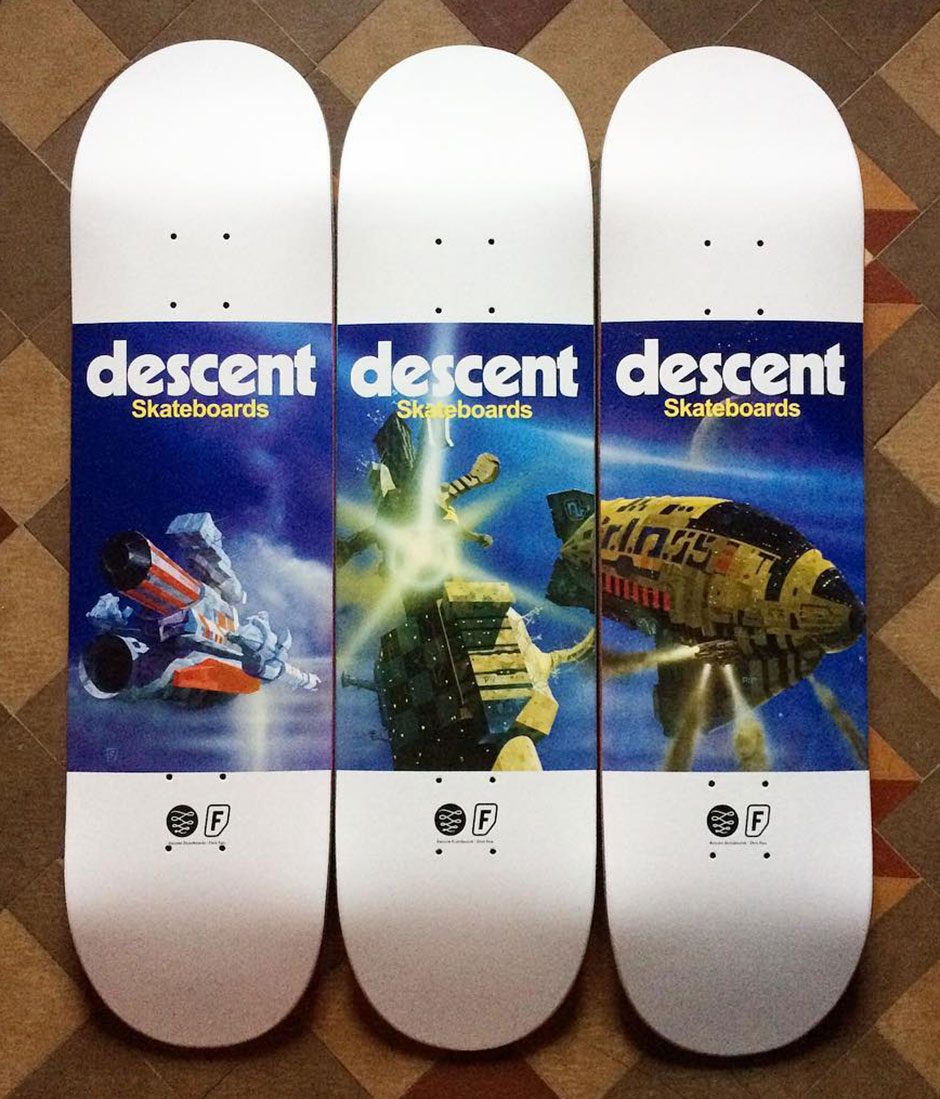
Descent Skateboards board series designed by Chris Foss
Retrospectively, regardless of it working, having that Chris Foss series is meaningful.
It was. The thing is now, I know if I was functioning at 100% Pizzer I would have thought, fuck this chocolate factory shit off. I’ve got to go up to Keen, get on the phone, and start talking to shops. That’s what I needed to do: help the sales guys at Keen move this stuff. They were really struggling to shift it; they couldn’t move the boards. Mike needed different boards, but I didn’t have any. I needed to sell those to get the money to pay for the next lot. The graphics were ready to go for the next year’s boards, but I didn’t have any money to buy them. I took the stock back from Mike, and over a year, I gave all the eight and a halfs to Chris Mann, as he was skating them. I gave all the 8.1” boards that were left to Myles, but then there weren’t boards for some of the other guys. We ran out of sizes. I put what was left on eBay and basically closed the company down. I’ve still got some boards here and some wheels. I’ve got loads of wheels. If anybody needs 58mm Descent wheels or 57mm Descent wheels, I’ve got a box. I have some 51s too, but nothing in between. I have truck bolts and a couple of boxes of 8” boards. It was a lesson in failure at a time when I was having lots of lessons in failure. It was a tough time, and it took me a while to get through that.
There was a point after this where you spent some time in Scotland and almost became a ranger for the National Trust. As idyllic as being in Scotland in the wilderness sounds on paper. I imagine that stepping away from skateboarding wouldn’t have aligned with your authentic self.
No, I couldn’t do it. I actually tried that when I lived in West Wales. I worked at a National Trust property for a while. The reason I worked there was because I wanted to become a ranger for Pembrokeshire National Parks and do that stuff, go out and talk to farmers about agriculture, fix fences, check water quality, and look at wildlife. I really wanted to do that because at that point with skateboarding, it wasn’t unimportant to me, but I didn’t need it every day because it had slightly soured in my mouth because of what I’d been through with it. I felt like I had failed at everything, and I felt like I’d failed at skateboarding. I was telling myself that I was just hopeless; I really hit rock bottom. I thought I should be good at this shit, but I can’t do anything. I had to dig myself out of that hole, and so I worked in the National Trust. I didn’t end up getting the job as a ranger because I was getting really bad anxiety even doing that very simple job. That was when I knew something wasn’t right mentally. I was organising Halloween trails for kids at a National Trust property through a lovely, beautiful woodland, and I was getting anxious about it! That was causing me to lose sleep, and it was stupid because it wasn’t a big deal. I found that work was causing me a lot of anxiety at that point. Any responsibility or any chance of failure at that point was causing me anxiety. I almost didn’t want to do anything because I was too scared to fail. I’d lost all my confidence.
In the meantime, I was dating. I actually dated various people and met some really fascinating, interesting people. During the summer of 2018, I spent most of the summer in Edinburgh with someone really cool, and I got to walk her dog, and that was brilliant. I got to go up to Hermitage with a mini schnauzer and just have a time with someone. I basically got to borrow a dog for the summer, and it was exactly what I needed. I love dogs; I don’t have a dog, but I love dogs. I’m soft for animals. So I got to have a dog and walk around. It didn’t rain for that summer of 2018. If you’re from Scotland or Edinburgh, I’m sure you remember that summer was really dry. I skated the little DIY down at Ocean Terminal, went to Livi, went to Glasgow, skated Calvingrove, went up to Newport, which is opposite the coast from Dundee, the skatepark up there. I went to Perth; I love Perth skatepark, it’s banging. If you ever get to go to Perth skatepark, go. It’s fun. It’s old, but it’s loads of fun. So I spent a lot of time in Scotland; I considered moving up there, even moving as far as Orkney.
Ewan Bowman’s territory.
Yeah, but that’s long; getting to Scotland is long, and I have a kid. Part of me knew I could do this, just get out of there, but the other part was aware that my son was coming up to being a teenager. When I was a kid, when I was around 12, my dad went away to work for a little while. He went away to work for two years right when I started skateboarding. So that father figure was less present, and skateboarding definitely filled that role. I knew that my son was going to be 12, and I wanted to be close to him because I knew how important it was to be around. It felt important to me, especially as a father figure, a male figure, whatever that really means from that ever-so-slightly gendered approach. But I have a different life experience to share, I guess. I decided to move back to Surrey and be there for Keith. Coming back to where I live now, there’s a good skatepark in Guildford, and a good crew. I started skating more often, and it started to feel right. I was still drinking, but I was drinking less, and I started getting a bit fitter. I started walking, getting into nature, reading a bit more, and slowly, my mental health got better. I had some help with that as well. I had a good friend who was really helping me listen. That was really good; they saw some terrible stuff and saw me at my worst, but also saw me get past that as well. When someone’s seen you at your lowest, and then they see you another time, and they see you much better. They can always go back and remind you of how bad you were, and how you got through it. That can be really helpful. People who can just let you rant, and they’ll just listen to you reel off stuff. That’s almost like therapy. So anyway, I started skating a lot more. I deleted my Facebook, my Instagram, and my Descent skateboards Instagram. I downloaded everything, and deleted them all.
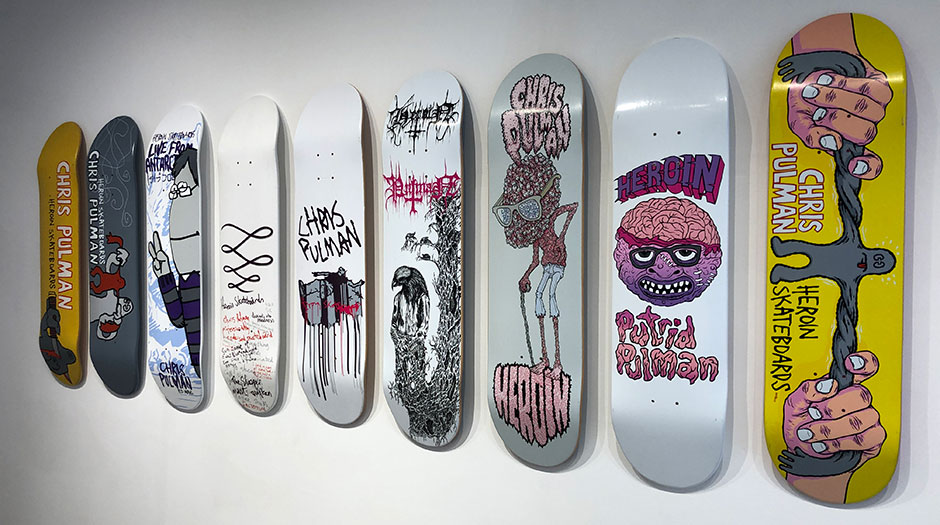
This period coincides with you getting back on Instagram, which is a whole other conversation. But it’s interesting that social media, particularly this social media sweet spot, helped to take you out of a low moment, connected you with a community, and gave you a platform.
It did. There were a few reasons. When Ben Raemers died in 2019, there was a BBC program, and Ben and Sam Bruce were on it. James Threlfall did this radio program for the BBC. It made me realise that I had kind of got myself through that. It felt like I couldn’t go through that and not tell someone else the story, in the hope that they will also get through it. It became really important to me that I could share that because I’ve got no shame at all, no pride or anything. I know a lot of people have really worried about talking about that to me, but I don’t give a shit. They’re just words. If you’re offended by words, it’s up to you to close your ears and ask me to shut my mouth almost. That was part of it. When I got back on Instagram, I thought I’m going to do this again because I like skateboarding. I’m going to do the skateboarding bit, and I want to talk about mental health, and I have some philosophies I want to develop and talk about. So I came back on Instagram, and I did a little post, a little kind of mission statement, and that felt right, using Instagram as a tool.
“I came back on Instagram, and I did a little post, a little kind of mission statement, and that felt right, using Instagram as a tool”
Fos has always told me that you’ve got to remember that all this stuff is just a tool. You’ve got to see it as a tool because if you don’t see Instagram as a tool, you start believing you are the consumer. With Instagram, you’re not the consumer at all. With Instagram, the consumer is the advertisers; we are the products, or rather, our attention is. If we were the consumers, we’d be buying things, but we’re not giving them any money. They give it to us for free, like they give grass to cows for free, so they can exploit them.
Every tool eventually becomes a marketplace by default.
Yeah, humans have a knack for tarnishing things by measuring them financially. I got back on Instagram with this new intention, but also the intention of wanting to skate again. I was looking at the level I was skating at, and obviously, times have changed, but can I do enough in skateboarding to call someone up and say, “Look, am I doing enough here where you’d give me boards? Am I doing enough here where I could get a set of wheels once in a while?” What can I do as a 45-year-old man in skateboarding that will fit your market? If I’m irrelevant, cool, that’s fine. Tap me on the back, and give me a discount. You can get a discount if you want, but we don’t really want to bother; you don’t have to tag us in the posts, kind of thing. I would have been cool with that. That tap on the shoulders, time to go off and do it on your own in a quiet way. I spoke to Fos and asked if I could get boards again. He said yes immediately, to call up Nick [Zorlac] and see what he’s got, so I had boards straight away. I had an alumni board that Fos had done for the 20 years of Heroin. I had a few of those; they were 8.3”. That was a sick graphic because it had the London Bridge stairs story on it that Fos had drawn. I had that momentum going.
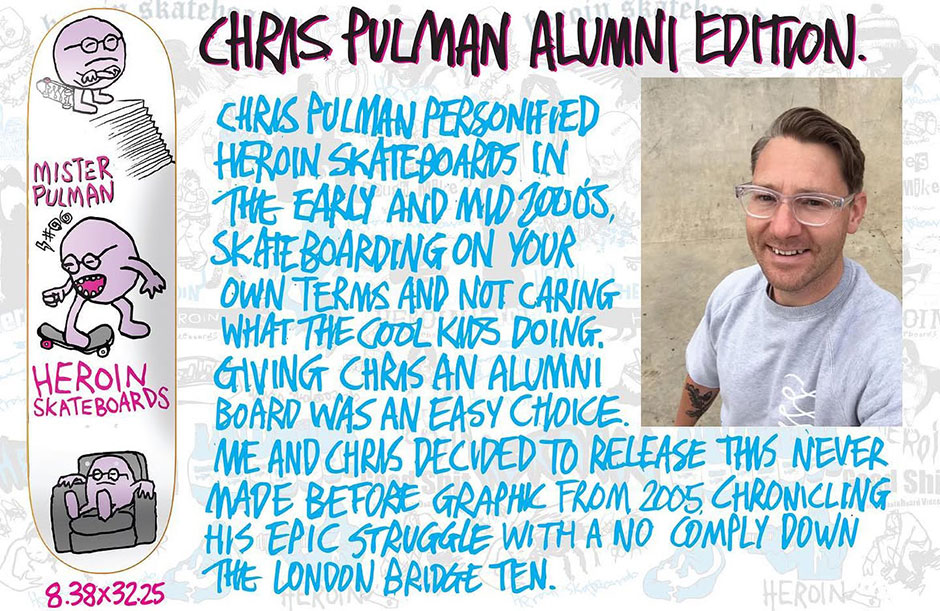
I messaged Alan Glass at Shiner, and I messaged Vans. It must have been Dave [Atkinson] at the time. I explained that I want to do this. I want to do whatever work it takes. Is there something I can do in skateboarding that will justify you sending me a box of stuff once in a while? I wouldn’t have to work to pay for it; I could just do it the way I always used to. Trading skateboarding, content, tricks, and footage for product. I like that model; it suits my mentality well. I messaged a few people, and Alan said he could get me Indys and the odd set of Spitfires. Fos was giving me boards, and Dave said he could get me shoes but wouldn’t be able to pay me. I was like, “Dude, I don’t want to get paid. I wear slip-ons, and I can shoe-goo them. I’ll only need two pairs a year.” I can make those things last almost six months. They’re indestructible if you shoe-goo them. It’s not like I’m a big backside kickflipper, so I’m not going to wreck the toes. I knew that I could do what I do. I’m a 45-year-old man who skates; there must be something marketable in that somewhere. People help you out because they’re friends, it’s not a lot to give away, and they probably wanted to help me phase out of skateboarding quietly and happily. But I was skating a lot; I could push. I was pushing. I got fitter. I was exercising, I stopped drinking, and then I was on it.
At this point, you connect with Forde Brookfield, and he put out a sick part of you in the Baghead Crew video. How was that experience? I can imagine being around that crew at that point, and having this brand new filming scenario and project would have been massively motivating for you.
It was, it was a strange one, because the very first time I went up, I was so nervous. I went to Slugger, went to the park, met some people, met Forde for the first time, met Jazz Wade, and Dan Mercer came out, all the good lads from Sheffield. We just went to skate street, the first time we went out. The first bit of footage I got was because Forde suggested this bank to wall down by Slugger. I had just gotten out of the car, having driven to Sheffield for hours, but we went and skated this street with a bank to wall. I said I can’t do much on that, but I can do a line down the street. Forde’s good; he had the sense to film everything I did because I guess you never know. He just got this rad clip: I do a little varial, a 180 no comply, and I’m obviously loving it. Then I did the little step-off no comply manny on the curb. It was basically what it looked like. It looked like an old man enjoying skateboarding. This man can still do it, and he’s obviously loving it. I think that really appealed to people, and that clip went viral. It went nuts. That went on the Berrics; it was a weird viral moment there. So that happened, and obviously, Instagram went nuts at that point and created a whole other platform.
“It looked like an old man enjoying skateboarding… I think that really appealed to people, and that clip went viral”
That was the start of filming for that, and I filmed with Forde afterwards. I think I went to Sheffield three times, and I met him at Milton Keynes one time, and we went to Portsmouth. But I only went on four sessions with him. Things were going on; I got injured a bunch of times, and I started to get knee pain. It was really hard to commit to going anywhere or traveling because I didn’t know what I was going to feel like on any given day. I didn’t film as much with Forde as I wanted to, or as I originally intended, but he managed to make a part out of not a lot of footage. That didn’t pan out perfectly, but it came out pretty good. Out of the whole venture, I got to meet Dead Dave, and Dead Dave’s a genius skateboarder. He’s a one-man demo, and he can do a demo anywhere. He’s really interesting. I got to meet Forde, got to reconnect with some Sheffield people, and getting the viral clip helped. A viral clip is better than any video part because it increases your platform.
I wanted to talk about that. There’s the viral clip, so this is your skateboarding reaching an audience, but concurrently, you’re also unpacking your mental health journey on Instagram and using that as intended, a platform to talk about that. You went from having a few thousand followers to over a hundred thousand. I know from talking to you and knowing your due diligence with dealing with DMs, that you kind of became a counsellor by default. How was that as an experience?
The thing is, if someone takes the time to send me a message, I want to respond if it’s a skateboarder. If a kid comes up to me and wants a board signed, that’s a big deal. If someone sends a message to me as a pro skateboarder, I treat that as a big deal because it can be quite scary. I’m not going to email Brian Eno and ask him about his latest album. I want to know about it, but I wouldn’t have the balls to do that, and he probably wouldn’t reply. I appreciate what it’s like to actually make that request to talk to someone. So I replied to all my DMs if I could. I usually have, unless it’s gotten impossible. If it has gotten impossible, I apologise, but I think everybody understands. I do try to answer all my DMs. As an upshot, when you start talking about mental health, people do treat you as a safe space to talk about that stuff, which is an absolute privilege. But when it’s a hundred thousand people potentially to talk to, and say 10 of those are in crisis, that can be quite overwhelming. That was something I hadn’t fully considered; I think I knew it was a possibility at the start, but then it happened a few times. Obviously, I did suicide first aid training, and that is fine when it’s your friend or someone at a skatepark. But what if it’s someone in Wisconsin who is not safe at that given moment, and you don’t have the mechanisms that you normally have to help someone who’s thinking of ending their life? That was really stressful.
Because you don’t know what resources are available.
Yeah, you can’t say, can we make a call to a GP? Do you think we could make a call together with someone? Would you like to do that? Would you like to speak to a medical person, or can I help you do that? You can’t do that when someone’s at a distance. It’s much harder. It’s almost a case of asking them to promise me that they will talk to someone first thing in the morning. Can they do that just for me, and when they’ve done it, can they message me and tell me that they’ve done that? Trust me, do that one thing, and I’ll get you. There have been things like that where I’ve been able to do something from a distance, but nothing like what you could do as a mental health first aider. I’m still an amateur because I’ve only done first aid training, so that was quite hard. It was a little bit of counselling, but a lot of sharing my story with people more in depth. You can’t say everything online because then your whole life’s out there, and it’s like your dick is on the line. But in those DMs, I could talk more personally to people and give them actual examples of things I’ve done, and things I’ve got wrong, and things I’ve learned. It’s mentally quite taxing to do that, and it happens a lot when I post. That’s a reason I don’t post very often; I’m more careful to do it when I have the mental bandwidth to respond in a respectful and hopefully useful way.
Then you also had the sMiLe video for the Ben Raemers Foundation.
As soon as I saw the first ones, I thought they were perfect, and knew I’d love to do that. A documentary where I can talk about it in my own way. Those sMiLe films, essentially, they’re all telling the same story. They’re stories of survival and people’s situations, but not everybody’s situation is the same. Not everybody’s background is the same. So those videos are really good. Some of them are more or less relatable. My video feels a little different from some of the others; it feels a bit looser and slightly vaguer in a weird way. In a way, that’s probably good because the vaguer something is, the more accessible it can be. More people can see something in it that relates to them. It was a real privilege to do that, a real privilege to have Rob [Mathieson] and James[Coyle] come and put that together. To have a day in London, and involve Keith, because he’s part of the story, and talk about it. That sMiLe film felt like the culmination of being on Instagram. That was the point, really; the goal of being on Instagram was to do something valuable, something useful through an authoritative source. Doing a short documentary-type thing with those guys on that platform was perfect. That’s what I wanted to do. I wanted to tell my story in a helpful way, packaged up in a way that could be recycled, and used, and forwarded on. It became a tool that people could go and use, which was timeless. It was a real privilege, and it did me the world of good. I look at that, I watch that video, and I use it as a reminder of where I’ve been and where I’m at. Those things are really helpful for your mental health. If you have reminders of when you were good and when you were bad. You can look back on both, see that they both happened, and you can get past both. It’s really helpful to have those reminders. Make bookmarks for yourself.
“It was a real privilege, and it did me the world of good… I watch that video, and I use it as a reminder of where I’ve been and where I’m at”
You’ve got this the sMiLe film, you’ve got your own kind of personal Instagram chamber. You’ve got Keith, a son of your own, and I know that you talk to a lot of younger people on your travels. Do you think and feel that the generation coming up right now will be more understood and supported?
I think skateboarding, and our community, is in a really healthy place for being diverse in approach and background. Now it’s much more diverse across race and gender. It seems like everybody’s a skateboarder. I’m not just seeing lots of cis-het white men at the skatepark anymore. I’m seeing a wider variety of skaters, and that’s making skateboarding so much better. Basically, the upshot of the pandemic, weirdly, was that skateboarding got broader, it could broaden, and get more mainstream. Now, the people in skateboarding who want to make money, that’s a gift to them because they want more people skateboarding; there’s more money to make. That’s fine. If people want to make money, cool. I have no problem with that as long as they’re not ripping people off. But with skateboarding getting bigger, it got a lot more diverse. A lot of people who used to skate started skating again. I think from that point, we’ve gone past this threshold of all the old gatekeepers in skateboarding; they look a bit silly now. They look like dinosaurs; they look like old men shouting at the clouds. Basically, skateboarding freed itself from all the gatekeepers. It became bigger than them,
That’s a good thing because it makes skateboarding more inclusive, and if it’s inclusive, anybody can do it. I’ve always believed that skateboarding is for everybody. If everybody rode a skateboard, I think everybody would have a slightly different worldview about personal space, about usage of public space, and about tenacity, as it were, about dealing with setbacks. Skateboarding can teach you a lot of stuff, plus it has a bunch of good music in it, and cool fashion; it’s got a lot. Skateboarding is like a Swiss Army knife for life; it’s got a lot of good shit. You can use skateboarding to fix a lot of things. It can also be a tool to get you into trouble too, but that’s great; it works both ways. I think skateboarding is this great thing, and you can do a lot with it. If you’re going to invest your life into something, skateboarding is a pretty good thing because it’s wholesome in a way, and it’s got a large inventory of good stuff.
Do you think youth are making better choices than we did? There are many cautionary tales at this point, and the evolution of skateboarding is pretty young in the grand scheme of things.
I think skateboarding is at a point where it’s gone from being a slightly anarchic art form to being something much more established. As I said, people are pushing that to happen; a lot of people don’t want skateboarding to be punk and anarchic and have a real hierarchy. They want structure so they can sell it to people. But I think with the kids, I see a lot of kids out there skating, younger guys, and I see the progression, and I am so stoked. When I see the kid, last week I saw him do a smith grind and this week he’s doing a smith 180 out, and the next week he’s doing a smith flip out. I’m stoked to see them coming up. There are a few kids I see out and about, some kids at Hove and around the place who are really good. Whether they’re making good life choices? The world has evolved. Obviously there are still rotters in the world, like Andrew Tate, and all those misogynists, people who somehow think that men are better than women. They’ve really got that the wrong way around, but that’s another story. So there are a lot of bad rotters in the world. In the past, there have probably been a lot of those rotters in skateboarding, but if they’re still there, they’re quiet. They’ve had to shut up and go away, or be quiet, or keep the misogynistic macho shit out of skateboarding. We don’t really need that; we never needed that. I’ve never felt particularly like a bloke in a macho, masculine kind of aggressive way. That performance of masculinity never worked for me. I don’t think it’s important. I don’t think we should differentiate between any humans; they are human beings first and foremost. If you’re a human being on a skateboard, that’s good. Anything else, I don’t think is important. But if you’re a human being, and you’re a human being on a skateboard, I’m a fan. Being a skateboarder is the most important thing to me.
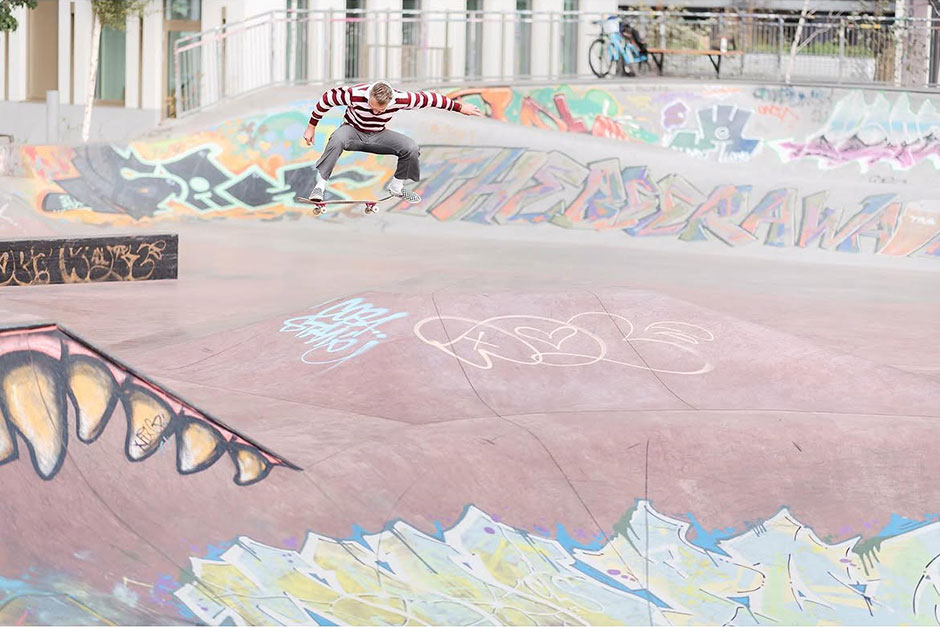
Picture perfect No Comply at Stockwell back in 2023. PH: Rafski
I think, as well, from your perspective, you’re not personally staring backwards and hanging reissues on the wall. You’re a fan of modern skateboarding
Ever since the day I started skateboarding, I wanted to see the new shit. I always want to see what’s next. Who’s going to push it? Who’s going to go further? Not in an athletic way, but who’s going to slide that? Who’s going to noseblunt slide that whole thing? Somebody’s going to do it one day. Somebody is going to do that, Nikolai [Piombo] or someone. Then the guy does it. I’m like, yes! But then I want to see the next thing. I don’t want to see the before. I remember the before. I was there for a lot of it. I did it all already, and it was good. But nothing is as good as what’s happening right now, and what potentially could happen in the future. I love all of skateboarding; I love the history, and I respect it. Even all those guys who say that they were the most important people in skateboarding. They were all super macho about it; I even take those guys with a pinch of salt now, because they were there and they were part of it in their way. But skateboarding has evolved, and the new stuff is much more important than the old stuff. Obviously never forget your history, but the most important part of skateboarding is what you’re doing on your skateboard right now. Living in the moment, that’s important. Or maybe planning to do something next week with your friends. The skateboarding you’re doing right now at the skatepark is much more important than the skateboarding someone did 50-60 years ago. It has to be for yourself.
Also as a parent, you’re getting to see that firsthand. Keith is ripping right now. How does that feel? He has you as an anchor, but you’re getting to see it firsthand through somebody else’s eyes.
I’m a 51-year-old man now, right? I’ve seen a few different ways of skateboarding. I’ve skated continuously through it all apart from injuries. Personally, I’ve had to evolve as a person because I was born in the 70s in Britain. All of my childhood heroes turned out to be not very nice people, pretty much, apart from one. All our TV heroes turned out to be not very good role models, as it turned out. I think my generation has had to do a lot of looking hard at itself and working on what wasn’t good. There are lots of things around being a man in this world, lots of misogyny. As an adult man, I’ve had to do a lot of learning and relearning, and improving myself, and reading. Listening to people, and listening to people’s lived experiences to get the true story instead of just assuming that I can guess. I’ve had to do a lot of learning, a lot of emotional maturing, and I’m not scared to admit that. I think it’s a continual journey; if you’re not spending the rest of your life learning, you’re kind of missing it. If you think learning stops at the GCSEs, you’re kind of blowing it; you’ve got to keep reading, you’ve got to keep improving yourself. Take in new information, even if it’s just going on holiday to somewhere interesting and exciting.
So that’s where I’ve come from; I’ve evolved as a person myself, but then you’ve got a new generation. You see each generation of kids come up, and they’re different because they’ve been born into a slightly better culture, a slightly more aware culture, a slightly more awake culture, as it were. They have inherited a slightly more diverse culture with better rules, and better language, and more talk about mental health. So for every generation, every batch of kids, I think the world is better for them in some ways, the way we talk about emotional stuff. I know there are a lot of people out there who are undesirable, the manosphere crap and all of that. So there are those guys, but then I think kids are alright. I’ve always believed that the kids are alright, and this is their world. Having a child means I can watch kids skate at the skatepark, and I’m watching kids’ progression. I’ve seen dads out there with kids, and I’ve seen variations of dads. I’ve seen the dad who’s really good at skateboarding, who’s just skating with his kid. I’ve seen the dad who’s not so good at skateboarding, who’s out with his kid. I’ve seen the dad who was kind of okay at skateboarding, but wants his kid to be really good at skateboarding and pushes it. There are all these variations of dads; it’s not just dads, it’s mums as well. It’s all kinds of parents. I didn’t mean to gender that, but there are various different types of parents out there.
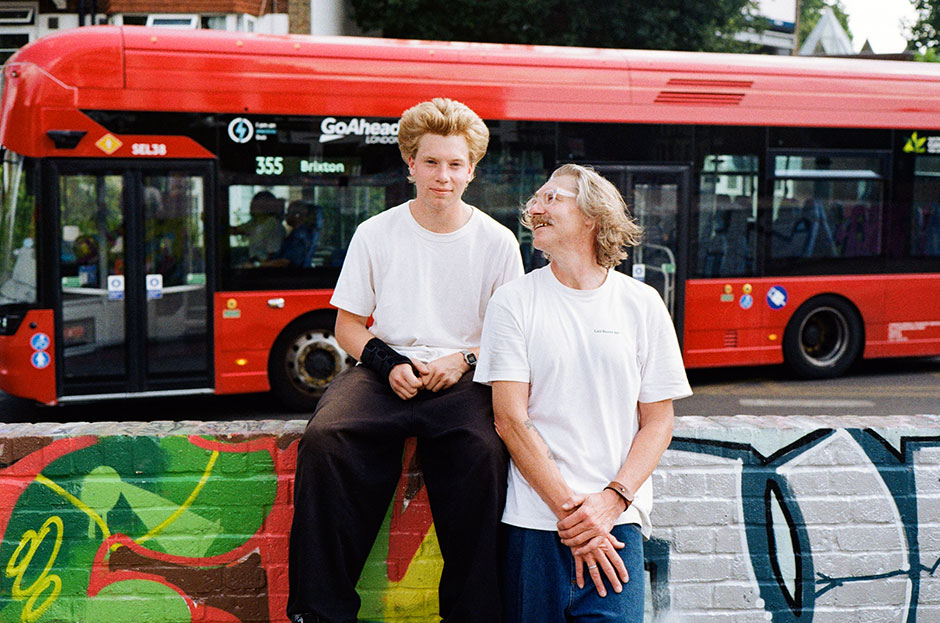
Keith Pulman on one of many skatepark visits with his dad. PH: Tom Delion
With Keith, I’d be lying if I said I didn’t want him to skate. If you have a kid and they skate, you’re made up because you’ve got something to do together. I don’t play football, and I don’t go fishing; I don’t do any of those stereotypical male things. I do other things. I make things. I do leather work, and I do repairs. I fix things. I fix the car. I fix the oven. So Keith sees me doing things as a role model, as a parent. But when it came to skateboarding, he ended up skating because there were skateboards around all the time, but I was very careful not to push him in any way at all. I would tell him I’m going skateboarding, I’m going to the skateboard park, the really cool place. I’m going there, do you want to come? Every time, he said Of course. Skateparks are a really cool place. Keith would always come; I’d take him, and it was something fun to do. So he was always whizzing about on a skateboard. I think he just really enjoyed riding around the way that I do. The rolling along is the most important bit. If you take that out, skateboarding is nothing. I think he just enjoyed the really honest experience of skateboarding. He’s never really had to worry about a board; there’s always been a skateboard to ride, whether it was mine or his own. He’s been to interesting places because I, selfishly, want to go to interesting places. So I have probably taken him to a greater variety of skateparks than your average kid.
The breadcrumb approach.
Yeah, but I’ll be absolutely honest. I know that I’m ‘me’, that I’m the best version of myself when I’m when I’m doing the thing that makes me feel good, and that is skateboarding. When I’m skateboarding, I’m better and more focused emotionally. I’m a better person when I do the thing that gives me that relaxation or that reset. You do the thing, it fixes your mental health, and you can function again. I think being a skateboarder made me a better person, and a better parent for that. I let Keith do it all by himself, though, almost to the point where I begged him to start learning tricks. I didn’t know what he wanted to do with skateboarding; he just enjoyed it. He just looked like he loved it. There have been moments like any kid where it wasn’t the most important thing in his life; maybe music is more important, or your girlfriend’s more important, and he’s done that as a kid as well, I think. But where he’s at right now, skateboarding is really important to him. You can tell by watching him; the passion, you can see it in the way he rolls around. I’m not saying that as a dad; I’ve been around long enough. I’m just stoked to see him find a passion that he can throw himself into that I know is a safe passion. It’s a wholesome, well-rounded thing to throw yourself into. As I said, if you’re to throw all of your existence into one thing, skateboarding is not a bad one. So it’s really heartening to see that, and to see him be actually really good at it too. That is the cherry on the cake. Seeing him love it is rad, but seeing him be sick at it is mind-blowing. How did I make that? How are half my genes in there? It looks like someone else’s genes because he’s really good at it.
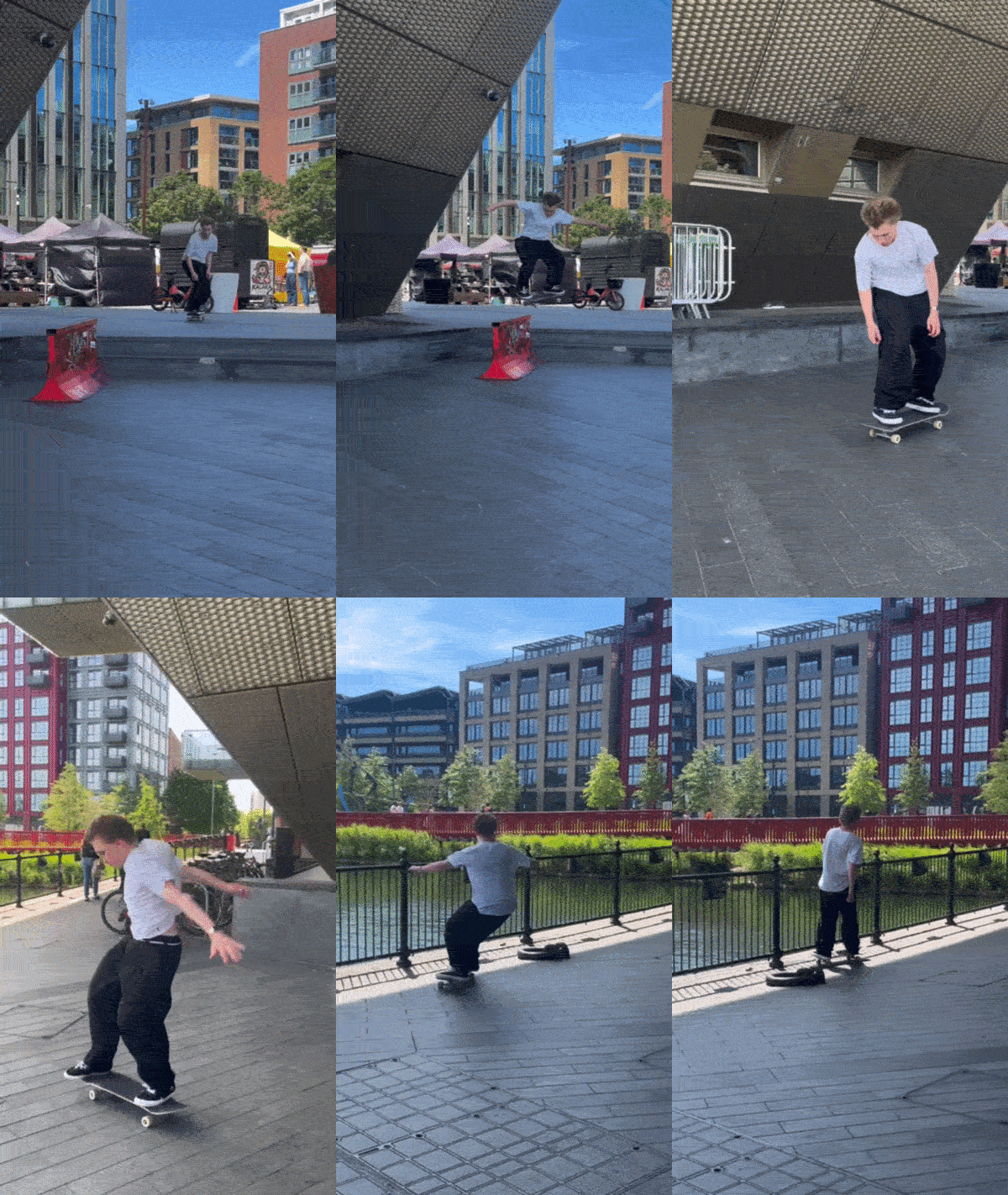
Keith following in his dad’s footsteps and continuing to progress. Clip filmed by Campbell O’Hara
Watching him improve in real time is cool. It’s one of my favourite things to see on Instagram.
Every time I skate with Keith, which is probably once or twice a week at the moment, because of how things are set up and where I’ve been injured. Every time I go skateboarding with him, he learns something fundamentally new, and the stuff he’s been doing before is smoother than it was. He’s piecing things together, right? He’s piecing things together, but he has the humility to ask me how to do things. Or he asks me what to do, or to give him a trick to learn. I knew he could do switch 180s well, so I suggested frontside 270 ones over hips. Then he started kicking them around and realised he could do that. It’s really good when he asks. I am terrible for giving people suggestions, but with Keith, I know what’s extra to what he can already do.
I saw him begin to post crooked grinds and a week later he was doing half cab ones.
He has stuff on his Instagram. I saw him do a crooked grind yesterday and thought, “Dude, just go delete your Instagram and start again”. Every week needs deleting because everything he does looks different to how it did last week. I can’t tell him that. I’m not going to tell him how to run his Instagram. That’s his deal. But part of me is like, don’t post that; put that one trick as a single on a reel, but I can’t do that. It is rad having a kid who skates though. I’m not going to lie, it gives me the motivation to stay fit. I have my own motivation because I still love skateboarding, but it’s extra. It’s also given me the motivation to travel a little bit more, to not be boring and just go to the local, but to take him to see different stuff. Also, through Keith, I’ve met people. I once skated with Nathan Clancy. I didn’t think I’d go skate with Nathan; it wasn’t a huge session, but I got to skate with him. Nathan’s sick; he’s up and coming, and he shreds. That’s rad for me to go skate with someone who’s 30 years younger than me. We can talk, and I can make suggestions, and he doesn’t view me like an old fart, or I don’t think he does. There’s an upshot of having a kid who skates; it also keeps you connected in a weird way, and I don’t take that for granted. I’m really grateful for that. Having the motivation to keep skateboarding. Motivation to stay fit, motivation to keep the car in running order so we can go places. All those things. Eat well, don’t be hungover. Trying to enjoy my passion, and share it with my child. I feel so lucky. Isn’t that lucky to be able to do that? It’s wild, and you have that experience yourself now. It feels like a really kind of beautiful, rare chance as a life experience. I guess as we all get on a little bit, you start thinking about what your entire life experience will be. I always think I will look back and think there was lots of luck, and lots of brilliant moments, and some tough times, but God damn it!
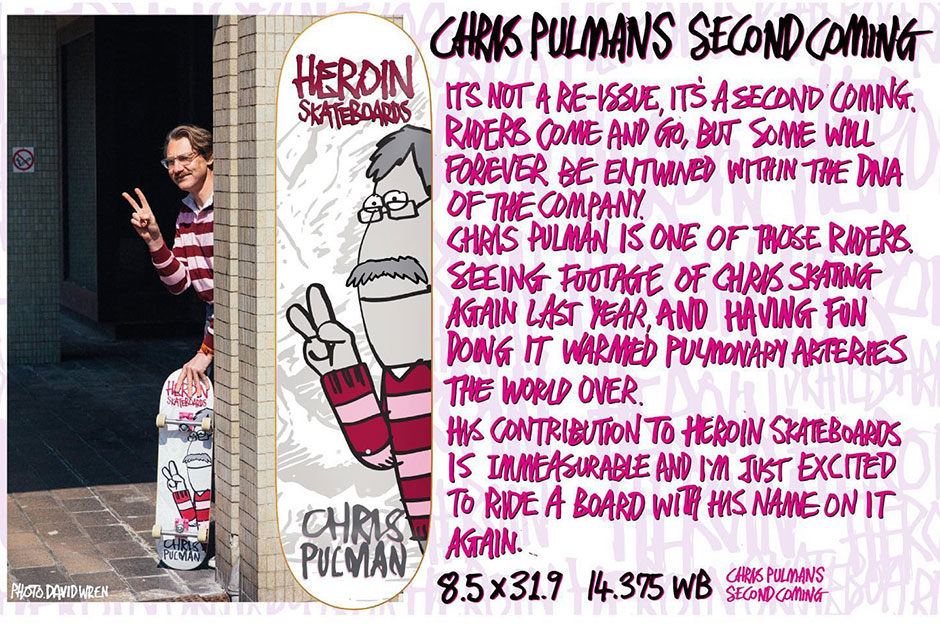
The Heroin second coming advert announcing his return to the ranks
You have a pro board back on the wall as well.
And that’s not a special edition. That’s a board in the line, in the catalogue, in a series of boards with Dalton Dern, and all these guys who are gnarly skateboarders who do it for a living. I’ve got a board alongside them.
Fos putting that out there must have felt good.
When Fos did the reissue, the kind of second-coming board with the Live From Antarctica graphic, he changed the colours to a bit of pink and whacked a mustache on it. I’m looking at that now, and it’s surreal. We went out and shot the photos with David Wren, and I got an ad in Thrasher. I didn’t have that the first time around. I didn’t have that 20 years ago, and I got it now. Then I told Fos I wanted to design my own shape, and asked what symmetrical boards he had over there because he was already messing around with symmetrical eggs. I wanted to know what symmetrical popsicles he had. He thought they were such a niche thing, and not for me, More for Ishod Wair or Shane O’Neill because they can use that technically.
This is the twin tail we’re talking about?
Yeah, personally, they’re not for me. I don’t like how a twin tail looks, and I don’t have the skills to utilise it the way those guys do. Ishod can skate a twin tail because he can skate switch. Shane O’Neil, or Dylan Jaeb can skate a twin tail. But I wanted a twin nose because I knew it would be more fun than that. It’d be a fun setup, a really easy-going board, with a nice, perfectly round, straight popsicle shape. But then I wanted to make the wheelbase short. I sat down and did the math, if you take a regular board, you can chop a bit off the wheelbase, then have a seven and an eighth inch nose with a 14” wheelbase on a 32” and a bit regular length deck. He did it, and it came back, and the very first sample he did was perfect. I went from a uni directional board to a double kick to a twin nose because it makes total sense.
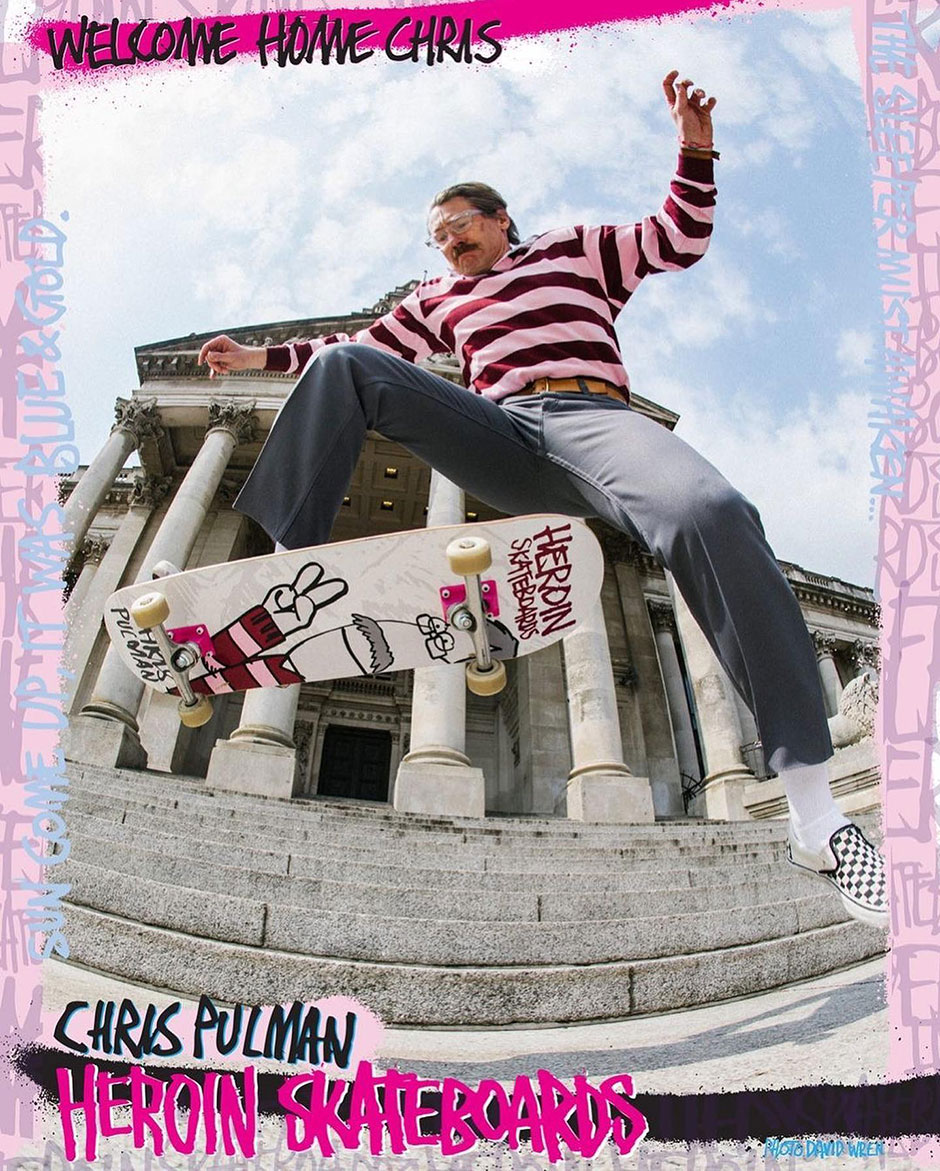
The Pulman Welcome Back to Heroin advert that appeared in Thrasher
What has that changed for you?
 It feels like the shape I’ve always wanted: 8.5”, nice round nose, symmetrical. One thing I always liked in the past was a long wheelbase, because a long wheelbase is great when you do tricks like Smith grinds on a mini ramp or something. You have that long reach, and it feels great. But the short wheelbase, I prefer as I’ve gotten older. I love having really wiggly, loose trucks, and the turning part of skateboarding, at risk of sounding like Daniel Gesmer, is the most important bit. That’s what the trucks are for. They’re for holding the wheels on, and for going around corners. If you think any different, you’ve missed the point of skateboarding. That’s what they’re for, right? So I like the turning part of it; I like turning and sliding so sharp that you’re barely in control of it. That kind of wiggle, saving the trick when you get it wrong, but you squidge out and make it. That is where the real control in skateboarding is: the corrections. I always say style comes from imperfection, but the skill is in there to be able to fix it when it fucks up and not slam. You squidge out of it, or change one trick into another trick halfway through because your body weight changes.
Anyway, I used to like a long wheelbase, and now I like the best turn. That’s why I switched to Lurpiv trucks because they turn the best. I have them so loose, so the little bit of extra height on a Lurpiv meant that I didn’t have to go down the route of having to deal with wheel wells or riser pads, because I don’t like riser pads. I like metal against wood. As soon as I put something between the base plate and the board, I can feel it’s softer, which sounds like madness, but to me I can feel there’s a riser pad on there. So I wanted the Lurpivs, and they worked out great. They’re high, they turn sharp, they’ve got a lovely kind of stability in the middle when you need it, when you’re doing manuals and stuff, but when you want them to go, they go. Sorry, I sound like I’m selling a set of Lurpivs here, but I love those things. They went great on this new board. I’ve got the perfect setup. I have 58mm Spitfire Conical Fulls because I like something a bit chunkier, and it’s just perfect. It’s taken me 39 years, but now I have this board that feels like I could ride it forever. It does everything I need it to do. There are lots of things about a twin nose. It’s not a twin tail, so it’s not going to have that sharp pop that the twin tail has. But as I said, most people don’t have the flatground ability to really appreciate that twin tail, that shortness. A twin nose is similar, but it’s a more casual thing. It’s more laid back, almost.
The other thing that’s great about it is when you’re out skating, you’re just messing about at the skatepark, you bail, and you pick your board up. I can throw my board down any way that I want, and it’s the right way around. That is really freeing. It’s a really weird thing when you first do that, and I did it so naturally the first time I went skating. I don’t know which way around this board is, but I’ve realised it doesn’t matter. It instantly became really unimportant, whichever way around it was; usually, you favour one end over the other. This is another one for Slam’s economically-minded customers. If you are like me and you don’t have a very big switch stance game, if you ride a unidirectional board, you wear the tail out, and you don’t wear the nose out. But if you have a twin, your boards last so much longer. Don’t tell anyone in the skate industry, but twin noses last a really long time! My boards last ages now. I’m an old man who has never had a very good switch game. My nollie flip is disgusting; you wouldn’t want to see it if I could even do one today. I don’t need that kind of finessed tech. I just want something that’s fun, and this is fun and easygoing. It makes skateboarding enjoyable, low-maintenance, and fun.
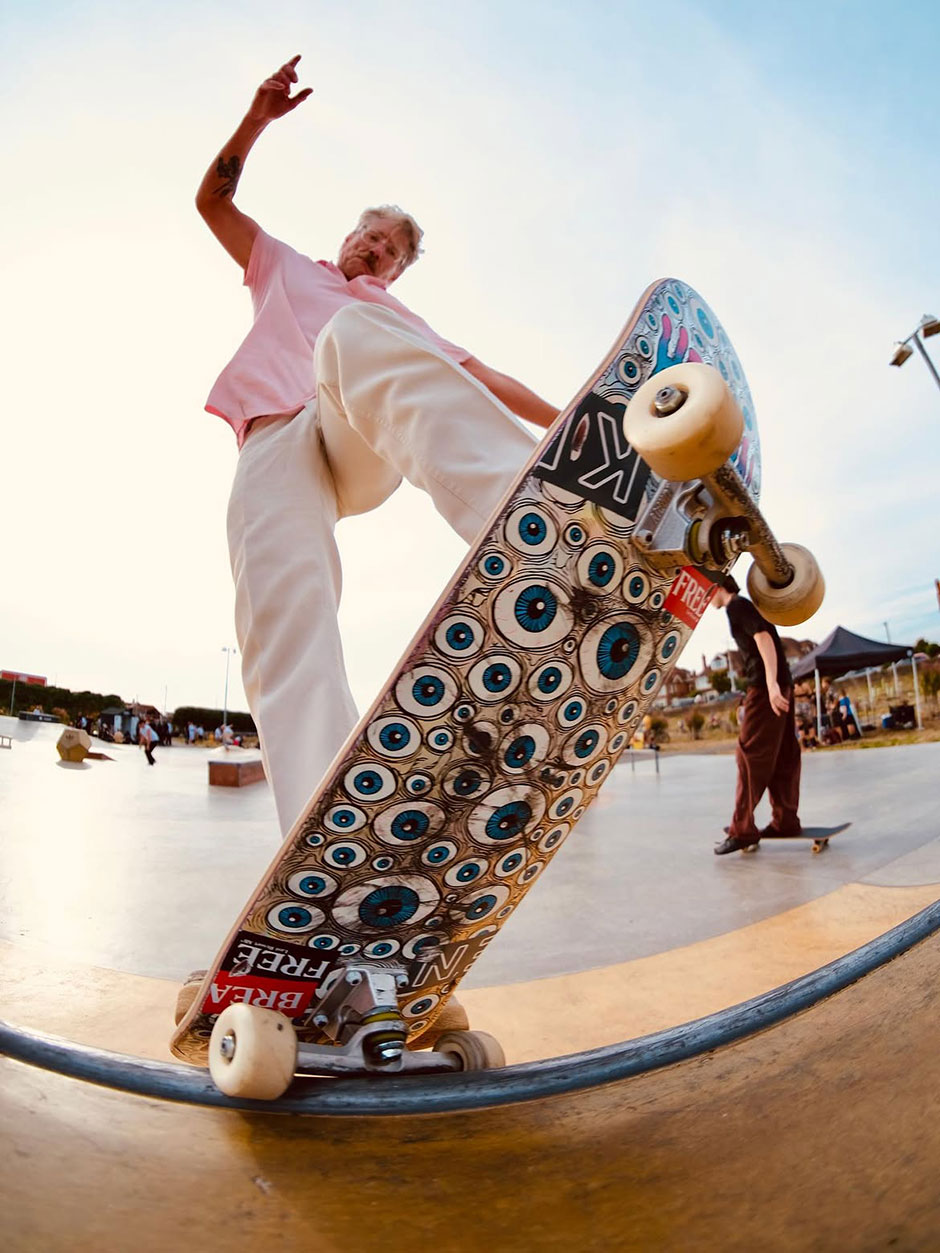
Chris now chooses to support his salad grinds with Lurpiv Trucks. PH: Chris Chatt
Those eggs, those symmetrical egg boards, those massive eggs, they limit you in a way because it’s not easy to do a flip-trick on them. So you throw all that out of the window, you forget about those things, and you just enjoy the wiggling about, and that’s why they’re fun. If you’re old, or you’re injured, or you’re just not super technical at skateboarding, you can go and slappy kerbs and have a lot of fun on those things. They are another thing that made skateboarding accessible. We have talked over all the years about skateboarding being fun. Fun is the most important thing. Graham Baker used to always say I’m good enough to have fun, and he was right. He was totally right. We always pretended, and we’ve always said that skateboarding is about fun. But I think, deep down, a lot of people have taken it much more seriously than that, and the fun is part of the seriousness. But for me, the fun has become the primary thing now; I’ve really let go, and I’m just enjoying it. That’s why the Instagram stuff works, when you were seeing footage of me skating that Phil filmed from the side of the skatepark. I don’t really know that I’m being filmed, and it’s not filmed by a skateboarder. It’s filmed by a person who’s just training their dad-cam on me. But that is so honest; that’s who I am! When I’m laughing, and falling, and making silly noises, and even occasionally looking at the camera, that’s who I am. That’s the real Pizzer. That’s the real Chris Pullman. I think the reason Instagram works is that people can see that it’s honest. It might not be the gnarliest shit, packaged up, filmed well with a fisheye, and 16 mm backup lifestyle shots. But what I put on Instagram was real; people could see it was real, and that I’m enjoying it.
It’s all relatable; that’s what connected you with a wider audience to begin with.
Nobody can say they are authentic, but I try to live a version of an authentic life, whatever an authentic life means to me from my philosophy and worldview. But I like trying to do things authentically, like showing my skateboarding. I don’t cut things out when I fall over; I include them because falling down is part of it. When skateboarding is packaged up into a marketing thing, you miss a lot of the really fun bits of it. That’s why those raw files we were talking about are interesting. Because the trick is rad, the video part is rad. But I want to see the five minutes or the five days that Dylan Jaeb took to do that fakie heelflip manny. I want to see how long that took; I want to see the battle. I want to see him trip on it, and laugh, and shout, and scream, and talk to the cameraman. That’s authentic; that’s the real skateboarding experience. And I think people connect to that because it’s much more than just a trick and a picture of a product.
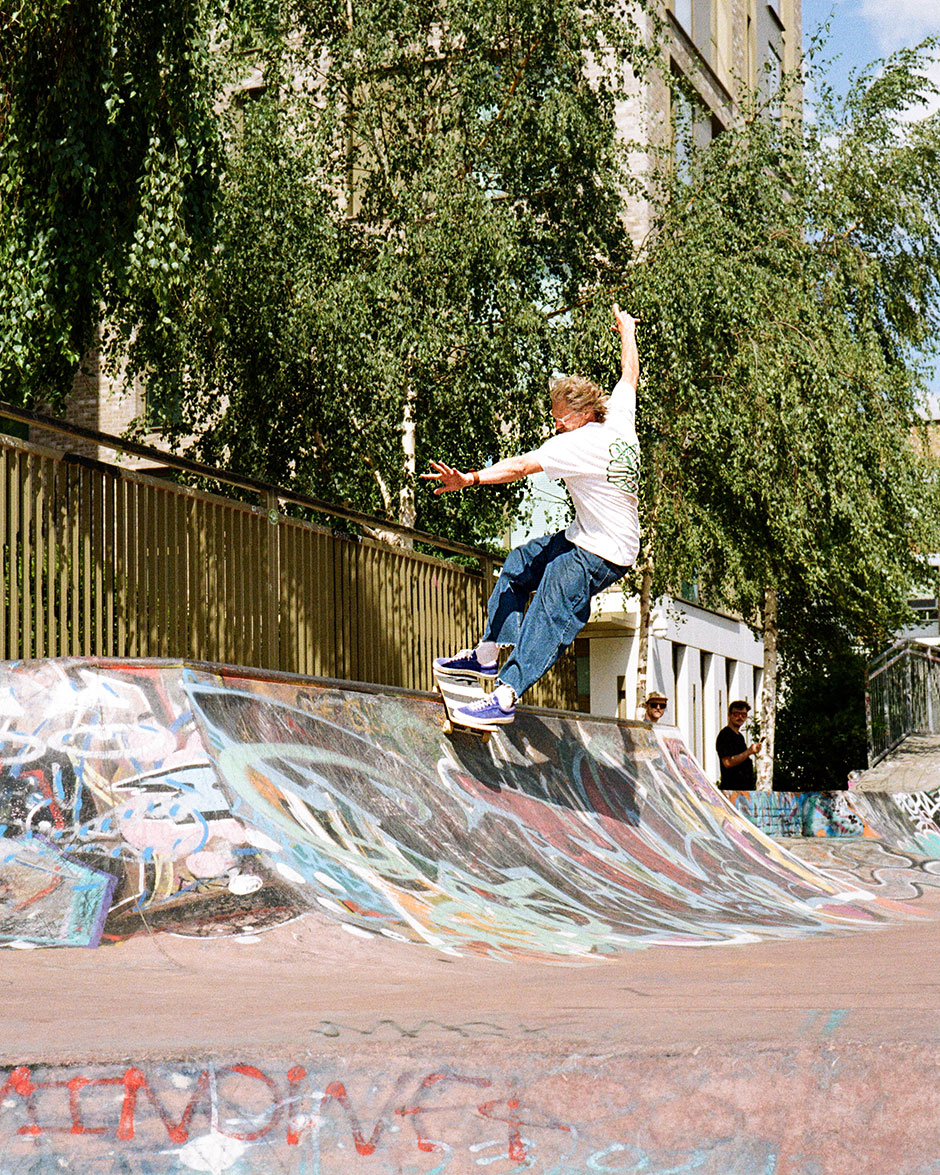
Stockwell plays host to a Last Resort powered smith grind. PH: Tom Delion
Talking of products, you recently swapped out the Slip-Ons for Last Resort shoes.
I’ve been wearing Vans my whole life in some way or another. My first pair of actual skate shoes was a pair of Vision high tops, canvas ones that looked like Chuck Taylors. Then I had two pairs of Pacer Hogs. Then I had two pairs of Vans, and I was in Vans from Cabs up to Lampins, and Bluchers in 92. Then, Vans fell off in the mid 90s; they were bad, and so it was Emerica. Then I got back on Vans, so Vans has been important. That regular waffle sole, that sole on griptape, it’s pretty hard to beat that. It works really well, and it’s always worked really well. I was wearing Slip-Ons because, as everybody knows, if you don’t have a shoe sponsor, a checkered Slip-On for me is a go-to. I’ve seen other people do it, and Jamie did it because it’s the one shoe. Everybody owns a pair of Vans, but they could have been in their cupboard as slippers. You’re not on Vans if you wear a pair of checkerboard Vans. I was getting to wear the shoes, but I didn’t ride for Vans; they’d just give me the odd pair here and there if I asked nicely. I was really strongly vegan, so the canvas thing meant a lot. And the way I skate means I can skate in Slip-Ons. Plus, my arthritic toes make me quite picky with shoes. I’ve got really bad arthritis in my toes, so Slip-Ons work great. I had them for ages, and I Shoo Goo’d them, and did a lot of stuff to them. But Vans are a big company, and they’ve got other priorities.
I don’t think they were particularly interested in a 51-year-old man who’s trying to keep skateboarding, and trying to inspire other people who are that age, or trying to show that side of skateboarding, or that demographic. It didn’t seem like Vans were very interested in that; they already have legends who fit that purpose. There are legends who ride for Vans, and I’m not one of them. I’m not technically good, and I’m not a legend. I think I just wanted to feel more part of something, and with Vans, I didn’t feel like I was very much part of it. But with Last Resort, when Pontus [Alv] came out with the first kind of mission statement and that Jenkem interview, which people should go back and read. That shows where Last Resort came from: Good production, good people, good ethos, good team. It started in a pandemic, and it kept going. All along, I thought it was something I could get involved in; I was thinking I could rep that, it’s an easy brand to go and rep. If they ever needed a shoe rep, I could do that. It’s a real easy sell; the fabrics and the shoes look great. When you put them in front of people, you could show them the stitch line, how they were put together, and the thought that went into that. Those guys knew what they were doing. Sami [Tolppi] knows that it all works together. It has its own complete- what’s the word?
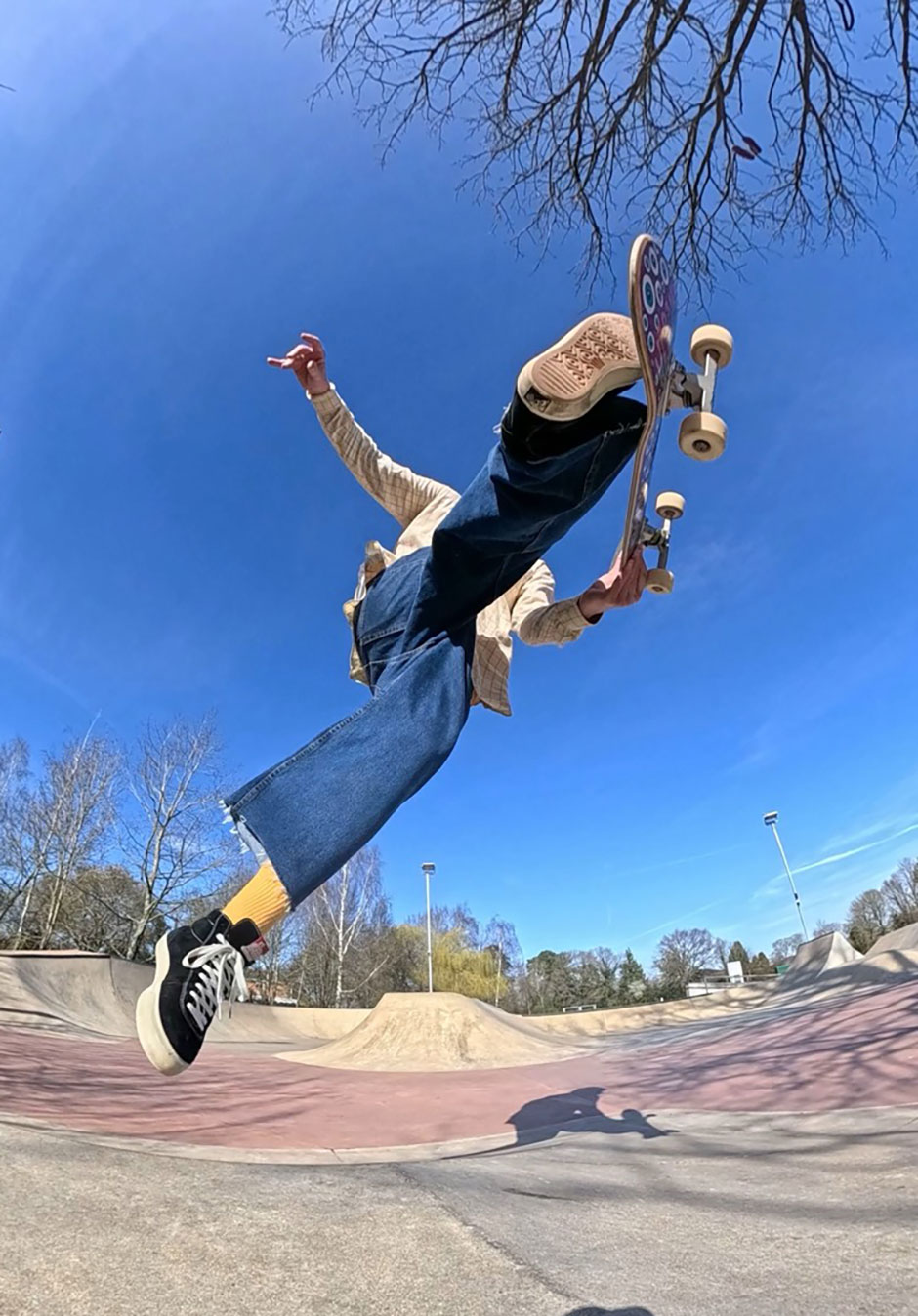
Blue sky thinking. Go-Pro captured boneless in the Last Resort VM001
Undeniable aesthetic?
Right? Last Resort really is the last stop. If you want to be involved in skateboarding but you don’t want to be anywhere near corporate or sporting goods, then you have the Nidecker brands; they are where they’re at. Vans used to be a brand, even though it was corporate, that wasn’t a sporting goods brand; at least it had nothing to do with sports. I don’t need sports to be anywhere near skateboarding because they don’t belong together, although people have different ideas about that. Vans are justified as being good, but Last Resort has nothing to do with any of those things. Last Resort really is the true core skateboarding footwear brand for skateboarders to do hardcore skateboarding in. They’re tough shoes. The VM001, the very first shoe, the very basic first shoe, has no seams in a critical area, and a tight toe. If you’ve got that, you can pitch your toe onto the board, and it feels nice. Pontus [Alv] knows about that. It’s really important how that toe box works. If your foot fits well in that toe box, it makes skateboarding work a lot easier. So Pontus understands that about shoe design, and Sami understands that about shoe design. Between them, they have put together almost the workwear of skate shoes. I don’t want to expand on that because the brand is so much more, but they’re almost as solid as Dickies, or as solid as Ben Davis. You can put them on, and they work. They do the job. They last; they don’t mess up. If I’m going to buy something as a tool, I’m going to buy the best tool I can for the money. And it feels to me like that, a lot of those Last Resort shoes are a good tool for the money.
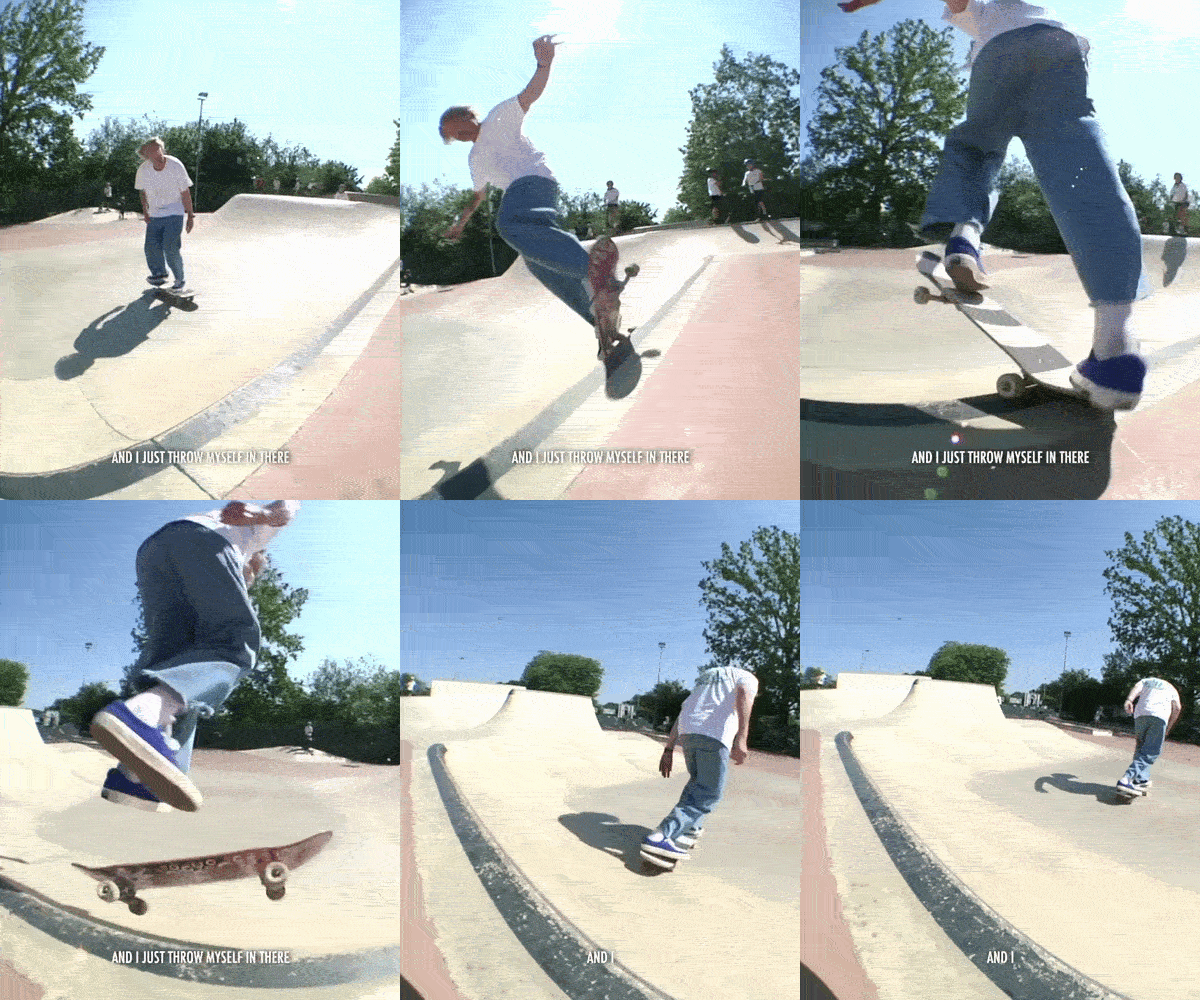
Click on the wizardry above to be transported to Chris’ new clip for Last Resort filmed by Jimmy Silv
Plus, it supports the industry, and I feel I can put my energy behind it. I want to support that. Pontus [Alv] is an inspiration. As soon as I first read that mission statement, I was sold on it and thought I’d love to get involved. I was kind of wedded to Vans in my head at the point because I was wearing them, but then I saw an orange rust-coloured wallabee style shoe Last Resort were making in a catalogue. I liked the direction they were taking. I want to see Wallabees, I want to see brogues. I want to see it. I hit up Mike [Halls], and he sent me some of the Wallabees. I went to the skatepark, put them on, and I skated them straight away. I hadn’t had a pair of shoes like that forever. I could skate in them straight out of the box. They had a gum sole, and the foxing was gum as well. So they were really grippy. Straight out of the box, they were like a worn-in pair of shoes. I had two pairs last summer, and I Shoe-Goo’d them, because it’s quite a lot of maintenance to keep a shoe like that in one piece. Even the couple of flip tricks I do are not designed to cope with that, but they’re fun, and I maintained them and made them last months and months. They looked really nice, and it suited my gear and everything. It was a really good experience; the shoes were great, and that inspired me last summer. I hit 50 in December 2024, and I kind of decided that I was going to just enjoy being 50. I just went out and skated as much as I could, and kept on top of my injuries. I kept on top of my strength training to keep the arthritis away, just enjoyed skateboarding, and filmed the odd bit when I could. I was enjoying 2025, but I didn’t really have any footage, and I didn’t post much. Then I had a nice clip, and people liked it. I think a lot of it was because it was the Wallabee footage, and it looked kind of interesting. But it was nice for me to put out a clip on my 51st birthday that again went viral. That was pretty mental. That was a good birthday. 3.4 million views on a birthday clip without telling anybody it’s your birthday, which is always my style, was quite a nice one. It was a good birthday present, and it was a nice way to say thank you to all the people who give me stuff. People give you boards; people give you shoes. It felt good to be able to give something back to the people who give me stuff.
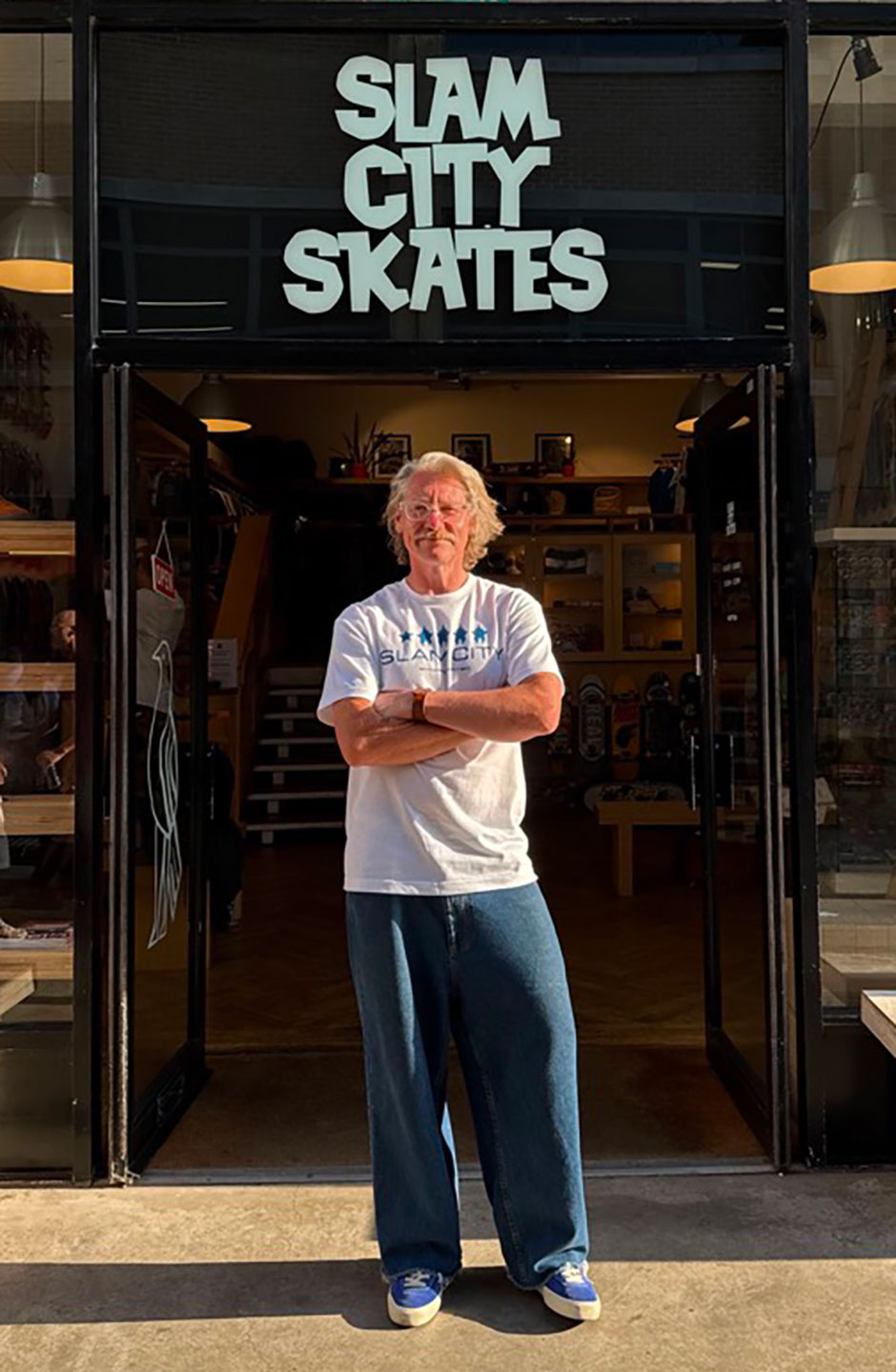
This interview announces that Chris Pulman is now an official member of the Slam team
On that topic. We wanted to use this to announce that you’re now on the Slam team officially.
Oh, my God! I’m actually crying. What the fuck? Is that real? You’re going to put me back on the Slam team? Oh my fucking god, I need some large t-shirts. I gave them all to Keith. Oh, man, I need a minute to let that sink in. That’s a big deal to me. That feels like such a big deal.
Full circle.
Oh, wow! I hope everybody’s cool with that. Is everybody cool with that on the team? Nobody was like, “Oh fuck man, not that guy!”
Only Toddy had a problem with it, but we talked him around.
Hey, Toddy did a hardflip yesterday. He can’t say shit.
Hardflip revert, Toddy Gangemi.
Oh, thank you! That is rad, that’s mental. What am I supposed to do with that? You know how long I’ve needed a shop sponsor? I would have to go into little mum and mum and dad shops and ask if I could swap three sets of Descent bolts for some griptape. That’s really meaningful to me. I know some people might see it as a bit of a joke, but to me it’s still meaningful. Thank you!
I guess you’ve never officially been put on, as it were, but have always repped the shop.
I managed the shops, so I was on Slam for salary. I did get paid and did a bit of skateboarding.
When I spoke to Lloyd [Davies], he said that you were one of the first people to ever speak to him at Southsea when he was young. He said you taught him to do the two-wheeled wallride on the side of the block.
Hahaha, oh, shit, that’s crazy. There are a few kids like Jake Skinner, who runs Pitt Street skatepark. He’s a similar age, and he told me that I taught him how to do a no comply when he was like a baby. I can’t fucking remember that. I can’t remember, but he said he would never forget that, that I taught all these kids to skate. I’m so old, I can’t remember doing it.
But that’s something we have spoken about before, with helping kids to drop in. Think about how many kids you’ve helped to drop in over the course of your life, and how formative that experience is; it’s indelible.
I think as time has gone on, there’s the community aspect of skateboarding, which I’m not particularly good at because I’m quite an individual, and I mean individual in a keep myself to myself kind of way. Most of the time, I keep to myself. Obviously, I can be social, but I’m quite happy in my own company a lot of the time, and I’m not ashamed of that. I can be in the woods for hours just sitting there looking at buzzards and shit. But assisting people, I think I’ve always done that, but as time has gone by, and I’ve gotten a bit better at regulating my mental health. I’ve come to appreciate those things that I’ve been able to contribute to skateboarding, like teaching a kid to drop in. I appreciate how important that is. The first time a pro skateboarder talks to you, the first time someone helps you fix something. If somebody can’t get their axle nut on, I’m always the guy at the skatepark who’s got a re-threader. If you fix an axle nut that won’t go on for someone at the skatepark, you go from dude at the skatepark to wizard. You become a wizard of skateboarding. You’re Gandalf at that point, because you fixed the unfixable. You know what I mean? You become a wizard-grade skateboarder because you’re just an old man who happens to have all the tools with him.
I’ve kind of promised myself with that wonder of meeting a professional skateboarder, or meeting someone who’s good at it, or just being an old man who still does it. There’s obviously that joy of meeting those people, but there’s also a massive responsibility, I feel, for making that a good experience. That person will skate forever if you make that a good experience, which will teach them something they can use in life. I kind of like that; I don’t know if I’d be a skateboard teacher, as it were, or a coach. But those moments when there’s an authentic chance. You see someone trying to drop in, and you say, “Excuse me, if you would like some help, I’m available to give you some help; I know how to teach someone to do that. If you want help, I can do it. But if you want to be left alone, I totally get that, too”. I’m very sensitive to who the person is and their background. Because at the end of the day, I am an old man at the skatepark, and for some groups of people, an old man is still quite an intimidating person. If you’re a little kid, or a young girl skating in a park with an old man could be intimidating. So I’m always responsible, and make sure to give people lots of space, and only try to offer advice if I’m asked or if someone looks like they might need it, and then walk away. It’s about making a skatepark an inclusive space for everybody. As skateboarding has become more diverse, it’s more of a community space. It’s for everybody who skates to use that space, regardless of ability.
“The more active and the nicer your skatepark is, the more chance you have of improving it or getting more facilities built”
If you’re filming at a skatepark, that’s not the priority. That skatepark isn’t built for filming. Skateparks are built for skateboarding. If you’re filming there and you’re getting in the way, that’s not cool because people come to skate. If you want to film, go streetskating, and film there. Park footage looks crap generally anyway. It doesn’t look as good as street skating. It’s footage, but when people dominate the park when they’re filming, that can be a bit odd. Filming is part of skateboarding, and we do film at the parks. It’s just when people dominate through it, and it’s not fun filming, that it can be a bit strange. That’s one example, but there are other bad behaviours like shouting, littering, and all those things. We have to remember, this is a place for everybody. The more people skating, the busier the park is, the more chance you’ve got of going to your local council and saying, “Hey, this park’s really busy, let’s build another one, or make this one bigger”. The more active and the nicer your skatepark is, the more chance you have of improving it or getting more facilities built. So I think it’s important to remember that. This sounds like an old man’s speech, but from dealing with skatepark companies, user groups, and councils, if your zone is nice and inclusive, you’re much more likely to get money to make it better.
Thanks for your time Chris. We need to close this out although I know we could keep going. Welcome to Slam officially, and we look forward to seeing more footage and hosting future visits from yourself and Keith. Do you have any last words?
I mean, what a responsibility. If you’ve made it this far, you deserve a reward, or a medal. Thank you for taking time out to read our conversation. I hope it was an insight or made you laugh; hopefully both. Usually people take this opportunity to thank people, and I’ll get on to that, but first I have a message for you as a skateboarder or even someone that’s considering skating or starting up again: DO IT! – That’s the most important thing: Just get on and roll. The more time you spend on your board, the better it will feel. There are no real rules to this thing. Your interpretation is as valid as anyone else’s, and if you’re smiling, you’re winning…
I’m convinced the world would be a better place if everyone knew the genuinely levelling effect of skateboarding. We are all humans, just humans, experiencing this lifetime in our own unique way. The uniqueness is what makes this thing worthwhile. Being your true self can take work, but being yourself is the path to a happy, authentic life, I think. Life can be hard, and it’s certainly unfair, and it’s absurd to expect otherwise. You kind of have to chuckle about it… even when it gets really hard. Community, through skateboarding, makes it so much easier and nicer…
Here’s to the folk who help make spaces safe for everyone, the ones who build skateparks and organise jams and competitions. The ones who build communities for like-minded folk or those with similar lived experience. The ones that realise that by sharing our experiences, we can help some people feel a little less alone in their own struggle. The people that document what we do and preserve it so that our rich heritage isn’t lost and can continue to inspire and influence a new generation. Here’s to all the skaters that have inspired us in any one of a myriad of different ways. I’m grateful to have shared this journey with you. Here’s to the ones who are no longer with us.
Thank you to the folk that support me in skating: Fos at Heroin Skateboards, Nick at Power Distribution, Mike and all the good people at Keen Distribution. Sami for having faith in me to make something nice for Last Resort. Jimmy and Tom for giving me their time and making it a reality. Jonny at Skullcandy and Jake at Forever Social Agency. Slam City Skates for finally putting me on the team…
Keith, I’m so grateful to be your dad. Shred on!!!
Lastly, thank you, Jacob Sawyer, for patiently listening to my rambling and fashioning it into something digestible. Some heroes don’t wear capes; they wear body warmers…
The rest of you, I’ll thank in person…
Keep on truckin’
Chris
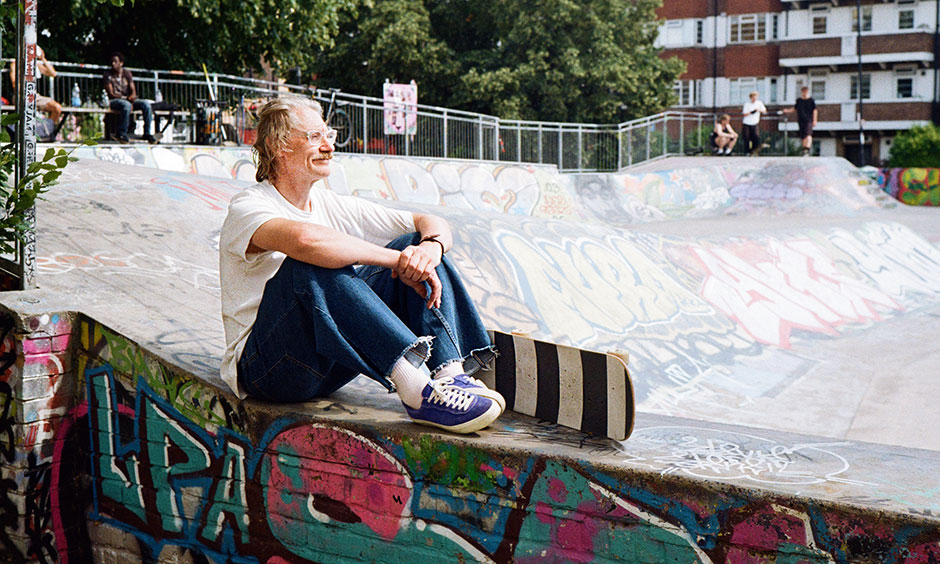
We would like to thank Chris for sharing his story with us. Be sure to follow Chris Pulman and Heroin Skateboards on Instagram for more updates.
Related Reading: My Board: Chris Pulman, My Board: Mark “Fos” Foster.
We want to thank all of the photographers who have allowed us to us their photographs, a huge share of which came courtesy of Wig Worland. Many thanks also to: Richie Hopson, Sam Ashley, Rafski, Tom Delion, Chris Chatt, and Dominic Marley. Thanks also to Neil Macdonald for the mag scans.
We are proud stockists of all of the brands supporting Chris’ journey: Heroin Skateboards, Last Resort, Lurpiv.