

We are happy to have recently welcomed Parra clothing to our rails, to coincide with this new addition, and on the cusp of a special collaboration, we proudly bring you a Piet Parra interview. This conversation with the artist behind this popular Dutch clothing imprint covers a lot of ground, beginning with the story of his deep skateboarding roots…
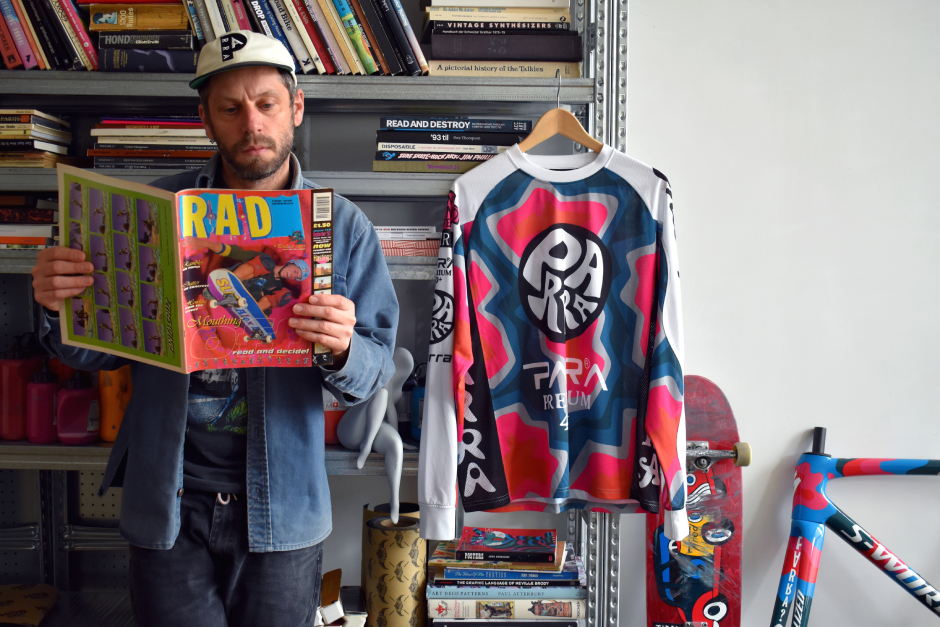
Words and interview by Jacob Sawyer. Piet Parra in his studio wth some R.A.D Mag inspiration
Piet “Parra” Janssen is well known for his incredible artwork and is a celebrated artist in his own right. He has been exhibiting work for over two decades, and his inimitable style has found him in some life-affirming situations. From his early work adorning flyers and posters for parties created for his immediate community, interest in his style snowballed, and initial independent clothing experiments reassured his direction. Beyond gallery exhibitions, his abstract eye and distinctive colour palette manoeuvred its way onto magazine covers and shoe colourways, a powerful aesthetic with continued commercial applications that continue to reverberate, breathing new life into classic shapes intertwined with his formative years.
When Piet’s work became synonymous with Nike releases, this relationship delivered a brand new audience, one he is grateful for, but one whose interest peaks at that point. As an artist, his story is as old as his earliest work, but the backstory behind that, the influences, and the many years of skateboarding that got him to that point are rarely touched upon in interviews. That is why, when the opportunity to speak to the Parra founder arose, we jumped at the chance, eager to find out what the early years of this storied Dutch skater looked like. We realise that some may be unaware that the individual producing the sleek brand they are familiar with was there in the mix when they slipped the earliest incarnation of the Blueprint squad into their VHS player in 1996. This interview shines a light on that period of navigating the nineties, the journey that led up to it, and a rich skateboarding history with many chapters, sponsors, and brand-building opportunities.
We are hyped to have just added Parra clothing to our inventory, and to have offered exclusive access to a very limited Vans OTW release, which sold out instantly. This conversation also teases a further collaboration we look forward to bringing you more news of very soon. The latter part of the interview explores the story of the Parra brand, some notable waffle-soled collaborations and their evolution, the inspiration behind the work, and the artistic process that remains fused to skateboarding in many different ways, including having TIRED as an outlet for the expression of many others. There was also space to examine new work and how creating it remains fluid while remaining true to the framework underpinning it.
It was a pleasure curating this one, thanks to a wealth of visual material plucked from the archives to support it, years of good photos that keep on coming. To recapitulate, what you will read below is not the story of an artist who used to skate; rather, it is the story of a skate rat who found art as a passion that can exist in tandem. Enjoy learning more about the visionary responsible for the newest brand on our rails…
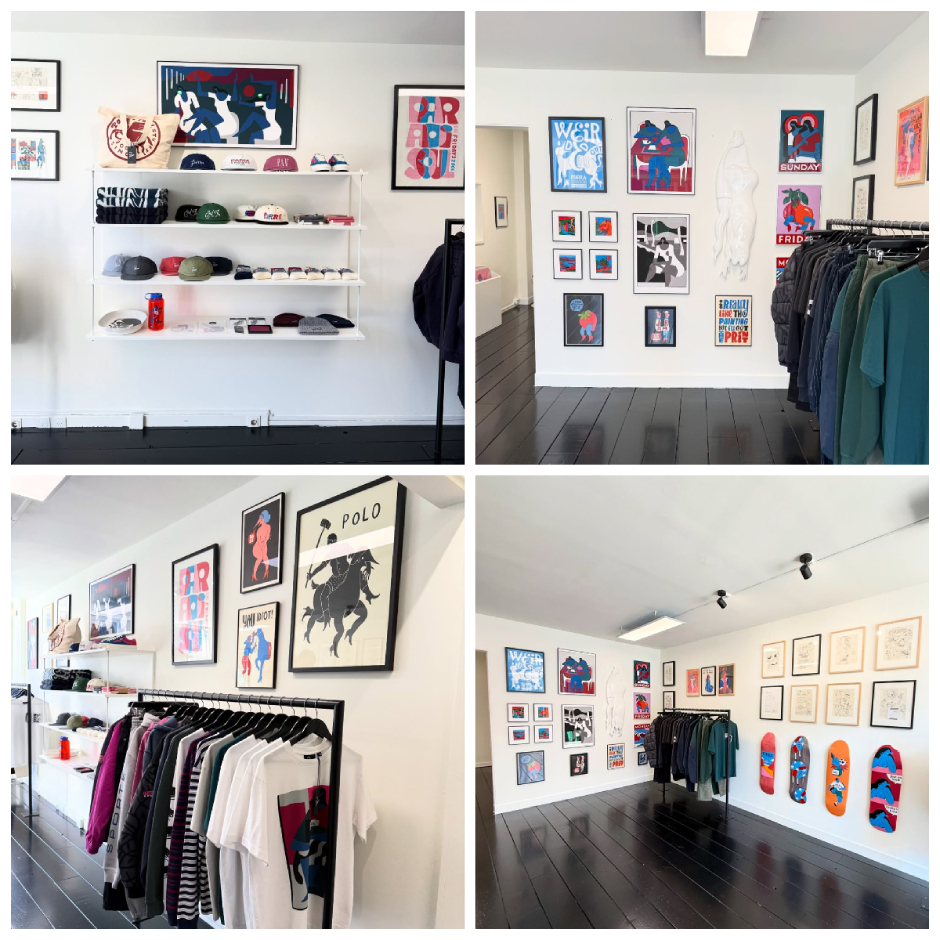
The first photos of the new Parra store in Amsterdam which just opened above Ben-G skate shop
Hey Piet, how are you doing?
I’m good, man. Just messing around in my studio and framing some sketches to hang up in the Parra store in Amsterdam.
Where is your studio now?
There’s the Ben-G skate store in Amsterdam, my friend Benny Komala has run it since 2006, and he’s been a long-time friend. A couple of years ago, he asked, “Do you want to open up a little miniature store?” like a Parra store upstairs, and I was keen to do it. That used to be my studio back in the early 2000s. So it felt kind of fun. I just chucked some work on the walls, and now we sell the line there. I kept it quiet, really. There was a second store in between called Very Special, also run by friends, and they are moving to a bigger space close by in the centre. That second floor is where we’re going down to. It’s a bit of a bigger space. I have to fill it up with more crap. So I’m currently looking around for what I can frame and hang up. By Parra started in 2000 under another name, it was called Rockwell, then Rockwell by Parra, and then in 2015, we changed to By Parra. For Dutch standards, we are pretty OG, haha. So it makes sense to have an actual store in Amsterdam.
I feel from reading past interviews that your skateboarding involvement is not really even alluded to in a lot of stuff. So I wanted to make this as much about skateboarding as it can be.
Yeah, nobody asked, you know? At some point during the Hypebeast era, I got chucked into that realm, and then nobody asked me about skating. I always try to mention it or say that’s where I come from, that’s where the roots are. I was always neither here nor there because I was never the Hypebeast brand. Maybe with some Nike collaborations that had a few people camping outside in front of the Patta store, but that’s as far as it went. The scene has changed, and I’m still around. So I don’t know what I am, you know?
“At some point during the Hypebeast era, I got chucked into that realm, and then nobody asked me about skating. I always try to mention it or say that’s where I come from, that’s where the roots are”
Are there still a lot of skaters frequenting Ben-G?
The core skaters, the skaters that know what’s up, you can find them at Ben-G. Amsterdam always had kind of a small skate scene back in the 90s and early 2000s, but it’s been growing for sure. Crews like POP Trading, for instance, took another look at the city and reinvented it to skate in. It’s not a city that’s naturally good for skating because it’s so old, and there’s very little new stuff being built, so skate spots are hard to come by here. I think my generation was just more lazy, and the small wheels did not help either, haha.
It seemed to me that you guys thrived on indoor parks back in the day.
You tried to be street, you know, but there is just too much bad weather, and Amsterdam never really had a proper indoor park until 2014. I also think back in the day we travelled a bit more, right? Just hours for some skateparks. I remember in the early 90s, they all used to be in Germany, these parks, just across the border. You had these really good skaters coming from this one generation we’re from. Mönchengladbach is a park I went to so many times because it was only an hour away from the town I lived in in Holland. We used to go there, and the level of the German skaters at that time was way higher. I remember going to the Munster contest, and all the Americans would just ignore the Germans. They ignored them, but they were so good. The only person they didn’t ignore, maybe, was Sammy Harithi. They had these amazing parks in Germany; there was the iPunkt park in Hamburg, and the store is still around, actually. Jan Waage was the local hero there. At that time, Jan Waage skated for New Deal; he was on the Euro team with Jeremy Daclin. Sami Harithi was from Berlin, if I’m not mistaken, and he was on Powell, and that was it. There were dozens of really good skaters that never really got picked up, and it was the same here in Holland.
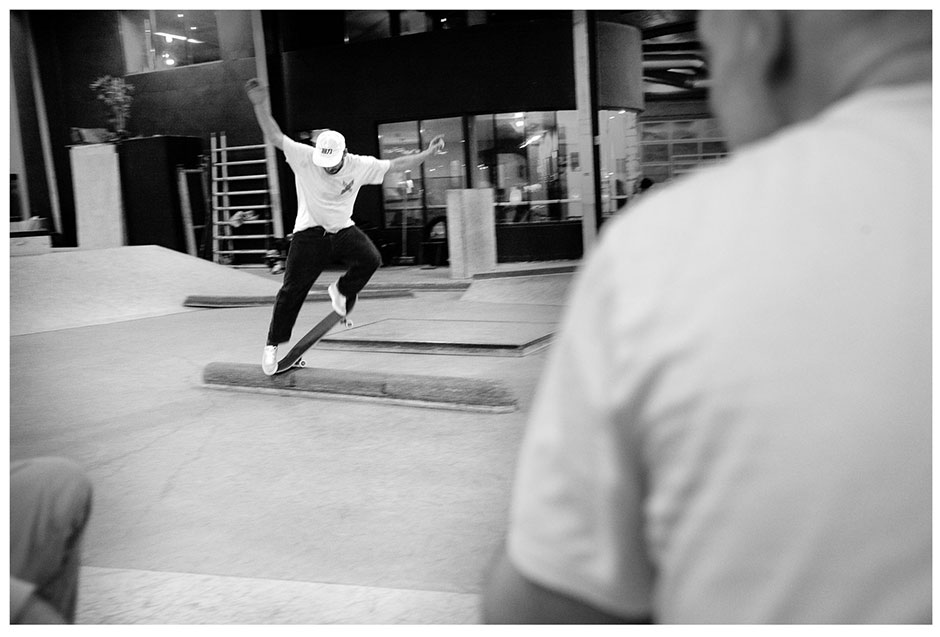
the indoor park still saving the day. Frontside noseslide pop over for Marcel Veldman’s lens
You dipped into the contest circuit?
I have a Radlands story, actually, because my sponsor at the time flew me out there. I arrived, and I was so afraid that I didn’t even sign up! I had the money with me, but I didn’t sign up because the level was just insane. I couldn’t skate that park. Being Dutch, everything we made was low, with no steep transitions. We were not used to anything steep. Everything there was steep, and I was like, “what’s this?” I was supposed to skate because I was qualified. There was a contest circuit in the 90s, before Munster, there was the Bochum contest. I tried to do all of them. I didn’t mind doing them in Holland because the level was not that high, and I could, like, flourish. I was in the top five on a good day. But outside of Holland, that was a different story.
What year is this?
I would say Radlands would have been 93 because I remember Girl skateboards just came out, and I got those boards, and I remember them being really flat.
Who were you riding for?
Rodolfo’s, which is a distribution. Marcel Appelman (we called him Appel) was the team manager, he was the homie, and he is still a good friend to this day. I’ve always been a distribution flow, but multiple times I deluded myself into thinking I was on actual teams. I guess that’s the Euro skater dilemma, right? Until not that long ago, you were never really on; you were just getting the distro flow, right? I skated via distribution for Think and Venture, which is 92, I think. Then a little stint on FIT, my time on FIT skateboards was short. That team was crazy. I remember going to San Diego to the trade show and introducing myself, and they’re like, “Who are you?” Henry [Sanchez] was on, and it was quite intimidating. Back then, you know, I had the visor on sideways, Helly Hansen jackets, and everything. FIT skateboards, C/O wheels, and Civilian clothing were the package. I also rode for weird shoe brands like Kastel and Vita. I guess that’s in a nutshell why I don’t feel bad about selling my stuff in Slam, because I took skateboarding so extremely seriously and tried to be pro. I did the whole early 90s dream thing. You go to America, try to make it, and you’re just not good enough, you know? Then the dream shatters, you get depressed, you tear down, and then you’re on a shop team. Well, I skated as an amateur for Panic. I think that was my last sponsor.
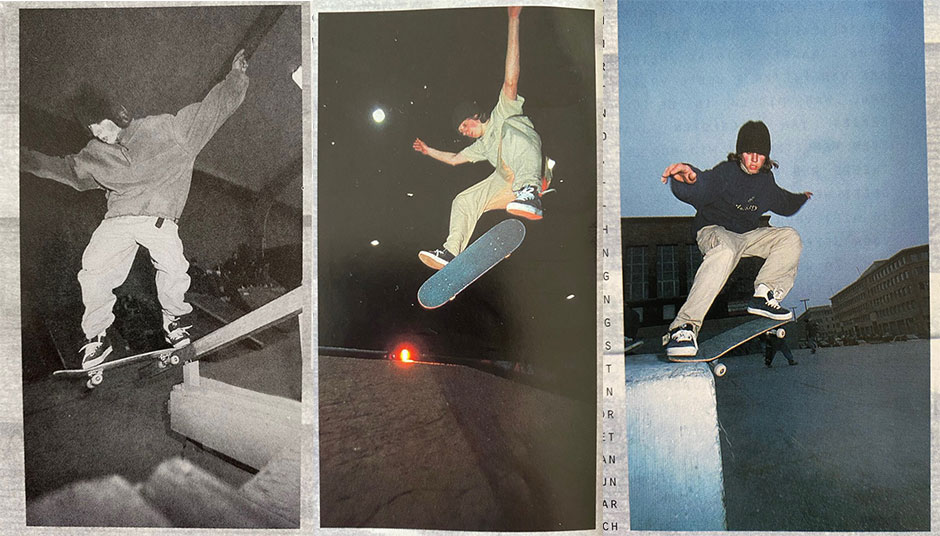
The Penny influence is strong with this one. Backside tailslide, switch frontside flip, and crooked grind from Lift Mgazine in 1996. PH: Rutger Geerling
We’ll definitely get into that a bit later on.
I was already on my way out mentally at that point. With the experience I had in the States, the difference was too big. I had never learned to skate stair sets or handrails. It was too little, too late, you know? So then I think around 99, 2000, I kind of really quit, I quit the sponsors, quit everything, and then started focusing on my art stuff. Supreme had just started, which was very influential for me because it was a skate store, and they made t-shirts, but cool stuff. Then there was Union, and so the birth of that early skate slash streetwear stuff, I was fully into that. That kind of matched with the opening of Fat Beats Records here in Amsterdam. They opened up here, my mate Craig ran it, and I was there every day hanging around, DJing, everything you do after skating. The skate roots were still there; I would still skate once a month or whatever. Some friends were still skating, and I would hop on a board now and then. But I would say I focused for a good eight years on just getting my own thing started. I started to make things. I had a few t-shirts screen printed here in town, and I would be selling them in a bar. Put them in your backpack, you know. Very grassroots stuff. It was as simple as hell because there was nothing out here, nothing was sold here. You couldn’t even get Stussy. For all the cool stuff, you would have to go to London, actually. That might have been the closest place to get proper stuff. So it was easy for me to start something here and be noticed quite quickly; there was not much competition in the clothes department.
Before moving forward, let’s rewind. When did you first start skateboarding? How did you find it, and what was your first board?
I think I was 10 maybe, and I got a banana board from a cousin who lives in another town. Let’s sketch the scene where I live. I’m living in a rural environment, really small towns, like 200, 300 people, so I was always the only one doing something. My father’s an artist, a painter, so we moved around a lot. He would find these cheaper places where he can get an atelier and a house in one. Because of that, I was never really part of the local community; I didn’t go to the soccer club or any of that kind of stuff. So I found skateboarding to be something I could do on my own. I think that was the most important thing for me. The banana board didn’t really do it for me, plus I didn’t see anybody else; you’re super alone out there. All I did was go from A to B. I tried to push on it and stuff, but then I think I forgot about it.
“I was walking around with my father, and we saw a jump ramp session in the middle of the square in the city. I was just mesmerised, and he couldn’t get me out of there”
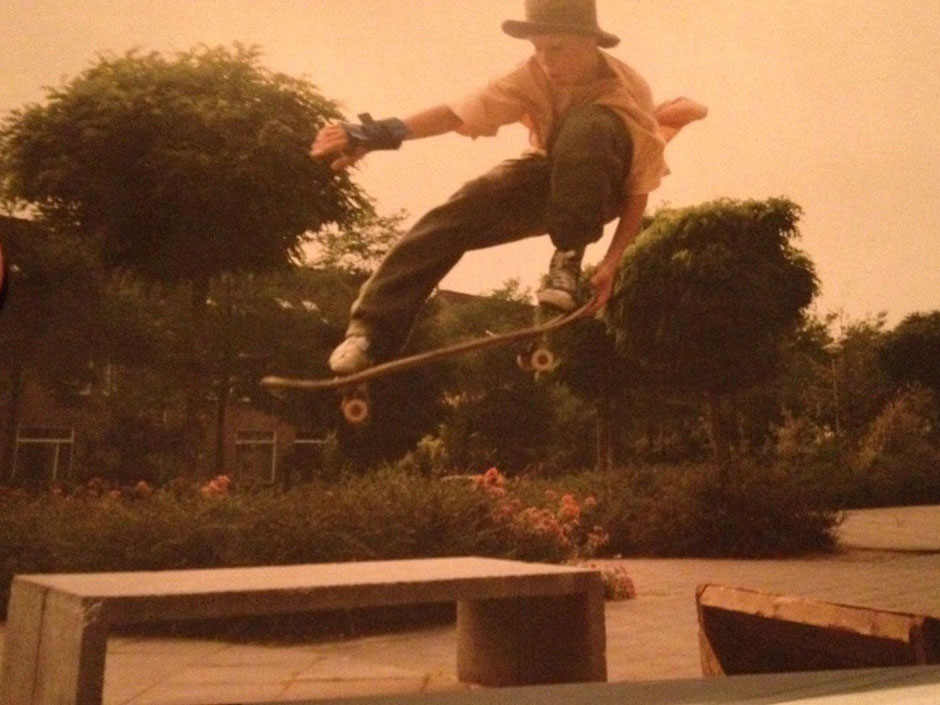
a jump ramp planted the seed in Piet’s brain shortly before he employed this one for a tail grab
Then, when I was about 14, we moved to another place closer to a bigger city. I was walking around with my father, and we saw a jump ramp session in the middle of the square in the city. I was just mesmerised, and he couldn’t get me out of there. I think I wanted to stay for like 30 minutes just looking at it. I still know the exact feeling, how are they doing that?? and what are those boards? I think this must have been 86 or 87. Then the journey started. I go home and ask for a board. You get the shitty toy shop thing, and you put the roller skate wheels on it. There was not much money, so the real first board, I remember, was a BBC Monty Nolder I got secondhand. It’s either that one or it was the Santa Cruz Cory O’Brien. There was a little bit of the graphic left, so I bought it. At this time, I was in the first year of secondary school. The year before this, I had been mucking about on the toy board. So when I went to that school, there were real skaters there, so I was just so happy. I tried to connect with them, they’re not super into it, and then after months and months, we started skating together, and I could buy their stuff secondhand. They were kind of more well-off kids, they had new boards every six months or whatever, and I could get their seconds, you know? That’s where it all started, that must’ve been 1988, 1989, something like that.
And when you say the city, you’re talking about?
It was Nijmegen, an hour and a half from Amsterdam in the south. This is all in the south of the country.
You said there was a square, now you’re somewhere where it’s okay to skate?
Yeah, I didn’t live in that city, though, so I would just go on my bike towards small villages, and usually every church would have a little stair set. I would just find stuff. Then, after I met those other kids at school, they had a ramp, and it was an hour bike ride or 45 minutes away. I would go over there, sometimes I would show up, ring the bell, and the mum would open up the door. I would ask, “Is he here? Can we skate? Or can I skate?” I would hear him in the background and be told that he doesn’t want to skate. Then I would see him, and wave, but then be told that he doesn’t want to see me today. Then I would have to bike back. It was kind of brutal; they were a bit older, you know, they were really mean. If you’re 13 and the guy you’re trying to skate with is 15, they don’t necessarily want to hang out all the time. It sucked because they weren’t good or anything; they just had skateboards. They weren’t real skaters. They had all the cool gear, but they didn’t like it as much as I did. I think you really need someone who is just as crazy about it as you are. Then, in the second school year I met a new kid at the school, and he was just as insane about skating as I was. Together we connected to more serious skaters in the surrounding villages, and that’s when it really started.
“They had all the cool gear, but they didn’t like it as much as I did. I think you really need someone who is just as crazy about it as you are”
What three videos made the biggest impact on your young mind?
There was an older skater who lived maybe half an hour away from me. He never skated, but he had all the videos. It’s the same thing again, I would ring the bell, and hopefully I was allowed to hang out and watch a skate video because I didn’t have any. One day, he opened up. He was skating in front of his house, and he told me there was something I had to see. It was Speed Freaks, that’s the video, the first real video I witnessed. What was very important was to have him explain what was happening. Who was who, you know? He was fast-forwarding pool skating because it’s lame, because we don’t have those. There’s a Mike Vallely part in there, a Neil Blender part, and the Neil Blender part really stuck with me. So when I saw that video, it would have been 1989. Then he kind of pressured me to buy a new video because he didn’t have money, and I had a paper route, so I did. I wanted to buy some wheels, but he said I needed to buy a video. He explained how to get one from this mail-order place that doesn’t exist anymore, and he told me what video to order because he wanted it. That was Rubbish Heap from World Industries. That video changed my life completely. I could navigate it, and it was all street skating, except for a bit of vert. Then, simultaneously, I was watching the Deathbox video, and I would watch two of those at the same time. That was the Spirit of the Blitz video. It’s insane if you compare the level of skateboarding from those two videos. So it was Spirit of the Blitz, Rubbish Heap, and Hokus Pokus by H-Street as well, because I had a copy of a copy. A bit later, I got heavily into the Planet Earth video Now ‘N’ Later, and the H-Street Next video. All the greats are in those videos.
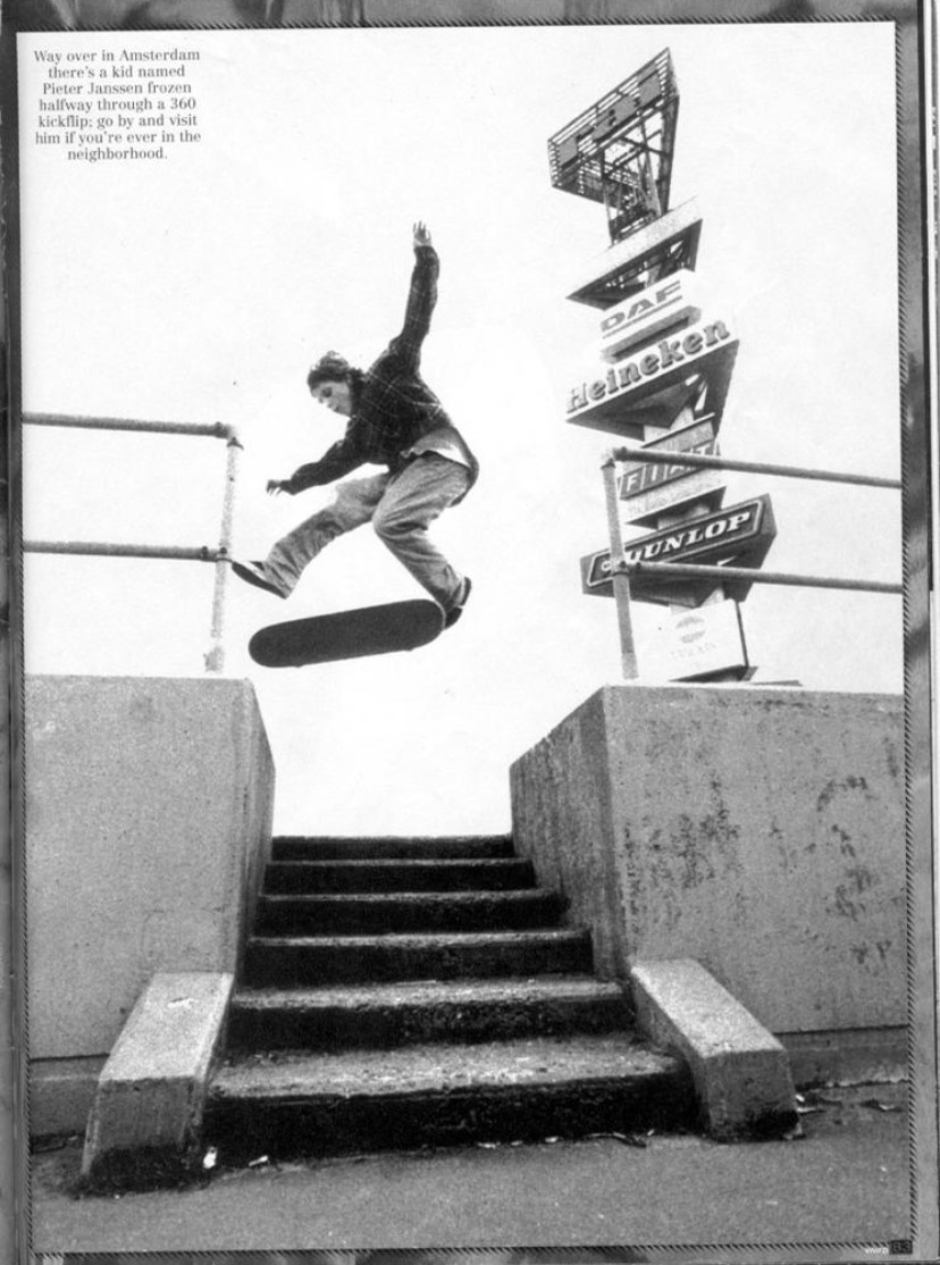
Pieter Janssen 360 flips a stair gap while Miki Vuckovich shoots for Warp magazine
There’s no skate shop, this is all independently soaking stuff in at your friend’s house or home alone?
Yeah, years alone. The only other companion I had was R.A.D Magazine because they would sell it randomly in a slightly bigger town, pretty close to where I lived, like 15 minutes away. They would have it every now and then, and I would buy it. That was the only skate mag available; I’d never even seen another one. I thought that was it. I did manage to buy them all back, all the old R.A.D mags. I found them on eBay. They give me goosebumps still. I couldn’t even read. I didn’t even know what was going on; I was just looking at the pictures. So I think being alone so long with this culture kind of did something. Just looking, and with no explanation but that one guy telling me that pool skating was lame.
Top three skate styles, who did you look to as an example of how things should be done?
I think every skater goes through a little period when they really don’t know yet, I would say the grommet stage, where you think everything’s cool. They’re flying high, or triple flip is cool, you have no clue, I think I kind of realised about how you should skate and how it should look is with the Video Days era. Correct me if I’m wrong, but Video Days came out the same year that the Planet Earth video [Now ’N’ Later] came out. So suddenly, you see Jason Lee skate or Guy Mariano. I think the Guy Mariano part from Video Days was it, it’s very corny, and everybody has the same story, but that was it. Same exact age, same height, I’m super small at that age, so I can definitely relate. Oh, and Brian Lotti, so good and stylish. Then, also at this time, I’m skating with the guy who’s better than me, so he also gives me tips. Your foot is in the wrong position, that board’s stupid, don’t buy Powell anymore, you need a World Industries, that kind of stuff.
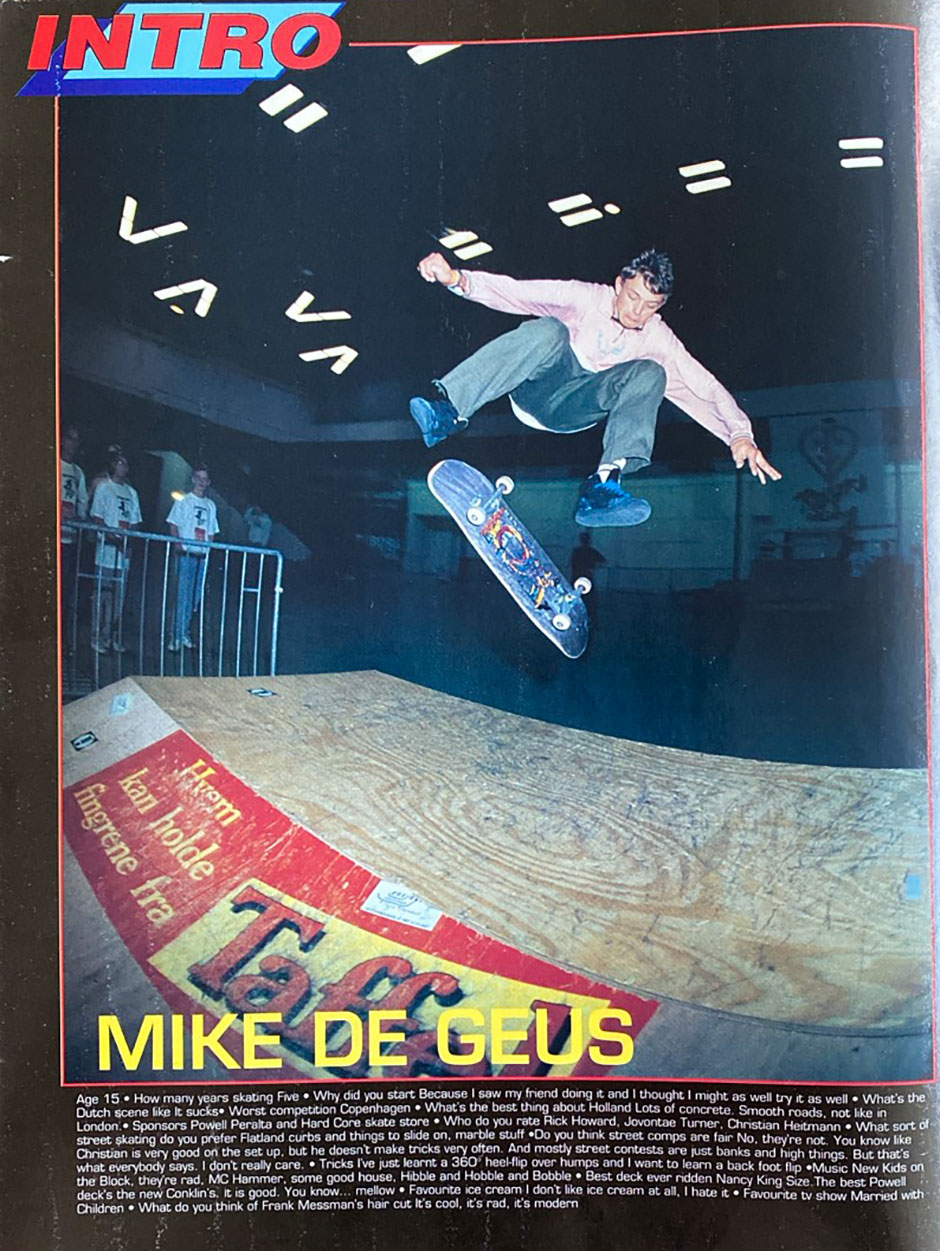
Mike De Geus Rest In Peace. Mike’s Intro from R.A.D Magazine in 1992
Jumping ahead a little, tell us about the journey that led to riding for Panic?
It’s an embarrassing story because they never really wanted me; who they really wanted was Mike De Geus. He had already had a spotlight in R.A.D Magazine in 92. He’s not on the cover. I have the issue here, but he has a check out in there and an interview. Mike [De Geus] was riding for Underworld Element at this time. So in 1992, I was skating with the most influential skaters in Holland, and everything went really fast. From 90 to 92 big steps are being made in skateboarding, the shapes of boards, everything. Then, with Mike, what happened was that he was supposed to go to the States. I think Andy Howell asked him to come out there together with Curtis McCann and build their pro careers, basically. It turned out that his mother and stepdad didn’t want him to go, so he wasn’t allowed to go. I think he was 17 years old, he was a bit too young. So he stayed in limbo with all that talent, and nowhere to go, he kind of quit skating a bit and just hung around. We were both on the same distribution team through Rodolfo’s skate store. Then Blueprint asked him to ride for them in 95 because he was still really good. He said, “Yeah, but only if I can have Piet on the team as well”. They had to think about that, then they came back like a week later to agree, but said they would put me on Panic as an amateur. They never really asked me to be on; I was part of the Mike guest package.
Then you get to travel together…
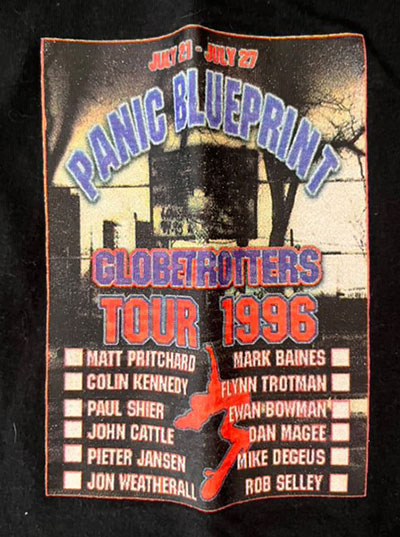 At this point, Mike was kind of out there. He was not skating that much, smoking a lot of weed, and very much into rap and writing lyrics. To be honest, he wasn’t really skating. So when they called us up, hey, we’re doing this tour, that was another story. He was completely out of it, to be honest. I didn’t even speak with him for those two weeks. It was quite weird in retrospect. I should have rang the bell at that point and realised maybe something was wrong with him. But, you know, when you’re that young, I’m like maybe 18 or whatever, you just think he’ll be fine. We had never met anybody on the team when we arrived. Alvin [Singfield], the team manager, picked us up at the airport or ferry, and we got seated in the van. We didn’t know anybody. Mike immediately connected with Flynn Trottman. Immediately, they had a bond, and they were gone. I connected with Rob Selley and [Paul] Shier; we were just making jokes, so we made our UK friends immediately, and we didn’t really hang out together, which is quite strange. Flynn and Mike were both more into smoking and rapping. Flynn was a gnarly skater, though, and that was another moment where I felt like the level was a bit too high for me. Thank God I was an amateur, you know, it didn’t really matter.
It was the famous tour where they kicked off Matt Pritchard. It was all because he wrecked a hotel room, and we were staying in this chain of hotels. It’s in the video at the end of A Mixed Media; there was literally a police helicopter out looking for us. I was tripping out. You can see me like, “Where’s my passport?” I was so afraid, and then the weird thing was that Mike was just laughing the whole time. So at that time, there was another realisation that he was in another place. When we came back after that tour, I kind of never heard from them again, so riding for Panic was short-lived. They tried to work with Mike, I think, but he was far out of it. It was just a bit too late in his career. For me, I had already experienced the going to the USA, it’s not going to really happen thing prior to that.
What UK spot that you got to skate on that trip for A Mixed Media was a favourite?
Oh, I think it was in Scotland somewhere, a spot called Bristo Square. That was a fun day because all of the other shit I can’t remember that well, it was all kind of gnarly, or there were like weird skate parks. That was kind of a street spot we could skate. I had a good day there. I would say that place because we didn’t really skate London this trip. That was Colin Kennedy’s territory. He was funny on that tour; he sat in the back of the bus, not talking to anyone, listening to techno music. He was a ripper though, God, he was so good. Mark Baines, too, I really got along with him very well. There was also this very old snake run looking cement park where Mike de Geus does this super sick, tweaked melon grab out of the snake run, it’s in the video, and that was amazing to watch. Nobody was doing melon grabs at that time cause grabs were considered not to be cool, but if you are Mike, the rules don’t apply, and you just fly.
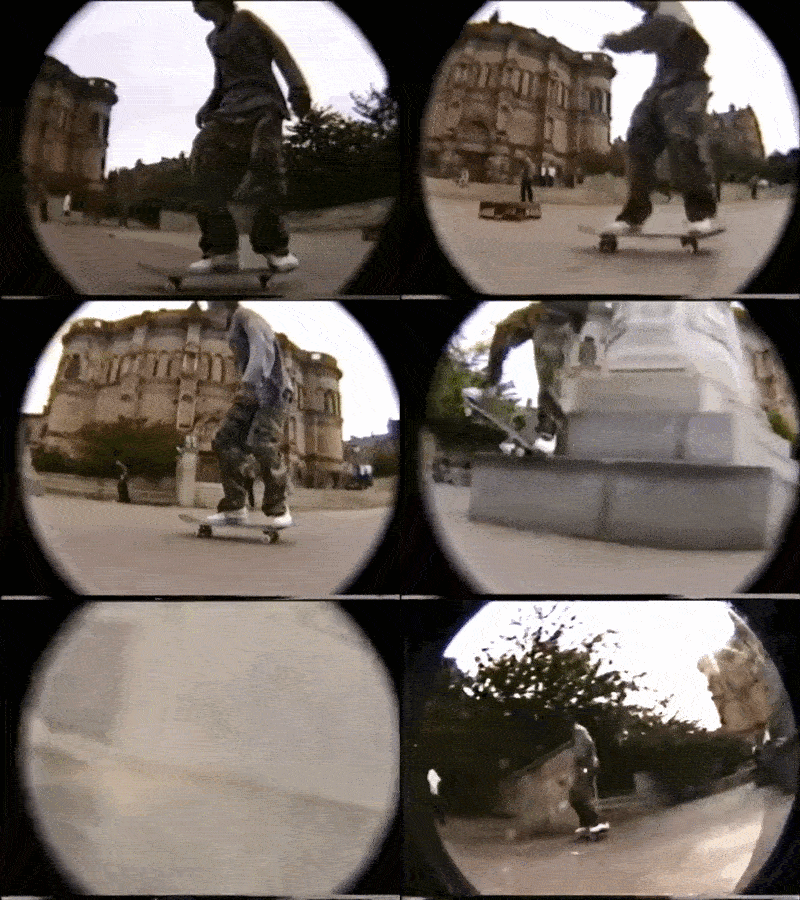
Piet getting to grips with Bristo Square in Edinburgh. Tricks from Panic/Blueprint: A Mixed Media (1996)
You had been to London before, though?
I think we went in 93? No, it was Christmas of 92. Neil Macdonald is writing a book about the UK skate scene called Elsewhere. I did an interview with him, and it’s all in there. We kind of found out where it was because I have one photo from that trip, and it’s with Winstan Whitter and the crew at the time, and I think it’s Christmas 92. I went there with Mike De Geus and another friend. We took the ferry, little did we know that Christmas is a pretty serious time in the UK, nobody is skating, nobody. And we couldn’t stay anywhere, especially not with the three of us, so we all had to split up, and we all stayed at other people’s places. So yeah, I had been to London before that trip. That was a strange time, but super cool though.
What’s your favourite clip from the A Mixed Media era?
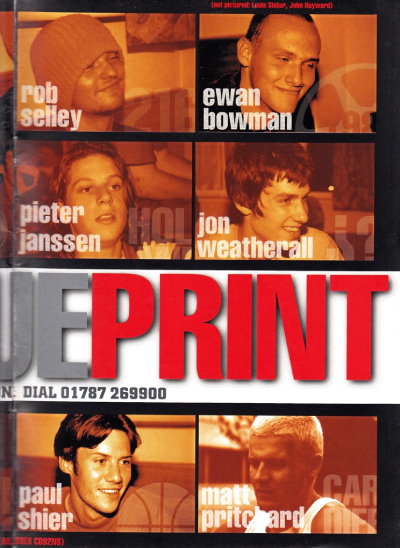 Everything I do sucks in there. It’s that little line, think at that square, a little tail slider, very basic. But my favourite trick of the video is the whole Mike De Geus part. You have got to imagine that with this guy, there were only a couple of times that he skated, and they got it on video. He didn’t do anything on that tour, but when he got on the board, he could do one thing, and I would just be sat down watching, and it would just look beautiful. What a weird time that was, man. I was just in limbo at that time in my life. You’re not going to be pro and skating, what are you going to do with the rest of your life?
At that point in time, were you drawing at all, or were you just sort of soaking up what you were surrounded by?
Yeah, just fully soaking, I wasn’t even thinking about doing art or anything, that came a bit later.
Do any visuals or brand identities from that mid-90s period stand out as being something influential?
The mid-90s? None. Like zero. Everything that’s etched into my brain is from magazines from 88 to 93 because those were the hungry years. In 93 or 92, I got sponsored, and then, I didn’t care anymore. Well, you care, but you’re not that hungry anymore, right? You’re just worried about the free stuff and being really competitive. I wasn’t looking at the graphics that hard anymore because I didn’t have to pay for stuff. The boards were more tools than an object of desire.
Do you think poring over mag layouts and just looking at mags informed the way you incorporated typography when you started working as an artist?
Of course, also thinking about it now, I think it was around 94 that people started using computers for their graphics. You definitely see that in the quality of skateboard graphics, magazine ads, and all that stuff. It all became very computerised. Everything before that was Xerox copy or whatever, like cut and paste, photograph it. I like the old school way. It just looks better in my opinion, and I was a sponge, for sure. Just looking back at those Santa Cruz ads on the back of magazines, you know, like in 89 or the Speed Wheels graphics, insane! The graphics on wheels, the Rat Bones, all that stuff, all hand-drawn shit. So yeah, definitely, it definitely made a mark on me, but I wasn’t really trying to do that because at the time I started doing my flyers and stuff, that was not what was in vogue at all.
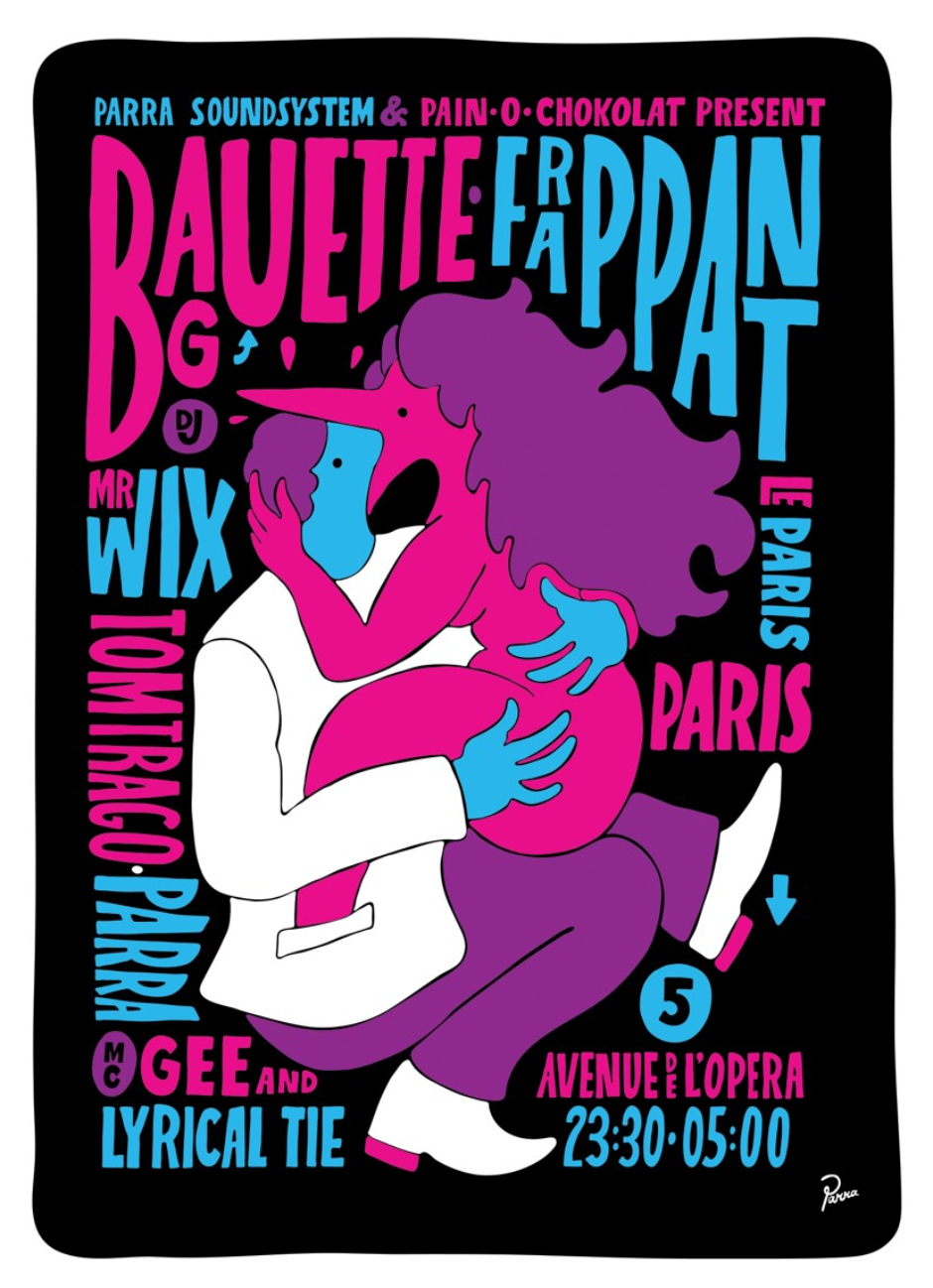
Parra Soundsystem and Pain-o-Chockolat flyer work from 2006
So the Fat Beats era for you was around 1998?
In 1998, I came to live in Amsterdam, and Fat Beats were already there. I think they open up in ’99, so yeah, 99 through to 2004, because in 2005 Patta opens up, and those are the guys that worked in the Fat Beats store.
Was your flyer stuff initially through Fat Beats?
No, they never really asked me; that was through the guys who worked there. They had their DJ nights and stuff. It came from just meeting everybody that would come into Fat Beats; the flyers were for the parties that were thrown. Also at that time, I got a job in the middle of the internet bubble, which is 98- 99. I was really young, and they were paying me so much money because it was all a bubble at the time, like the AI stuff now. I had enough money to get by, so I would offer my flyer services for free, and I would undercut everybody else. That’s how I kind of got in there, you know? Then, because I was hanging out at Fat Beats, I got to know the coolest people. Back then, it was all about who you know. You do one flyer, and it works, then you get asked again, and then it all starts happening.
Was hip hop influential visually?
Visually, no, weirdly enough, because if you look at the artwork, especially the late 90s stuff with all due respect, it’s pretty bad. But I was looking at it for sure, there’s some grittiness. Again, the early 90s albums look amazing, EPMD, or even earlier, the Public Enemy stuff, that’s all hand-drawn stuff, good photographers, and a bit of budget. So I think it was influential but in a different way.
On a tangent, but what was the best hip hop show you saw through that time?
Definitely the full Wu-Tang Clan in Amsterdam on the Wu Tang Forever tour. I wish I had bought 20 t-shirts. That’s before Fat Beats, through them I saw DEFARI, that kind of stuff, early West Coast stuff I was really into. Early Madlib stuff, Lootpack, and all that. I was fully backpack hip hop because that was skateboarding too, right? It kind of went hand in hand. And we actually had shit in the backpack, we already wore that thing. Souls of Mischief and Casual and all that stuff are very, very influential. All I wanted to see was a Casual show, but he never made it to Amsterdam.
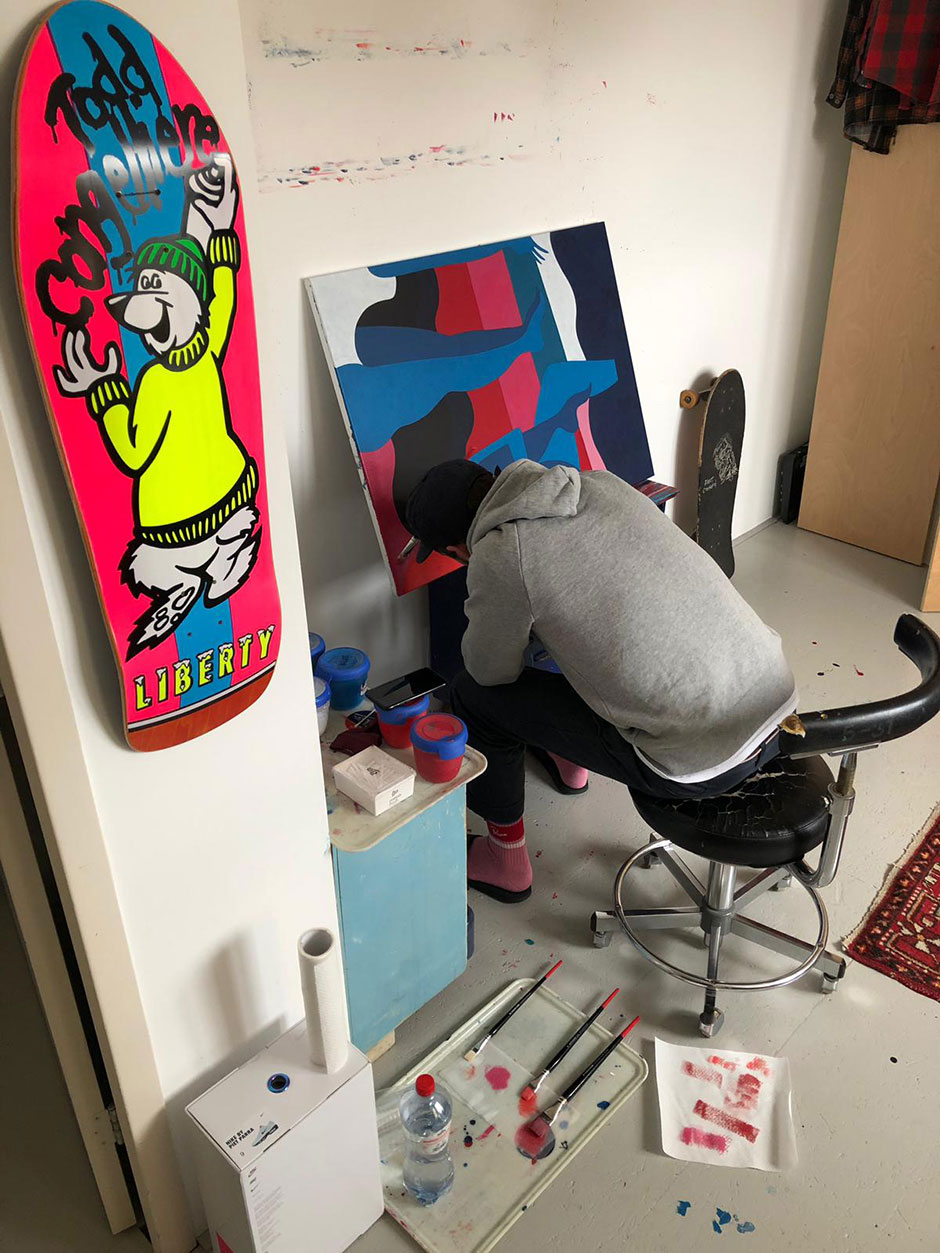
Piet hard at work in his studio back in 2016 under the watchful eye of Todd Congelliere
What’s been inspiring you lately? Is there anything new you’re getting a kick out of that might be feeding into your work?
Man, that’s a hard one. I consume so much skateboard media. I watch everything, right? I try to get inspired, and I look at everything that’s being made and brands. With the streetwear stuff, I can’t look at it anymore because I don’t think it was ever influential to begin with, as far as me looking at that stuff, except for Supreme, the earlier late 90s stuff. It sounds weird, but not much at the moment; it’s a dry spell. I’m drawing landscapes, man. I’m getting old. I don’t know if you have this in London; you probably do, but here in Amsterdam, they put these cupboards up on the street under a little awning or something, and people put their unwanted books there. That’s where I find the greatest stuff, to be honest.
What about in your practice? Do you listen to music while drawing and does what you listen to creep into what you’re doing?
It varies. I think it’s very mood-based. Since COVID, I think like everybody else, I’ve gotten into podcast stuff. This is also a tangent, but I think I’m seeing fewer and fewer people, so I like just listening to people waffle on about stuff; I don’t really care what it’s about half the time. Not the bro stuff. I can’t listen to that, it’s usually politics stuff or whatever. I’ll find something interesting because at this point in my life, I like listening to people talk. Before that, it was always music, man, and it would vary, but the classics that went on when in doubt were Dinosaur Jr., Kate Bush, and The Cure. With The Cure, I would start with the first album and end with the last. I would listen to all of their songs.
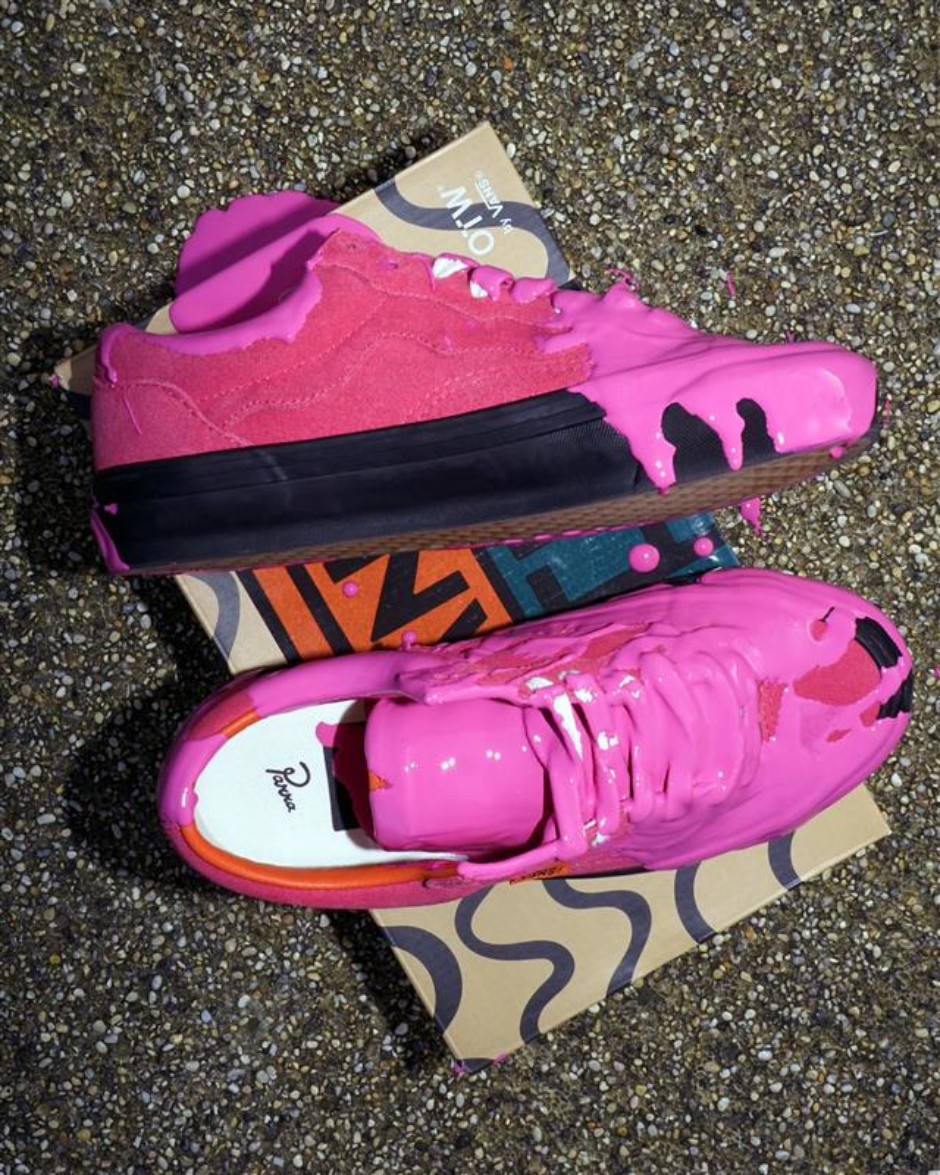
Piet harnessed a memory to create this Vans Old SKool 36+ which sold out instantly
Let’s talk about the Vans collab. We’re hyped to be the shop exclusive on the Vans Old Skool 36. Obviously, the pink upper and the carmine trim fit into your preferred colour palette but is there a specific inspiration there from your days as a sponsored skateboarder?
On the fully pink one for sure. This was slightly before I was shop-sponsored, so you would get a discount, right? And it was at that time, I think this is early 92 or 91. There was a shop called Hardcore, which was run by Nico; he’s still around. That was the coolest shop you could skate for at the time. But also, times were tough, so you wouldn’t even get griptape for free, you would have to pay wholesale for grip as well, and every nut and bolt or whatever. But at that specific time, I think the first Plan B video [Questionable] had come out already, and because of the Beastie Boys, we all needed adidas Gazelles or Puma States, or Suedes. For some reason, nobody could find them here in Holland; I don’t know why. We went to London. I didn’t, at the end of the day, but Mike [De Geus] went, and another couple of friends, a friend who now owns a sneaker store, by the way. They went, and they got the sickest navy blue Puma States and Gazelles, and I was so jealous!
Then I asked Nico at Hardcore if he could get Pumas. He said he could, and then for some reason, he got a shipment of Pumas, and they were fucking pink! Pink with a black midsole. I took them and just spray-painted them, as one does. But when you would skate in them, the pink would come through. When I was doing the shoes, there was a Parra colour palette one, the multicoloured one. It’s cool because they let me make a few different colours, because you can do small runs with them. I wanted a white and black midsole because that reminds me of Mike Carroll when he was riding his Half Cabs prior to his own model. There is one ad that has always stuck in my mind. I don’t remember what video [Las Nueve Vidas De Paco], but he has them on, and [Eric] Koston does too, white suede and then black midsole. I needed to think of another colour and that Puma sprung to mind, which was actually, in retrospect, pretty fucking sick.
You brought the box back.
Yeah, exactly, and we only made a hundred and fifty-six pairs.
Are there a particular pair of Vans from back in the day that meant something to you? Some that you had or that you wished you had?
Those white and black Half Cabs. I ordered them because I rode for Vans. I was sponsored by Rodolfo’s, and there was a package deal because they were a Vans distributor as well. That was great. I would get like three pairs a month from them, it was amazing. But what they didn’t have were the white Half Cabs with a black midsole. So, I ordered some because back then, you could make a custom order and they would make them for you. I think a factory in Mexico at the time would make them for you. By the time they arrived, four months later, my feet had grown. So yeah, I never ended up having them. I remade them two years ago for the Half Cab I did with the OTW. There’s also a white version, a Friends & Family release knocking around. I’ve been obsessed with that shoe simply because I was never able to get it. Also, the Chukka, the white Chukka with the black midsole that Eric Koston wore during his 101 era.
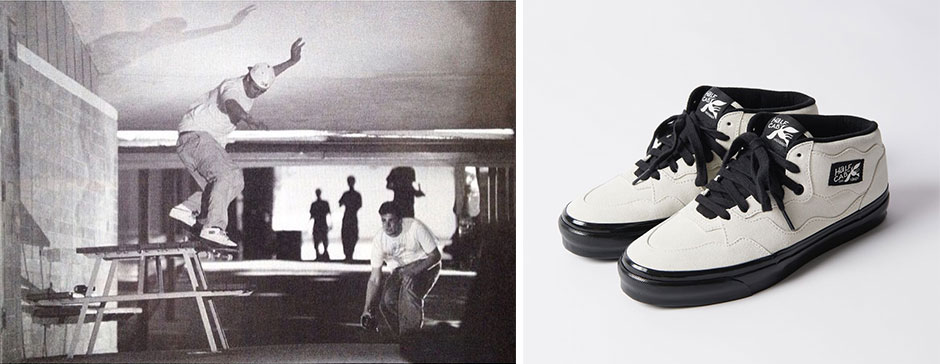
Pure inspiration. Gabe Morford photo of Mike Carroll filming with Aaron Meza for the Chocolate Las Nueve Vidas De Paco video in white/black Half Cabs. Next to this photo are the ‘Friends & Family’ pair Piet got to recreate with Vans OTW
Were extra tongues something you implemented?
No, I did not. Why didn’t I do that? I remember people doing that, but I didn’t do it, though, because at that time I was skating Half Cabs. I think I have a very narrow foot, but it’s a high foot if that makes sense. It didn’t really work for me to put extra shit under the tongue because it would fly out. I definitely probably tried.
There have been some notable shoe brand collabs in your story. My personal favourite being the Air Max 95. It seems to me that with the half cab before the 2024 one, the four colour Old Skool 36 before this one, and now the monochromatic pink one. The Vans silhouettes and the build of their classic shoes as a blank canvas lend themselves perfectly to your box of colours…
Yes, I would say so. It’s perfect, actually. Obviously, working with Nike was a dream; I was really early with them. When the whole real Hypebeast collector stuff started, I was right there. I think the first one I did was in 2006 or 2005. That was an Air Max 1, and I think the one you’re referring to, the Air Max 95, was 2008. I was just in the mix with Nike because they had this cool team that had their feelers out in the scene in every city. They were looking at artists, the people who created art. Now it’s all musicians, and not that that’s bad, it’s just a different way of how they’re trying to approach their market and their public. Back then, I was very fortunate to be in the mix of artists they liked, and I think I agree with you because that 95 at the time, people didn’t like it, man. The black midsole threw people off, for sure. But that’s the one that people keep reminding me about. I was actually hoping for a call because they’re reissuing all those ’95s.
Maybe it will come after this.
Yeah, maybe, probably not, haha. I also loved working with Nike SB. I’ve done a few nice projects with them. For the Vans projects, I have to give credit to Sam Atherton, who was working as a buyer for End Clothing at the time; that’s how we knew each other, I had seen his face here and there because he would buy Parra clothing for End. He walked into the showroom in Paris, and I think this was 2022 or maybe 2023. We greeted each other, and I asked him how things were going at End, which is when he told me he was now working for Vans. In jest, I said, “Let’s do some Vans,” and he was like, “Are you serious?” He jumped on the phone, and an hour later, we were talking.
The panels themselves look like panels in your landscapes already.
Yeah, exactly. So that was a no-brainer. Vans just made sense to me at the time, and it’s also been great to work with Jake Mednik at OTW.
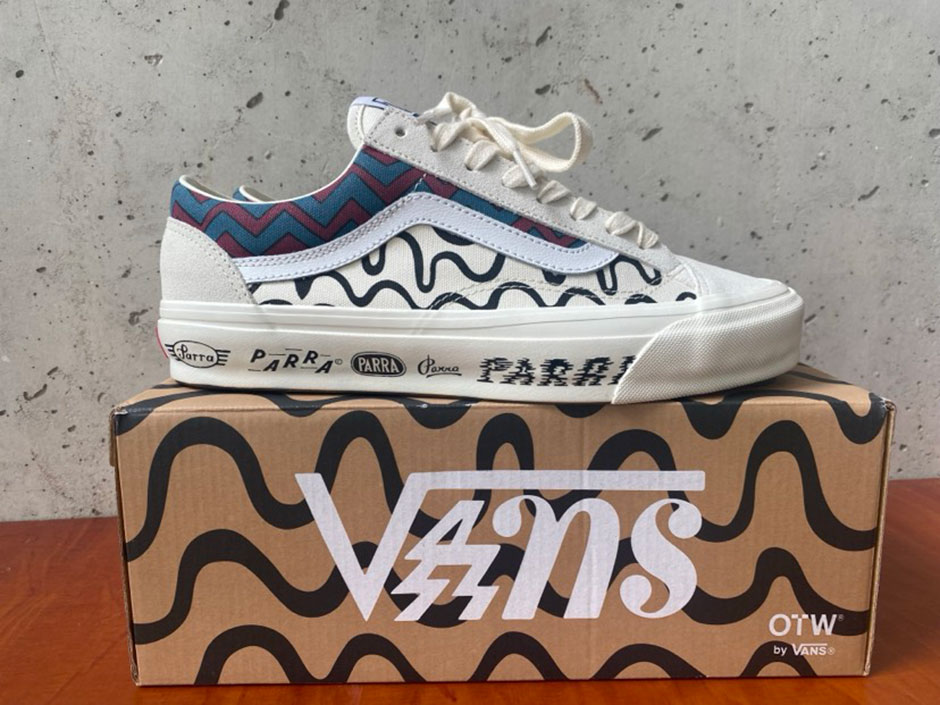
One of the earliest Parra designed Vans Old SKool 36+ samples which never made it to production
When you knew you wanted to replace the jazz stripe, how did you go about creating the shape of the panels? How did you learn to do that when you worked on the Half Cab?
I did not start with the rounded-shaped panels at first. The first thing I did was a pretty lame attempt at putting graphics on a #36. I can share the photo with you. I still have the sample, but the graphics were like wavy lines printed on the panels. Once I got the sample in hand with the graphic printed on it, it did not look special enough in my opinion. However, the printed wavy lines gave me the idea to mess with the actual panels of the shoe. We switched to a Half Cab, and then the shaped paneling mission began. I wanted to mess with it so that you can see it’s messed with, but not so that you can’t identify the Half Cab anymore. Such classic models cannot be messed with too much! When it came to the last #36 release, I applied the same custom panelling, and it worked straight away. I did not mess up the shoe, but it gave it a different character. I was already cutting off the jazz stripe on regular #36’s, so I knew my version would work without the jazz stripe.
“I was already cutting off the jazz stripe on regular #36’s, so I knew my version would work without the jazz stripe”
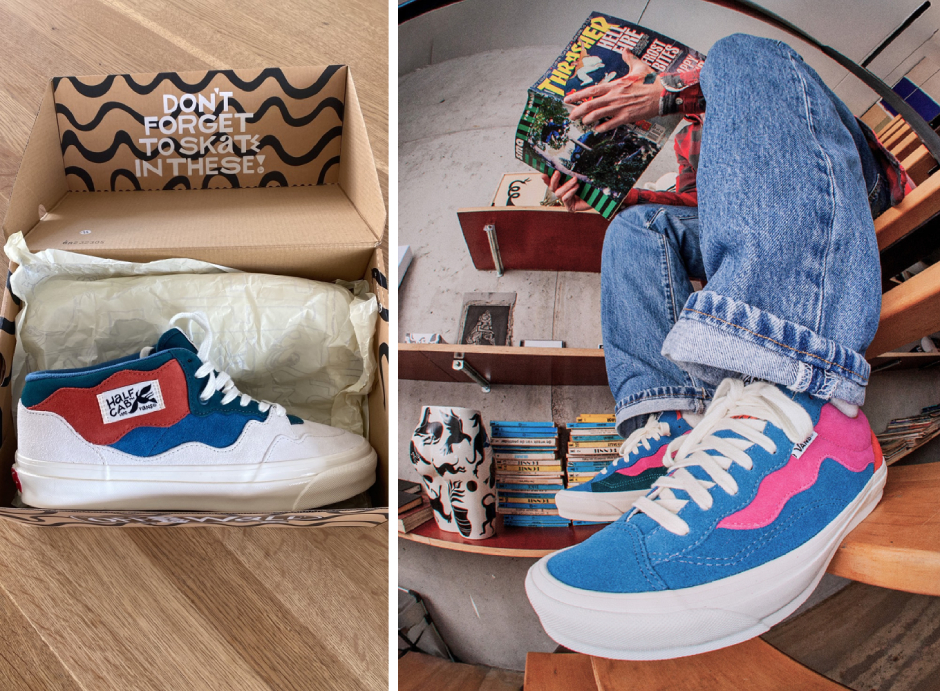
Piet Parra’s lines redefining Vans icons. The Half Cab OTW x Parra Paris edition and the artist mining the Bible for inspo wearing his Old Skool 36+ creation
Was working on the artwork for the Slam collab something fluid? Was it an easy one to do?
So easy, that was all R.A.D magazine inspiration. That’s the only mag I could get back in the day, and I have been revisiting those magazines. Two years ago, I got a bunch from eBay, and I’ve just been going through them again. I’m like, “holy shit, it’s like stuff I do now, it’s right here”. Like that brand Insane, right? I hadn’t thought about that stuff until two years ago, when I had the magazine in front of me again. I immediately looked him [Ged Wells] up, and I ordered a sticker pack, t-shirts, and everything because I thought it wasn’t around anymore, you know? It was mythical for me because you couldn’t get that shit here anyway. So it just existed on a page for me, but it was cool as hell, and I loved the way those ads look in retrospect. So all that was in my brain. I put on old skate music from the old videos. Sometimes I put on Hokus Pokus just for the audio. It’s just running in the background, so I had skate videos in the background all afternoon, and I just banged out a couple of drawings. I’ll never forget that trip with Panic and Blueprint, the humour, just the jokes, man, the banter. I wasn’t used to it, but I loved it so much. How funny Paul Shier was, and how funny Rob Selley was, and so I wanted to have a bit of humour in it as well. So Slam City Swords, just a bit of stupid stuff, you know? Jokes, like the jokes there would be back in the day. It was all kind of tongue-in-cheek; it was fun, that’s what comes out.
How did the gatekeeping theme come about, and how do you think gatekeeping has affected your skateboarding experience?
The gatekeeping was that you would cycle for half an hour, and they didn’t want to skate with you. Then you go home and wonder why they didn’t they want to skate with you. Because you fucking talk too much. You ask the wrong questions, you know? You annoy them, you’re being a dumb kid. OK, let me adjust my attitude a bit. Maybe if I talk a bit less, you know, maybe next time I can hang. And it’s this ritual that eventually makes you kind of hip to like, okay, this is how you interact with people, you know? When you meet another skateboarder, now you’ve got this rapport going. And that’s what I see now in skate parks, like a kid that has no fucking clue and will never have a clue. But maybe it doesn’t matter anymore. It mattered back in the day. Maybe it’s a good thing there is less gatekeeping; you never know.
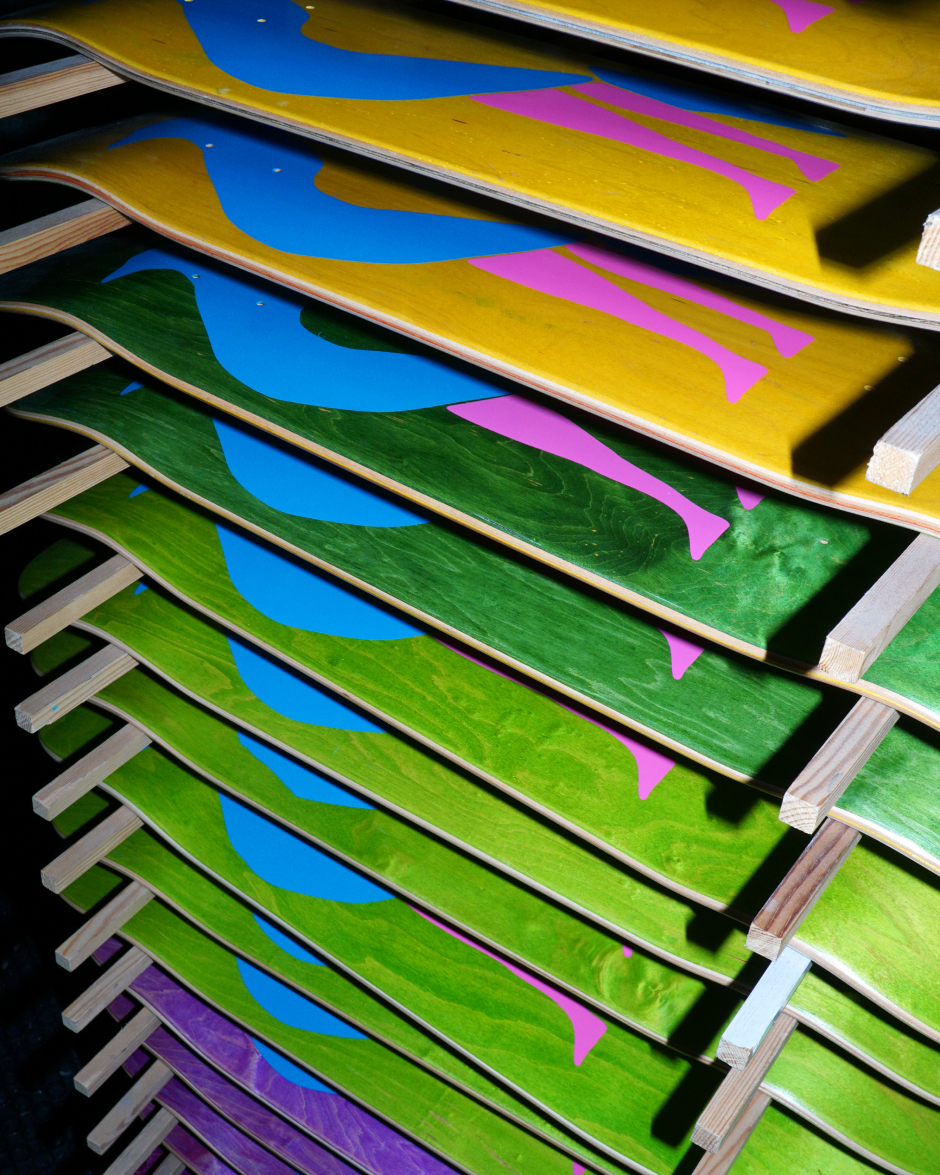
Keep them peeled for a very special Parra x Slam City Skates project coming soon
How do you think that experience is different for a new generation?
I wish I knew. I think I have a feeling that when kids skate now, they skate, but they also are into other stuff; there’s so much shit they can do nowadays. It’s cool, but they don’t care if an older skater doesn’t talk to them; they don’t even want to talk to him, probably. It changed, and it could never be as it was back then because it had its purpose back then, it’s just completely out of style and out of date how that went, but I did want to put it in there because if you pushed mongo, you couldn’t hang, you know? Funnily enough, nobody does that anymore, but there were still people asking what you’re doing. I remember I got my 360 flips dialled. I’m talking 93, somewhere around 93, and I was happy because I had got them every time, right? Then Mike De Geus told me that my foot is too much on the edge. I’m like, “What do you mean?”, and then he does one in front of my eyes, and his feet are just normal, like an ollie, and he does one. I’m like, fuck. I have to relearn this shit now. And I had to go and relearn it, and I still can’t do it. Keepers of the gate, you know? I think skate shops were also gatekeepers in a way; their curation of brands can influence a whole scene.
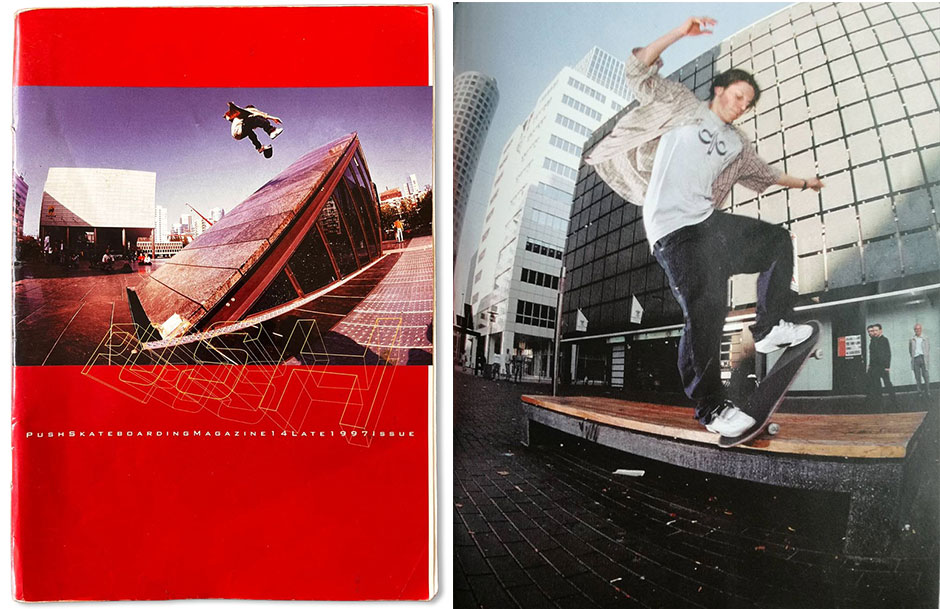
Same outfit, same day. Kastel shoes power the frontside flip cover of Push Magazine and a frontside noseblunt slide in the same issue. PH: Jan Doggen
I think a good part of your experience of being sponsored through a distro is that you got to skate a lot of different stuff.
I totally forgot, man, the coolest package I ever got was after Rodolfo’s started distributing Channel One. I got Channel One boxes. It was pretty cool; they would put an extra box with the shipment that would go to the distributor. So it would make you feel special because your name was on the box. It wasn’t like the distribution filled the box for you; it did come from the States. The only guy who knew was the team manager, but he did not tell the US team, obviously. So you were being kept in this weird limbo.
After riding for Panic, the sponsored dream continued for a little while, right? There was another company in the mix?
Exactly. After the Panic/Blueprint tour, that kind of goes south. At the time, I was not riding for Rodolfo’s store anymore. I was on Left skate store, and Left was kind of the most core store in the Netherlands at that moment. It was located in Rotterdam, and it was run by Miesj Hoffstaetter, who was a kind of famous person back then because he started the core store. His nickname was Miesj, and I was on the team, Mike [De Geus] was on the team, a lot of guys were on the team, my mates and stuff. He would actually treat it like you were on a brand. Every weekend, he would have a little minivan, and we would go to Belgium or visit a park. He really tried to treat it like a family and a skate team, which was kind of cool, and it made me stay around a bit longer. I think the Panic Tour was in 1996, and the dream is kind of fading, but I’m still skating.
“Every weekend he would have a little minivan and we would go to Belgium or visit a park. He really tried to treat it like a family and a skate team which was kind of cool, and it made me stay around a bit longer”
So I’m on the Left team, and at some point, I forgot the year, Miesj tells me he wants to start a company. He called it Colorblind because he himself is colour blind. I had a hard time with it at first because there was a brand called Color, and then there was obviously Blind, but whatever, you know, it’s Dutch, right? It’s local, it’s small. He asked me to do the second series of Colorblind graphics because I told him I was doing some illustration work or flyer work and stuff, so he asked me to make the boards. That was one of the first big jobs I had come to think of it, and I think I did three series because back then everything had to be a series, right? Sven Aerts from Belgium was on the team, Wieger, who went on to become the great Wieger van Wageningen, was on, Kaspar van Lierop, who later ran Nike SB marketing and now works for Asics, was on. We had Louisa Menke, too, a female rider at the time, which is pretty cool, Then after the first and second series, I have a board. The dream came true, but it was a local dream, which is pretty interesting. I owe Miesj from Left a lot because he was there when skateboarding was in dire need of help.

The third series of boards Piet Parra designed for Colorblind Skateboards
How did it feel opening the first box of boards you designed
That’s a good question because I was kind of terrified. You’ve seen board graphics all your life; now you have to do some. They’re not the greatest-looking boards, man., I’d be embarrassed if you found them online. I think the first series I did they were like clearance sale graphics. I had been to the States, and I was influenced by those hand-painted sales signs you see in supermarkets and stuff. So I did my version of that. It wasn’t hand-drawn or anything. I was still trying to work with the computer, and it looks a bit stiff and weird. I think the second series was pornographic; it’s really bad, it’s a scratch-and-sniff board series. The idea was pretty funny, but I saw somebody post a t-shirt of it, and it’s pretty rude. I wouldn’t do that now, it’s kind of embarrassing, really, but at the time it was pretty funny. I remember the Belgian rider Sven Aerts didn’t like it at all; he refused to ride those boards. So anyway, there was that one, and by the third series, I was already developing my style. That was vegetables with high heels and stuff. That must be around 2005, 2006. So there’s quite a big gap in there.
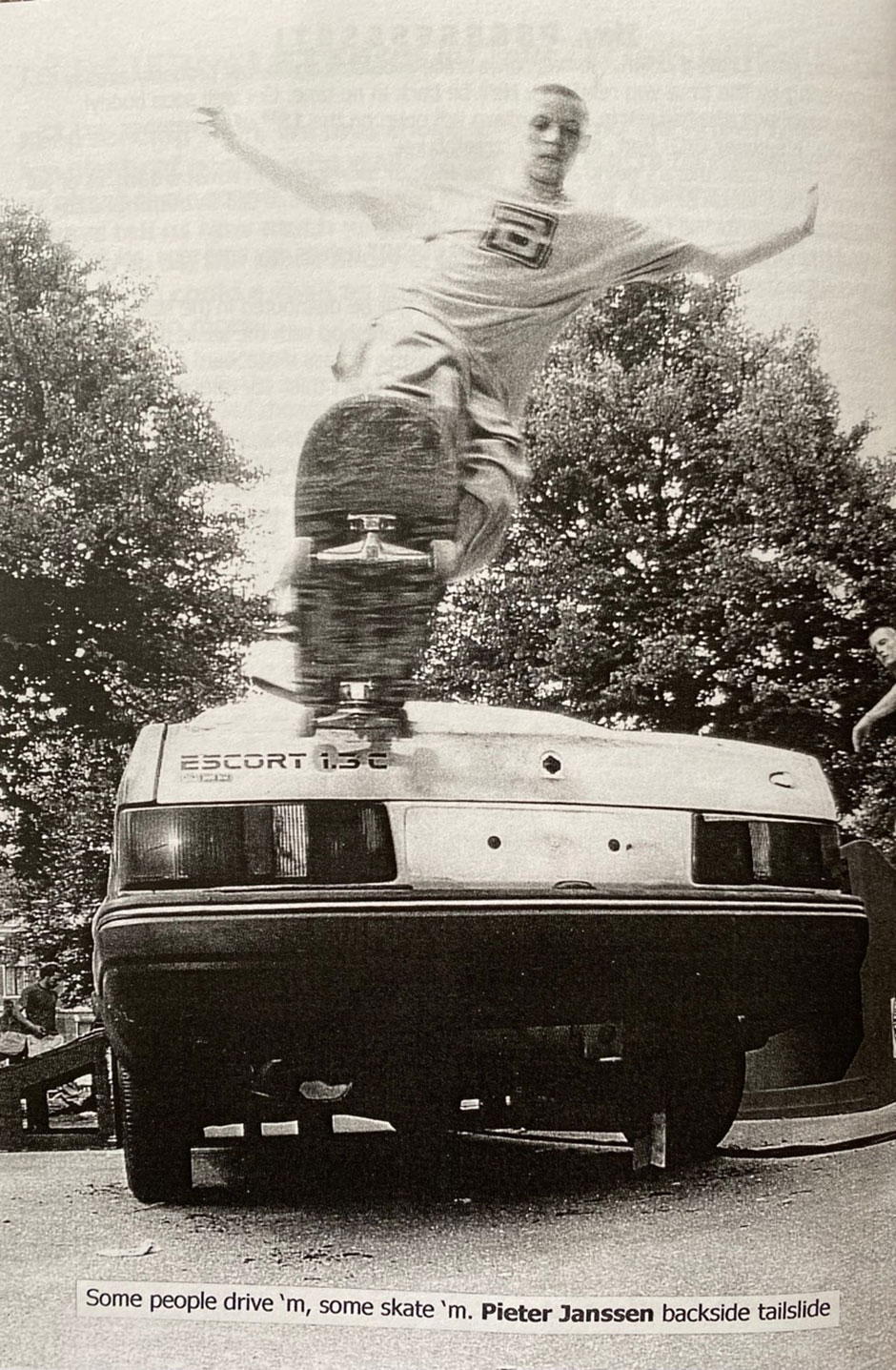
Piet backside tailslides a Ford Escort boot during the Colorblind era, a shot that appeared in the short-lived Guilty magazine. PH: Marcel Veldman
That lasted for a while, then.
Yeah, it went on for a while. I only had two pro models, and then I quit. That kind of makes sense. It would have been around 99 or 2000, and then I’m out. Then the team goes on, and he keeps asking me to do graphics for a little bit. That was fun, man, especially the vegetable series. The other ones I don’t really count. That time period, let’s say from 2000 to 2005-06, sometimes I don’t count. It’s like if you compare it to skateboarding, they are the years you learn how to ollie up a curb, you know? It’s not really cool to have a photo of that, but it’s cool to have a photo when you do your first noseslide or something.
So you began to wire the process or get the hang of it after three board series?
Yeah, for the first two series, I was just looking, looking to be who I should be in that graphic and illustration world. Then by the third one, I kind of knew what I was doing, or at least where I wanted to go with it. So, yeah, man, I’m super thankful for that opportunity at the time, and it kept me kind of half in skateboarding. Shout out to Left skateboard store and Miesj.
That was a key moment in time where European independent brands were beginning to flourish as well.
For sure, and unfortunately, I was not paying attention, but just to have Wieger [Van Wageningen] on that team, and how talented he was. I saw him coming up as a really small child, and then to see what he became! It’s awesome that he started there, you know? Mike [De Geus] at the time wasn’t around anymore, but he was also on Left. It was a pretty cool store, and the coolest team you could be on for a long time.
Do you remember the first time you visited Slam?
Yeah, because that’s the time when I was there at that Christmas ordeal. Vaguely, I remember, I think we were with Winstan Whitter and Mike [De Geus] and just a bunch of people, and we were hanging around. I remember going into the yard. I vividly remember that, and afterwards we went, but we didn’t even have skateboards. This was a time when it wasn’t really cool to walk around with a skateboard, so you stashed them, and we had on puffer coats and Timberlands, you know? I remember being literally a bit embarrassed to hold your board.
Your father’s a painter as well. How has his practice informed yours and vice versa?
So now, a lot, back then, I did not care what he was doing because skateboarding was everything. I didn’t even notice, to be honest. That was just something he did; that was his job. But in retrospect, obviously, when you grow up, you’re surrounded by a lot of visual language all day. We would live in these small villages, and he would buy the old farm. The farmer would build a new house, and the old farm would be empty, and he would rent it. So we lived in a couple of those in different villages. I remember there being an old cow shed, but it had concrete floors, and it was pretty sick. I would skate there on my own with the toy board and roller skate wheels, and he would be painting in the corner. I just never thought about it, but it was very romantic. I’ve been around visual stuff all my life, colours, paints, and that kind of stuff. All I could see was skating, man. But now I sometimes steal his drawing ideas! I go to visit him, and I shoot photos of his sketches, and I then rework them in my own style. He also looks at my work and is definitely influenced by it. We’re completely different, but with parents and sons or daughters, it gets more interesting when you get older.
“We’re completely different, but with parents and sons or daughters, it gets more interesting when you get older”
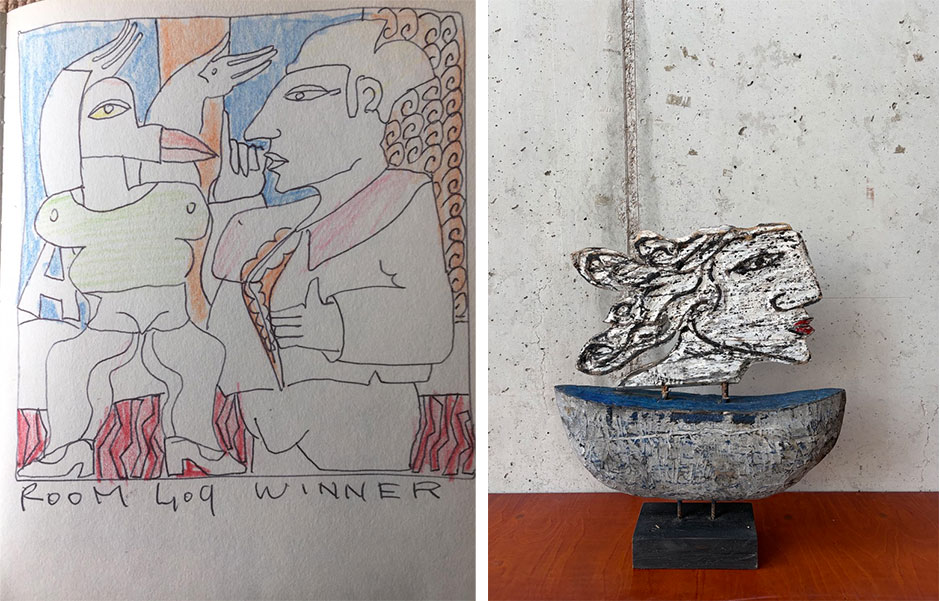
Some work created by Piet’s father, an inspiration to keep creating
Your father is still painting regularly?
He is, but that’s the thing, man. I don’t know if I can do it the way he does it because in art and everything, really, you have a window in life, right? For him, it opened up in the late 80s and 90s. He was doing really well, selling his work and stuff. And then that window closes at some time because your collectors are dying or they’re ageing out, or they have enough, and you don’t have the right gallery. Then the career kind of slows down, but he always drags himself to the studio, and he makes something every day, no matter what. It’s very impressive.
It’s like his version of skating.
Oh yeah, that’s great, yeah, exactly. I didn’t even think of it that way. He needs to do it, man. He’ll make so much shit, he’ll work in different mediums, and then he’ll make wooden sculptures with a chainsaw, but nobody’s there. Nobody’s there to buy it, and not a lot of people even get to see it. It’s crazy. But he’s still going. It’s very influential for me to see, I hope I can end like that, where it’s all still very important to you when nobody’s looking. I skated alone so much when I was a kid that I hate skating alone now because it was so sad, you know? For me, with skating, I need to go with my friends, with the homies.
I like the looseness of some of the new paintings you posted. Are you happy with your new work, or are you your own worst critic?
I’m less and less of a critic. The stuff I’m doing, like the looser stuff, I’m trying to get somewhere, and I don’t know where it’s going. That’s kind of nice because I’ve been stuck a pretty long time in this formal language that people expect of me, which is cool because it’s my job. When people ask if I can do something I’ll deliver, and it has to look like a Parra. But with the art thing, I also did that. I have to make something that looks like this. So I did that for maybe 10 years, and I kind of burned myself, and also burned collectors a bit because they have enough now. I’m starting to reset, looking at techniques. Maybe I’ll get more loosey-goosey with it and see where that ends up.
“I’m starting to reset, looking at techniques. Maybe I’ll get more loosey-goosey with it and see where that ends up”

A glimpse at the direction of some new Piet Parra artwork
Does it feel exciting or ominous, deviating from something that’s become quite established?
Very ominous, yes, because I’m still in the same ballpark. You can still see it’s me, but obviously, I’ve never done university or anything. I’m having to figure it out myself; some shit looks terrible. I’m using coloured pencils and crayons now. It’s the most childish thing, but if you buy the really nice ones, it can be good. So that’s what I’m focusing on now, just trying to look left and right. It’s scary, nobody’s looking at the moment, so I’m taking that little window closing moment to keep experimenting because I really couldn’t when the window was fully open. Let’s say it’s closing, but it’s still ajar. There are some people looking, which is enough for me.
It seems like TIRED the community is thriving. What is happening with TIRED, the company?
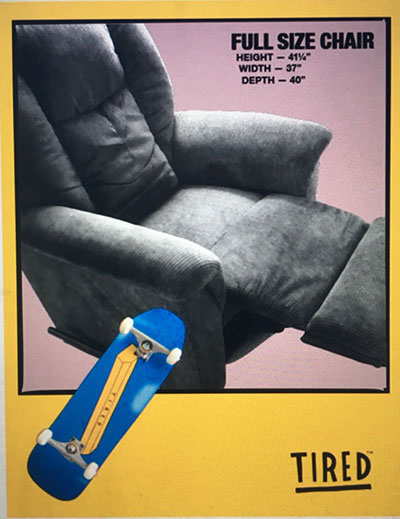 We fell asleep for a bit! TIRED was born out of pure fun, banter, and bullshit with Brad Staba. But back then, when he started it with me, it was obviously an American company. Skate Mental was on an upward trajectory at the time, so there was a warehouse with a private skatepark in it! This was when Brad started 3D with Brian Anderson, and Brad and I started TIRED. It was one of the most incredible times I had because this was it, I’m back in skateboarding. What the fuck? I was so happy because I missed it, I missed it so much. I made boards with my own brand, but it felt like I was faking it cause it wasn’t a real skate company, but now I had the cosign of Brad [Staba], and Brad’s an interesting person in skateboarding. He is a unique person who knows so many people in the industry. So he was a vessel, and through him, I got to meet so many people. I was so happy, dude. I think it was the perfect time. I remember going into PS Stix, that’s where we made the boards. We had an afternoon with the Professor, and it was so sick. Brian Anderson was there as well. I’ll never forget that, man. That’s one of those things, like the Blueprint and Panic tour, visiting PS Stix with BA and Brad Staba.
Back to the source.
Yeah, back to the source. Everything came pouring out during that meeting with the professor. I’m like, “Remember the G&S boards in this concave?” and Brad’s like, “Piet, slow the fuck down”. You know how he can be? like, “Chill, Piet, shut the fuck up”. I’m like, no, dude, you don’t understand, I wanna know everything. So I asked everything. I got so much information out of Professor Schmitt. That was amazing. Why were the World industries boards so good? Why were they so flat? All that shit, right? So yes, I was back, back to the source. Great. So we started the company, and it was going fine. Really, for a couple of years, you know, people were buying it. But then the shaped board thing kind of became a thing. It became less and less exciting because we weren’t the only company that made shaped boards. After a couple of years, we lost focus a bit, just life, COVID, you know? We’re going to pick it up again.
“TIRED was born out of pure fun, banter, and bullshit with Brad Staba”
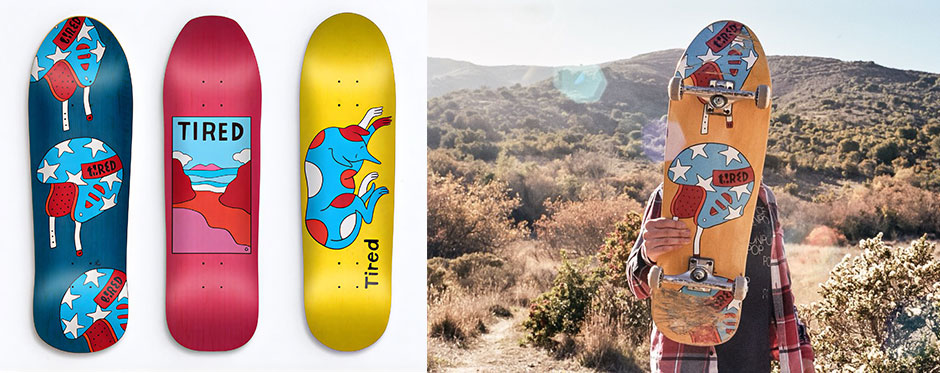
The very first run of Tired skateboards from 2014 and Brad Staba road testing one in the desert
So we can expect boards again in the future?
Yes, for sure! Boards and some other stuff.
You have good stuff in the last vid, and that double-sided curb looks like a lot of fun. Are you managing to skate a lot right now?
Yes, I really try whenever I can. I’m a bit of a nice weather kind of skater at the moment, but the basis of skateboarding is just there, right? So if you don’t skate for a couple of months, you can just click back in and pick it up right where you left off because I don’t have to learn anything new. I’m stuck. You know where I’m stuck trick-wise? I stopped learning stuff after Brian Lotti’s part in the Planet Earth video Now ’N’ Later. There’s one trick I can’t do. I’m still going to have to learn it, and it’s a frontside 5-0 backside 180 out because I’m afraid of the front five. But yeah, that level of skateboarding, low to the ground, low impact, I love it.
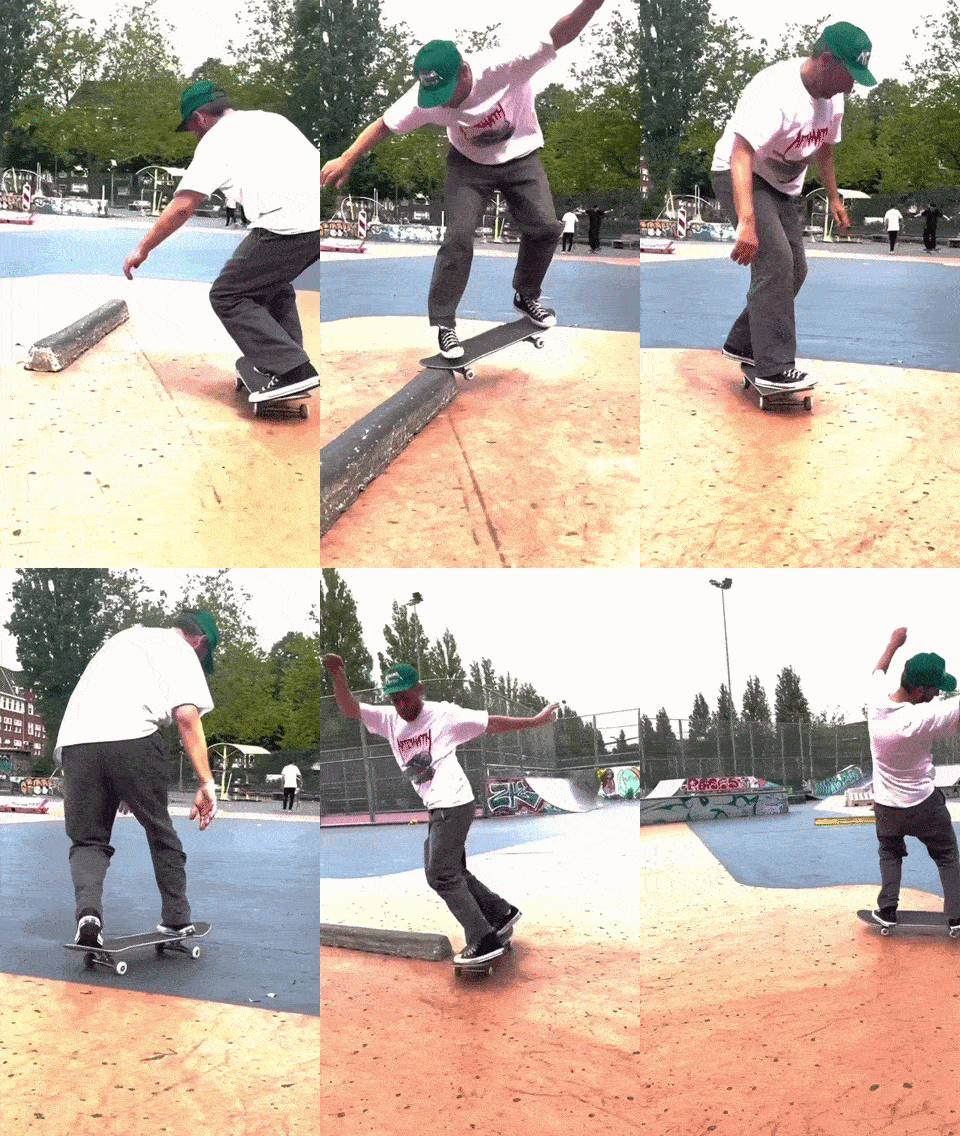
Some more recent Piet Parra clips captured for the Tired Skateboards THIRED Video
How does skating feed into making art? If you’re having good skates and hyped on it, is making work easier because you’re happier? Or does a lack of skating make creating pieces like the antidote?
I don’t think it has anything to do with the creative output for me; it’s definitely mental health, man. When I wasn’t skating that much or in the winter, I go cycling on road bikes, put on a stupid Lycra kit because I need something, and cycling worked for me because I try to go as fast as I can in the red, no music. I’m not going skating and just pushing around, never, I wanna do something, right? So I wanna have a hyper-focus on something. I think if I don’t have that, life gets really bleak. So if I don’t skate, you notice it, or my girlfriend would be like, “What’s wrong with you?” The answer is I haven’t skated in three weeks. Then you go and skate for two hours, and it reloads something. I wish I knew what it was, but it does something. It’s really necessary, but it doesn’t necessarily mean I make better work. I don’t think so. We would have to do research on that. You would have to do a science experiment. I would have to not skate for a month and do a drawing, then skate for a full month and do another.
Also, it feels like you’ve done something physically; it hurts afterwards, which I like. I guess that’s why gyms are so popular. You wouldn’t see me in a gym, though, I can’t do that. Also, skateboarding is so fucked, because let’s say a noseslide 270 out, right? You know what that is, I know what that is, you even probably know where to press on your front foot if you want to get the twist going. People don’t know that shit, they go to the gym and pick up weights or whatever. With skateboarding, there’s such a small micro muscle, weird brain thing going on, which I think gives you extra cool chemistry in your brain, probably. You solve the puzzle, and you have worked out something.
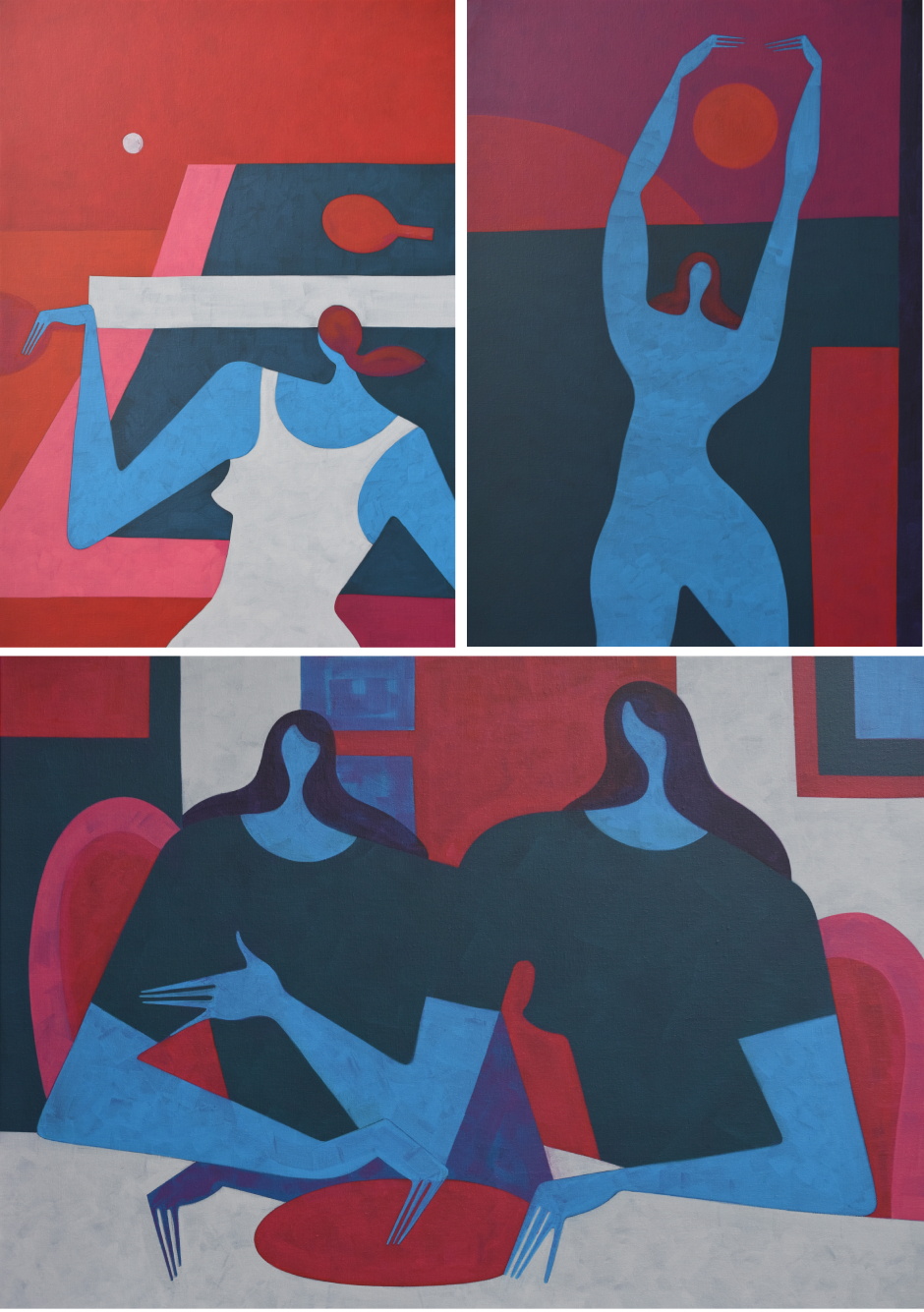
Three more recent Piet Parra paintings that exhibited at Alice gallery in Brussels
You’ve talked about a specific moment of time where you kind of gave up on the skateboarding dream as a career and decided to focus on your art. Looking back retrospectively, do you feel this has made the physical act of skateboarding more sacred as a result? Like it saved you from something external potentially spoiling it or becoming burned out?
I think the universe got me out in time. I have also seen it with people who carry on too long, you know? It can have an effect on you. It just feels like failure, right? As a person, I don’t think I do very well with failure. So I had an early inkling that I had to walk away from this because it’s not going to happen. I’m a bit more of a realist, maybe in that respect. So I was burnt on it, I’m not going to lie. In, let’s say, 99 to 2005, I didn’t like it. I didn’t look at videos. I wanted it to be out of my life for a bit. I think that’s a story with a lot of people. Because I wanted something from it. I wanted to make it, and it’s hard if it doesn’t work. It was tough.
“I would say that my sponsored time in skateboarding was the worst. If I could speak to kids, I would tell them not to worry about being sponsored”
But coming back to it, the second life it gave me is amazing. Because you have all this base knowledge, it’s like you’re picking up where you left off, but it doesn’t matter anymore. I would say that my sponsored time in skateboarding was the worst. If I could speak to kids, I would tell them not to worry about being sponsored. In retrospect, those are the worst years. The years before are great because you’re so hyped to get sponsored, and you immerse yourself in the culture and you study it. Then you become the jilted student who doesn’t care and who doesn’t go to skate class anymore. Then, after sponsored life, you appreciate skateboarding for what it originally gave you. It’s not everybody’s story, obviously, that’s just what I went through.
Whose TIRED contributions always brighten your day?
Obviously, my favorite is @rawrodgers, which is Mike Condello. Actually, he’s the first guy I saw because I was scouting for people to put on the Instagram page when we started it. I saw a clip of him doing a G-turn, filming himself, but he’s so far away in like an abandoned tennis court. I’m like, this is perfect, so I DM’d him and we are still friends to this day. There’s another guy from LA called Sven Barth, he has one of the sickest video parts for the The Tried video. There’s an attempt at a frontside flip down the EMB three stair, I think it’s 85 tries, it’s pretty mental how he does not stop. Every try is even crazier than the one before, and you think, oh, he’s gonna land it, then it’s back to zero. I skated with him, and it’s just amazing. Basically, it’s actual people our age that are restarting, or that still have it but took a little break, you know. Those are the ones that always get me fired up.
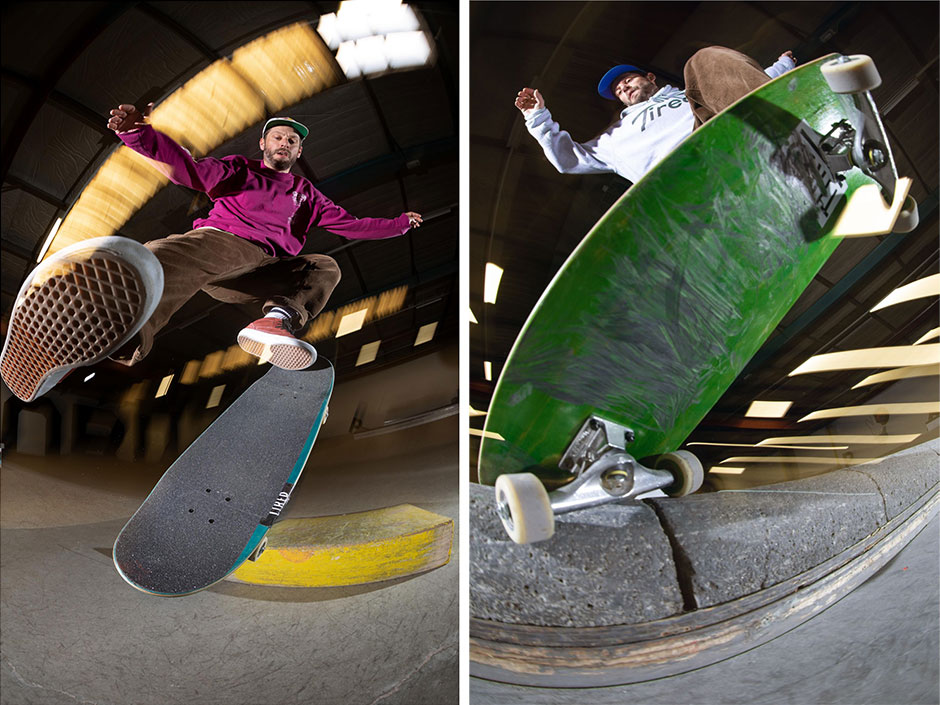
Piet fired up for a one footed waffle sole reveal and a crooked grind pop over. PH: Marcel Veldman
Is there anything in the skateboarding world right now that is inspiring you?
I like seeing Dylan Jaeb footage, and there’s a Japanese skater I really like called Daiki Hoshino, insane, what style. There are so many good skaters now. I watch everything, actually, everything. I think it’s so interesting, man, skate culture now. I love it, I really love it. I love it from left to right. But I still gatekeep for myself in private, you know? That’s still in me.
There’s an overwhelming amount of content, really.
Yeah, there is, but… There are always two or three skaters who just rise above it. That’s what I think is so cool, I don’t know why or how, but usually the gnarliest skating gets boring, right? It doesn’t matter anymore; everybody can do everything. Then I thought it was about style, but… everybody figured that one out as well. So I don’t know what it is now that makes the Dylan Jaebs. How do you explain that? It’s so clean! It might be boring, but it’s not boring to me.
Have you watched that Wallenberg battle?
Yes, it’s not even a battle; he doesn’t slam, he jumps and does a roll out. Can you imagine going full speed, jumping down, and doing a back roll out of it, like 25 times? I don’t understand, I love to see it. It’s so sick. And I think the old crowd, all of us, can really, really appreciate it. I think more even than the younger kids who started skating later, because our videos were absolute horse shit compared. I mean, emotionally, they mean everything to me, but if you really take a look at it, it’s pretty crappy. So from Spirit of the Blitz to fucking fakie kickflip Wallenberg, that’s quite the journey.
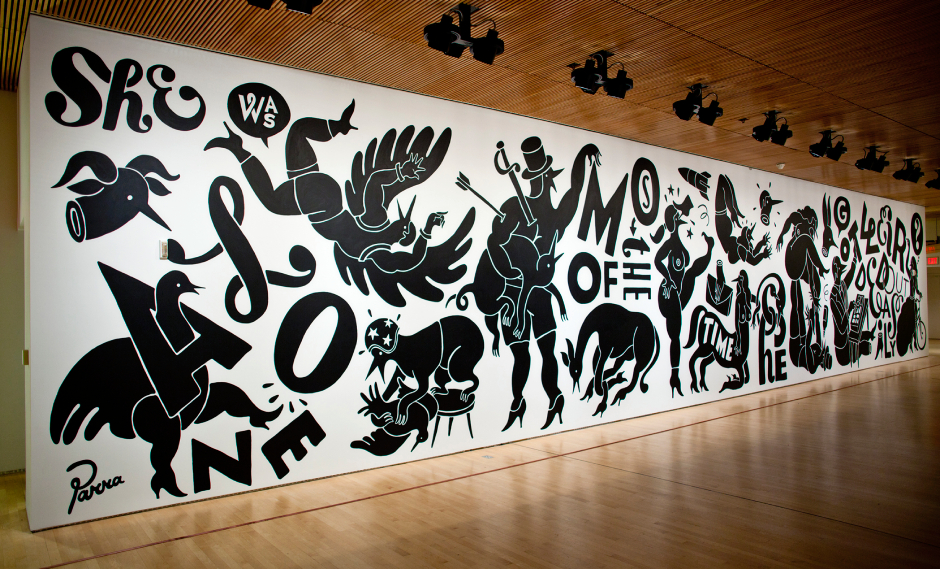
Back in 2012 Piet painted this incredible ‘Weirded Out’ mural at the MOMA in San Francisco
Bringing it back to artwork, looking back at your body of work, there are many amazing accomplishments. What is the most bizarre scenario thus far? Like somewhere you never imagined your artwork would live or appear?
Two things, I think the most dear to my heart is the first TIRED skateboard, I think, because that was just everything I loved. Just coming back to it, just being at PS Stix, so definitely that one. Also, I think the big mural that was at the MoMA in San Francisco, they asked me to make a super long mural inside the museum, and painting it took a full week with help. That was kind of special, having work in an actual museum.
Are you still making music regularly?
Yes, I try to as much as possible. I found this great little 20 euro app called Koala for your iPad. And that’s where I make sample-based stuff. Then I try to play guitar whenever I can. There are a couple behind me, staring at me. So it’s good. My studio has shit staring at me that reminds me that I should be doing things, skateboards, guitars, paintbrushes.
We’re hyped to be welcoming Parra to the shop. Can we expect some visits in the future?
From me, from actual me? Yeah, because I want to come this summer, I want to come and skate. It’s been too long, the last time I was there I don’t even know. But the last time I actually did an art thing there was in 2006 or something. It’s insane. Yeah. So that’s too long ago.
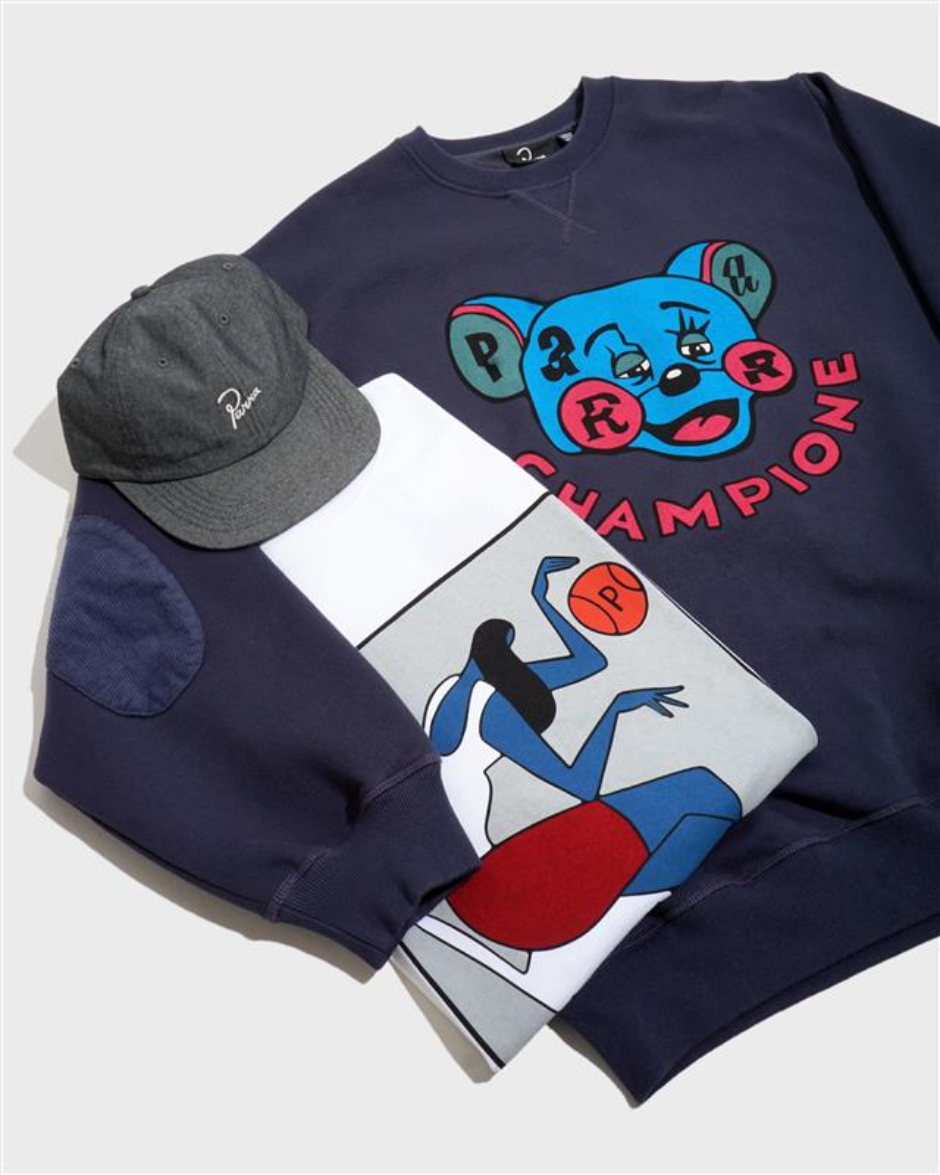
The first drop of clothing from Parra to hit our shelves available now
Thanks for speaking to us. We look forward to seeing some new clips in the near future.
Yeah, for sure. Well, I’m turning 50, so I have to do the 50 for 50. I hate that, but I kind of have to. It’s just too boring to watch, right? So we have to think of something different. 50, they’re not going to be great tricks, so what are you watching? What are you looking at? So I’ll figure it out.
Maybe you need to paint them.
Yeah, exactly, like animate them or something.
Paint them and do them! Nice one, we appreciate it.
Likewise.
We would like to thank Piet for his time and for digging out so many assets from the digital shoe boxes to make this one the visual treat that it is.
Be sure to shop with us for Parra each season, and follow Piet Parra for more regular updates. Also, check out Work By Parra to see an archive of past work.
Related Reading: Paul Shier Interview , First & Last: Colin Kennedy , Neil Macdonald Interview , Dan Adams (Read and Destroy book) Interview.