

With his third novel ready to buy and an independently released video part doing the rounds we thought it was high time for a Walker Ryan interview. Enjoy learning more about his writing, his books, what skateboarding looks like for him right now, and more…
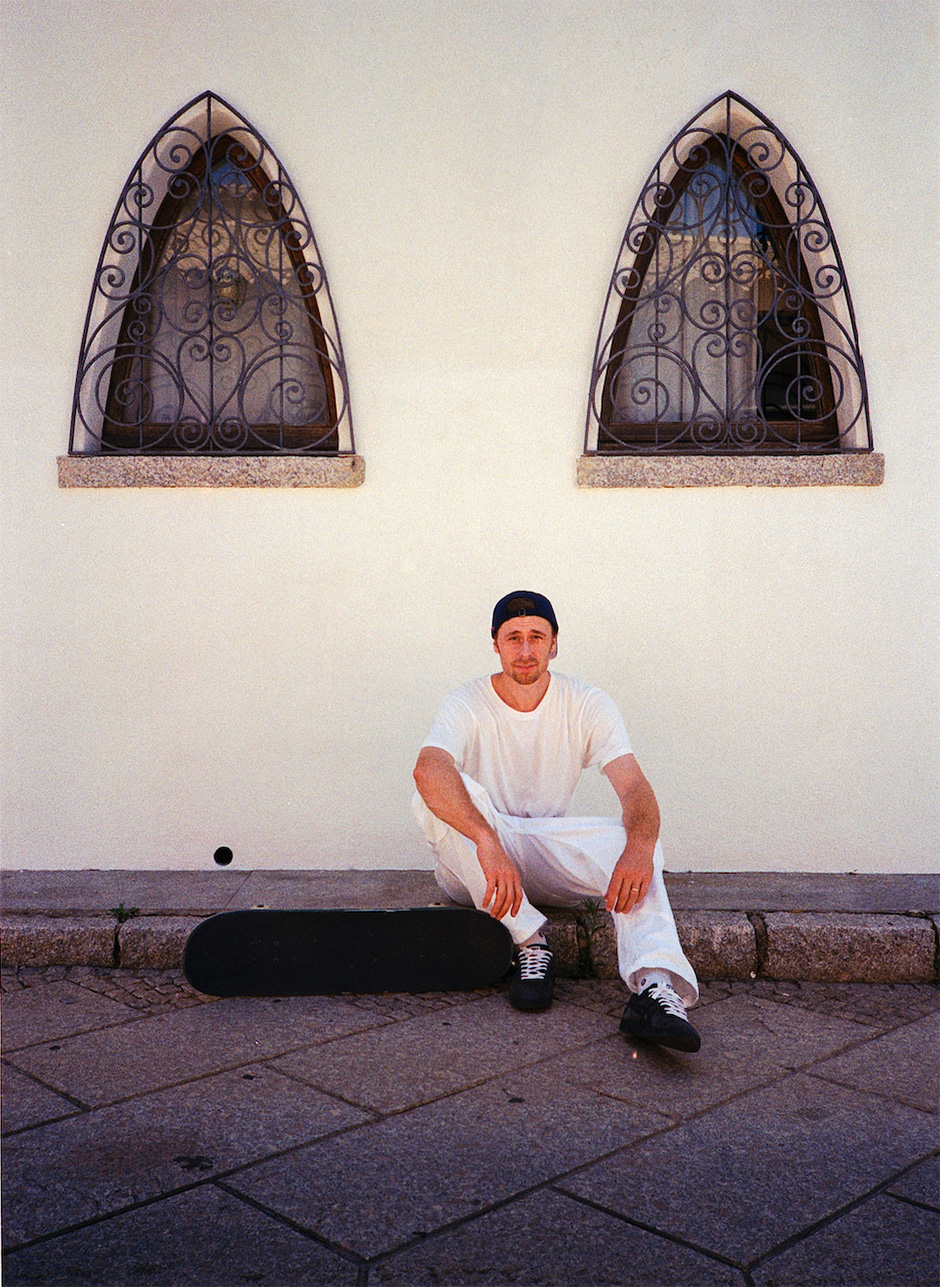
Words and interview by Jacob Sawyer. Walker Ryan captured on Sardinian streets. PH: Patrik Wallner
Walker Ryan has had a very productive few months. At the start of July, he released a new video part, a passion project realised by clocking some hours with old friends and long-time collaborators, Patrik Wallner, and Matt Schleyer. One month later, Walker released his new novel, the third one in five years, a continuation of a universe he has created that places his characters in a skateboarding world that is a parallel to our own. Walker’s contributions to our culture on a pro skateboarding level have been prolific and punctuated by some absolute hammers. Switch backside flipping the Love Park stairs or switch backside 360 flipping the Brick 9 in New York are two perfect examples of him progressing the realms of possibility at established proving grounds, moments that have stories of their own. Walker’s obsession with skateboarding and personal progression is a switch he admits to being unable and unwilling to turn off. We’re glad because his “Siesta” part, while easy on the eyes thanks to some family holidays, shows no sign of him taking his foot off the gas, ends with an epic NBD, and was created for the love of crafting video parts, even with a pro board no longer on shop walls. That commitment to the cause bleeds into his writing approach. As his body of work continues to build, he progresses as a writer, and this obsession ties into, and feeds off, his endless enthusiasm for skateboarding.
When Walker’s second book released, we spoke about working on something together, but projects arose and time elapsed. Then one day, a package arrived containing all three of his novels. While that may seem like an ominous assignment to some, from a few pages into the first book, the compelling nature of the worlds he has built had me turning pages until I had finished the third. It is the most preparation for an interview to date, and also the most enjoyable. He has taken this world, our world, and culture, and encapsulated and presented it in a way that won’t make you wince. The characters, scenarios, and plots exist in a world grounded by examination through a skateboarding lens without a cheesy sports formula in sight. This is a feat in itself and is something explored in this interview, which focuses on each of the three novels and the process it took to create them. Each book, while existing in the same universe, is a very different animal, and we encourage you to read them all, hoping that this interview equips you with enough info to choose which one to dive into first.
Our conversation follows his book releases chronologically and delves into the details of what went into creating each one. Every novel is also accompanied by a photo of Walker plucked from the archives that was shot in a city where the book being discussed takes place. The interview closes out by discussing his latest video part (his seventeenth), his addiction to the craft, the relationship between skating and writing, some of the most memorable moments from “Siesta”, and his future plans and projects. Thanks for reading, hopefully this inspires much more…

Top Of Mason by Walker Ryan (2021)
I loved your first book, and I got to read it at a point where I could get hooked into the trilogy you have created. How do you feel now looking back on Top of Mason?
It’s funny because last night I was really trying to think of the plot, how it moves, and the different things that happen in it because it’s been a while since I read it. So it’s not super fresh but I feel like there were just so many things I wanted to write about San Francisco. In the beginning, I just had this very simple goal to write a fast paced story that leads to a hill bomb, and that was it. Then it ended up developing with all the changes that happened through revision. I’m happy with it and I’m floored when people hit me up having read it recently and tell me that they love it because it feels like it’s so far away from me at this point. There are some things in there I’m a little self conscious about reading again because a lot of it had to do with my mid twenties anxieties, and now I’m already past my mid-thirties, haha. So, revisiting some of the anxieties you feel during that era of your life, I’m curious to do.
It was a six-year passion project but you said that two of them were the editing process having got the story down. Whose opinions had the biggest impact on reshaping things?
I would say my wife had a lot of early criticisms that were really good, as did my mother. My mum is a long time reader, and novelist herself so she had some really constructive thoughts on it. But my friend Nic Henry, who I had previously written a script with, he also really helped shape some things. He called out some fiction writing taboos that I was doing without realising as it was essentially my first time trying to write fiction. Nic Henry was great, and then Mark Suciu came in after I already had a pretty tight draft, and he helped to fine-tune some of the skate stuff that I was writing about. It was something I was nervous to put out, a book that has so much of our skate culture, pro skating industry culture in a novel that flows, and Mark had some really good feedback which he has continued with for the last two novels I put out.
You built some memorable characters, and introduced them in this skateboarding framework that didn’t feel forced, laboured, and ultimately wasn’t cheesy. Was how that would be perceived a big concern?
First of all, I feel like I am yet to see a movie, or TV show that captures the culture of our skateboarding world in a way that isn’t cheesy. So writing this book it was front of mind, I didn’t want to make our world cheesy, as cheesy as it often is portrayed. So the main thing I wanted to make sure I wasn’t writing was a coming of age story that has to do with a skaters journey to becoming pro because I feel like that is where there is something that misses.
“I don’t know why the sports formula doesn’t work for skating but it just doesn’t work. So with this book I really wanted to make that a background aspect of the story”
I don’t know why the sports formula doesn’t work for skating but it just doesn’t work. So with this book I really wanted to make that a background aspect of the story. That was what I hoped would keep it grounded essentially. That way in the book I can make references to the skaters journey to becoming pro but from the perspective of a guy who has already failed. I felt like that was an easier way to do it so it wasn’t this forced hook that you’re trying to get from a reader, this goal of wanting to make it. I was nervous when putting it out that it could come off like that. There is still a little bit of that going on in the story, the arc of getting sponsored but I wanted to make sure that wasn’t the focus of the story.
It was refreshing in that respect, it’s a pleasure to read about skateboarding when it’s done well, but painful when it isn’t.
Yeah, I’m not sure how you feel but I have always felt as a skateboarder who has dedicated their life to obsessing over skateboarding. I want it to be shown in novels, and TV shows, and movies accurately, I just want to see it done. But, at the same time, I’m so critical any time it is attempted. I’m not sure what it is exactly that I’m looking for, I don’t even know if what I’m writing is what I’m looking for but I can’t help but try because I want it down on paper, at least for now.

Walker kickflips in the San Francisco avenues back in 2012. PH: Dave Chami
There’s some heavier subject matter in there too. This idea of everyone being one bad decision away from being on the street, an issue that’s historically intertwined with San Francisco. Were you mindful of handling that in the right way?
That was a driving force of the story. Since I’m dealing with a character who is about to experience homelessness, someone who is on the verge of being lost completely, and drugs are involved, it’s not something I’m writing from experience. So I really leaned on some friends who have gone through that experience. I didn’t want to put it out there until I had their blessing and approval. That’s really where I was the most nervous. Skateboarding I know, heartbreak I know but I don’t really know what it’s like to be in that life in San Francisco. I only know it from secondhand stories so leaning on some close friends who are a little bit more familiar with that world, and have luckily come out on the other side, was really what encouraged me to put it out there. It couldn’t have happened without their feedback.
It’s hard growing up and seeing friends fall into a bad track so writing that book was also maybe a way to process that because when it’s happening it’s something that’s really hard to believe. When it happens with someone that you’re close with, specifically drugs and heavy drug addiction. So that was a challenge to write and it took a lot of reworking, and revision, and re-writes but I felt for the story, and the setting, it was important to do that right. There are so many examples in our skate culture of people who become the sober superstars after having lived the rough life, and talking about it in hindsight. A lot of people don’t come out the other end of that, and it’s a dark chapter they’re not going to expose. You can’t really expose or showcase it because it’s happening so far behind the scenes. I feel like for Top of Mason I wanted to showcase a little bit of what that is like, a glimpse, because the party eventually changes.
Did parts of the first novel fall out of you? Did you hit flow state with your writing at some point or was it a sporadic kind of learning process?
There were definitely parts of the book that I really wasn’t expecting to write, where you get into the mode. For me, what’s really fun about writing these books is that there will be a couple of scenes that I’m really looking forward to writing, so it’s a process of getting to those scenes. With Top of Mason I really just wanted to write a hill bomb from the perspective of someone experiencing it. It seems like it’s cliché and everyone has done it but I wanted to do it in a way with the plot that it was a cliffhanger as well. Getting to that scene, it was surprising the directions I went.
“With Top of Mason I really just wanted to write a hill bomb from the perspective of someone experiencing it”
There was another scene I really wanted to get to, I wanted to get to him waking up in the piss corner of the skatepark, but I wasn’t sure what would happen to get him there. It’s the most disgusting real life corner of a skatepark ever. Anyone who has ever been to SoMa West skatepark in San Francisco will know there is one corner that is just revolting that your board sometimes ends up in. So for this guy to be waking up there in a suit, I just wanted to get there. It’s really fun to have a vague idea of where it’s going and surprising myself with what happens along the way. There’s definitely a flow state that happens within that process that I really enjoy. As you mentioned earlier it was written over about seven years from start to finish so there were chunks of time where I wasn’t working on it. Then the motivation would come back and I would dive in and have a lot of fun writing it again
You’ve written about the vicarious nature of describing skateboarding that is perhaps outside of your comfort zone, that it made describing it more enjoyable.
Yeah and it was funny with that hill, with Mason Street in particular. I have lived in San Francisco and spent a lot of time staying with my friend who lived just a couple of blocks aways from that hill. I just thought about it and that hill hadn’t been bombed before which I thought was weird. I did all of this research, I hit up Ryan [Garshell] from the GX1000 crew and asked who had bombed Mason from the top. I asked Frank Gerwer – “who has done Mason from the top?” No-one had really done it and it was this funny coincidence that it’s become a popular proving ground spot.. I wanted to have that aspect of being true to the skate history, of course someone probably had done it, I obviously didn’t survey everyone who had ever lived in San Francisco. But, it was a funny twist, the real life interaction with that hill, that it became a kind of hot spot, in particular skating that rail and then bombing the hill from there. It was funny that all happened at the same sort of time because I was just looking for the craziest hill and just imagining what I would be like to bomb it, then all of these people start real life bombing it, which was kind of freaky.
“I was just looking for the craziest hill and just imagining what I would be like to bomb it, then all of these people start real life bombing it…”

Miles Silvas front crooks at the Top Of Mason for the November 2023 Thrasher. PH: Dan Zaslavsky
Whose real life Mason Street moment is a personal favourite?
 I’ve got to say Miles Silvas because he got the cover, and he got Skater of the Year, and I’ve known Miles since he was fourteen, and watched him come up as a skateboarder. So to see him get SOTY, get the cover, all while skating Mason, it just got me so hyped. He’s not know for death-defying sidewalk hill bombs either. I will say that seeing the Jeff Carlyle backlip in the GX1000 video and watching him go all the way down was also really, really amazing
Did you think when creating any of these characters back then that they may reappear later on? Did you have that foresight?
I wasn’t sure if they would reappear in later novels but when you spend so much time writing about them, and thinking about them, it’s hard to leave them behind. They don’t really feature heavily, in the second book there is mention of them, but the skaters in Top of Mason come back in a bit stronger in the third book and I had a lot of fun with that. I actually now wish I could continue writing about all of them, and I probably will. I haven’t really done it yet. It’s really hard to just leave them behind
What was the best feedback you got when the first book was finally out there?
I was so nervous about putting this out myself. I spent a couple of years essentially querying agents and publishers, and that experience is really demoralising. It wasn’t that I was getting rejections, I was just getting no response whatsoever which leaves you feeling helpless, and it’s a bummer. I thought all along that I would self publish them and put the out through Old Friends but I wanted the experience of a real publisher, so it just felt really vulnerable. Jonathan Russell Clark is a skateboarder and writer who hit me up pretty much the week I put it out. He wrote a piece about it for the LA Times book review section and that was really incredible because I feel like it immediately gave a little bit of legitimacy to it which is hard to get without a big New York publisher. That was incredible feedback, the fact that he read it and even wanted to do that, to write a piece and interview me, was so cool. That’s one side of it.
Anyone who told me that they read it in two or three days, is just the coolest feedback ever because it’s not easy to read a book in two or three days. I have only had a few experiences in the last couple of years where I have needed to do that, a compulsion where you can’t put something down because you need to know what’s going to happen. To know that there are skaters, and other readers out there who have had that experience with the book. That was the best feeling in the world, that what I had aimed to do had worked. I wanted to make something that people enjoy reading, and I hope if you read something in two days that you enjoyed it. There’s nothing wrong with having a book that’s more laborious to read, there can be pleasure in that too but the kind of books I am often looking for are the ones that feel like I’m not even reading, where I’m sucked in and need to know what happens. It’s been really flattering when people tell me that’s what they experienced with my books.

Off Clark by Walker Ryan (2024)
How was it going into the next novel? You must have felt you de-mystified the process a bit and knew what you were getting into. Was it easier?
Yeah, writing the second book was much easier. I had a better rhythm, I had more confidence that I should trust my gut and my instincts with moving the story forward. But, just like the first one there were a lot of changes from the first draft, and the initial storyline was changed a pretty good amount by the time I published it. For each of these books, I wanted to try writing in a slightly different style and perspective. The first one is written from an omnipresent third-person but from one characters perspective. The second book has three characters, one being female which was a challenge and something new, and they all take place in the present tense. Switching the style was a lot of fun, some people might not notice that stuff, but I do and I love it. Writing from the third-person present was totally different, it makes everything feel a little bit more immediate, and a little bit more fast-paced. It was also hard because I had to keep remembering to write from certain perspectives.
That’s how it was different as far as writing but it was also a more complicated plot. It spans the globe but mostly Chicago and the Middle East. That meant there were a lot of special specific details that needed to work. It was a bit more like an equation and I hadn’t experienced that with Top of Mason so that was also fun.
The plot line in Off Clark is more complex, there are more moving parts. Do you have to whiteboard all those different elements or are you able to visualise the through line?
I needed to use Google sheets, an Excel sheet basically. I had to keep an eye on the timeline to make sure I was sticking to everything correctly, I needed a reference for that. That was sometimes discouraging because I would mess things up and they wouldn’t work time-wise. There are specific time-sensitive factors which are an integral part of the story so that occasionally became complicated. There’s a podcast element involved too, it briefly interjects reinforcing the same storyline but from a point in the future so that was also really hard. There was an equation aspect to this plot which was different.

The character of Richie is interesting; he has mental health issues, and you describe him being sensible enough to keep his wilder thoughts to himself. You seem to have a well-rounded understanding of the character’s struggles. Was that another thing you trod delicately when describing?
Definitely, the second book deals with a pretty serious mental health condition, not to be too much of a plot spoiler. For that I have a number of people I know who have experienced something similar to that so there was a lot of, not firsthand experience, but some secondhand that I was drawing from. Then I wanted to make sure I did as much research on the subject as possible alongside it. I wanted to be very sensitive to that. There were at least five books that I read, as well as a ton of articles. Recently someone reached out and told me that aspect of the story was very well done and that they really appreciated how it was done because they have a family member who experiences the same condition. To have that feedback meant a lot, it’s really encouraging, because once again writing about some subjects I don’t have firsthand experience with is nerve racking
In your Thrasher interview you talk about elements from Off Clark, as far as the investigative aspect, being loosely based off Michael Mackrodt’s experience which is really interesting. When formulating the bones of a novel do you have this distinct idea of the story or little stories you want to intertwine?
Generally when I start writing these books or brainstorming an idea for what a novel could be it starts with a little story, a little scene, something small. For Off Clarkthe conception point was this unbelievable story that Michael Mackrodt shared on a trip where he had been essentially interrogated by a CIA agent who didn’t believe he was really a pro skateboarder. This just blew my mind and immediately a storyline developed from that – what if there was more? What if it led to something crazier than what actually happened? So as I’m drawing from an experience that wasn’t mine Michael [Maackrodt] really helped me workshop it, as did Patrik Wallner who was involved in his own way in that episode.
“the conception point was this unbelievable story that Michael Mackrodt shared on a trip where he had been essentially interrogated by a CIA agent who didn’t believe he was really a pro skateboarder”
For this book in particular, there were two experiences that I had romantically which I drew from. There’s a scene in a hotel that is inspired by an early romance of mine, an ex-girlfriend of mine had run out to say goodbye to me when I was leaving and ended up stuck in a hallway. This whole funny thing, but also awful. So I knew I wanted to write that, and I wanted to write the scene inspired by Michael’s experience. He was stoked, and he definitely had some good feedback. I even went to Chicago coincidentally with my wife who had a work trip. I tracked down all of the places where everything really happened so there’s almost a non-fiction aspect to a little portion of Off Clark. Michy [Michael Makrodt] is a really good friend, and even though he wrote about it publicly for Free Skate Mag I wanted to capture it a little more vividly because for me it was just crazy. I also took some liberties but wanted to make sure that scenario was captured accurately with a heavier storyline attached. In isolation it’s an interesting anecdote but if it played into the plot of a broader story I thought it could become way more fun. Off Clark wouldn’t have happened without that trip I went on with Michy where he had just had this experience, it all went from there.
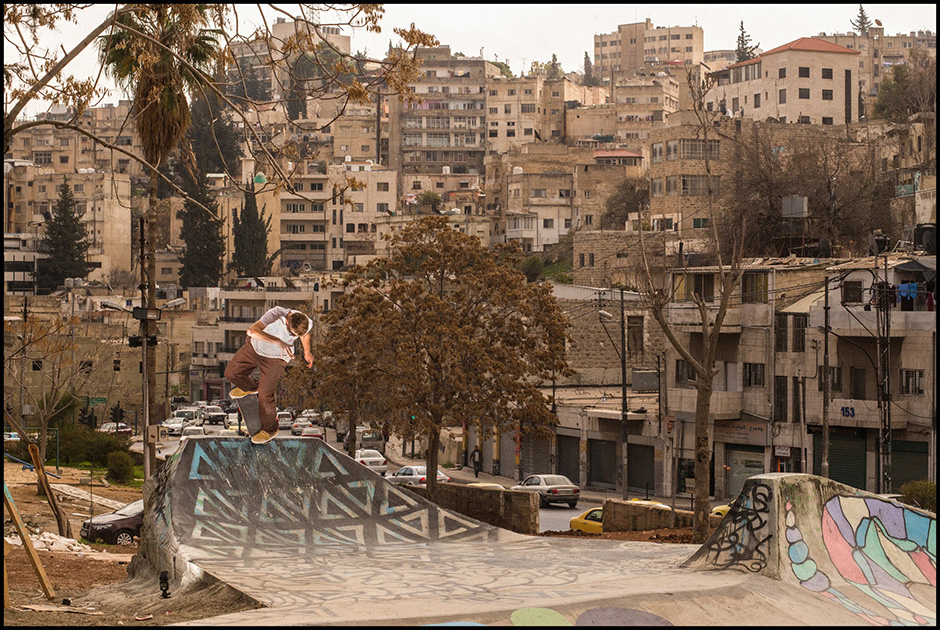
Walker’s travel experiences fed into “Off Clark’. Backside noseblunt in Jordan in 2015. PH: Patrik Wallner
Do you have an existing log of stories and anecdotes you will continue to draw from?
I wouldn’t say I have a log, but I definitely have a Notes folder with funny quotes, and the quotes often lead to stories I have heard, or something I thought I could work off. Someone says something interesting or funny, and it’s revealing of a character trait I think could work well in a novel and lead into a story. Mini pieces of a puzzle that I can go off from in a different direction, if that makes any sense.
Did writing this one coincide with travels of your own at all?
I was at the tail end of my travelling as a pro skater when I was writing Off Clark. I was actually totally at the end because I wrote it mostly during Covid. So for me it was the opposite, no travelling, I was locked in a tiny house with my mother-in-law and my wife. Maybe that was why I was so excited to revisit the travelling I did as a pro skateboarder in my early twenties which involved a lot of the Middle East thanks to Patrik Wallner. I drew from those travelling experiences to write Off Clark. I never really thought about that, but maybe the fact that I wasn’t travelling at all made me want to write a story about a nomadic skateboarder
Is there an element of therapy to exploring the ramifications of being part of the skate industry in differing degrees. Has putting his stuff down, even though it’s not your undiluted perspective, affected how you feel about the industry itself or your place within skateboarding?
Yes, there’s definitely a therapeutic aspect to writing these novels for me. I have dedicated my life to skateboarding in ways that are healthy and unhealthy. I feel like the writing was on the wall a good half decade ago that a pro skaters life wasn’t on the cards for me anymore. You stop getting sponsors, you stop making any money from it, it’s probably time to hang it up. I have a really hard time hanging it up, meaning I still love to film video parts, I still consider myself in the skate world even though I’m not really technically.
“it’s a way for me to digest, process, and play with the experiences I had in the skateboarding world as a pro that are good and bad”
I think writing these books helps with the rejection I felt, or I could feel. I could be going down a much more bitter path, I think, if I wasn’t writing these books because it’s a way for me to digest, process, and play with the experiences I had in the skateboarding world as a pro that are good and bad. I can’t say that if I wasn’t writing these books I would have a different attitude but I think it has been really good for me mentally, and psychologically, to have a place to put a lot of the thoughts I’ve had as a skateboarder because no-one would want to read my memoir. I don’t even like reading memoirs, so writing fictional novels is, I think, a lot healthier.
You address thoughts that every ageing skateboarder has, you to a greater degree for having had a career in skateboarding, but you have to approach them while mindful of presenting this complex world to a reader who has, potentially, no prior understanding of it.
Yeah, and ultimately I do want these books to be something that someone who has never even thought about skateboarding or the skate industry can read, and enjoy, and feel like they learned something in the process. Bringing it down to its base level has helped, I think, and been fun. I was kind of jokingly saying this when I put out the first one but I think it stays true to the three of them… throughout my entire life I’ve had such a hard time explaining what it means to be a pro skater at the dinner table with a stranger. That’s one of the reasons I wrote these books: to try and scratch the surface of what it means to be a pro skateboarder.

High Street Lows by Walker Ryan (2025)
Your dad’s passion was winemaking. Was this an ode to him and to Napa, and was wine country an obvious next setting you knew you’d end up in?
Yeah, this book was definitely an ode to my father in different ways. He had dedicated his life to winemaking in a fairly similar way that I have to skateboarding. Winemaking is possibly a much more stable career path, haha, but it is a world that involves so much passion which is where I feel the two are similar. However, I never really liked the idea of writing a story set in my hometown because I always thought of it as being pretty boring. It’s essentially an amusement park for tourists, mostly wealthy tourists. Growing up there you just feel kind of trapped, it’s like nothing there is meant for you. People just want to drink wine there and have fancy dinners. So for that reason I had been kind of off the idea. I didn’t know how a novel would work there, especially a novel involving a skateboarder.
The inception of this novel actually came from writing Off Clark because in that book I mention this skater who has made millions of dollars from his shoe, which is a similar storyline to a couple of people in our skateboarding industry. I then had this idea to expand on who that guy is. Who is this guy who hit the goldmine with this successful pro shoe, even though he never really got to skate in it because he was plagued with injuries. I just went off that, maybe he’s a guy who ends up in Napa? That’s something that rich people do. So many people that I knew growing up came from families who made their money elsewhere and then came to Napa because they wanted to realise their passion project which was to start a winery. I thought why can’t there be a really wealthy skateboarder who moves to my hometown to start a winery but then doesn’t get to. The main character has a bunch of money, no idea what to do with it, and he gets in a bunch of trouble. That was the inception point, then I just started to explore the different kinds of interesting characters that could potentially come from my hometown.
It’s been almost eighteen years now since my dad died, and there’s a lot I wish I knew about his early time working in the wine industry. There was probably something therapeutic there too, still dealing with that grief, and thinking about what it was like to end up living in Napa.
There is a theme in the book of making sense of being an adult and the adult non-skating relationships that evolve. You capture this, the lost in translation communication that happens one way between skateboarders, and the challenge of forging new friendships with people who don’t skate later in life.
I know a lot of skaters where the friendship making part of life stops within the skateboarding world, they never really expand beyond that, their whole world is skateboarding. I wanted this character to be one of those guys, since he was sixteen, the only thing he has known is skateboarding and he doesn’t really have solid friendships outside of skating. So for him, being stuck in this town, not skateboarding, forging new friendships was something I really wanted to play with and explore. I feel it to an extent sometimes and I’m sure a lot of other people do too, but it was really a process of stepping into someone else’s shoes and imagining that world.
Did you write any of the book while back at home in Napa?
No, it’s funny, most of this book wasn’t written while I was at home. I haven’t been living there for years, and haven’t been spending as much time there as I’d like either. I think there was something fun about imagining my hometown and writing it from a distance. Then occasionally I’d get back on the ground and do a little fact-checking. With each novel I have written I would say the setting is very much the character of the book. Top Of Mason is San Francisco, Off Clark is Chicago, and High Street Lows is St. Helena in the Napa Valley but I wrote them while I was living somewhere else so it was imagining each place from memory. I don’t know if that was helpful but I think it was. If I were there I think there would be certain aspects distracting me from what it is that actually stands out in my mind.
“The main character has a bunch of money, no idea what to do with it, and he gets in a bunch of trouble”

How do you feel your writing or process has improved or progressed from the third novel to the first?
I would say I feel like I’ve gotten better at structuring out the plot beforehand and having a better idea of how it’s intending to move forward. That is something I have improved from the first one. It’s actually kind of addicting. Now I have all of these other loose storylines plotted out and floating around, whereas I really had no idea when I first started writing Top of Mason, that was very much a process of winging it. I now feel a little more confident in how I am able to structure a story and a plot. I also think I’m better at choosing the time to write. With the first book writing would be buzzed, late night, if I had some time. Maybe it would be on an airplane, maybe in the morning. The writing for that one took place all over the place, now I am better at having a schedule. I will write first thing in the morning. Anytime I’m doing something on the computer I will dedicate half an hour or an hour to writing and that’s it instead of keeping it open-ended any occasion I have a free chunk of time.
Sex, drugs, skateboarding replacing Rock n’ Roll. There are themes that make certain books or movies memorable. Do you have themes you like to explore because of books you have enjoyed?
I think the things I really like to explore with these books because of things I like to read, are awkward social situations and how they lead to events. I’m not really sure that’s how someone would describe my books but its a lot of the motivation and what I most enjoy reading. I like to read stories about well-done characters who get into situations because of the way they fumble social interactions. I think those are some of the most interesting aspects of life. Tom Perrotta is a good example of a writer who I think is the best at that.
I was talking to Mark Suciu about how much I loved the playful ending of this one. It must have felt good to weave something poetic like that in there.
It really did, and I had planned something completely different. I had so much fun writing this ending and weaving in something different from what I would usually write.
“I think the things I really like to explore with these books because of things I like to read, are awkward social situations and how they lead to events”
You expanded on tackling grief in this book with Mostly Skateboarding, your first book involves addiction and homelessness, Off Clark tackles mental health issues. This really grounds each book, are these things you have tried to write about to make sense of in their own right before beginning to include them in a story?
I think attempting to ground each book in a relatable human condition is something that is important to me and helps me process these big questions I feel we all end up encountering in some way or another. This book is essentially a sad story, and I wanted to capture that, dealing with grief is hard and writing these books is one way that I deal with it.
You articulate some things older skaters think but probably never express. One example is the main character in the new book actually wanting the younger girl skaters [Julia and Anabel] to know you skate but no letting on, or the anxiety of other people showing up at the skatepark. It’s great stuff that will resonate, thoughts we would maybe never vocalise.
I’m stoked that stood out for you, like when he shows up at the skatepark and is super insecure about who is watching him, I feel like that is just a weird thing to talk about, or to bring up, why would you bring that up? It’s such a vulnerable thing, maybe it’s easier to talk about when you’re younger, but when you’re older, shouldn’t we have moved past that? Especially as a person who has been used to people looking at them, expecting them to be really good. Pro skaters are meant to be good, they better perform. Whichever way you look at it, showing up at the skatepark is performative, it’s undeniable. The way you are going to skate by yourself at the skatepark is going to be a little different to when there’s a bunch of people there. Writing from the perspective of someone who is as low as he has ever been as a skateboarder, off-peak and not confident, I just wanted to try to pinpoint some of those feelings.

Walker Ryan switch ollies in his hometown of St.Helena. PH: Jason Hainault (2006)
We have gone through the books in a linear chronological way, if someone wanted to start reading your work which book would you recommend right now?
If someone asked me which book they should pick up, I would really like to know a bit more about them and what they like to read, I think. I have tried to write slightly different novels that each have a different pace and movement. I don’t think I would recommend reading the third one first, I would probably say that someone should read Off Clark to begin with, because I think it’s the most fun and fast-paced of them. Many more people have read Top of Mason or purchased it at this point, and the feedback has all been really positive so I would probably recommend that one too. I wouldn’t recommend High Street Lows to a young reader. What people have told me about the first two books is really flattering. Tim O’Connor hit me up and said he read Top of Mason and was going to give it to his thirteen-year-old and I thought “hell yeah!” It’s so cool that it could be a book he would want to share with a teenager. I hope the first two books can work in that way, something an adult or a kid could read and be psyched on reading it. I’m not sure that the third one checks that box in quite the same way.
Of all the characters you have created, who would you most like to hang out with?
That’s a good question, of all the characters I think it would be Lock from Top of Mason, and Corey from High Street Lows but I would also want to encounter Gary at some point.
Which book has been the most fun to write?
I think I would say the third one has been the most fun to write, it was really enjoyable writing something that is set in my hometown, something familiar. I wouldn’t say that I relate to the main character but like I said earlier about changing the perspective, this book is written in the first-person and that was somewhat freeing in a way. You’re locked in one character’s point of view and you’re in it from there. I don’t necessarily like the guy that much, even though there’s going to be pieces of me in there too, but it was fun writing that way because I hadn’t written fiction from that perspective.
I know that you experimented with a pilot for a TV show before beginning to write a novel. Have you ever thought about a screenplay?
That’s actually why I was thinking about Top of Mason last night because I would like to try and adapt that story into a screenplay because a ton of people have told me it should be adapted. I have never done that, my experience was making a pilot TV show that we obviously didn’t end up making. That was more of a team effort with my friend Nick but I would definitely like to do that, and I think it would be the first book that I would like to revisit and try.
When will you start nibbling at a new novel? Do you feel more freedom or more pressure with each book you start?
I wouldn’t say pressure but recently I have felt overwhelmed by what I would like to write next so I have taken a totally different direction and just started writing short stories. I have about five done now. It’s a way for me to start moving along a little bit faster with a different mindset for these narratives I have floating around in my head. That’s been really satisfying, rather than having a scene and wondering how it could be turned into a novel, I can just focus on the scene without it being this big undertaking. I have been having a lot of fun this past year trying to write these short stories. I’m kind of working backwards compared to what fiction writers normally do. They usually get some short stories down before jumping into a novel but I did it the other way around. The short stories are set in the same universe, the same skate world, but deal with different issues.
Walker Ryan’s “Siesta” Part
Filming this involved two family vacations with Patrik Wallner to Menorca and Sardinia. Was it easy to juggle this project with fatherhood and family?
Filming “Siesta” with Patrik Wallner was definitely challenging because both of our wives were with us on vacation and they both know how we can be with filming skating, how it can turn into half a day if not a full day. So keeping our skate windows relatively brief was hard but we got really lucky with being on vacation in places that happened to have really nice spots, and they were spots like neither of us had ever seen. For me and Patrik, and our history of skating together and filming, we get so pumped when there’s a discovery. It’s great to find spots where you already know what they like because you’ve seen them in videos, but it’s even better when you find something you’ve never seen in a video before. We got really lucky, particularly in this town in Sardinia, it was full of spots we’d never seen so we were hyped. It was a challenge juggling new fatherhood, vacation expectations, and trying to stack solid clips, haha.
This is your seventeenth video part! It seems you are still just as excited to be stacking clips…
Yeah, I’m still addicted to the video part making process, I can’t turn it off. I’ve got a couple of other projects I’m still working on. One is here in Martha’s Vineyard, where the spots are pretty shitty and limited, but I still can’t help it. Any time I have a window, I want to get clips. Obviously there are examples now in skateboarding where people in their forties are putting out parts but the closer I get to forty, I still want to be able to do things I’m really proud of, and I don’t want that time to slip away. I’m not a pro skater any more in the sense of being paid to do this but I still feel like a pro when it comes to what I think I’m capable of doing. I can’t not try.
For many of us the act of skateboarding also fills headspace in our downtime. Working on a video part must double that mental load. Have you found now that writing takes up a good portion of your thoughts you can be freer when you do get to skating, like it’s less weighty because you haven’t overthought the mission first?
I definitely think that’s true. Honestly, I started writing Top of Mason while I was still very actively a pro skater, and I think having the book project in mind really helped ease the pressure I put on myself when I did get the chance to film. Going filming is often disappointing, you’re never really fulfilling your expectations so having a different creative outlet to think about, daydream about, and work on was really healthy for me while I was filming. It’s just devastating when your whole week revolves around this one afternoon to try this thing you think you’re maybe capable of, and then not doing it. That’s just a shitty feeling, especially when it’s pretty much your only job. Some people talk about it and some people don’t. Some people probably have a healthier process in place but I don’t, I put a lot of weight on the opportunities I have to film so writing these books has certainly helped.
“So that trick, the switch impossible crook, happened the first day I tried it there, but the idea of it had consumed me for years”
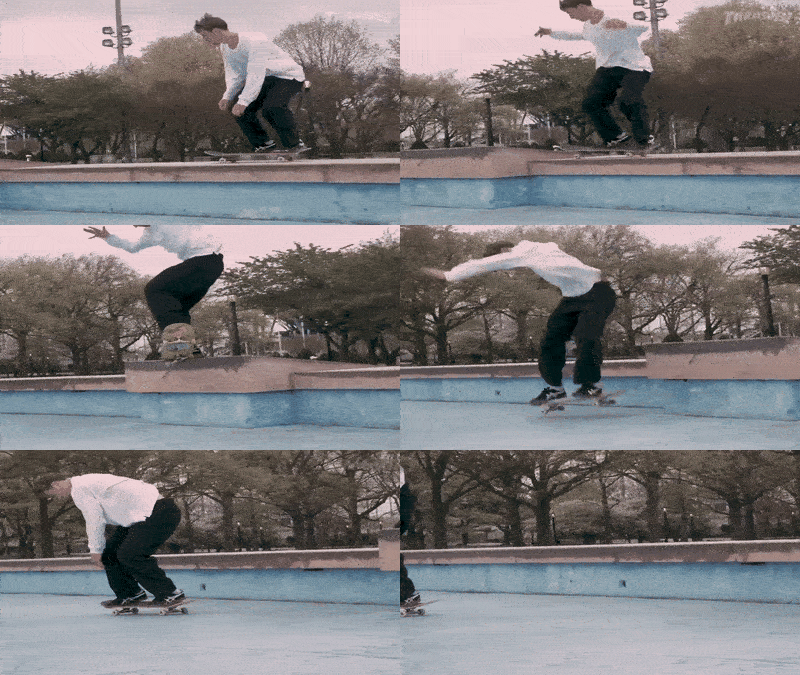
Walker’s NBD “Siesta” ender – switch impossible to switch crook at Flushing Meadows
What trick in your latest part consumed you the most?
For this latest part, a lot of it was spontaneous, I would say the majority of it was, which is different to other parts I have filmed. Even the New York footage involved very little planning. The switch impossible to switch crook at Flushing [Meadows] consumed me the most, but it wasn’t the trick so much as the movement. I say that because I have wanted to do a switch impossible into something, like a crooked grind or a nosegrind, for so long. It’s a movement that I have been thinking about for five or six years, but was never able to do. So that trick, the switch impossible crook, happened the first day I tried it there, but the idea of it had consumed me for years. That was really satisfying because I learned switch impossibles kind of late. I always thought I was doing them but they were really three shuvs. Then, in my late twenties, I learned how to really wrap it, and once I had that I wanted to do it into something. I had done it into fakie manual but I really wanted to do it into a ledge trick. I tinkered with it for years, but always came up short so to find the spot for it to work – I was so psyched! That’s the one that consumed me the most.
Which one is the most special in retrospect?
Getting that switch impossible to work was special but I think the one that is the most special looking back was the trick the part opened with. Brendan Bill filmed me do a nose manual – nollie frontside flip, that would be second on the consumed-me list because it took two missions and each time it was way harder than I expected it to be. Union Square is such an important part of skate history, and although I never got to skate it when it was the former Union Plaza it is so cool now! It was always really heavily security-guarded, and it still is but you could get these windows. I love San Francisco, and I love getting a clip there. The opening clip is epic because in the foreground on the roll up of the clip I landed is this pro basketball player. There’s a tall guy standing there and he is a famous pro basketball player. I didn’t recognise him but while we were filming Brendan [Bill] was like “you got to do it, that guy plays for the Warriors”. So to land it while he was standing there, after it had been such a battle was sick, and I could tell that Brendan was really hyped by that. It’s kind of cool because it’s a piece of San Francisco from a different aspect. People love the Golden State Warriors. I don’t really care about sports but a lot of other people do. The basketball player’s name is Dario Šarić, I don’’t think he even plays for the Warriors any more but it made the clip special, there was a lot happening there, we were getting kicked out constantly but it worked out, and I just love that trick.
“that would be second on the consumed-me list because it took two missions and each time it was way harder than I expected it to be”

Walker’s “Siesta” opener – nose manual nollie frontside kickflip at Union Square
You’re already building another part, are there any new tricks in the quiver you’re hoping to find somewhere for?
Oh yeah, I have a ton of tricks I have never done before that I want to do for this part. Switch impossible to switch crook was cool because no-one has done it and I wanted to do it but there are a lot of tricks everyone has done that I’ve never done which I want to do. I’m moving backwards a little bit, but I want to push myself in that way and do some tricks that are outside of my wheelhouse that I have never done before. I hope that continues for the next twenty years.
Are there any new Old Friends projects on the cards?
Old Friends is still just a little side project I’m doing mostly with Dr Kyle Brown right now. We are about to put out a hot pocket ankle injury rehab program which is kind of fun. We are still doing these skate-specific rehab programs and podcasts. If you had a hot pocket, check out this exercise routine, and it will hopefully help you recover properly. Kyle is a lifelong skater, he turned pro for Preduce Skateboards out in Thailand so he knows his shit as a skater but he is a full-on physical therapist and he treats skaters. There are a lot of injuries that don’t have that internet-accessible information. That’s what we’re trying to do with Old Friends right now: continue to make programs to help skaters deal with common injuries. After the hot pocket one we have a filmer program ready to go. Strengthening exercises for filmers, and common injuries from filming, very niche. We also have about twenty other programs that skaters can really benefit from.
Any other new projects you’re working on?
The short stories, and maybe a longer novel. I’m just having a blast being a dad and raising my son. My wife is the current breadwinner holding down the fort with the full-time job and I’m doing side projects and some freelance work but primarily taking care of our son. It’s been really incredible; there’s nothing like parenthood.
Will we see you in London any time soon?
My wife and I love London, and we really want to get back there soon. It probably won’t happen in the winter but we try to make it out to Europe every summer. I hope we can be there in the spring and stay for a little while because I have never gotten a single clip in London, and it really irks me that it has never happened. I have passed through so many times but it has always been layover style trips or random work-related trips for my wife where the weather hasn’t been banging. It’s still on my bucket list to get a nice, solid skate clip in London, it needs to happen.
Thanks for the interview Walker. Any last words?
Thank you for taking the time and reading my books. Thank you to anyone out there who has read them. There is nothing more amazing than talking to somebody who has taken a dive into the stories. I appreciate everyone.
We want to thank Walker for his time and for gifting us three unforgettable novels. We look forward to reading more.
Buying Walker’s books could not be easier and there is no long wait time or expensive shipping as they are printed to order. Simply visit Old Friends to order yours and have it delivered to your door. Check out an Audiobook Sample of Top of Mason for a taster. While you’re there you should also check out the Old Friends Fitness program Walker has been working on with Dr. Kyle Brown.
Follow Walker Ryan and Old Friends on Instagram and the Old Friends YouTube for a video goldmine. Watch Walker Ryan’s anthology of skate video appearances HERE.
Related Reading: Visuals: Mark Suciu , Evan Schiefelbine Interview