

Welcome to the first “Longevity” interview with Dan Bardallo, the creator of the Skateboard Strength program. We wanted to pick the brains of different people who have invested a lot of time into pursuits outside of skateboarding to maintain it being enjoyable, and maximise the time doing what they love. When injuries, poor recovery techniques, or advanced age start slowing things down it’s probably time to implement some changes but we often don’t know where to look or are overwhelmed with options of what we should be doing. That waiting list for the physio itself may even be enough to stop you from entertaining any further support. We are confident that any un-answered questions you may have could already have been tackled informatively and effectively by Dan and we are going to point you in the right direction.
Having discovered the passion for skateboarding when Covid changed our every day Dan quickly realised that the community who had embraced him needed his help more than any other. He had already spent years studying his craft and using his experience in strength and conditioning to assist people with different problems. When he found skateboarding it exposed weaknesses in his own body which he had already been training for fifteen years and he realised this would be worse for older skaters or people just beginning to learn. He used all of his experience to develop a program that would help skateboarders of different levels train, recover, and strengthen their bodies.
His Skateboard Strength Instagram is an incredible resource you need to visit which will undoubtedly have valuable advice if you’re looking to change up things for the better. This interview covers his personal history, the Instagram experiment that started all of this, the incredible program and resources he has developed from that point, and his evolving journey that has improved many lives along the way. He also dispels some myths and common misconceptions about the type of training we need to be doing. We’re all looking for longevity and we hope this conversation leads you to some helpful information that will increase your own…
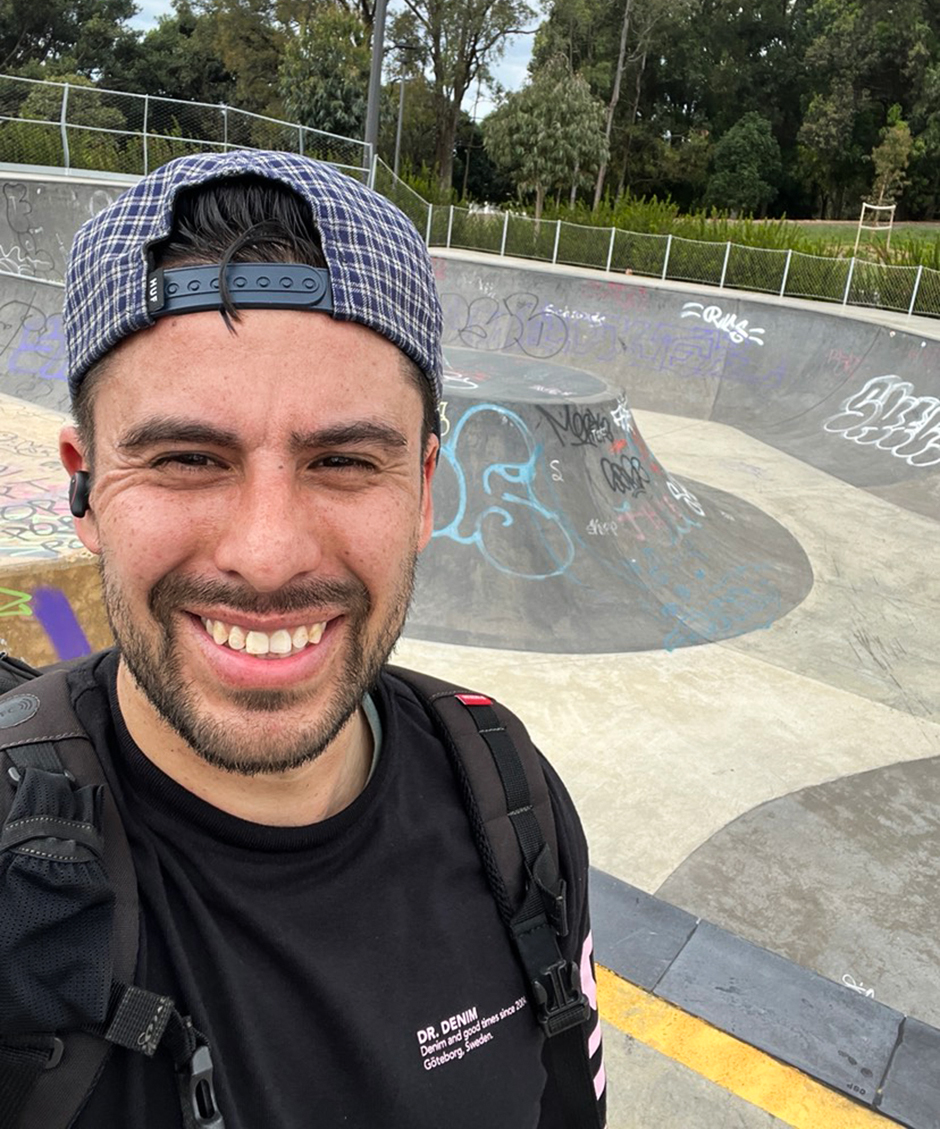
Words and interview by Jacob Sawyer. Dan Bardallo at the Sydney skatepark that started his journey
You discovered skateboarding later in life, what were you into before that?
When I find things like when I found skating I become obsessed with them. Originally what I’m doing now with skateboarding I had done with one of the first things I fell in love with in my life which was ice hockey. I was finishing up my party career, going out clubbing and boozing was coming to an end. I was over that repetitive cycle. There was a guy I used to work with who played ice hockey, I went to watch him play and thought it was fucking sick. He encouraged me to try playing and gave me a bunch of gear. I went to my first practice session and just fell in love with it. I became obsessed which I think is part of my personality.
After that I started playing ice hockey four or five nights a week, I was obsessed with the culture of it and learning all about it. Ice hockey filled that big hole left in my life from not partying. It was a nice transition in that way and through the process I realised that I enjoyed figuring out the puzzles for my body. There are big consequences if you fuck up but you’re using your body as a facilitator for these certain movements, there are certain gains needed to achieve certain goals. That thought process tied in really nicely with what I do which is strength and conditioning personal training. I had transitioned from using personal training for aesthetics like weight loss or fat loss and putting on muscle. I had also used it for repair because at a certain time I was quite broken as well. I challenged myself to use the training I had learned that was tried and tested and to apply it practically to help me perform better when it came to ice skating and ice hockey. That’s when I started noticing that the training really made a difference. I used to be the fat, chubby kid at school, I was always last in class. I’d be hiding in class, I was never the athletic kid. Then all of a sudden, playing ice hockey, I was the quicker guy out there. I could last a lot longer than the other guys too which was impressive, especially at my age, and I didn’t have any pain after playing for a few hours. That was the first time I realiised that this stuff meant a lot more for my body beyond aesthetics. I got to a certain point after about five years where I needed to give it up though. It was getting to be too much, it’s really late nights here in Australia when you’re playing ice hockey. I had training sessions that would start at 10:30pm which was just brutal as I had early starts for my personal training. When I did give it up though there was this massive hole in my life again.
How did skateboarding enter the picture?
Around Covid time we used to walk around the local park and they were building a skatepark there. I used to walk past it all the time. I was already in love with the Dogtown guys, the gnarly attitude they had, and everything that came along with that Dogtown culture. Mostly I was drawn to this idea of riding bowls. So when the park opened up I bought myself a skateboard for my birthday. At first I was just riding around, pushing around and even that immediately started giving me so much happiness and joy. One morning I went there at about 6am so no-one else would see me and started trying to ride the small bowl, I couldn’t drop in or anything yet. As soon as I rode the bowl a little bit I was hooked on something again. I fell in love with it and started to get obsessed with doing it myself and with skateboarding general. So anything and everything to do with skateboarding I started to get into and one of the big ones was listening to The Nine Club episodes. They spoke to all of the OG’s and it was a way to learn about the culture which for me was a massive deal. I was able to listen back to the things that were important to skaters, the way they spoke about things, and about certain parts of the culture. That is so important for skateboarding, the culture, and the respect for people who have come up from the past. There are all of these unwritten rules and regulations which aren’t written down anywhere but mean a lot.
“As soon as I rode the bowl a little bit I was hooked on something again”

Skateboard Strength creator Dan Bardallo hitting the tiles at his local bowl in Sydney
If I hadn’t had The Nine Club to guide me I think that when I finally started to post content it wouldn’t have been as successful because I wouldn’t have understood what was important to skaters as well as I did as a result. I think it would have been shit on and gone nowhere because skaters can spot a poser a mile away. I’m not the greatest skater but I had the understanding of things you don’t do in the skate community, and things you don’t say. I had an idea of what people would respond well to and what they wouldn’t. I greatly attest that to The Nine Club because of the education it offered me. I bought Kelly Hart a coffee when I saw him at SLS and shook his hand, I told him I wanted to thank him because if it wasn’t for The Nine Club I don’t think I’d be doing what I’m doing.
When you discovered ice skating you were already helping people as a trainer?
I had already been a trainer for about five years at that point. My arc with training was that I had always struggled with weight, weight loss and aesthetics never came easy to me which was frustrating. I always wondered why my mates could eat whatever they want and not put on any weight whereas aI had to work so hard for it. Then I found a trainer who helped me and I realised how much easier this stuff could be when you actually understand it and know the things you could be doing. At the time I was actually working construction and living with a personal trainer. My body was broken from construction and the guy I was living with suggested I try and work as a trainer. When I left school I originally wanted to do physiotherapy or a sports master’s degree but I was never really good at school, and later in life diagnosed with ADHD and other shit. School just wasn’t the right environment for me but I found you could do a course in personal trading and get a certificate. So I saved up the money from construction and did that full time. Then I ended up doing a full years apprenticeship with another personal trainer as well.
By the time I finished working construction my body was absolutely broken. I had stuff going on with my back and my hips and no-one could really piece me together. Then I found this guy who was next level, he exposed me to a level of trainer that I still really aspire to be to this day. Something I seek out still. I don’t think people really know that is out there in terms of what their understanding is in terms of the human body, anatomy, biomechanics, hormones, and how that all plays in. What they can do with this knowledge in terms of fixing people is incredible. Once he fixed me I started going down that route. For the first five years I was in a course every other weekend and putting anything that I earned back into education. I realised there was this level of trainer out there which is a whole other thing and that’s what I wanted to do. I kept upskilling and learning. Then I started helping people with pain, cases involving issues that were anomalies, people who felt they had been to see everyone and found out nothing. I slowly started to help people. You help one person and build on it, the more people I helped gave me a quiet confidence that I had the knowledge to really do this. By the time I found ice hockey I had the experience in aesthetics, weight loss and fat loss as well as the rehab experience. Finding ice hockey is what set me down the performance route. By then I had dipped my toe in everything.
But then you discover skateboarding. What led you into tailoring your skills to supporting the strain skating puts on your body?
I was doing with skateboarding exactly what I did with ice hockey. I was using my tools, my craft, and experience to figure out what the best training methods would be. What do I need to be doing, and how can I maximise my performance for skating? There was a big difference between ice hockey and skating though. With ice hockey I just started seeking out the best S&C trainers for ice hockey in the world, I would pay them extraordinary amounts of money to sit down with them for half an hour. These are guys who were training people in the NHL, some of the best ice hockey players out there. I would pay them for a video consultation, ridiculous sums of money to pick their brains. I trained with one of them as well. Again it was costing a lot of money but for me it was invaluable research. I was learning from these top-tier guys on top of my education and personal practice. When I found skateboarding I went to do the same thing because it seemed to be the natural process. The difference was that if you type in strength and conditioning coach for any other sport, and I know skating is not a sport, but type in any other sport and you’re flooded with websites and multiple coaches. Do the same thing for skateboarding and it’s just crickets out there. Especially when I first discovered a love for skateboarding, I searched for resources and nothing came up. I felt like I was in the Twilight Zone, some alternate universe. That seemed weird but it didn’t really matter to me because I already had the tools, it was about building understanding and taking the time to practically apply what I knew. I was watching so much skating, and still am. It’s amazing to stop clips and understand the biomechanics of certain movements while also experiencing that in real time as I progressed.
“I couldn’t believe there were so few people out there helping skaters. Then I started having one too many conversations at the park”
I couldn’t believe there were so few people out there helping skaters. Then I started having one too many conversations at the park. Everyone always has something that’s hurting them, everyone is skating semi-injured all the time. I’d hear guys saying they couldn’t do certain tricks anymore because it hurts, or their days of doing X, Y and Z were over. Then two things happened, first I was at the park and I was fortunate enough to watch Kieran Woolley, Keegan Palmer and Dylan Donnini. I was watching them skate this big bowl in Sydney from a distance. They were all trying a trick together, launching out of the bowl and running out. Sometimes they were landing on the flat bottom and I was thinking how the fuck are these guys doing this? How are these kids taking this impact? I was dumbfounded that no-one was doing any training for skateboarding especially with that level of impact being so brutal. The second thing that happened was I was skating the bowl with a kid who was down there with his dad watching. His dad kept giving his son tips and he gave me a few too. The kid told me that his dad used to be a really good skater. The dad kind of brushed it off when we were talking that he used to skate but mentioned his knee isn’t so great anymore so he stopped. That to me was already a common tale but a sad one because it’s a moment where you can really connect with your child by enjoying the same thing but you’re bound by your failing body.
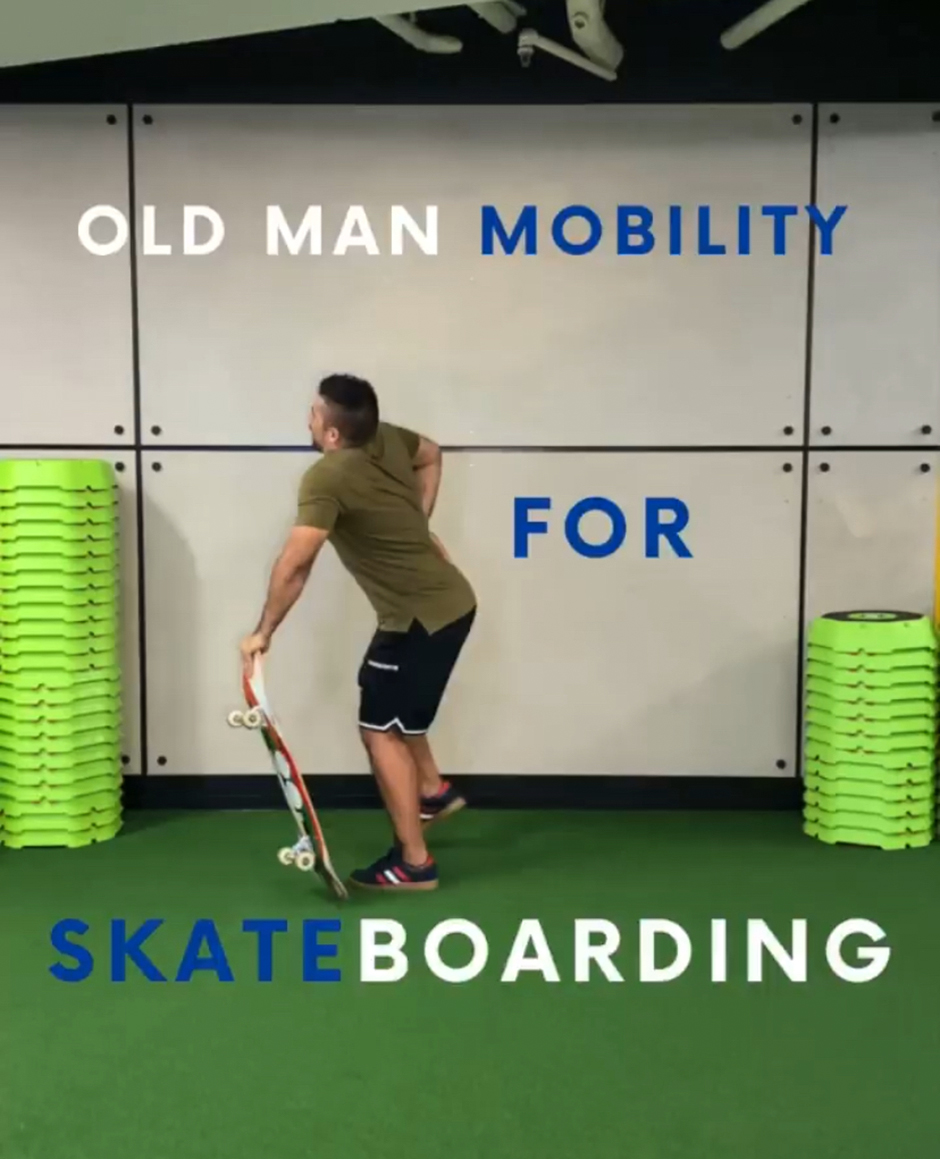
The very first Skateboard Strength Instagram post inspired by many conversations at the local park
That motivated me and so I posted a few things up on Instagram to help people because this stuff is out there, it’s pretty well-known and well-studied advice but it seemed like skaters weren’t aware of it. So I made a few Instagram posts and they started to do really well. At the time I was running a basic personal training page on Instagram also but the Skateboard Strength one was getting more engagement. There was a lot more positive feedback and it was just a lot nicer. Personal training and fitness online, especially on Instagram is a shitty kind of world. It’s not one I ever felt I belonged in. All of the things skaters don’t like about the gym, I don’t like about the gym either. If you scratch the surface level you can discover really interesting stuff within it but I get how it looks on the surface because there’s too many wankers in string singlets and girls showing their booty. That’s not what it actually is but what a select few tend to do with it. Running the personal training page was exhausting, keeping up with that stuff and battling against it. When Skateboard Strength started doing well and getting good feedback it gave me a chance to step outside of the world I had been in, this fitness world I didn’t like. It was giving me joy and happiness, and it was helping my career because it was revitalising my interest beyond this pornification of fitness through social media. I decided to go all in on Skateboard Strength because it was giving me more happiness than that other world, and that’s still where I am today.
Let’s talk about the basic principles your course builds from. How did you cherry-pick relevant poses and exercises to help aid a skateboarders mobility?
I got injured quite early, I fractured my elbow. So even when I was recovering from that I would sit at the hill by my local skatepark and just watch skating. When you already have an understanding of biomechanics you can begin to understand what muscles are being fired, what joints are being used most, and what are the positional demands people put themselves through. Then you can start to extrapolate back and work out what you need to give people, what their bodies need. You begin to fine-tune things, I have the best exercises and modalities already there so it was about cherry-picking what’s best suited based on the demands I have been seeing. I started looking at myself and the problems I was up against. I train, I’ve been training for over fifteen years now so I feel I’m on the fitter side, especially for my age, but even I found myself getting tight. Skateboarding exposed certain weaknesses within me, so if it did that to me it was probably going to be way worse for older skaters or people just learning to skate.
So I used what I had noticed in myself and I also started training some high-level skaters, sponsored guys. It’s got to the point now where I’ve trained some pros as well. So getting to know them and their bodies was interesting, the issues they had, and the issues that kept coming up. What did they come in with on a weekly basis and how does that interact because if they’re having these problems and they’re at the top of their game those needs will filter down. It was basically like getting a crash course, these guys are out there filming parts and putting their body through the mill, it was a magnifying glass on the body of a skater. They’re doing things on a more intense level while the people downstream who aren’t so good won’t be experiencing the same level of strain but will be using the same movements. That higher intensity exposes things a lot quicker, the guys downstream will experience similar things but it will take them longer. I used all of that experience to work out what people will need at different levels and what will work for them.
“I used all of that experience to work out what people will need at different levels and what will work for them”
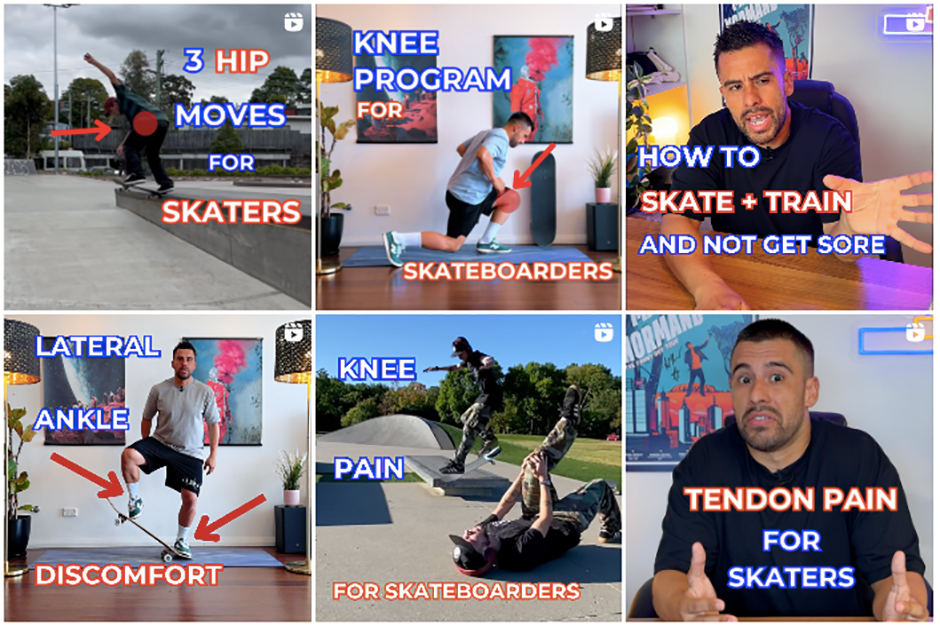
The Skateboard Strength Instagram is a valuable, clearly labelled resource answering many questions
Yoga or pilates are practices many people gravitate towards to help their skateboarding. Are there any poses that may not be so helpful?
I think I’ve shit on yoga and pilates a bit in the past and I think people maybe misunderstand what I’m saying but this is how I see it. I use bits of yoga and bits of pilates within my programming. If we have a 45-minute session we’ll start with some of that stuff. The issue is that you tend to get skaters who will find yoga or pilates, that’s usually their first entry point. They want to be less stiff and feel more mobile so they start stretching and they’ll feel better as a result. The problem is that skating is a game of impact and forces. If you’re not training to better adapt yourself to receive those impacts and forces you kind of get put on a hamster wheel. You’ll do the yoga or pilates, gain the mobility that you’re after, and feel good. Then as soon as you go back to skating you haven’t really armed yourself with the ability to handle the impact and forces at that new range. You’ve opened up your range with these poses, opened up these muscles but you’re not really strong there. You go back to skating, beat yourself back into that range, and your body responds by tightening up so you don’t go there again. The message your body is sending you is that if you keep going into this range it’s going to cause damage to the joints. That’s why it tightens up. It knows you’re going to hurt something so it tightens up because the muscles are overworked from those forces of impact. It tightens up to stop you going to those end ranges to prevent structural damage. So people often tend to get enhanced mobility from yoga and pilates, go skating and beat themselves up, then have to keep doing yoga and pilates more and more to maintain. It’s a hamster wheel.
“people often tend to get enhanced mobility from yoga and pilates, go skating and beat themselves up, then have to keep doing yoga and pilates more and more to maintain. It’s a hamster wheel”
It’s the same thing that happens with stretching and with all of these other tools that are out there now which can be cool if used properly, things like thera-guns, foam rollers, leg sleeves etc. You want to do some of this stuff but skaters barely train as it is. So if you’ve got two 45-minute sessions a week to dedicate time to this stuff it makes no sense dedicating the entire time to yoga or pilates where you’re only working on one side of what a skater needs which is mobility. In that 45 minutes, it is better to choose the best yoga and pilates exercises and do them in a five-minute warm-up period before arming you with the capability to handle the loads and impact that skating puts you through. Then this means you don’t have to keep doing this all the time, you don’t need to do more and more mobility stuff. You want that stuff to stick so you do less and less of it. So you do the yoga and pilates stuff to increase mobility, then create stability in those joints at those newfound ranges then strengthen up into those ranges. This way your body feels strong and capable enough to use those new-found ranges when you skate. This all means you have to do less mobility work, you’re holding onto that mobility because your body is capable of using it when you skate. When it comes to training to skate and you’re short of time which most skaters usually are that’s what you want to be doing, and that’s how I structure my programs. What are the best things we can be doing? I want to maximise that 45-minute block by incorporating the best things to aid performance.
You had to incorporate stability as a goal taking into account the specific positions and movements unique to skating. What do we as skateboarders do regularly that puts a bizarre strain on our bodies?
One of the things that’s really unique to skating is part of the reason that ankles get so beaten up as well. When someone jumps normally and lands on the ground their heel will eventually find its stiff point from the ground contact. The ground will be the limiter, your heel will hit it, and that will stop the range of motion happening to your ankle. If you have to cut direction or jump, when you land, it is your heel hitting the ground that is where the range of motion will stop. This helps as far as being a brake mechanism. When you skate, even if you’re just popping a small ollie off of the ground, when we land it’s possible for our heels to drop below toe level because our trucks steer the board. So when you do take impact when you land, the point when the board is going to be straight is when your heel is in line with your toes. Depending on how you land that heel can drop below toe level, and that is where you put a massive strain on your Achilles, calf, and your ankle in general.
A snippet of The Skateboard Strength Foot, Calf, and ankle program which is Free to Download
You also need to go from your heel being below toe level back up to it being in line with toe level to steer the board straight which can make or break your trick. Staying with the heel below means that you’re just going to drift off backside and turn. Not only does this motion put a massive strain on the calf and the Achilles, something else happens. When you watch a big trick done down a stair set in a video or someone landing the same trick constantly at SLS which I love watching because you can see this so clearly. When someone lands a trick down some stairs you see their ankle snap down but then it snaps back up to toe level to steer the board straight. That snap there is really unique to skating. You don’t get that in a lot of other places because everywhere else the ground will stop your heel from dipping down. This is why the foot, calf, and ankle get so strained from skateboarding. The demands being placed on the ankle joint are insane in skateboarding so that’s one of the big ones I always highlight that is very unique to skateboarding.
You incorporate strength training exercises in your routines that are obviously beneficial for performance. I noticed many of the exercises on your Instagram rely mostly on body weight and maybe resistance bands but rarely weights. Is there any strength training traditional workouts may include that could be counter-productive for skateboarders?
This is another thing I battle with skaters on. Most skaters don’t go to the gym so I try to make everything I post on Instagram really accessible to them. I make the exercises things they can just do at home. Resistance bands are cheap and easy to get hold of, and dumbbells are too. For most programs I run there is a home version where all you need is a set of dumbbells, some bands, and a foam roller. From there on you’ll have a long range of programming, that’s how it’s set out. I battle with skaters on this because I want them to load but they tend to view the gym and loading as this whole jock thing, it’s something I try hard to break the stigma on. When you look at skateboarding and the amount of forces that get placed on the body by either popping the board or taking landings, the forces far exceed body weight. So that being said bodyweight exercises alone simply aren’t going to cut it. So many guys message me with bad knees and tell me they’ve been following a program. They show me the program and it just includes bodyweight lunges. You take at least four times your body weight when you pop the board. If you want to repair your knee to skate you need to load that bad boy up and it seems skaters are afraid of that load.
“bodyweight exercises alone simply aren’t going to cut it…If you want to repair your knee to skate you need to load that bad boy up and it seems skaters are afraid of that load”
When I post stuff that includes loads that are heavier they tend to tank, they’re not popular. But skaters need load and we’re turning the corner as far as that awareness. You need to load and you need to load heavy. If you’re asking if anything will be detrimental to someone? I don’t think skaters will ever go to that point. If you were doing jut regular bodybuilding training it might not be as efficient but the way skaters are and the level they go in at even that would be beneficial to them.
I feel like the resistance to it comes from not wanting to bulk up, the perception being you’ll end up top heavy.
Let’s get into that. On paper, there will be a point where it could hinder your skateboarding performance if you got that big and bulky. So certain training methods could hinder performance. Most skaters in their lifetime won’t ever run the risk of going anywhere near that. That’s the difference, they’re so worried and afraid of something that’s non-existent to them- it’s just not going to happen. The process of putting on muscle is difficult enough so it’s not a concern, it is not going to happen to you. You’re not going to beef up like that, to put on muscle you have to strain the muscle to the point where you’re training super hard. Then you also have to eat, to put on muscle you need to be getting more calories and putting more energy into the body than you’re expending. Skateboarders are burning so many calories skating alone to begin with. You would have to be eating so much food to even get to the point where your muscles are getting the fuel they need to get bigger.
You would have to go to serious lengths to put on the type of muscle people think will hinder their skating. Muscle isn’t put on in the gym, the weight training is a stimulus, the catalyst to you putting on muscle. The actual muscle is built in the recovery period, are you recovering well? Getting eight or nine hours of quality sleep a night? That’s the environment you need to put on good-quality muscle. Most skaters aren’t doing any of these things. They may put on some muscle which will only aid them in their pursuit, to get to the level of muscle where you’re worried about it, it ain’t going to happen. Someone like Neen Williams is a good example, you see that dude and his discipline, it’s insane. That dude is ice bathing, taking saunas, he tracks all of his meals. He knows everything that goes into his body, the calories, the carbs, the protein, the fat content. That’s what it takes if you’re trying to put on muscle. He trains like an animal and he’s not too big for skateboarding. I think the misconception skaters have is that they’re going to stumble into putting on too much muscle and get bulky but it’s like chasing the boogeyman. It’s not going to happen, it’s a bad perception to have because it hinders them from training. Your goal should be to put on muscle. They say swing for the stars and end up on the moon, you’ll still end up with something good.
“You can create this nice environment where training and skating work together but you need to understand what a good quality program looks like. One that allows you to build over time rather than drill you into the ground”
Also when people say it will affect their skating because of the stiffness you get from training. That’s just down to the quality of training they’re doing. It’s not usually because of putting on muscle it’s usually because they are training inefficiently and getting too sore. They feel stiff because they’re sore, it’s not muscle, the training has made them stiff and that’s all. It all comes down to education and understanding, how to train properly, how to manage your intensity levels when you train. It’s understanding that if skating is your goal and training is meant to aid your skating then that’s the way you need to train. Skaters often approach training with the same gnarly mindset they approach skating with, if you do that with training you’re only going to pull up sore the next day. With strength training you don’t have to work to fail to get a result, you have to get close and flirt with failure. Skaters think they have to leave the gym sweating and on the ground and to feel like they upped stuff out. The reality is that a lot of the movements need to be slow and controlled, intentional. You’ll get all the benefits from this, the adaptation of strength but without the muscle soreness the next day.
You can create this nice environment where training and skating work together but you need to understand what a good quality program looks like. One that allows you to build over time rather than drill you into the ground. It’s like trying to ollie a ten-stair when you first start skating, you’re going to be pulling up sore, what did you think was going to happen? You need to develop the technique, the language, and the tolerance for it. Training is a lifetime pursuit, it’s not something you do for a few weeks then quit. I’ve been trying to get this message out to skaters, it goes beyond training, beyond skating, this is about quality of life. Guys out there are getting older and we see the toll skating has taken on their body, their knees, and hips. I wonder how I will feel when I’m sixty, there are parts of my body with screws in. The thing that training gives you is this quality of life off the board to play with our kids and show up for the physically and not in pain. It’s another benefit training gives you that is undervalued and not spoken about as much. If you take the time to learn it and learn the craft as well it will pay off in many different avenues.
Your program includes lots of helpful exercises for recovery, something it was common once upon a time to treat with beer, zoots, skate videos and some ankle alphabet exercises at best. It’s amazing that Instagram feeds like yours offer free tutorials that can aim people in the right direction and help them get back on track. It’s great that you aren’t gatekeeping this info even though you obviously are offering complete programs…
Thanks mate. I have the program I’ve put together and had some guys hating on it, hitting me up saying why don’t I do it for free. They’re accusing me of trying to make money off skateboarding. Anything you want I have already solved the issue for free you just have to look at my Instagram, my website, blog or at some of the YouTube tutorials. If you look at my Instagram every single post is labeled so you can go backwards and easily find what you’re looking for, it’s all there for free. I went really out of my way to create the program, this next level that builds from what you can see. I wanted to develop the best thing I could and it took up a lot of time, it still does and I’m still trying to deliver. All the info is there and you have both options, there’s definitely no gatekeeping and I’m definitely going to continue putting free stuff up there. This other option just makes things that much clearer for those who really want to make that change. Even then I tried to make it as cheap as possible for everyone to achieve that entry point to get in. I know the economy is tough and they say there is no money in skateboarding, I wanted it to be accessible in that way. I’m doing everything I can to support the community in both ways. The free stuff is cool but when you get the paid stuff there really is an incredible resource there for what you’re paying. That was my aim, if someone is going to hand over their hard-earned money they’re going to be getting more than they thought they ever would.
When I built the program and created the Skateboard Strength app I went and bought so many other programs because I wanted to see what other people were putting out there. My aim was to blow all of those other programs and apps out of the water in terms of what level of content I was going to be giving out to people. I also wanted to underprice it compared to other programs. Both avenues are there and a lot of effort has been put into both so I hope people appreciate it, enjoy it, and get a lot of value out of it whether they’re in pain or not. It’s about helping the community as much as possible.
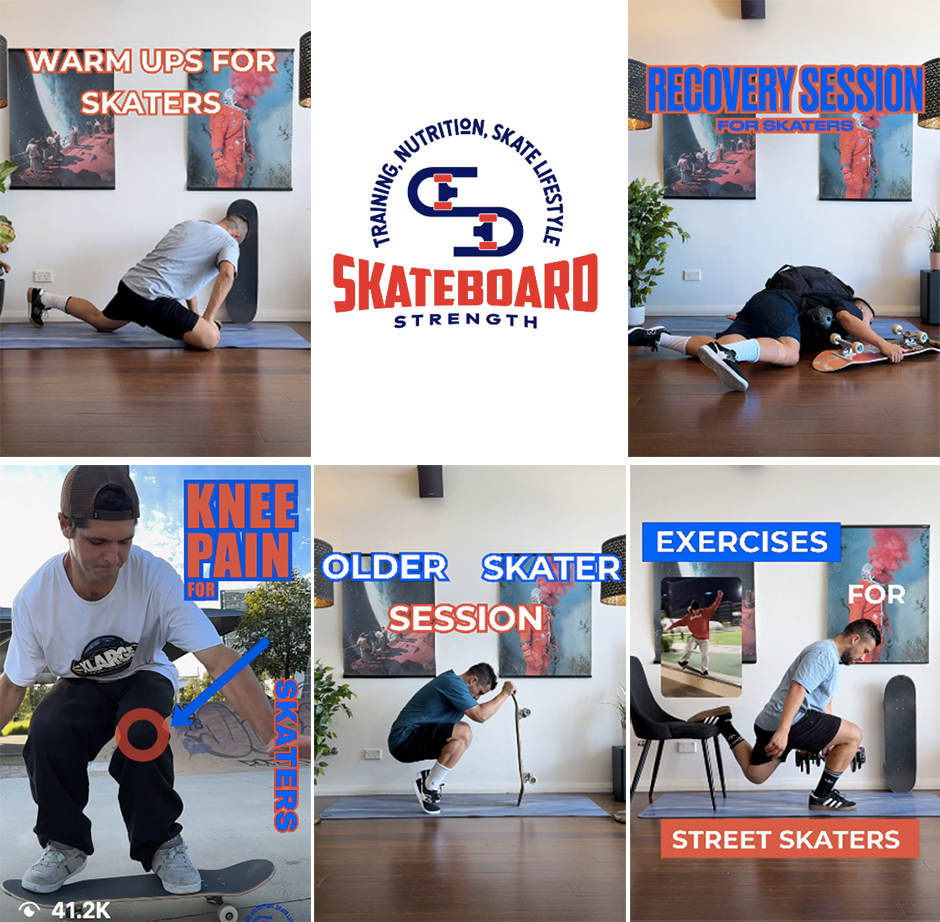
warm ups | Recovery | Knee Pain | Older Skaters | Street Skaters
Saying that, even with all of the info there it can sometimes be overwhelming, The Netflix effect, an hour choosing something and never getting around to watching it. If you could recommend five regular exercises that would improve and safeguard skateboarding for anyone out there what would they be? Something you could do daily.
Above you will see five blocks of exercises I recommend that could be a useful starting point. With the programs I had done and with the free stuff that I post a lot of them are built of ten or fifteen-minute blocks of what you can do, I have pieced them together like that. They are there as advice for someone who has fifteen minutes to spare. All of the videos and demos are there, I have literally given it all away for free. But this is the issue, do this program, do it exactly like it is written here, the order is there, the repetitions. My feed is tailored to every different problem you can think of. I get that people are overwhelmed but I try to make it as easy as possible. I’m worried that I have included too much information on the app which could be overwhelming but even then I’ve made introduction videos and broken it down to be simple. There’s a group chat where you can ask questions and I’ll direct you to the right starting point. When you’re dealing with lots of people I have realised that many get lost.
Attention spans have dwindled too.
It blows my mind, I’m not sure if it’s attention spans or laziness but people literally want their stuff given to them. That’s what’s hard sometimes when people hit me up in my DM’s. I don’t have one unread message in there, I’m on it and every question gets answered. But a lot of them are still the stuff I want out of my way to prevent having to answer in the first place. I have dudes messaging me asking what to do for their ankle? If they took a second to look at my feed they would see all possible angles have been covered and labelled.
What do you think people underestimate the most as being beneficial?
I think people definitely underestimate the benefit that good quality strength training will have on their skating. Hips are a big one but I think people underestimate the importance of their tendons and how much they affect the rest of the joints like the ankle, the knee, and the hip. I see this a lot with older skaters and older skaters getting back into skating, and also with people learning to skate who are a bit older too. Tendons require what we call plyometric loading to remain springy. They fulfill this role of being these still springs that can absorb and produce elastic energy. There’s tendon use everywhere in skating, as soon as you step on a board and try to pop it. When we’re younger we run, jump, skip. We’re playing with our friends and our tendons are getting that style of loading a lot and are adapting to take it. When you’re young and you go outside and start skating for the first time you don’t really notice these things. You try to skate, you can recover easy, it’s all gravy.
“People are telling me that when they finish skating now it’s because they have run out of stamina, not because something hurts.That’s the perfect feedback”
What we see with old skaters trying to get back into it is that they undervalue the use of their tendons. Someone who hasn’t jumped or run in years is suddenly doing all of this plyometric loading trying to skate like they used to. The amount of plyometric loading a forty-minute skate requires is insane. So we see their tendons blow up, Achilles tendon, quad tendon, plantar fasciitis, jumpers knee. It’s a long list because the tendons just aren’t ready having been sitting around doing nothing for five or ten years. They get overused, tired, and can’t take it. How good your tendons are at accepting load plays a massive role up the chain on how much loading the knee or the hip takes. That’s when your knee takes a beating or your hips get overly tight, this upstream of forces are placed on the joints because the tendons are overworked and aren’t being used in the way they’re meant to be. They no longer have that capacity so there is a knock-on effect to all of these other injuries. Strengthening your tendons is definitely undervalued especially by those trying to get back into skating later on in life.
Can you give us a success story where you have helped the recovery of someone we may be familiar with?
I’ve got a few I don’t want to really talk about just yet because I’ve helped a lot of skaters and quite a few pros now too. More than I’ve talked about. Training still has a bit of a stigma surrounding it in skating and I’m very conscious of that so I don’t want to put anyone out there who doesn’t want to be mentioned. The amount of skateboarders who train and don’t post about it or talk about it is insane, most of your favourite skaters are training but never talk about it because of the stigma and how they may be viewed. I’m mindful that people maybe don’t want their recovery out there or talked about. There are two ends of the spectrum, I got messaged thanks the other day by a guy who was saying that beyond skating he can now pick stuff up off the ground without being in pain. His day-to-day life has improved, his knees and back aren’t hurting, and he’s not in pain when he wakes up. That’s huge to me, I love that shit because it’s quality of life beyond skating. Helping someone do tricks again is great but helping someone who has struggled with back pain for ten years to having none is massive. People are telling me that when they finish skating now it’s because they have run out of stamina, not because something hurts.That’s the perfect feedback.

Sam Saddleton fakie 360 flips for Satoru kamatsu’s Homage video
In terms of higher-profile skaters the last one was probably Sam Saddleton. That was a really nice one where I was fortunate enough to be close with him and training with him while he was working on finishing his video part. Towards the end when these guys are trying to finish things it gets fucking intense. He’s working to a deadline obviously and to see what those guys put their body through is nuts. I can’t try and take too much credit for what anyone did, it’s bullshit when people say these athletes are where they are because of me. They’ve put years of work in before they even met a trainer. I like to think of it as I’m working alongside an athlete and helping in any way I can. But one of the coolest things was not just what they put their body through but something I don’t think maybe other skaters in the community understand. Sam would go out at the weekend and skate, trying to film on Saturday or Sunday. I would then get a message from him on Sunday evening saying this is what’s happened, this is what went wrong. He would send me a bunch of clips, some of them would be makes, some of them would just be fucking slams. He’d then tell me what feels shit. Then he would come in on Tuesday and we would figure out what hurts, what’s bad, and take time out to try and fix his hip, or fix his ankle. We’d work to a point that would help with his recovery, I’d set him some homework. He’d be back in on the Wednesday, then by Thursday he’d be feeling a bit better and we’d train him enough that he’d feel confident to go back out on Saturday to do it all again. That was the process, every week he’d come in broken and we’d try and do enough in the week that he could get back out at the weekend and stack another clip.
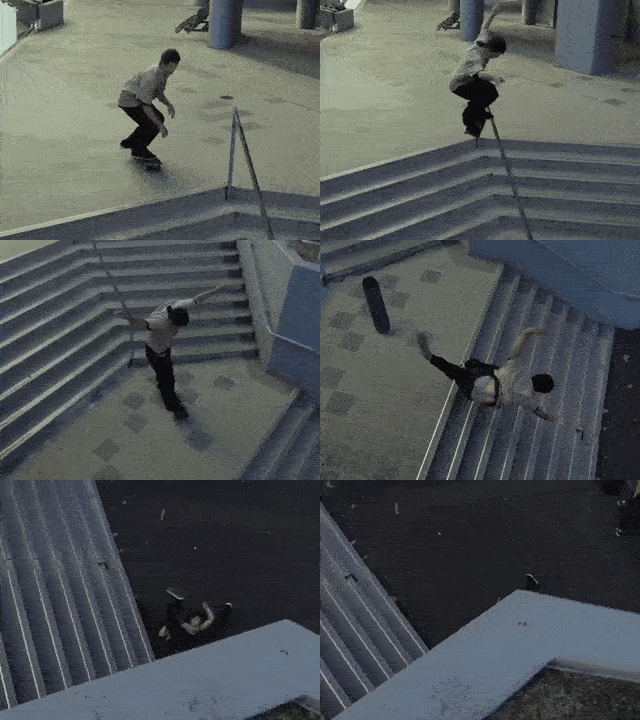 We went to the premiere for Homage which is what he was filming for. Sam kills it in that video and so does Lenny [Tejada] who shuts down Sydney with his part, he kickflipped and tre flipped the Hyde Park stairs which was nuts. You should definitely watch that video if you get a chance. When I went to the premiere I was watching Sam’s part which to me is the best part he has put out yet. He had some slams in the bails section and watching those just brought all of these memories back. I honestly got a bit emotional because it was so nice to have been a part of that. I remembered all of those instances and how he had put his body on the line for it. I’m very thankful that he allowed me to be a part of that process and to see the result of what he was able to put out was amazing. That was pretty cool for me, a really cool moment so that’s probably the most recent one.
I think you’re doing a good job in reducing the stigma of looking after our bodies which as you said is quite a funny taboo in skateboarding.
It’s sort of okay to speak about it now. Lots of people would still never post about it but you’re seeing a lot more people talking about it than before. I think it’s still considered lame to talk about it. If you talk about the Dogtown culture, that whole skate or die attitude, even skaters like that are doing stuff now. They present a “don’t give a fuck” persona and I guess training is perceived as giving a fuck, I don’t know, haha.
“They’re telling me this stuff is ruining skating but it’s there to make things better for skaters so they can enjoy it for longer. That’s what this has all been about for me from the beginning. Reaching out with help to a community that was so welcoming and nice to me from the start”
I will still get a bit of hate online when I post stuff up, some of these older guys saying this is bullshit, that skaters don’t do any of this, and that all the top level guys don’t do any training at all. I always respond that they need to open their eyes, everyone is doing this shit and trust me, I know. I remember one guy made a comment about looking at all the top guys in SLS, that none of them do this stuff. Dude, look at the top guys in SLS, everyone does this stuff, I fucking know for a fact. People’s perception is really out.
Armchair critics.
Yeah, and the guys commenting don’t even skate anymore because their bodies are broken. They’re hyper-critical of it but they’re falling apart and can’t skate anymore. They’re telling me this stuff is ruining skating but it’s there to make things better for skaters so they can enjoy it for longer. That’s what this has all been about for me from the beginning. Reaching out with help to a community that was so welcoming and nice to me from the start. There’s a lot of pain and suffering in the skate community because of stuff that seems silly to me. There are solutions for this and there have been solutions to this for years. There’s no reason to stop skating at twenty because your knee hurts, it’s an easy fix.
You have also branched out into a podcast which has had a number of qualified guests and has included skaters like Spencer Hamilton and Felipe Gustavo. What has this outlet opened your eyes to from the evolving community?
It’s been a hard one because I would like to do one every second week but I wanted it to be with experts in their chosen field who skaters could learn from, or skaters who have had success with this stuff and are proponents of it. I want it to be somewhere people can learn and somewhere that breaks down the stigma surrounding this stuff. Hopefully people will see from it that more skaters are doing this stuff and benefiting from the results. It’s a hard thing to do because not everyone is willing to speak on this stuff.

Three notable appearances on the Skateboard Strength podcast available on Apple and Spotify
You get some G’s like Spencer Hamilton or Felipe Gustavo who are willing to speak on this stuff, they’re out in the open about it and I’m so appreciative of those guys for talking about it. Then coming on the podcast too, they didn’t need to do that but they openly spoke about their stories. I know many other skaters who do train but don’t really want to talk about it. You must know what it’s like, I’ve had lots of people say they’re down to be on the podcast but the reality is that it’s impossible to actually get them on. As I said, I’m hyped on people like Spencer and Gustavo and I think they’re doing really valuable shit for the community. My aim for the podcast is just to put that in the spotlight a bit more, raise awareness, let people learn from their favourite skaters, and realise it’s cool to do this stuff. It’s one thing coming from me but it’s a whole other thing coming from skaters people they know. I think it has opened my eyes to the fact that there are more skaters training than you think.
What timeframe do you think people need to dedicate to this?
I always tell people to start with two 45-minute sessions a week. If it’s yoga and pilates, whatever it is, just do something but start dedicating time to doing it. What I was saying before is that you can be a bit more efficient with your time. You can get a lot more done if time is an issue and you’re clever with it. If it’s yoga that’s an easy entry point the perfect go and do that. Do something towards it for two 45-minute sessions a week. With the training sessions I build, in 45 minutes we can cover it all, mobility work, stability work, strength, plyometrics. You can do it all in that two-session timeframe a week and that is plenty to start with. On top of that, I always tell the guys I train that everyone sits down and watches TV in the evening so I give them 5 or 10-minute mobility blocks for the evening where they can pull out the foam roller or do some stretching on the couch. Do that another couple of times a week and it’s plenty, especially initially. I always tell people it’s a bit of a gateway drug where if you do this for 4-6 weeks and are consistent with it you will notice enough a change in your body that it will make it a complete no-brainer for you. It will make you wonder why you haven’t been doing this forever. It will also make you realise just how shit you’d been feeling before. Perspective is everything when you have no barometer on how bad the body was. Once you get a test for how much better the body can feel daily and how much better you feel on your board you will be all in. You will start prioritising your training after that because you just can’t live the other way anymore.
There was an interesting point in London where we found out that AVE trained with ankle weights. Quite a few of us would wear ankle weights all day at work then go skating, take them off, and feel a kind of liberation and improved placebo-pop when in actual fact we were probably just twice as tired as normal. Would any of this be founded in science?
You were wearing ankle weights all day? That would be brutal. I think that would again be being weighed down all day and then the perspective afterwards being that everything else feels light. You were just giving your body a form of loading and your body adapted to it and got stronger. That’s it, that’s what you were feeling, that you’d gotten stronger. Was it the most efficient way to do it? Probably not but you got somewhere anyway, it’s a gnarly way to do it.
The craze didn’t last very long.
Haha, yeah, probably not the most sustainable which is another big thing I talk about. You want something you can sustain and keep doing long term. Will you wear ankle weights every day for the rest of your life? Probably not, and it will be something you give up. If you get those two 45-minute sessions locked in as part of your routine and it’s something you can progress at, then it’s something a bit more achievable.
Is that the biggest mistake people make, going all in and burning out?
100% and we see it a lot at this time of year, people go in on their New Year resolutions then by the end of January everyone’s dropped off. The reason is that it’s too much too quickly, it’s too big of a change. We see this with weight loss and fat loss as well, if you change too much too soon you’ll maintain for three or four weeks then it becomes overwhelming. Work-life comes into play, you get stressed out and everything else crumbles because you changed something so radically. Instead of saying I’m going to drop a little bit of weight people rebel against the entire process and forget all of it. That’s the all-or-nothing approach but if you start making subtle changes, a little bit at a time, that’s how you create and form habits that are easy to sustain. Over time, after a year or half a year of developing these things you don’t remember changing much because it’s been subtle and it has just become your lifestyle now. There’s nothing to rebel against because it’s just been slowly integrated into your life. That’s how you want to do it.
“if you start making subtle changes, a little bit at a time, that’s how you create and form habits that are easy to sustain…There’s nothing to rebel against because it’s just been slowly integrated into your life. That’s how you want to do it”
Does slamming regularly actually making your body or bones tougher?
I have been curious about that. When you think in terms of kids who have grown up slamming a lot. I was thinking about it because what happened to me was getting shinners and later on in life. I have had some shinners that have taken me out where I have thought “fuck this!” I see kids taking shinners and it still hurts but I feel like their bones have calcified and developed a tolerance to it over time. You take Muay Thai fighters, I did a little in the past and the kickboxers will kick trees. You do start getting used to that pain, initially, your shins are purple and it feels like crap but you start developing a tolerance to it, and you also acclimatise to being kicked in different places. I was curious about building this tolerance in your shins especially when you’re younger. In extension to that if you’re slamming a lot when you’re younger do you develop a tolerance that allows you to take it a bit more when you’re older? Over here with Rugby League, or Rugby over there, or GridIron in the US, those guys are just slamming their shoulders into each other all the time, you develop a tolerance and the body is incredible a adapting so I think there would be a lot of adaptation to slamming especially if you have done it from a younger age.
Who have you noted as having the most effective slamming technique that smacks of proper training?
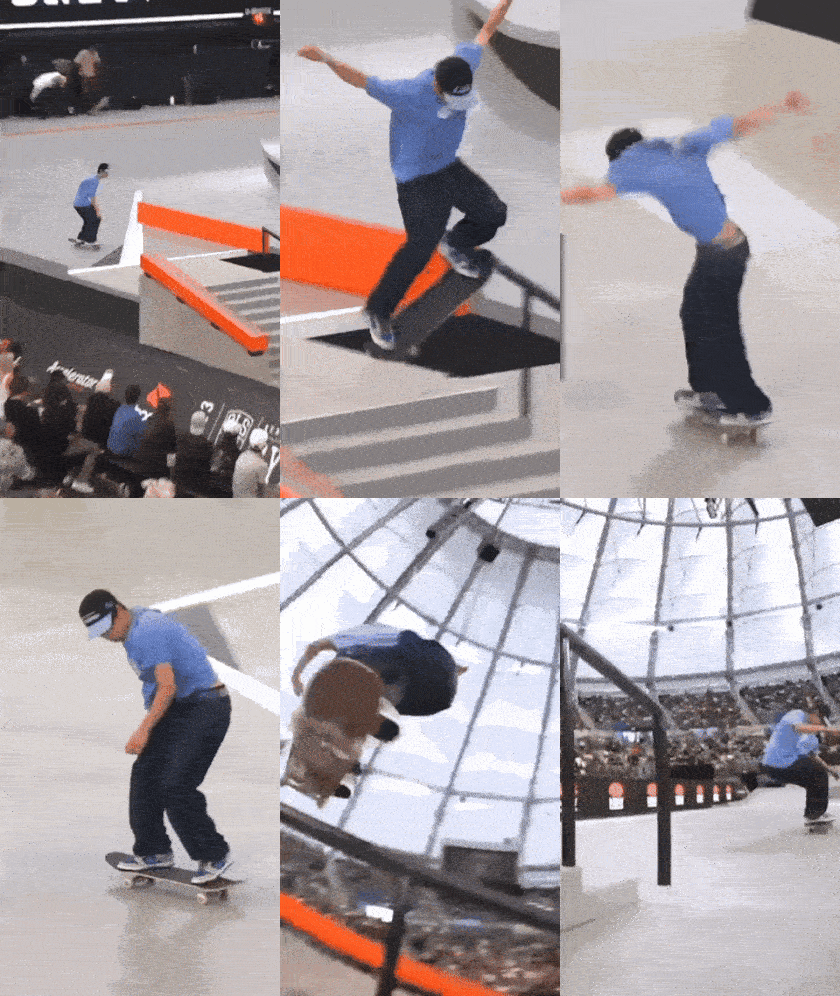 You know what, I can’t name a particular person but one of my favourite things to do was watch SLS warmups. Every time I went I would get there early to watch that because I just love watching them bail over and over. I’ll name someone actually because it was a really unique experience. I remember one of the first SLS comps I went to we were watching Yuto [Horigome] warm up. I could be exaggerating here because it was such an incredible experience but I don’t think I saw him land more than a couple of tricks in the warm-up. What he was doing instead was he would pop the board, get close to the rail, or get his foot on the rail and run out. He would get there and just bail out, he wasn’t really landing anything. I remember watching him and thinking maybe he’s just not on today. Then as soon as his round went on he landed every single one of his tricks except the last one, then every single one of them in his second run and he got a Nine Club. I have never seen a skater just turn it on like that. It made me realise that at the beginning what he was doing was just feeling things out, judging distances, and getting a handle on things. Then when he wants to it’s on and it’s all there. That was cool watching someone so comfortable bailing. Watching those warm-ups is incredible because none of those guys look like they’re in any danger. Nyjah [Huston} is a freak when he’s skating big rails too, he never looks in danger and that delicate dance they do is so underrated. I call skateboarders athletes for that reason and a lot of people don’t like to use that word. But look at what they’re doing, it’s insanity.
I think when you’re younger you naturally recover quickly and may feel you don’t need to do anything extra to keep skating. Do you think younger skaters should incorporate strength training? Will this ultimately lead to greater longevity?
I think that when you’re younger you can get away with not doing it because you’re more pliable. But let’s take the NFL in the US as an example, or rugby here or in the UK. If you go back to the 80s and look at these sports look at the players and the athletes involved. They were working factory jobs and playing on the side before they became professional athletes Look at the body sizes of the guys playing then, they were tiny compared to today, they were smashing beers at halftime, it was so fun to watch. But their body types were way different, now look at the fucking animals playing today, they are huge, jacked units. Go back to that argument of can you get too big for skating? These guys are huge but also some of the quickest, most dynamic athletes in the world. They have no problem running fast or changing direction quickly and they are absolutely massive. The biggest thing that has changed for those guys is that they started strength training, and they grabbed these athletes young. These guys started strength training in High School.
The reason why this is so effective is that if you grab an athlete that’s going through puberty their hormones are through the roof. You talk about performance-enhancing drugs and guys take testosterone and steroids, young men at that age, fourteen or fifteen upwards, it’s like working with free steroids. The level of testosterone that gets shot through you at that age when you’re going through puberty is insane, it’s what allows them to recover so quickly. You get them doing some simple strength training at that age where they’re recovering so well and they just become the super athletes. They do so well because they can recover and they gain so much from it. That’s the difference, when you’re younger you can get away with not doing it but if you can get really good quality strength training to these kids at a young age we’re going to see some incredible shit start to happen and some incredible athletes start to happen. When you see them at twenty or twenty-five, not only will it create longevity where the kids will be able to perform at a high level until their late thirties but I think the level skating is just going to be insane. The volume of parts they’ll be able to put out, the volume of impact they’ll be able to take, their pop. It’s going to change the game which is the other side of things I get really excited about, and what I love about what I do. Where can this help with the level these guys want to take it to, and the level of gnarliness they want to achieve? When kids start doing it and doing it properly at a young age it’s going to really change the game for them.
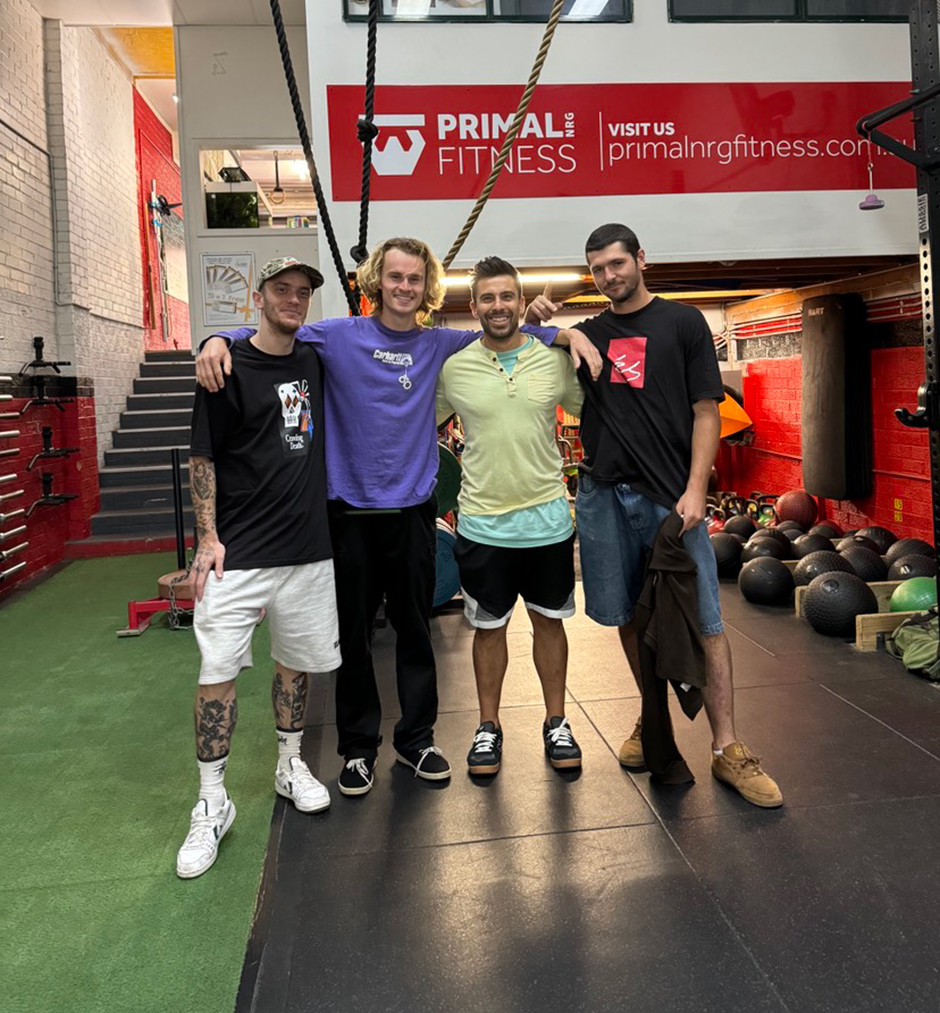
Dan with the crew he trains in Sydney. From left to right – Sam Fairweather, Justin Schmidt, Dan Bardallo, Sam Saddleton
Thanks for you time mate, what would your advice be for someone looking to begin working with you and what equipment do they need to begin this journey?
The willingness to give it a try for 4-6 weeks is what I need, I guarantee you will see results that will make this a no-brainer. You just need to commit to those two sessions a week and maybe do some extra stuff on your days off, easy stuff you can do while you’re watching TV. The biggest thing you need is the commitment to working for 4-6 weeks consistently. You won’t see results overnight, it will take you a few weeks to notice these things but once you do you won’t look back. You get people who join the app but never try. You got that far, you obviously wanted to make a change. Joining the app is one thing but doing the sessions is what you need. I can’t do that bit for you, even with the best program laid out for you, you need to do the program to receive what you’re after. That’s the hardest thing and the only thing I need from someone is to be willing to try it and actually have that commitment to do it.
We would like to thank Dan for taking the time to answer our questions. We recommend following his Instagram which is regularly updated and full of valuable advice and free training videos. You should also visit the Skateboard Strength website where you can find out more and sign up to the Ultimate Performance Program.
Related Reading: Industry: Kelly Hart Interview , Offerings: Spencer Hamilton Interview